This site is supported by our readers. We may earn a commission, at no cost to you, if you purchase through links.
Reptile carpet and dry aspen still line pet store shelves, but they get one thing wrong: they treat substrate as an afterthought. Your ball python’s enclosure floor does real work. It regulates humidity, nurtures beneficial microbes, and gives your snake something to burrow through, just like it would in a termite mound back in West Africa.
Get ball python substrates for naturalistic enclosures wrong, and you’ll fight mold, poor sheds, and odor for months. Get them right, and the tank practically takes care of itself.
Here’s how to choose a mix that actually earns its keep.
Table Of Contents
Key Takeaways
- Build a bioactive base with 80% organic topsoil and 20% play sand, then mix in 20-30% coconut coir, topped with orchid bark or cypress mulch, at a depth of 3-5 inches to support humidity, drainage, and natural burrowing.
- Maintain enclosure humidity between 55-65% using moisture-retentive substrates, a humid hide with sphagnum moss, and twice-daily hygrometer checks to prevent poor sheds and respiratory issues.
- Bioactive setups with isopods and springtails need less frequent replacement (every 8-12 weeks) than non-bioactive substrates (every 4-6 weeks), since the cleanup crew naturally breaks down waste and controls odor.
- Avoid pine or cedar shavings, reptile carpet, dusty loose bedding, and chronically wet substrate, since these cause respiratory irritation, bacterial growth, snagged sheds, and mold.
For a deeper dive into substrate choices that pair well with bioactive setups, tropical snake substrate options walks through which materials best support thriving cleanup crews.
Best Naturalistic Ball Python Substrates
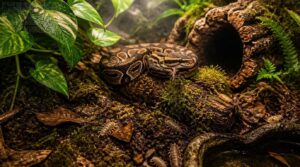
Choosing the right substrate shapes everything from humidity levels to how natural your enclosure feels. Not every material works the same way, and some integrate better with a bioactive setup than others. Here’s a breakdown of the top options worth considering for your ball python’s home.
For a deeper dive into moisture retention and texture, check out this guide on choosing the best substrate for ball python humidity before setting up your enclosure.
Organic Topsoil Blends
Not every soil works for a bioactive setup. Organic topsoil blends bring nutrient density and moisture balance, but skip peat-heavy bags. Look for peat-free, screened mixes with pH near 6.0–7.0. Sourcing quality blends matters most—loose, crumbly texture prevents compaction while supporting drainage.
Combine topsoil with sand and coir rather than using it alone; pure natural soil holds too much moisture for ball pythons. healthy topsoil harbors millions of microbes that support plant health.
Coconut Coir Options
Where topsoil brings nutrients, coconut coir brings structure and moisture control. Coir fiber and coco chips add aeration, while coir pith retains water for humidity.
Rinsing coir lowers salt content, protecting your snake from EC buildup. Sun-dried, pre-rinsed brands stabilize pH near 5.5–6.5. Coir holds up to eight times its weight in water, making it ideal for burrowing setups.
Cypress Mulch Benefits
Coir controls moisture below the surface, but cypress mulch protects it up top. This bark forms a dense mat with natural antimicrobial properties, discouraging mold in a moist naturalistic vivarium.
Its slow decomposition rate means less frequent replenishing, while dense coverage offers real substrate moisture retention and soil temperature insulation. For a bioactive substrate with reddish-brown appeal, cypress mulch checks every box.
Orchid Bark Texture
Where cypress mulch mats down, orchid bark opens things up. Its chunky, irregular pieces create air pockets that boost drainage efficiency and stop moisture pockets from turning stagnant.
Why it works:
- Coarse texture resists compaction
- Prevents root rot
- Grade selection matters (fine vs. coarse)
- Lightweight for mixed substrates
- Breaks down slowly, lasting months
Pick your grade based on enclosure humidity needs.
Leaf Litter Top Layers
Think of leaf litter as the forest floor’s finishing touch. Scatter dried leaves or sphagnum across your substrate to mimic a real bioactive microenvironment, where decomposition feeds nutrient cycling naturally.
This layer buffers moisture, cushions humidity swings, and gives springtails a place to forage. In a naturalistic ball python enclosure, that microfauna habitat isn’t decoration. It’s function, quietly supporting the environment beneath your snake’s belly.
Leaf litter isn’t decoration, it’s function, quietly supporting the microfauna beneath your snake’s belly
Bioactive Vs Non-Bioactive Substrate
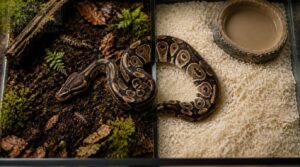
Choosing between bioactive and non-bioactive setups changes how you manage your enclosure day to day. Each option comes with its own demands around cleanup, moisture, and odor control. Here’s how the two compare, so you can pick what actually fits your routine.
Cleanup Crew Compatibility
Isopods and springtails do the dirty work so you don’t have to. These invertebrates handle waste decomposition, driving nutrient cycling without threatening your snake.
| Species | Role | Temp Range |
|---|---|---|
| Isopods | Detritus processing | 68–78°F |
| Springtails | Mold control | 68–78°F |
| Millipedes | Decaying matter breakdown | 68–78°F |
Keep density managed—overcrowded crews sometimes nibble fresh shed.
Moisture Retention Needs
Since ball pythons hail from humid rainforests, your substrate’s water-holding capacity directly controls enclosure humidity. Bioactive mixes—coco coir, organic topsoil, sphagnum moss—retain moisture longer, slowing evaporation rate naturally.
| Substrate Type | Moisture Behavior |
|---|---|
| Bioactive (coir/topsoil) | High retention, gradual release |
| Non-bioactive (coconut husk) | Faster drying, needs frequent misting |
| Dry solids (paper) | Poor retention, humidity spikes |
Balance substrate porosity carefully—oversaturation invites sogginess, while dryness stresses shedding cycles.
If you’re unsure where your snake’s setup falls on that spectrum, this guide to safe substrate options for corn snakes breaks down moisture-retentive materials that beat reptile carpet for hygiene and shedding support.
Odor Control Differences
A bioactive substrate experiences smell through biology, not chemistry. Its microfauna cleanup crew breaks waste down before bacteria produce sulfur compounds, meaning less odor overall.
| Substrate Type | Odor Method | Maintenance |
|---|---|---|
| Bioactive | Microbial inhibition | Spot-clean only |
| Non-bio-active | Enzyme neutralization | Frequent treatment |
| Untreated solids | Masking only | High cleaning frequency |
Non-bioactive setups rely on enzyme-based neutralizers, targeting amines directly rather than covering scent temporarily.
Replacement Schedule Comparison
Non-bioactive substrate cleaning frequency runs every 4–6 weeks, while bioactive setups stretch to 8–12 weeks between refreshes.
| Substrate Type | Replacement Cadence |
|---|---|
| Non-bioactive | Every 4–6 weeks |
| Bioactive | Every 8–12 weeks |
| Seasonal (hot/humid) | Shorten to 4 weeks |
| Seasonal (cool/dry) | Extend to 10 weeks |
| Mold detected | Immediate refresh |
Microfauna maintenance timing matters most: healthy isopod populations extend bioactive cycles naturally.
Beginner-friendly Setup Choice
Starting simple beats starting overwhelmed. For your first setup, pair organic topsoil with coconut coir at roughly 70/30, keeping depth at 2–4 inches for easy moisture management.
| Setup | Depth | Maintenance |
|---|---|---|
| Beginner (non-bioactive) | 2–4 in | Weekly spot-clean |
| Transitional | 3 in | Biweekly |
| Bioactive | 3–5 in | Monthly |
Once you’re comfortable, move to bioactive gradually—it’s cost-effective and prevents common moisture mistakes.
Ideal Substrate Mix and Depth
Getting the substrate right isn’t just about picking the right materials—it’s about mixing them in the right ratios and building them to the right depth. Your snake’s comfort, humidity levels, and burrowing behavior all depend on getting these layers correct. Here’s exactly how to build that foundation, piece by piece.
Topsoil and Play Sand
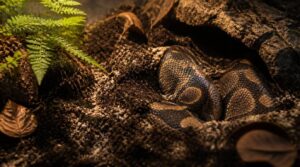
Mixing dirt right sets the whole enclosure up for success. Mix 80% organic topsoil with 20% play sand for the base layer, giving you drainage plus moisture retention. Topsoil’s organic matter (5-25%) feeds beneficial microbes, while sand’s 0.5-1.0mm grains improve aeration. If you’d rather skip the sand entirely, apartment dwellers often turn to moisture-retentive coconut fiber substrates for easier humidity control in smaller spaces.
- pH range: 5.5-7.5
- Grain size: fine to moderate
- Ratio: 80/20 split
This combo prevents compaction, letting your ball python burrow naturally.
Coconut Coir Additions
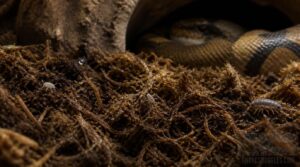
Once your topsoil-sand base is set, work in 20-30% coconut coir to boost moisture buffering capacity. Coir’s fibrous structure resists compaction, creating irregular air pockets for steady gas exchange near burrows.
It absorbs several times its weight in water, so humidity swings stay gentle. As a bonus, coconut fiber (think ReptiChip) doubles as habitat niches for future springtails and isopods.
Bark and Charcoal Layers
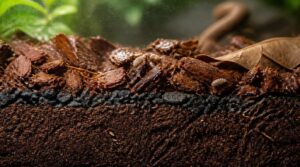
Bark and charcoal finish the profile once your coir’s worked in. A 1-3 cm orchid bark or cypress mulch layer creates microhabitats and improves footing, while a thin charcoal band underneath boosts drainage and odor adsorption.
- Bark aids aeration
- Charcoal traps ammonia
- Combined layers build a moisture gradient
- Promotes bioactive substrate health
- Reduces compaction risk
Three-to-five-inch Bioactive Depth
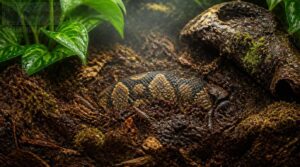
Depth matters more than most keepers realize. A 3–5 inch bioactive layer gives microfauna reproduction space while supporting root zone stability and humidity buffering capacity.
| Depth | Benefit | Result |
|---|---|---|
| 3" | Minimum microfauna range | Basic nutrient cycling |
| 4" | Balanced moisture | Anaerobic pocket prevention |
| 5" | Full root support | Long-term substrate composition ratios |
This moisture-retaining substrate sustains healthy burrowing behavior naturally.
Two-to-four-inch Basic Depth
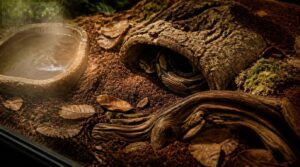
Not every enclosure needs bioactive complexity. A two-to-four-inch depth suits keepers who want easier cleaning efficiency without full cleanup crews.
This shallower substrate depth still allows burrowing space balance while cutting compaction risks common in deeper layers. Moisture evaporation rates stay manageable, keeping humidity near 55–65%. For a naturalistic ball python enclosure with simpler upkeep, this substrate composition ratio delivers stability, moisture retention, and practical, low-maintenance appeal.
Humidity-Supporting Substrate Setup
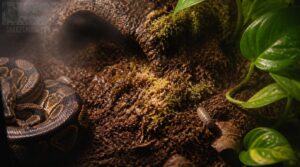
Humidity makes or breaks your ball python’s health, and your substrate carries most of that job. Get the moisture balance wrong, and you’re looking at bad sheds or respiratory issues down the road. Here’s what it takes to keep humidity steady without tipping into a soggy mess.
Maintaining 55–65 Percent Humidity
Getting humidity right isn’t guesswork—it’s about consistent monitoring and the right substrate. Place your hygrometer at snake level, not the enclosure lid, for accurate readings.
Coco chips like ReptiChip or Zoo Med EcoEarth hold moisture well, supporting stable 55–65% RH. Calibrate misting frequency based on daily hygrometer checks, and keep ambient room stability steady so your substrate doesn’t fight against outside air swings.
Shedding Humidity Boosts
When your snake goes cloudy-eyed, it’s time to raise moisture, not overall humidity. A humid hide with damp sphagnum moss softens old skin without soaking the whole tank.
Mist lightly during pre-shed days to help eye caps hydrate and release clean. This targeted boost prevents patchy sheds far better than blasting the entire enclosure.
Preventing Soggy Substrate
Waterlogged substrate breeds bacteria fast, and that’s a real threat to your snake’s health.
Squeeze a handful: a faint moisture ribbon means good field capacity. Darkened color or slick surfaces signal oversaturation.
- Add a 1–2 inch drainage layer beneath substrate
- Top with dry bark or coconut fiber
- Check moisture weekly, not just by eye
Screen separators keep drainage layers from mixing into your main substrate.
Ventilation Without Drying
Think of airflow like a gentle breeze guiding humidity, not blasting it away. Use cross ventilation with mesh intake and exhaust vents, placed to avoid direct drafts over the substrate. Passive vents along opposite walls help control humidity gradients.
Don’t set vents too low or near hot spots; that dries substrate too fast. Check substrate depth—thicker layers hold moisture longer, balancing air exchange and humidity.
Moist Hides and Moss
A moist hide packed with sphagnum moss acts like a humidity reservoir, soaking up 20 times its weight in water. Rinse and rehydrate every 1-2 weeks to prevent mold.
Sheet or reindeer moss works too, depending on hide depth. Keep entrances clear, and pair moss with coconut coir below for balanced, moisture-retaining substrate depth.
Top 5 Enclosure Products
Great substrate only works when the rest of your setup backs it up. Heat, enrichment, and airflow all play a part in keeping conditions stable and your snake comfortable. Here are five products worth adding to your enclosure.
1. Lucky Herp 150W Ceramic Heat Emitter
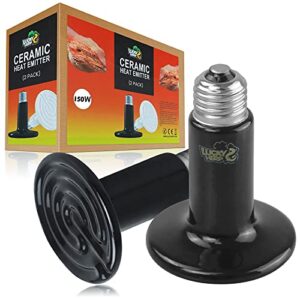
Nighttime warmth without a hint of light—that’s the whole point of the Lucky Herp 150W Ceramic Heat Emitter. Its E26 base fits standard fixtures, and the ceramic housing reaches full temperature in about four minutes.
Rated for 10,000 hours, it runs on 120V and pairs best with a thermostat. Keep it 30cm from your python.
No UVB here, so you’ll still need supplemental lighting. For steady, light-free heat in naturalistic enclosures, it’s a dependable pick.
| Best For | Reptile, amphibian, poultry, and small mammal owners who need reliable overnight warmth without disrupting their pets’ natural sleep cycles. |
|---|---|
| Weight | N/A (not listed in oz/lb standard) |
| Dimensions | Standard E26 bulb size |
| Material | Ceramic housing |
| Primary Use | Heat emission for enclosures |
| Power Source | 120V AC, E26 base |
| Safety Consideration | Maintain 30 cm distance from animal |
| Additional Features |
|
- Emits heat only, with zero visible light to disturb sleep
- Reaches full operating temperature quickly, in about 4 minutes
- Durable ceramic housing built for a long rated lifespan of up to 10,000 hours
- Provides no UVB, so a separate lighting source is still needed
- Requires a quality ceramic holder and steady use, since frequent on/off cycling shortens its lifespan
- Needs careful placement, with at least 30cm of distance kept from animals for safety
2. Dog Treat Puzzle Feeder
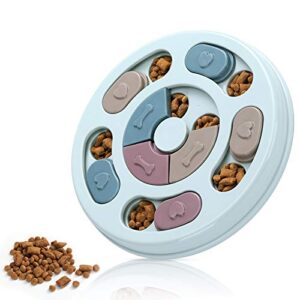
Once your emitter’s handling the heat, it’s worth giving your ball python something to do besides bask. A dog treat puzzle feeder works surprisingly well for enrichment during supervised handling sessions outside the enclosure.
Its sliding compartments and slow-feed design encourage natural foraging instincts. At 9.44 x 9.44 x 1.14 inches and 12.7 ounces, it’s compact and easy to clean. Just supervise use closely and pull it if any piece cracks or loosens.
| Best For | Snake owners looking for a safe, engaging way to enrich supervised handling sessions with their ball python. |
|---|---|
| Weight | 12.7 oz |
| Dimensions | 9.44 x 9.44 x 1.14 in |
| Material | Polyvinyl chloride |
| Primary Use | Interactive feeding and enrichment |
| Power Source | None (non-electric) |
| Safety Consideration | Supervise use; remove if damaged |
| Additional Features |
|
- Sliding compartments encourage natural foraging and investigative behavior
- Compact 9.44 x 9.44 x 1.14 inch size is easy to clean and store
- Lightweight at 12.7 ounces, simple to introduce during handling time
- Requires constant supervision, as it’s not designed specifically for reptiles
- Must be inspected and removed if any part cracks or loosens
- Made of PVC, so it should never be left unattended in the enclosure
3. Exo Terra Natural Branch
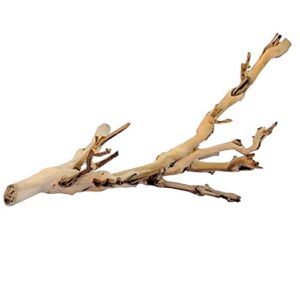
Puzzle feeders handle enrichment, but climbing decor gives your enclosure real structure. The Exo Terra Forest Branch uses heat-treated grapevine wood, sandblasted smooth to prevent splinters and abrasion.
It works in tropical or arid setups alike, creating multiple grip points for natural climbing. Available in small, medium, and large sizes, it suits everything from juveniles to adult ball pythons.
Secure it firmly against a wall or cork bark background. Loose branches shift, and shifting branches spook a settling snake.
| Best For | juvenile or small-size geckos, lizards, and snakes that need a stable, realistic climbing and basking spot. |
|---|---|
| Weight | 4.23 oz |
| Dimensions | 10 x 6 x 5 cm |
| Material | Real heat-treated wood |
| Primary Use | Climbing and basking platform |
| Power Source | None (non-electric) |
| Safety Consideration | May absorb moisture over time |
| Additional Features |
|
- Made from real wood shaped to look like natural tree limbs, adding realism to any setup
- Heat-treated to eliminate pests, so it’s safe to add straight to the terrarium
- Compact, sturdy build that’s a great fit for smaller reptiles
- Too small for medium or large reptiles that need bigger perches
- Natural wood can soak up moisture and may need drying out or replacing over time
- Comes as a single piece, so larger enclosures may need extra branches
4. Godonlif Candle Warmer Lamp With Timer

Branches give a python somewhere to climb, but a candle warmer gives your room some ambiance without any fire risk near the tank. The Godonlif lamp heats wax from above, so there’s no open flame or soot drifting toward your reptile setup.
Its dimmable knob controls scent intensity, and the timer offers four auto shut-off options up to four hours. The height-adjustable pole fits most jar sizes, making it a simple, safe decor choice for reptile rooms.
| Best For | Reptile owners and pet parents who want cozy, scented ambiance in their space without any open-flame risk near tanks or curious animals. |
|---|---|
| Weight | 0.9 kg (2 lb) |
| Dimensions | 5.5 x 5.5 x 12 in |
| Material | Metal base with glass shade |
| Primary Use | Flameless candle warming and lighting |
| Power Source | Standard AC plug with LED bulbs |
| Safety Consideration | No open flame or soot produced |
| Additional Features |
|
- Flameless top-down heating keeps wax melting safely, with no soot or smoke near reptile enclosures
- Four-setting auto shut-off timer (1–4 hrs) helps conserve energy and prevents wax from over-melting
- Height-adjustable pole and dimmable knob let you fit different jar sizes and control scent intensity
- Fragrance may come through weaker than a traditional open-flame candle
- LED bulbs can flicker slightly at lower dimmer settings
- No precise temperature control—melt speed is tied only to light intensity
5. Venty Portable Wireless Fan
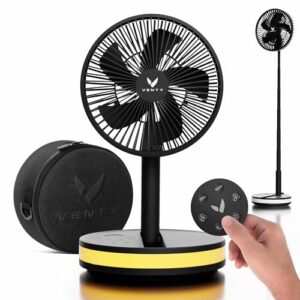
When your enclosure room runs warm, you need cooling that won’t rattle your snake. The Venty fan folds to 3.5 x 8 inches, weighs 2.6 lb, and runs up to 48 hours on low speed.
Its 16,000 mAh battery doubles as a USB-C power bank for your phone. Four speed settings and 120° oscillation let you cool the room without aiming drafts at the tank, keeping humidity stable while you stay comfortable nearby.
| Best For | Reptile keepers who want to cool a warm enclosure room without pointing direct drafts at the tank or disturbing the pet. |
|---|---|
| Weight | 2.6 lb |
| Dimensions | 3.5 x 8 in (folded) |
| Material | Plastic (EVA case) |
| Primary Use | Portable cooling and lighting |
| Power Source | Rechargeable 16,000 mAh battery |
| Safety Consideration | Single-port charging limits simultaneous use |
| Additional Features |
|
- Runs up to 48 hours on low speed, so it can stay on for extended stretches without a recharge
- Doubles as a 16,000 mAh USB-C power bank, so you can charge your phone without packing extra gear
- Folds down to 3.5 x 8 inches and weighs just 2.6 lb, making it easy to store or move between rooms
- Full recharge takes 8-10 hours, which can be inconvenient if you need it ready quickly
- Single USB-C port means you can’t charge the fan and a device at the same time without a splitter
- Runtime drops sharply at higher speeds, down to about 15 hours on the highest setting
Substrates to Avoid Completely
Not every substrate deserves a spot in your ball python’s tank. Some options look harmless but create real risks for their health over time. Here are five to cross off your list for good.
Pine and Cedar Shavings
Pine and cedar shavings smell great to us, but they’re a hidden hazard for ball pythons. These softwoods release volatile organic compounds and phenols that irritate respiratory tissue, causing coughing and wheezing over time.
Repeated exposure stresses developing organs and can slow growth in juveniles. When choosing reptile bedding, skip pine or cedar entirely, dust and softwood oils simply aren’t worth the risk to your snake’s lungs.
Reptile Carpet Risks
Though it looks tidy, reptile carpet hides serious problems for ball pythons. Waste soaks into fibers, fueling bacterial growth risks like Salmonella. Deep stains and odor often persist despite washing.
Frayed fibers snag shedding skin and claws, reducing grip during locomotion. Cleaning chemicals can leave irritating residues.
- Bacterial buildup in seams
- Torn sheds from snagging
- Reduced traction
- Frequent replacement needed
Dusty Loose Bedding
Fine dust clouds are the last thing you want in a naturalistic ball python enclosure. Pouring loose bedding kicks up particulates that irritate lungs and eyes, causing respiratory irritation and appetite loss.
| Problem | Fix |
|---|---|
| Airborne dust | Wetting substrate |
| Settled particulates | Catch tray, wipe-downs |
| Keeper inhalation | Dust mask |
| Batch variance | Trial small amounts first |
Mold-prone Wet Substrate
Damp substrate is a mold factory waiting to happen. Once surface humidity stays above 70% for 48 hours, fungal spore germination kicks in fast, especially in porous soil and bark blends.
Standing moisture pockets form when layers trap water unevenly, leading to substrate compaction and stagnant air buildup. Dry spot-check daily, swap saturated zones immediately, and never let organic matter sit soggy for long.
Bare Floors and Pads
Skipping substrate altogether won’t save you cleanup time—it just trades one problem for another. Artificial substrates like reptile carpet, paper towels, puppy pads, and shelf liner still need floor protection pads underneath to prevent scratching and heat transfer.
Silicone mats offer real benefits here: moisture barrier utility, subfloor damage mitigation, and easy wipe-downs after feeding or spot-cleaning.
Frequently Asked Questions (FAQs)
How often should I check enclosure temperature and humidity?
Checking once a day isn’t enough to catch sudden swings. Twice-daily monitoring, morning and evening, with digital thermometers and hygrogrometers, plus weekly manual probe verification of your thermostat, keeps temperature regulation and humidity control on track through seasonal shifts.
What enclosure size does an adult ball python need?
Adults need a minimum of 4 ft × 2 ft × 2 ft, giving room for thermoregulation zones and vertical enrichment. Snakes topping 5 feet require upsizing further, since accommodating adult growth means matching space requirements to their actual body length.
How many hides should a naturalistic enclosure include?
Like a good floor plan, hide placement strategy shapes comfort: include at least two hides, one per thermal zone, sized 6–8 inches for microhabitat variety and secure, low-stress retreats.
Does a glass or PVC enclosure work better?
PVC wins for heat retention efficiency and humidity control, cutting heater wattage needs.
Glass offers better visual observation clarity and lower upfront cost.
For naturalistic terrarium design, PVC’s ventilation airflow management and durability make it the stronger long-term choice.
What lighting schedule keeps a ball python healthy?
A 12-hour light/12-hour dark cycle on timers helps circadian rhythm. UVB stays optional but safe if limited to daytime. Keep nighttime dark or dim red, never bright white, and adjust seasonally by an hour to mimic natural photoperiod shifts.
Conclusion
A little upkeep now spares you bigger headaches later. Dialing in ball python substrates for naturalistic enclosures isn’t complicated once you grasp the basics: right mix, right depth, right moisture. Skip shortcuts that promise convenience but deliver mold and stress instead.
Your snake reads its floor like a map home. Build that floor with intention, and the enclosure stops feeling like a chore. It becomes a small, thriving world your ball python genuinely trusts.