This site is supported by our readers. We may earn a commission, at no cost to you, if you purchase through links.

A bearded dragon’s basking spot can drop 20 degrees overnight when your furnace kicks off and the house cools around it. Most owners never notice until their reptile stops eating or starts glass-surfing in distress. Winter changes the math on reptile heat lamps for winter: the wattage that kept your enclosure at 95°F in August won’t cut it once your living room dips into the 60s.
Getting this wrong costs more than a vet visit. Ceramic emitters, halogen bulbs, and dual fixtures each handle cold snaps differently, and picking the wrong one means fighting your thermostat all season. The right setup, matched to your enclosure size and species, keeps thermoregulation steady no matter what the weather does outside.
Table Of Contents
- Key Takeaways
- Top 10 Reptile Heat Lamps for Winter
- 1. Reptile Basking Heat Lamp Bulbs
- 2. Dual Reptile Light Fixture with Switches
- 3. Flukers Incandescent Basking Spotlight Bulb
- 4. REPTI ZOO Dual Reptile Light Fixture
- 5. Lucky Herp 150W Ceramic Heat Emitter
- 6. TFNN Reptile Heat Lamp with Timer
- 7. Lucky Herp Reptile Basking Heat Lamp
- 8. MCLANZOO Reptile Heat Lamp 75W 2 Pack
- 9. BOEESPAT Deep Dome Reptile Lamp Fixture
- 10. DaToo Reptile Heat Lamp
- Compare Winter Heat Lamp Types
- Match Heat Lamp Wattage to Enclosures
- Meet Species-Specific Winter Heating Needs
- Create Safe Winter Temperature Gradients
- Choose Compatible Fixtures and Sockets
- Plan Daytime and Overnight Heating
- Compare Lifespan, Reliability, and Energy Costs
- Prepare for Winter Power Outages
- Frequently Asked Questions (FAQs)
- Can you leave a reptile heat lamp on all night?
- How do I keep my reptile warm if the power goes out?
- What is the difference between a basking lamp and a heat lamp?
- Do reptile heat lamps use a lot of electricity?
- Can I use two heat lamps in one enclosure?
- How long should heat lamps run each day?
- Do heat lamps affect reptile humidity levels?
- Can heat lamps be used with LED lighting?
- What signs indicate a reptile is overheating?
- Conclusion
Key Takeaways
- Match your heat lamp’s wattage to your enclosure’s size and your home’s winter temperature, since a setup that worked in summer often can’t keep up once the furnace kicks off and rooms cool down.
- Ceramic heat emitters warm the enclosure without any light, making them the go-to choice for overnight heating that won’t disturb your reptile’s sleep cycle.
- Always measure heat at the basking surface itself with a probe thermometer or infrared gun, since air temperature alone won’t tell you if your reptile is getting safe, steady warmth.
- Pair any heat lamp with a thermostat and have a backup power plan ready, since unregulated temperatures or a winter outage can put your reptile’s health at risk fast.
For more on dialing in the right setup, this guide on how far your heat lamp should be from the tank can help you nail consistent basking temperatures from the start.
Top 10 Reptile Heat Lamps for Winter
Winter drops the temperature fast, and your reptile’s enclosure needs a heat source that can keep up without cutting corners. Not every bulb or fixture controls that job the same way, so picking the right one matters for your pet’s safety and comfort.
If you’re weighing your options, this guide to reptile heating mats for winter snake keeping breaks down how to size wattage and pair it with a thermostat for steady, safe warmth.
Here are ten options worth your consideration, each suited to different setups, species, and budgets.
1. Reptile Basking Heat Lamp Bulbs
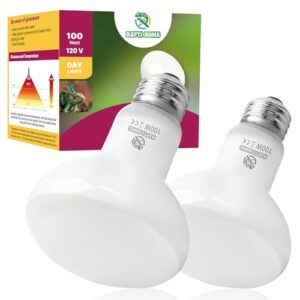
A warm patch of light can mean the difference between a thriving lizard and a sluggish one this winter.
The HL-100W basking bulb delivers 100 watts of concentrated heat, simulating natural sunlight for bearded dragons, lizards, turtles, and snakes. Its compact 3.1 x 3.1 x 4.3-inch build fits most standard fixtures, though you’ll need a compatible ceramic socket rated for the wattage.
High output means real warmth, but also real risk—pair it with a thermostat, and always monitor basking surface temps with a probe.
| Best For | Reptile owners with bearded dragons, lizards, turtles, or snakes who need a reliable basking spot to keep their pet warm and healthy, especially during colder months. |
|---|---|
| Wattage | 100W |
| Socket Type | Standard |
| Target Species | Bearded Dragons, Lizards |
| Heat Function | Basking Heat |
| Fixture Type | Bulb Only |
| Installation Style | Standard Fixture |
| Additional Features |
|
- Simulates natural sunlight to create an effective basking zone
- Versatile enough for a wide range of reptiles and amphibian terrariums
- Compact size fits most standard heat lamp fixtures
- Only works with compatible, wattage-rated fixtures (like ceramic sockets)
- High heat output requires careful monitoring to avoid overheating
- Best used alongside a thermostat and temperature probe for safe operation
2. Dual Reptile Light Fixture with Switches
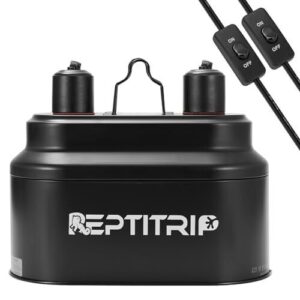
One bulb rarely covers every need, especially when you’re running heat and UVB side by side.
This fixture solves that with dual sockets rated up to 160W each, controlled by independent switches for separate zones. The polished interior boosts reflection, while ventilation holes keep things from overheating.
Bulbs aren’t included, and some owners report switch issues over time, so check connections regularly. Pair it with a thermostat for real control—this fixture controls the wiring, not the temperature math.
| Best For | Reptile owners who need independent heat and UVB lighting zones for pets like bearded dragons or snakes. |
|---|---|
| Wattage | 160W max |
| Socket Type | E26/E27 |
| Target Species | Bearded Dragons, Snakes |
| Heat Function | Basking Heat |
| Fixture Type | Dual Fixture |
| Installation Style | Screw-In Fixture |
| Additional Features |
|
- Dual 160W sockets with independent switches let you run heat and UVB bulbs separately
- Polished interior improves light and UVB reflection for better bulb efficiency
- Ventilation holes help dissipate heat and reduce overheating risk
- Bulbs are sold separately, adding to the total cost
- Some users report switch failure or electrical shorting over time
- No built-in thermostat or timer, so external controllers are needed for automation
3. Flukers Incandescent Basking Spotlight Bulb
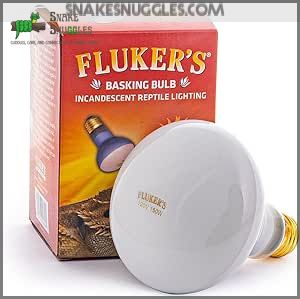
Switches and sockets only get you so far without a reliable bulb to plug in, and Flukers’ basking spotlight fills that gap nicely.
This 100-watt incandescent screws into a standard E26 base and throws yellowish light plus radiant heat onto one focal spot, working well for ball pythons, geckos, and Mojave desert tortoises.
Don’t expect miracles on lifespan, though. Some owners get months out of it, others just weeks, especially if you over-tighten it during installation.
| Best For | Reptile owners keeping ball pythons, geckos, turtles, or Mojave desert tortoises who need a dedicated basking spot with radiant heat. |
|---|---|
| Wattage | 100W |
| Socket Type | Standard |
| Target Species | Ball Pythons, Geckos |
| Heat Function | Radiant Heat |
| Fixture Type | Bulb Only |
| Installation Style | Standard Fixture |
| Additional Features |
|
- Delivers strong radiant heat and light focused on one basking area
- Fits standard reptile lamp fixtures for easy installation
- Works well across a range of reptile and amphibian species
- Bulb life is unpredictable, sometimes lasting just a few weeks
- Tends to burn out within 2–3 months even with normal use
- Over-tightening during installation can cause it to fail early
4. REPTI ZOO Dual Reptile Light Fixture
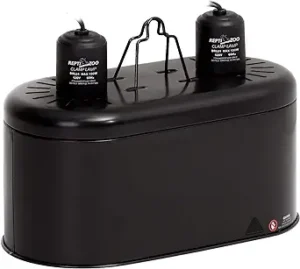
If a single bulb won’t cut it, REPTI ZOO’s dual fixture solves the problem by running two lamps at once.
Each socket aids up to 150W, so you can pair a daytime basking bulb with a UVB tube, or heat and infrared for round-the-clock coverage.
Independent switches let you control each side separately, and ventilation holes keep the housing from trapping heat. Just avoid mounting it on thin screen tops—heat concentration there can warp mesh over time.
| Best For | Reptile owners keeping bearded dragons, iguanas, chameleons, or other species that need both heat and UVB lighting running at the same time. |
|---|---|
| Wattage | 150W max |
| Socket Type | Ceramic Socket |
| Target Species | Bearded Dragons, Iguanas |
| Heat Function | Basking Heat |
| Fixture Type | Dual Fixture |
| Installation Style | Hanging Fixture |
| Additional Features |
|
- Two independent 150W-capable sockets let you run heat, UVB, or infrared lamps simultaneously with separate switch control
- Ventilated housing helps dissipate heat, extending the life of both bulbs and fixture
- Compact, ETL-certified design fits standard terrariums and can be hung or set on screen tops
- Not suitable for thin or non-metallic screen tops, since concentrated heat can warp the mesh
- Some users report intermittent switch failures or buzzing after extended use
- Bulbs aren’t included, so you’ll need to buy lamps separately to get started
5. Lucky Herp 150W Ceramic Heat Emitter
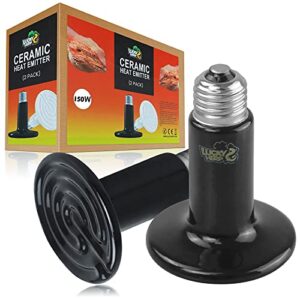
When nighttime temps drop, you need heat without light stealing your reptile’s sleep cycle—that’s exactly what Lucky Herp’s 150W ceramic emitter delivers.
Built from thick ceramic, it reaches operating temperature in about four minutes and carries a lifespan up to 10,000 hours. The standard E26 base fits most existing fixtures.
Surface heat runs hot, so keep it 30cm from pets and pair it with a thermostat. Avoid frequent cycling; it shortens the emitter’s working life.
| Best For | Owners of nocturnal reptiles, amphibians, or small mammals who need reliable overnight warmth without disrupting their pet’s natural sleep cycle. |
|---|---|
| Wattage | 150W |
| Socket Type | E26 |
| Target Species | Reptiles, Amphibians |
| Heat Function | Nighttime Heat |
| Fixture Type | Bulb Only |
| Installation Style | Standard Fixture |
| Additional Features |
|
- Emits heat without visible light, keeping nocturnal pets’ circadian rhythms undisturbed
- Heats up quickly, reaching full temperature in about four minutes
- Durable ceramic construction rated for up to 10,000 hours of use
- Surface can get hot enough to burn, so it needs a heat-safe fixture and safe distance from pets
- Needs time to cool down before switching back on, adding a bit of a wait between cycles
- Frequent on/off use wears it down faster and isn’t ideal for long-term performance
6. TFNN Reptile Heat Lamp with Timer
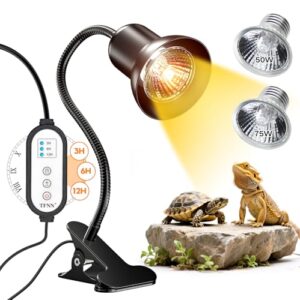
Setting a schedule by hand every day gets old fast, which is where TFNN’s timer-driven fixture earns its keep. Its intelligent cycle timer runs preset 3H, 6H, or 12H blocks automatically, so basking hours stay consistent even when you’re not home to flip a switch.
The dual-head design, often paired with 50W and 25W bulbs, spreads heat and UV across wider basking areas while the 360° goose neck lets you aim each head independently.
Standard E26/E27 sockets keep replacement bulbs easy to find.
| Best For | Reptile owners who keep turtles, bearded dragons, lizards, geckos, or snakes and want an easy way to provide consistent heat and UVA/UVB lighting without manually adjusting the setup every day. |
|---|---|
| Wattage | 50W/75W |
| Socket Type | N/A |
| Target Species | Turtles, Bearded Dragons |
| Heat Function | Basking Heat |
| Fixture Type | Swan Neck Clamp |
| Installation Style | Clamp Mount |
| Additional Features |
|
- Automatic 3H/6H/12H timer cycles keep basking schedules consistent without daily manual adjustments
- 360° rotatable 15.8-inch swan neck allows flexible positioning to aim light and heat exactly where needed
- Wide bell-mouth coverage and adjustable brightness levels support multiple reptiles and habitat sizes
- Timer and brightness controls are located on the cord, making them hard to reach from inside the enclosure
- Metal clamp needs a flat, flush surface and may not grip well on curved or mesh tank tops
- Some users report bulbs wearing out sooner than expected or inconsistent UVB readings with third-party meters
7. Lucky Herp Reptile Basking Heat Lamp
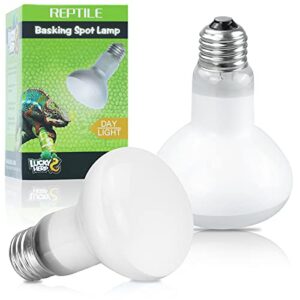
A 75W incandescent bulb sits in the center of this lamp, throwing both warmth and a soft daytime glow across the enclosure. That warm light does double duty, supporting thermoregulation while giving diurnal species the visual cues they’d get from natural sun.
Pairing that bulb with solid insulation matters most on cold nights, since knowing what temperature will actually kill a boa constrictor helps you set safer heat margins.
Sold as a two-pack, it’s built for owners running multiple tanks or wanting a ready backup. Standard E26 sockets mean installation takes minutes, not a trip to a specialty store.
| Best For | This lamp is best for reptile and amphibian owners—like those keeping bearded dragons, turtles, lizards, or other basking species—who need a reliable heat and UVA source to support natural behaviors and healthy basking temperatures. |
|---|---|
| Wattage | 100W |
| Socket Type | E26 |
| Target Species | Bearded Dragons, Turtles |
| Heat Function | Basking Heat |
| Fixture Type | Bulb Only |
| Installation Style | Standard Fixture |
| Additional Features |
|
- Supports appetite, digestion, metabolism, and overall vitality through natural UVA simulation
- Durable glass and filament build that’s passed strict safety certification
- Fits standard E26 sockets, making setup and replacement simple
- Only emits UVA and heat—no UVB, so it won’t cover a species’ full lighting needs
- Bulb needs replacing every 3 months to keep UVA output effective
- Limited lifespan of around 2,000 hours means it won’t last as long as some alternatives
8. MCLANZOO Reptile Heat Lamp 75W 2 Pack
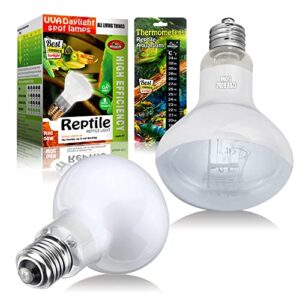
Explosion-proof glass sets this pair apart, giving you a safety margin most budget bulbs skip entirely. Each 75W lamp draws standard household current, no transformer needed, and screws into any E26 socket.
Rated for 2,000 hours, they won’t match ceramic emitters for longevity, but that’s a fair trade for the visible basking glow reptiles rely on. Two bulbs mean built-in redundancy: one keeps heating if the other fails mid-winter, which matters more than you’d think during a cold snap.
| Best For | Reptile owners who need a dependable basking heat source for bearded dragons, turtles, geckos, or similar pets kept in terrariums or brooders. |
|---|---|
| Wattage | 75W |
| Socket Type | E26/E27 |
| Target Species | Bearded Dragons, Turtles |
| Heat Function | Basking Heat |
| Fixture Type | Bulb Only |
| Installation Style | Standard Fixture |
| Additional Features |
|
- Explosion-proof glass adds a real safety margin over typical budget bulbs
- Simple E26/E27 screw base means no transformer or special wiring needed
- Comes as a two-pack, so you’ve got a backup if one bulb fails
- No UVB output, so you’ll still need a separate bulb for vitamin D3 synthesis
- Rated lifespan is only around 2,000 hours, and some users see earlier burnout
- Surface temperatures run hot, so careful fixture placement is a must to avoid burns
9. BOEESPAT Deep Dome Reptile Lamp Fixture
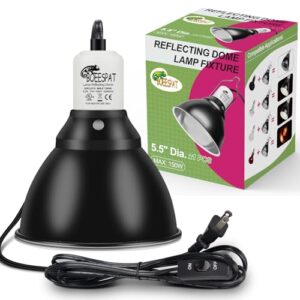
Handling up to 150 watts, the BOEESPAT Deep Dome accepts E26 basking bulbs, UVA/UVB bulbs, and ceramic emitters alike, giving you real flexibility across setups.
The 5.5-inch polished dome concentrates heat and light onto the basking zone, while top vents keep bulb temperatures from climbing dangerously high.
An inline switch and stainless hanging hook simplify daily handling, and the aluminum housing resists heat buildup, so it stays reliable through a full winter season.
| Best For | reptile owners with small to medium enclosures—like bearded dragons, chameleons, or ball pythons—who need a reliable basking and UVA/UVB heat source. |
|---|---|
| Wattage | 250W max |
| Socket Type | E26 |
| Target Species | Bearded Dragons, Chameleons |
| Heat Function | Basking Heat |
| Fixture Type | Dome Fixture |
| Installation Style | Clamp/Cord |
| Additional Features |
|
- Deep dome design with top vents helps dissipate heat efficiently and protects bulbs from overheating
- Highly reflective aluminum alloy interior boosts UVA/UVB output for better reptile health and basking behavior
- Works with a range of E26 bulbs, including UVA/UVB, basking, and ceramic heat emitters
- Maximum wattage is capped at 250 watts, which may limit use with higher-heat setups
- Heat and light spread can be narrow, making it better suited for smaller tanks like 10-gallon enclosures
- Some units have a loose or faulty switch, and a small number may arrive non-functional
10. DaToo Reptile Heat Lamp
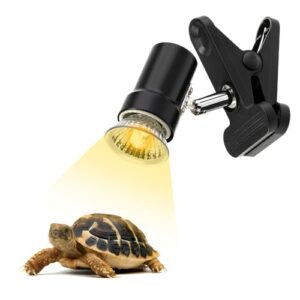
Budget-friendly doesn’t have to mean underpowered. The DaToo comes in 75W and 150W options, sized for small to medium enclosures, and fits standard E26/E27 dome fixtures you likely already own.
Its ceramic base resists heat buildup, and skipping the glass cover cuts breakage risk in busy households.
Pair it with a thermostat, since basking light alone won’t guarantee safe thermoregulation. For daytime warming zones on a budget, it’s a practical, no-frills pick.
| Best For | Reptile owners with small to medium enclosures who want an affordable, standard-fit heat lamp without extra frills. |
|---|---|
| Wattage | 50W |
| Socket Type | E27 |
| Target Species | Reptiles, Birds |
| Heat Function | Basking Heat |
| Fixture Type | Clamp Lamp |
| Installation Style | Clamp Mount |
| Additional Features |
|
- Available in 75W and 150W options to suit different enclosure sizes
- Ceramic base resists heat buildup for safer, longer use
- No glass cover, reducing the risk of breakage in busy households
- Requires a separate thermostat for reliable temperature control
- Fits standard E26/E27 fixtures only, limiting compatibility with other setups
- Offers basic functionality without added features found in pricier models
Compare Winter Heat Lamp Types
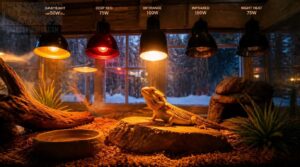
Not every heat lamp works the same way, and picking the wrong one can leave your reptile too cold or dangerously overheated.
Some bulbs give off light and heat together, while others work quietly in the background, warming without ever glowing.
Here’s how the five main types stack up, so you can match the right one to your setup.
Ceramic Heat Emitters
When winter strips the warmth from your reptile room, a ceramic heat emitter keeps working around the clock, no bulb glow required. It delivers pure infrared heat through a durable ceramic socket rated up to 250W, lasting 5,000-10,000 hours.
Pair it with thermostat control for a stable temperature gradient, and check contact points regularly since surfaces run genuinely hot.
To get the most out of it, make sure proper ventilation importance to prevent overheating and maintain consistent performance.
Incandescent Basking Bulbs
Where ceramic emitters skip the glow entirely, incandescent basking bulbs give your reptile both visible light and heat, running 40-100W with a warm yellowish beam.
Beam width matters: narrow beams concentrate a hotter spot, wide beams spread a gentler gradient. Expect 1,000-2,000 hours of filament life.
Use heat-resistant ceramic sockets, check E26 compatibility, and pair with a reflector dome for focused thermoregulation.
Halogen Basking Lamps
Step up from a standard incandescent basking bulb, and a halogen basking lamp delivers stronger IR-A penetration for deep tissue warming, whiter light, and better basking zone intensity, 25-100W with tighter beam angle focus.
- Redeposits tungsten, extending filament lifespan
- Reaches operating heat within minutes
- Works with thermostat compatibility for temperature control
- Fits dome fixtures with solid heat dissipation design
- Dimmable for finer wattage and heat output adjustment
Mercury Vapor Bulbs
Mercury vapor bulbs go further than halogen, combining heat with UVB light in one fixture, supporting Vitamin D3 synthesis and calcium metabolism.
Check ballast compatibility and outer bulb integrity before installing. Allow warm-up time to reach full brightness. Follow mercury disposal guidelines if broken.
Maintain your species’ proper basking spot temperature for safe thermoregulation.
Infrared Heat Bulbs
For nocturnal species that shun bright light, infrared heat bulbs deliver warmth in the 700–1200 nanometer range with only a faint red glow.
Far infrared (850–940nm) reaches deeper into substrate heat transfer, while near infrared stays gentler. A 150W bulb can lift basking sites 15–25°F.
Pair with a thermostat-controlled setup and heat-resistant mounting to maintain a stable heat gradient safely.
Match Heat Lamp Wattage to Enclosures
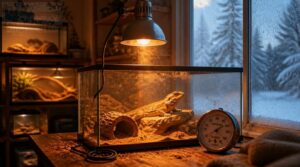
Picking the right bulb starts with knowing your tank’s size, since wattage needs shift as gallons go up.
Your enclosure isn’t just a home, it’s a heating system that has to fight winter’s chill every single day.
A reptile enclosure is a heating system that must battle winter’s chill every day
Here’s how wattage breaks down across small, medium, and large setups, plus what to do when the room itself runs cold.
Small Enclosure Wattages
Small tanks run hot fast, so wattage matters more here than anywhere else. Stick to 25W-75W for 10-20 gallon setups, with a 75W reptile heat lamp handling most basking needs. Pair it with a thermostat, since compact habitats overshoot quickly.
- Match wattage to gallon size
- Use 40-60W for 90-105°F basking
- Add insulation
- Monitor gradient
- Avoid oversized bulbs
Medium Enclosure Wattages
Once you move up to a 24-36 inch tank, the math changes. Aim for 75W to 150W, giving you a defined basking zone plus a cooler retreat.
A 150W ceramic emitter provides nighttime heating without light disruption. Pair a 75W bulb with a 100W emitter for dual-fixture flexibility, and always run wattage through a thermostat.
Large Enclosure Wattages
Big tanks demand big power. A single 150W bulb covers roughly 4×2 feet, while 6×3 setups need 250-300W emitters for a proper hot spot.
Three ways to distribute wattage safely:
- One high-output emitter over the basking zone
- Multiple 100W lamps for even coverage
- Ceramic emitters for light-free warmth
Thermostat control remains non-negotiable for overheating prevention.
Cold Room Adjustments
Ever notice your reptile room feels colder near windows and doors? Ambient room temperature below 65°F means adding 25-50 watts beyond baseline needs.
Check for drafts first, seal gaps with weather stripping, and verify insulation using a thermal camera. Better sealing means less wattage adjustment later.
Balance humidity too since dry winter air paired with ceramic heat drops moisture fast—keep a hygrometer nearby.
Thermostat-controlled Higher Wattages
Pairing a higher wattage heat lamp with a quality thermostat gives you both power and control. The unit cycles on and off, hitting your setpoint fast, then holding steady with minimal energy waste.
You get better heat distribution, tighter gradients, and built-in overheat protection—real safety margins for winter reptile care, not guesswork.
Meet Species-Specific Winter Heating Needs
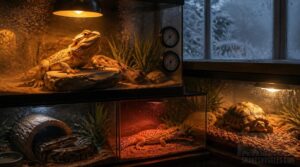
No two reptiles warm up the same way, and wattage alone won’t get you there. Your bearded dragon, ball python, leopard gecko, and tortoise each need their own basking range to thrive, and nocturnal species play by different rules entirely. Here’s what each one actually needs to stay healthy this winter.
Bearded Dragon Basking Temperatures
Bearded dragons run hot by design. Your ideal basking range sits at 108-113°F, with warm-side air near 95-105°F for a proper gradient.
Use an infrared gun on the exact basking surface, not the enclosure air. A quality reptile heat lamp paired with thermostat compatibility keeps that spot stable, while seasonal wattage adjustment compensates when winter room temps drop below 65°F.
Ball Python Warm Zones
Ball pythons run cooler than beardies. Your basking surface temp should hold 88-92°F, warm side 80-85°F, cool zone 76-80°F, roughly a 10-15°F heat gradient setup.
Check the hot spot with an infrared gun daily. Thermostat calibration and heat lamp safety features prevent hot-spot creep, keeping basking temperature control steady even when winter drafts chill the room.
Leopard Gecko Heating Needs
Leopard geckos want less drama than a python’s setup. Warm spot temperature should sit at 90-95°F, cool side near 70-75°F, giving a shallow gradient this ground-dweller can navigate. Night heating needs stay minimal, dropping to 65-70°F, since a ceramic emitter without light preserves sleep cycles. Verify surface temperature checks nightly, since heat output degradation sneaks up on you.
Tortoise Basking Requirements
Tortoises run slower than a gecko’s quick metabolism, but they still need real heat: basking surface temperature of 95-100°F, checked at shell height, not substrate. Use a flat slate or ceramic platform under the lamp. Pair basking light with UVB coverage across the shell zone.
Wattage adjustment matters in cold rooms, add 25-50W below 65°F ambient. Monitor thermal gradient daily.
Nocturnal Reptile Warmth
Darkness doesn’t mean your reptile’s thermostat needs shut off. A ceramic heat emitter delivers infrared warmth with zero light, ideal for nocturnal heating that won’t disrupt sleep cycles.
Bearded dragons need 82-90°F overnight, ball pythons 78-86°F, leopard geckos 75-82°F. Pair this with substrate heat retention and night thermostat control to hold steady gradients until morning basking resumes.
Create Safe Winter Temperature Gradients
Picking the right bulb is only half the job; your reptile also needs a properly mapped-out enclosure to actually use that heat safely.
A true thermal gradient gives them room to move between warm and cool spots, so their body can regulate itself the way nature intended.
Here’s how to set up that gradient and check it’s working, step by step.
Basking and Cool Zones
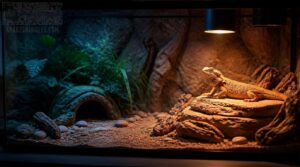
Think of your enclosure as two rooms in one tank. Thermal gradient planning starts with basking surface setup opposite a cool zone:
- Basking side: ceramic heat emitter or basking light, direct heat
- Cool zone: 70-85°F, no direct heat source placement
- 10-20°F differential between zones
This spacing drives thermoregulation, letting your reptile move freely between temperature monitoring zones as digestion demands.
Digital Probe Thermometer Placement
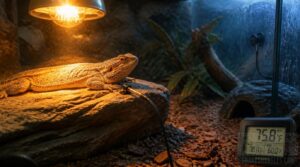
Where you put the probe matters as much as the wattage you chose. Position the sensor tip at head-to-midbody height, at least 2 cm from the bulb, facing where your reptile actually rests.
For multiple microhabitats, mount probes in basking, mid-ground, and cool zones.
Calibrate monthly, secure mounting hardware, and avoid burying probes under substrate.
Basking Surface Measurements
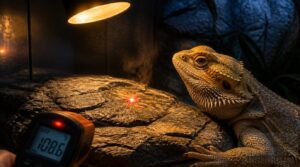
Air temperature lies to you. What matters is the basking surface temperature itself, measured right on the rock or tile your reptile presses against. Bearded dragons need 35-40°C at this exact spot, not nearby air.
Matte, dark surfaces hold heat better than slick ones, improving heat distribution. Check surface readings directly, since emissivity affects how accurately probes and thermometers report true skin-contact warmth.
Infrared Temperature Gun Checks
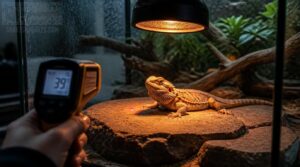
Your infrared gun measures surface temperature, not ambient air, so aim it right at the basking spot.
- Set emissivity to 0.95 for skin, ceramic
- Hold 2-6 inches away, per gun specs
- Keep the angle perpendicular
- Avoid glass or shiny surfaces
- Average several readings for accuracy
Log results over time to catch thermostat drift early.
Daily Winter Temperature Monitoring
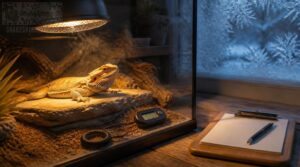
A cold snap can undo weeks of stable thermoregulation overnight, so daily logging matters. Record time, ambient, and basking surface temps twice daily, morning and late afternoon, using your probe. Track a five-day running average to catch drift. Flag readings outside 38-42°C basking or swings over 2°C for review. If targets slip three days running, bump wattage or check thermostat setup promptly.
Choose Compatible Fixtures and Sockets
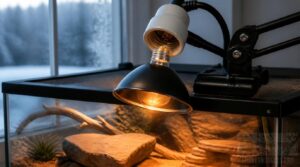
A great bulb still needs the right fixture behind it, or you’re just asking for trouble. Sockets, dome sizes, and switch setups all affect how safely and evenly that heat gets delivered. Here’s what to check before you buy.
Heat-resistant Ceramic Sockets
The socket matters as much as the bulb. Ceramic sockets tolerate 250–300°F, resist cracking under daily heating cycles, and pair safely with high-wattage ceramic heat emitters. Look for plated contacts, flame-resistant housing, and secure screw terminals.
That thermal stability prevents an overheated or underheated reptile habitat, while glazed surfaces resist warping, humidity, and substrate salts over years of use.
Standard E26 Bulb Compatibility
Ceramic sockets aside, most reptile fixtures rely on a standard E26 base, a 26-millimeter screw thread found on incandescent, halogen, and ceramic emitters alike. That shared fit means easy bulb swaps.
Always match wattage to the fixture’s rating. Overloading a 100W socket with a 150W bulb invites overheating, so check labels before installing.
Deep Dome Fixture Sizing
Getting the size right matters as much as the socket type. A 6-inch dome covers roughly 28% more surface area than a 4-inch model, so match dome diameter to your enclosure’s footprint.
Deep domes need 5-7 inches of hub clearance and stand 6-12 inches tall. Polished interiors boost radiant efficiency by up to 20%, sharpening heat focus without wasted wattage.
Dual Fixture Customization
A dome’s size gets you halfway there; the real control comes from running two zones at once. A Dual Reptile Light Fixture gives you independent switch control over each socket, so wattage and power needs differ per slot.
Fixture angle adjustment, a removable reflector design, and built-in heat guard inclusion round out true dual lamp functionality — often through one dual outlet adapter.
Reflector Heat Efficiency
Why waste heat you’re already paying for? A well-designed deep dome reflector boosts reflector efficiency by up to 20%, improving heat distribution and heat output.
- Aluminum retains 85-95% IR reflectivity
- Deep dome concentration raises peak basking temps
- Reflector angle shaping evens heat spread
- Tight tolerances reduce thermal loss
- Follow a surface maintenance schedule for consistent output
Plan Daytime and Overnight Heating
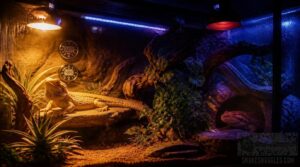
Winter heating isn’t a one-bulb job, since your reptile’s body clock still expects day and night to feel different. Getting that rhythm right means matching the right light to the right hour, without messing up their sleep cycle or UVB needs.
Here’s how to plan a full day-and-night setup that keeps thermoregulation on track.
Daytime Basking Light
Your reptile’s basking spot should feel like a sunny rock, not a sauna.
Daytime basking light combines visible light with infrared heat, driving thermoregulation and natural feeding behavior. Halogen basking lamps deliver stronger heat distribution for deep warming, while standard incandescent bulbs suit lighter needs.
Add UVB lighting for reptiles requiring it, then use thermostat control to keep your basking zone optimized and stable.
Overnight Ceramic Heating
Nighttime doesn’t mean your reptile’s thermostat gets a break. Ceramic heat emitters produce infrared warmth with no visible light, protecting sleep cycles while sustaining basking-zone gradients overnight.
Choose 25W to 150W based on enclosure size, always pairing with thermostat coordination to prevent burns. Mount fixtures at a safe distance from surfaces, and rely on insulation to hold heat steady until morning.
UVA and UVB Needs
Heat isn’t the whole story. Your reptile also needs UVB lighting for vitamin D3 synthesis and calcium metabolism, plus UVA for natural feeding and navigation behaviors.
Combined UVA/UVB fixtures simplify basking zone creation. Place bulbs at manufacturer-recommended distances, and replace UVB lamps every 6-12 months, since output weakens long before the bulb burns out, undermining thermoregulation and bone health.
Protecting Natural Sleep Cycles
Ever notice how your reptile’s basking light doubles as its sunrise? That’s not accidental.
Consistent day-night cycle lighting helps circadian rhythm stability, while dimming basking bulbs in the evening mimics dusk.
This light exposure timing keeps sleep cycles intact and preserves healthy thermoregulation, so your reptile’s internal clock stays synced through winter’s shorter, darker days.
Thermostat-controlled Nighttime Warmth
A good digital thermostat doesn’t just hold one temperature, it grips a whole overnight curve for you.
Set a Nighttime Temperature Drop of 2–6°F with Gradual Ramp Control, paired with Remote Probe Settings near the basking zone and Fail-Safe Overheat Protection, and your ceramic emitter delivers safe, steady warmth with real Energy Efficiency Savings built in.
Compare Lifespan, Reliability, and Energy Costs
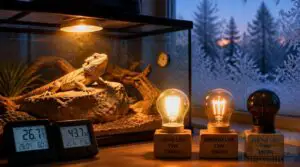
Winter heating runs your bulbs harder and longer, so lifespan and running costs matter as much as basking temperature. A cheap bulb that burns out in three months, or one that quietly spikes your electric bill, ends up costing you more than a pricier, longer-lasting option.
Here’s what to weigh before you commit to a heat source for the season.
Ceramic Emitter Lifespan
Ceramic heat emitters usually deliver 5,000 to 10,000 hours of service life under normal conditions. Thermal cycling from frequent switching accelerates wear, while voltage fluctuation and humidity exposure shorten lifespan further. A thermostat reduces on-off cycling, extending durability.
Watch for replacement indicators: cracked glazing, dimmer output, or odd sizzling sounds. Routine maintenance practices, including dust removal and clearance checks, protect long-term bulb lifespan.
Basking Bulb Replacement Schedules
Basking bulbs run a shorter clock than ceramic heat technology, usually needing swaps every 1-4 months.
Watch for bulb degradation signs: dimming, amber color shift, or a 10-20°F drop below target.
Many keepers set a preventive maintenance schedule—every 2-3 months—and log basking temps with each change to track lamp lifespan durability and improve future replacement timing guidelines.
Winter Electricity Usage
Tracking bulb changes naturally raises the next question: what’s this costing you monthly? Energy Cost of Reptile Heating hinges on wattage and runtime, not just bulb type. A 100W lamp running 12 hours daily adds up fast, especially with winter’s heavier loads.
Thermostat optimization and proper wattage calculation for enclosure size keep consumption reasonable without sacrificing your reptile’s warmth.
Reflector Energy Efficiency
A well-designed reflector cuts wattage waste before it happens. Reflector angle optimization and specular surfaces redirect infrared forward, improving heat distribution uniformity. A deepdome reflector with anodized aluminum (85-95% reflectivity) fights the reflector tarnishing effect for years.
- Check reflector angle
- Clean surfaces monthly
- Verify emissivity coatings
- Inspect for tarnish
- Confirm bulb alignment
Bulb Durability Concerns
Winter’s on-off cycling is brutal on bulbs. Glass envelope cracking happens when cold fixtures heat too fast, so thermal shock mitigation matters. Watch ceramic base stress from tight mounting, and electrical overvoltage risks from surging circuits. Fixture heat trapping shortens lifespan too.
For longlasting reptile bulbs, choose heatresistant ceramic lamp caps or explosionproof glass construction — proven bulb burnout prevention that extends heat bulb lifespan a lot.
Prepare for Winter Power Outages
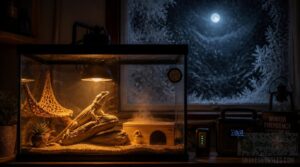
Winter storms don’t ask permission before knocking out power, and your reptile’s thermoregulation can’t wait for the lights to come back on. A cold-blooded animal can drop into dangerous territory within hours once that heat source goes dark. Here’s how to keep your setup safe when the grid lets you down.
Insulating Reptile Enclosures
A power outage doesn’t have to mean a thermal emergency if your enclosure insulation is already solid. Foam board insulation on walls cuts heat loss up to 30%, while reflective foil or a bubble wrap barrier adds backup protection.
- Cork exterior cladding
- Silicone sealant joints
- Foam board panels
- Reflective foil layers
- Insulated substrate base
These maintain your heat gradient and thermal regulation even when bulbs go dark.
Safe Backup Power Options
Losing the grid shouldn’t mean losing thermoregulation control. Portable power stations run small basking bulbs for hours; standby generators with generator transfer switches power whole rooms.
| Option | Runtime | Best For |
|---|---|---|
| UPS for thermostats | Minutes | Brief outages |
| Battery backup systems | Hours | Overnight gaps |
| Hybrid solar generator | Extended | Multi-day outages |
Keep independent circuit control on hand as your stopgap solution.
Temporary Emergency Heating
When a heating system fails outright, rented equipment becomes your stopgap solution. Emergency heater selection depends on room size: direct fired propane units for large spaces, electric models where circuit capacity allows.
A quick heat loss assessment tells technicians where to place units first. Rental unit logistics matter too, since availability and delivery time vary by provider.
Always practice circuit load management to prevent overheating or tripped breakers.
Heat-retaining Substrate Choices
A cold snap doesn’t have to mean a cold enclosure if your substrate already holds warmth.
- Water containers or ceramic tiles for thermal mass
- Cork tiles or coconut fibre as insulating ground cover
- 2–4 inch depth for lasting heat retention
- Cypress mulch layered over a heat-absorbing base
Styrofoam panels underneath add extra insulation, cutting heat loss when lamps cycle off during an outage.
Monitoring Temperatures During Outages
A blackout doesn’t mean you’re flying blind on habitat temperature monitoring. Battery-powered sensors keep logging via a temperature probe even without mains power, storing data locally until data sync recovery happens automatically.
For extra assurance, cellular gateway redundancy keeps alerts flowing. Set outage alert escalation via SMS, verify battery sensor lifespan seasonally, and run probe calibration checks alongside your infrared temperature gun before winter storms hit.
Frequently Asked Questions (FAQs)
Can you leave a reptile heat lamp on all night?
Not without a thermostat or timer. Bright bulbs disrupt sleep cycles and raise fire risk from overheating. Use a ceramic emitter instead, paired with independent power switches, to deliver steady heat output while protecting natural nocturnal rhythms safely.
How do I keep my reptile warm if the power goes out?
Don’t panic—your setup already buys you time. Wrap hot water bottles in towels, add hand warmers near (not touching) the enclosure, seal drafts, and monitor gradients closely until power or backup heating equipment restores normal warmth.
What is the difference between a basking lamp and a heat lamp?
A basking lamp pairs visible light with infrared heat for daytime basking behavior, while a heat lamp runs heat only, sometimes with UVA rays or UVB light, meeting nocturnal heating needs without disrupting sleep cycles.
Do reptile heat lamps use a lot of electricity?
Your utility bill needn’t spike. A 100W bulb run 12 hours costs roughly $35 daily—about $50 monthly. Thermostat control cuts waste further, making steady, energy-efficient heating far cheaper than an emergency vet visit from a cold, sluggish reptile.
Can I use two heat lamps in one enclosure?
Yes, a dual lamp setup works well for balanced heat distribution. Use separate thermostat control and independent power switches for each bulb, position them to avoid hotspots, and manage your temperature gradient carefully to prevent overheating.
How long should heat lamps run each day?
Like sunlight tracking across a savanna, your lamp’s schedule should shift with the seasons. Run bulbs 10 to 12 hours daily in winter, using programmable timers or thermostat scheduling for consistent light cycle management and energy savings.
Do heat lamps affect reptile humidity levels?
Heat output speeds evaporation rate increase near the basking zone, drying substrate faster. Ventilation impact matters too. Balance moisture with water dishes and retentive substrate for stable humidity gradient management across the enclosure.
Can heat lamps be used with LED lighting?
Sun and shade coexist in nature, and your setup can mirror that balance.
Yes, pairing works well: combined light setup using LEDs for daylight and heat lamps for basking keeps thermal zoning strategies effective while maintaining energy efficiency and heat lamp safety.
What signs indicate a reptile is overheating?
Watch for open mouth breathing, rapid panting, and restlessness as your reptile hunts for cooler ground. Lethargy and appetite changes follow if heat lingers. Verify readings with digital thermometers or an infrared gun, probe placed right on the basking surface.
Conclusion
Think of your thermostat as a modern-day sundial, tracking warmth your dragon can’t chase outdoors anymore. Winter doesn’t forgive guesswork, and reptile heat lamps for winter aren’t optional extras once your furnace cycles off at midnight.
Match wattage to enclosure size, verify basking temperatures with a probe thermometer, and keep backup heating ready before outages strike. Your reptile can’t tell you it’s cold. The right setup speaks for it, holding steady gradients through every frost, every flicker, every long January night.