This site is supported by our readers. We may earn a commission, at no cost to you, if you purchase through links.

A ball python coiled tight in the corner of a 40-gallon tank isn’t relaxed—it’s stressed, and likely searching for an exit that doesn’t exist. Undersized enclosures rank among the most common welfare issues veterinarians see in captive snakes, often mistaken for normal behavior by well-meaning owners.
Choosing the right tank size for your snake affects far more than aesthetics. It shapes muscle development, thermoregulation, and even immune function over years of captivity.
Getting the dimensions right isn’t guesswork. It follows measurable rules tied to your snake’s length, species, and life stage—rules this guide will walk you through, one measurement at a time.
Table Of Contents
- Key Takeaways
- Why Snake Tank Size Matters
- Measure Your Snake Correctly
- Choose Size by Species
- Match Tank to Life Stage
- Compare Enclosure Types
- Set Up The Space Properly
- Frequently Asked Questions (FAQs)
- Is a 75 gallon tank too big for a ball python?
- When should I get a bigger tank for my snake?
- Can a tank be too big for a snake?
- How to tell if a snake enclosure is too small?
- Can a snakes tank be too big?
- How often should I clean the enclosure?
- Do multiple snakes need separate enclosures?
- Whats the ideal room temperature for snake rooms?
- Can I build a DIY enclosure myself?
- Conclusion
Key Takeaways
- Tank footprint should equal 1–1.5 times your snake’s adult body length, with width at half to two-thirds of that length, since sizing for current size rather than mature length leads to costly re-homing later.
- Proper enclosures need a clear thermal gradient (roughly 80–88°F warm side, 75–78°F cool side) plus two secure hides, since cramped spaces force heat zones to overlap and undermine thermoregulation.
- Watch for behavioral red flags like nose rubbing, wall striking, refusing meals, or tight corner-coiling, as these signal an enclosure has become too small well before health problems appear.
- Enclosure material (glass, PVC, or plastic tubs) and setup details like ventilation, water bowl placement, and substrate depth matter as much as size for long-term health, security, and escape prevention.
Why Snake Tank Size Matters
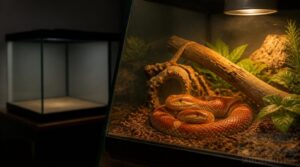
Tank size isn’t just a matter of comfort—it directly affects your snake’s health, behavior, and stress levels. Get it wrong, and you’ll see the consequences in everything from feeding response to immune function. Here’s what actually determines whether your setup is helping your snake thrive or just survive.
If you’re unsure where to start, this guide to appropriate snake tank dimensions by species breaks down exactly what size your snake needs to feel secure.
Health and Natural Movement
Because snakes are built to travel, coil, and climb, cramped tanks quietly erode their physical condition.
A proper snake length ratio—footprint at 1–1.5× body length—lets muscles engage fully, supporting joint health and preventing the stiffness that comes from restricted mobility.
Adequate space also encourages natural behavior like exploration, which keeps your snake physically and mentally sound over time.
Stress and Escape Risks
Stress compounds fast in cramped enclosures, and it doesn’t stay quiet. Watch for these escape trigger signs:
- Repeated nose rubbing at doors or lid gaps
- Rapid circling or wall rubbing
- Vigilant scanning near enclosure edges
Enclosure security matters as much as size—loose latches invite trouble. Undersized tanks with inadequate hiding space push snakes toward escape-proof design failures, so secure lids paired with proper dimensions reduce risk considerably.
Thermal Gradient Space
Locking a snake’s door isn’t enough if it can’t escape the heat. A proper temperature gradient needs enclosure size to spare a basking side near 28–32°C and a cool side around 24–26°C, connected by a mid zone for movement.
Cramped tanks force radiant heat transfer to overlap zones, undermining thermal stability and making accurate gradient monitoring nearly impossible.
Long-term Welfare Impact
Getting the gradient right on day one is only half the equation—what happens over years matters just as much. Chronic undersizing suppresses immune function, slows growth monitoring, and shortens lifespan.
- Suppressed appetite despite normal health
- Recurring respiratory issues
- Poor shed quality
- Muscle atrophy from limited movement
- Withdrawn, low-activity behavior
Proper enclosure size paired with habitat complexity encourages genuine behavioral enrichment and stress reduction, protecting longevity factors across your snake’s lifetime.
Measure Your Snake Correctly
Before you can pick the right tank, you need accurate numbers, not guesswork based on how big your snake looks today. That means measuring with intention and understanding which figures actually matter for enclosure planning. Here’s what to account for as you take those measurements.
Use Adult Snake Length
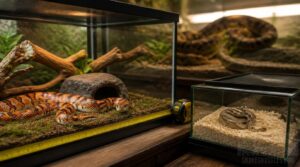
A snake never stops being what it will become, so sizing an enclosure for today’s hatchling ignores tomorrow’s reality. Adult length measurement should drive every decision. Corn snakes reach 90–150 cm; boas can hit 400 cm. Track growth every few months, since adult size prediction prevents costly, stressful re-homing later. Species specific care starts with knowing your snake’s genetics and projected mature length. Consider the benefits of non-elastic string technique for precise adult length assessment.
Apply Length-width Rules
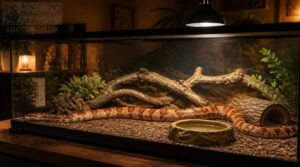
Length and width aren’t interchangeable numbers—each does distinct work. Pair the longer measurement with enclosure length, the shorter with width, always in a relaxed horizontal position.
Practical targets:
- Length: 1–1.5× snout-to-tail
- Width: half to two-thirds of length
- Combined L+W ≥ body length
- Consistent pairing prevents guesswork
This floor space calculation keeps thermoregulation and movement realistic for species-specific growth rates.
If you’re noticing wall aggression or climbing frustration, this guide to choosing the right terrarium size for boas can help you match enclosure dimensions to your snake’s actual growth stage.
Consider Body Thickness
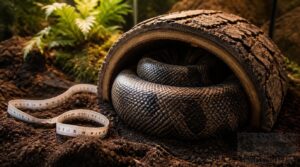
Girth matters as much as length. Measure your snake’s widest midbody point with flexible tape, then add 20–30% extra width beyond that figure for comfortable floor space.
| Girth | Min. Width | Hide Fit |
|---|---|---|
| 4" | 5" | Snug, uncompressed |
| 6" | 7.5" | Full-coil clearance |
| 8" | 10" | Deep substrate needed |
Thicker-bodied snakes need roomier hides and deeper substrate to avoid rib compression.
Plan for Growth Stages
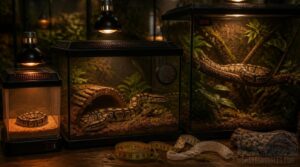
A hatchling ball python doesn’t need adult housing on day one — that’s wasted heat and lost security. Match enclosure size to current length, then plan two or three upsizes as growth milestones hit, roughly every 6-12 months.
Track length at each shed. This keeps floor space calculation accurate and thermal regulation reliable, without overwhelming a young snake with excess, unheated space.
Choose Size by Species
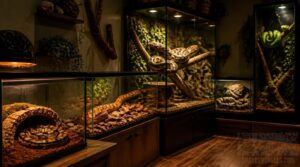
Once you know your snake’s length, the next step is matching that number to species-specific housing standards, since general rules only get you so far.
Ball pythons, corn snakes, boas, kingsnakes, and arboreal species each carry their own dimensional requirements, shaped by body type and natural behavior.
Here’s what adequate enclosure sizing looks like for each one.
Ball Python Tank Size
Ball pythons are deceptively bulky for their length, which is why a 40 gallon tank (roughly 36") is your practical floor, not a suggestion.
- Hatchlings: 10 gallons
- Juveniles: 20 gallons
- Adults: 40 gallons minimum
- Females: 55-75 gallons
- Always: two secure hides
Long, low footprints beat tall tanks—ball pythons prioritize ground space and a stable heat gradient over vertical climbing room.
Corn Snake Tank Size
Corn snakes reward horizontal thinking: a 40 gallon tank (around 48"×18") suits most adults, though 30 to 40 gallons works during earlier growth stages.
| Stage | Tank Size |
|---|---|
| Juvenile | 20 gal |
| Adult | 40 gal |
Enclosure height matters less here—focus horizontal space, moderate substrate depth for burrowing, and proper hide placement, thermometer positioning, and water bowl size for species specific care.
Boa Constrictor Enclosure Size
Boas outgrow small setups fast, so enclosure size must scale with each stage: babies do fine around 2×1.5×1 feet, juveniles need 4×2×2, and adults require minimum dimensions of 6×3×3 feet, up to 8×4×4 for snakes over 8 feet.
Provide 2-4 inches of substrate, secure vertical space for climbing, and placed enrichment supporting proper thermal regulation throughout growth.
Kingsnake and Milksnake Sizing
Kingsnakes and milksnakes are more forgiving than boas, but sizing still matters. Adults do well in a 30-40 gallon setup (36"L x 18"W x 24"H), with substrate depth around 2-3 inches for burrowing.
- Provide secure hides on both ends
- Maintain a temperature gradient (75-85°F)
- Size water bowls for soaking
- Upgrade gradually through growth stages
Arboreal Species Height Needs
Species that climb, like the Green Tree Python, need vertical climbing space rather than floor area alone. Height should roughly match body length, with sturdy branches placed to support ascent without compressing coils.
Front-opening enclosures make branch placement and cleaning safer at height. Watch humidity near the canopy zone—elevated air dries faster—and always secure lids, since climbers test boundaries constantly.
Match Tank to Life Stage
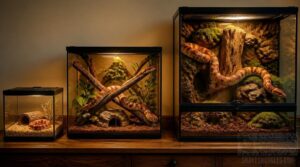
A snake’s housing needs change dramatically as it grows, and sizing for its current stage matters just as much as sizing for its adult length.
What works for a hatchling can become a safety hazard within months, so timing your upgrades correctly protects both feeding response and overall health.
Here’s what to expect at each stage, from first enclosure to final adult setup.
Hatchling Starter Enclosures
A newborn snake doesn’t need a mansion — it needs security. Keep hatchlings in compact 20-40 cm enclosures with species-appropriate substrate, a snug hide on each side, and a stable warm-side gradient (28-32°C).
Secure, ventilated lids prevent escapes and stress. Ball pythons start smaller (20-30 cm); boas need slightly more room. Oversized tanks overwhelm hatchlings, hindering feeding response and thermoregulation during this critical growth phase.
Juvenile Upgrade Timing
Growth doesn’t wait for a convenient weekend, so timing the upgrade matters as much as choosing the enclosure itself. Most keepers move ball pythons at 1.5-2 feet, corn snakes around 2.5-3 feet, and kingsnakes near 2-3 feet.
Watch body condition, not just the calendar — a stout juvenile outgrows housing faster than a lean one, regardless of age.
Adult Minimum Dimensions
Once fully grown, your snake needs permanent housing that meets clear minimum space requirements, not a temporary upgrade.
A 4 ft x 2 ft x 2 ft setup suits most Ball Pythons and Kingsnakes, while Boa Constrictors demand 6-8 feet in length.
Maintain a 1.25-1.5x length-to-width ratio, adequate height for vertical movement, and 2-3 inches of substrate depth for burrowing comfort.
Signs Upgrading is Needed
Watch your snake’s behavior, not just the calendar, to know when it’s outgrown its space.
Nose rubbing against enclosure walls, excessive hiding, poor feeding response, and increased defensive striking all signal cramped housing. Struggling to maintain a thermal gradient is another red flag.
- Repeated snout rubbing on glass or mesh
- Hiding well beyond shedding cycles
- Refusing meals despite good health
- Sudden defensive strikes during handling
Avoid Cramped Growth Setups
Cutting corners on growth space planning is the most common mistake I see in clinical practice. A "starter" tub that fits a hatchling won’t serve a juvenile for long, and delaying move enclosure timing stalls healthy juvenile size progression.
Delaying a growth-space upgrade is the most common mistake that stalls a snake’s healthy juvenile progression
Rehoming too late leaves snakes without room for movement or species-appropriate substrate depth. Watch for adult readiness indicators early, and upgrade before behavior—not the calendar—forces your hand.
Compare Enclosure Types
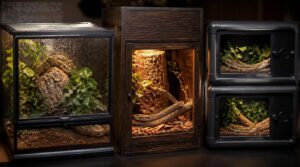
Size is only half the equation; the material and design of your enclosure matter just as much for your snake’s health. Different housing types handle heat, humidity, and security in very different ways, and picking the wrong one can undercut even a correctly sized setup. Here’s how the main options compare.
Glass Tanks
Glass aquariums offer impressive viewing clarity, but weight matters: a 40 gallon breeder runs roughly 180 lbs filled, demanding sturdy stands.
- Low iron clarity for near-invisible viewing
- Silicone seal quality to prevent leaks
- Glass thickness from 6-12mm for strength
Choose polished edges and verified escape-proof design, since species-specific needs and temperature gradients depend on secure, well-built enclosures.
PVC Enclosures
Weight and moisture worries fade with PVC. These enclosures resist chemicals and humidity swings, offering material durability that suits reptile rooms prone to condensation.
Vented panels support humidity control and temperature gradients, while non-conductive walls maintain electrical safety near heat sources. Custom sizing accommodates species-specific care needs, and UV-stabilized models handle outdoor use without warping or fading over time.
Plastic Tubs
Budget matters, and plastic tubs deliver. HDPE tubs resist cracking even in cold rooms, while PP variants handle higher heat better, often with snap-on lids for a tighter seal.
Wall thickness (0.5–2.0mm) affects rigidity and weight capacity. For breeders managing multiple species-appropriate substrate setups, tubs offer stackable, escape-proof design at a fraction of glass or PVC cost.
Ventilation and Humidity
Ventilation and humidity work differently across tub, glass, and PVC setups, so vent placement matters more than material alone. Tubs need drilled side vents, not just top holes, to prevent stagnant pockets.
Keep hygrometers at snake eye level, away from direct misting. Watch for condensation on walls—it signals poor airflow.
Passive vents suit stable rooms; active fans help in humid climates.
Security and Escape Prevention
Airflow means nothing if your snake can push through it. Locking seams and secure lids matter more than tank material—corn snakes especially exploit weak points.
Check three things:
- Lid locks engage fully
- No warped seams
- Latch resists steady pressure
Institutional-grade perimeter reinforcement, gate security, and sensor networks are overkill at home, but the basic idea—layered containment—still applies to your habitat security.
Set Up The Space Properly
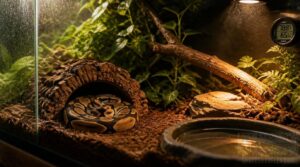
Picking the right size enclosure is only half the job; how you set it up matters just as much for your snake’s health. Every element inside plays a role in temperature, security, and natural behavior. Here’s what you’ll need to get the space working the way it should.
Warm and Cool Hides
A snake without proper hide options is a snake in constant low-grade stress. Provide two hides minimum—one warm, one cool—sized for snug, three-point wall contact. Choose PVC or acrylic for easy cleaning.
| Hide Type | Placement | Fit Requirement |
|---|---|---|
| Warm | Near heat source | Snug, 3-wall contact |
| Cool | Opposite end | Loose coil, 2-wall contact |
Monitor temperatures regularly to confirm gradient integrity.
Water Bowl Placement
Where you place the water bowl matters as much as the bowl itself. Set it away from the warm hide, roughly six inches minimum, so lingering heat doesn’t warm the water. Choose a shallow bowl, 1.5–3.5 inches deep depending on your snake’s size, and keep it reachable without stretching.
- Stable, non-tipping surface
- Away from basking spots
- Clear path for access
- BPA-free or ceramic material
- Refill every 2–3 days
Heating and Thermostats
Get temperature control wrong, and nothing else in the enclosure matters. Your snake needs a heat gradient: warm side 80–88°F, cool side 75–78°F, using a thermostat-controlled heat mat or radiant panel, not a bare bulb.
| Side | Target Range |
|---|---|
| Warm | 80–88°F |
| Cool | 75–78°F |
Place the thermostat probe near the basking surface, away from drafts, for accurate readings.
Substrate and Enrichment
Choosing species-appropriate substrate matters as much as tank size. Aspen suits ball pythons and corn snakes; cocofiber holds humidity for tropical species. Keep depth at 2–4 inches for natural burrowing.
Place hides at both temperature zones, and rotate enrichment items every few weeks to prevent habituation. Spot-clean waste daily; do full substrate swaps every 4–6 months to control mold and bacteria buildup.
Climbing Branches and Decor
A bare tank floor wastes vertical space your snake actually needs.
Anchor branches securely to the frame, angling them toward the warm side to support thermoregulation. Choose natural hardwood like maple, 1.5–3 inches thick, spaced 6–12 inches apart for arboreal species. Clean with dilute bleach (1:10), rinse, and dry fully.
Varied textures build muscle and curiosity.
Frequently Asked Questions (FAQs)
Is a 75 gallon tank too big for a ball python?
Surprisingly, no—a 75 gallon setup works well for most adult females once growth stage change is complete, offering enough footprint for thermal gradient balance, proper hide placement, and natural behavior across their full species-specific needs.
When should I get a bigger tank for my snake?
Watch for repeated wall rubbing, inability to stretch fully straight, or restless pacing—these behavioral indicators signal it’s time. Upgrade before cramped conditions cause chronic stress, ideally at each growth stage, rather than waiting for visible health impact to force the decision.
Can a tank be too big for a snake?
Yes. Oversized enclosures can undermine security and trigger stress behaviors like wandering or refusal to eat. They also disrupt thermal gradients and complicate feeding, especially for hatchlings, raising injury risks from poorly scaled climbing features or heat sources.
How to tell if a snake enclosure is too small?
Look for repeated striking at walls, constant escape attempts, or coiling tightly in one corner. Poor thermoregulation, stalled growth, and reluctance to stretch fully also signal your snake’s enclosure no longer meets its behavioral and thermal needs.
Can a snakes tank be too big?
Big tanks bring their own burden: space anxiety, feeding confusion, and energy waste from excessive roaming. Oversized enclosures dilute humidity and heat, triggering stress behaviors. Match housing to growth stages with proper substrate and enrichment for genuine security.
How often should I clean the enclosure?
Daily spot cleaning takes care of waste removal and water bowl hygiene.
A deep clean schedule every 1–2 weeks covers substrate replacement and sanitizing decor.
Good ventilation impact on cleaning is real—stagnant air worsens odor buildup between sessions.
Do multiple snakes need separate enclosures?
Solitary housing is generally safest: territorial behavior, feeding competition, and stress indicators all worsen when snakes share space. Cohabitation compatibility varies by species, so separate enclosures with multiple hides remain the standard for reducing aggression and protecting long-term welfare.
Whats the ideal room temperature for snake rooms?
Aim for 72–78°F ambient room temperature year-round, adjusting seasonally as needed. This helps your enclosure’s internal heat gradient, letting a thermostat-controlled heat source maintain 80–85°F basking zones without overworking equipment or causing dangerous fluctuations in humidity or overall thermal stability.
Can I build a DIY enclosure myself?
Building your own enclosure rivals constructing a small greenhouse in complexity, but it’s entirely doable with basic tools. Focus on structural integrity, proper ventilation planning, and escapeproof design—lid locks and front access panels make maintenance and security far easier.
Conclusion
Picture two identical ball pythons, one in a cramped tub, one in a properly sized enclosure. Within months, the first shows signs of chronic stress; the second thrives, muscled and calm. That’s not speculation—it’s documented outcome.
Choosing right tank size for your snake isn’t a cosmetic decision; it’s preventive medicine. Measurements, ventilation, thermal gradients: these details compound over years into either a thriving reptile or a struggling one. Get the dimensions right, and everything else, temperament, health, longevity, usually follows.