This site is supported by our readers. We may earn a commission, at no cost to you, if you purchase through links.
A classroom ball python can live 30 years, but a bad enclosure can wreck its health in a week. Picture a 15-gallon glass tank on a teacher’s desk, a heat lamp fighting a drafty room, and a hatchling that won’t eat.
You want a setup that keeps the snake steady and your students safe. That means locking front doors, a thermostat on every heat source, and room for an adult to stretch out.
Some of the best ball python terrarium kits for classroom use arrive nearly ready to go. Others fall short fast. Here’s how the top five stack up.
Table Of Contents
Key Takeaways
- Size your enclosure for the adult snake, not the hatchling, since ball pythons need at least 4’x2’x2′ and the 10 and 15 gallon tanks will force you to buy twice.
- Pick security and stable heat first by choosing locking front doors and putting a thermostat on every heat source, because those two features protect both your snake and your students.
- Aim for 88-92°F on the warm side, 74-80°F on the cool side, and 50-60% humidity, and check both ends an inch above the substrate.
- Keep students safe with signed consent forms, gloves, one handler at a time, handwashing after every contact, and monthly latch checks, and confirm your local laws first since some places ban ball pythons.
5 Ball Python Terrarium Kits for Classrooms
Picking a snake home for your classroom shouldn’t feel like a science project of its own. Here are five ball python terrarium kits worth a look, from compact starter tanks to roomy adult setups. Check each one against your space, your budget, and how many hands will be caring for it.
For a closer look at kits built with classroom safety and durability in mind, see this guide to ball python terrarium kits for teachers.
1. Joshs Frogs Ball Python Terrarium Kit
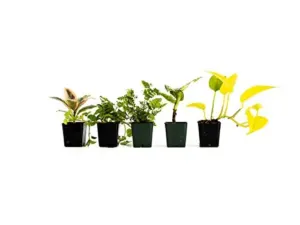
A plant-focused kit like this one gives your classroom ball python a naturalistic home without the guesswork. It’s built around live greenery picked for ball python setups, including terrestrial ferns, Pothos, and Sansevieria. Those plants add humidity support and enrichment, and they’re designed for easy care.
Know what you’re buying, though. The kit contains plants only, so you’ll need your own 36x18x18 inch enclosure. Exact plant varieties can vary. Shipping? The live arrival guarantee covers temperatures from 32°F to 85°F.
| Best For | Reptile keepers who already own a 36x18x18 inch enclosure and want live, easy-care plants to give their ball python a naturalistic setup. |
|---|---|
| Dimensions | 36x18x18 inches |
| Material | N/A |
| Assembly | N/A |
| Ventilation | N/A |
| Security | N/A |
| Heating/Lighting | N/A |
| Additional Features |
|
- Includes live terrestrial ferns, Pothos, and Sansevieria chosen for ball python terrariums
- Adds humidity support and enrichment to the enclosure
- Easy to care for, with a live arrival guarantee when temperatures stay between 32°F and 85°F
- Contains plants only, so the terrarium must be bought separately
- Exact plant varieties can vary and are not guaranteed
- The live arrival guarantee is void if shipping temperatures fall outside 32°F to 85°F
2. SUKEOPET 68 Gallon Reptile Enclosure
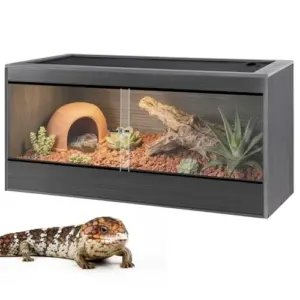
Need the enclosure to go with that plant kit? This one has room to spare. At 48x18x18 inches, it’s bigger than the 36x18x18 minimum, so your python can stretch out.
The composite build holds heat about 3 times better than glass, and sliding doors with a locking mechanism keep curious hands out. Assembly takes roughly 10 minutes, no tools needed. (Your class will love that part.)
Heads up: some buyers got wrong screws, and the mesh top can cave in.
| Best For | Ball python owners and classroom or home keepers who want a roomy, easy-to-assemble enclosure that holds heat well and has secure locking doors. |
|---|---|
| Dimensions | 48 x 18 x 18 inches |
| Material | Plastic, glass, wood composite |
| Assembly | Tool-free, about 10 minutes |
| Ventilation | Ventilated mesh top |
| Security | Locking sliding doors |
| Heating/Lighting | Lighting support via mesh top |
| Additional Features |
|
- Composite build holds heat about 3 times better than glass, helping keep temperatures stable
- At 48 x 18 x 18 inches, it gives a python more than the 36 x 18 x 18 minimum so it can stretch out
- Sliding doors with a locking mechanism keep the animal in and curious hands out, and assembly takes about 10 minutes with no tools
- Some buyers received insufficient or incorrect screws
- The mesh top can cave in under pressure
- Feedback on the assembly instructions is mixed, so they may be unclear
3. PVC Reptile Terrarium with Heating Setup
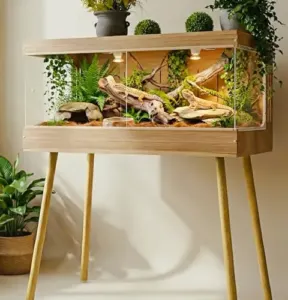
Want something that looks like furniture instead of a fish tank? This one’s for you. It’s built from PVC panels with a natural wood finish and a clear acrylic front, so your class gets a great view.
If you’d rather build your own, these DIY snake cage ideas show how to turn old furniture into a roomy, well-lit enclosure for a fraction of the cost.
It measures 39.3 x 20 x 7 inches, which means confirm the interior height before a python moves in. A built-in digital thermostat and two heating lamps help hold steady temperatures, and locking front doors keep feeding and cleaning controlled. Check the recommended bulb wattage first.
| Best For | Classroom teachers, hobbyists, and small-reptile keepers who want a furniture-style, insulated enclosure with a clear front view and built-in heating. |
|---|---|
| Dimensions | 39.3 x 20 x 7 inches |
| Material | PVC with wood finish |
| Assembly | N/A |
| Ventilation | Three-side ventilation |
| Security | Locking front doors |
| Heating/Lighting | Two heating lamps, thermostat |
| Additional Features |
|
- Built-in digital thermostat and two heating lamps help hold steady habitat temperatures
- Insulated PVC panels with a natural wood finish look like furniture and retain heat well
- Clear acrylic front and raised leg stand give easy viewing, while locking front doors keep feeding and cleaning secure
- At only 7 inches tall, the interior height may be too limiting for larger or taller animals like pythons
- You need to check the recommended bulb type and wattage before setting it up
- The listed unit count of 1 square foot measures floor space only, so interior dimensions must be confirmed for animal compatibility
4. MCLANZOO 15 Gallon Reptile Glass Tank
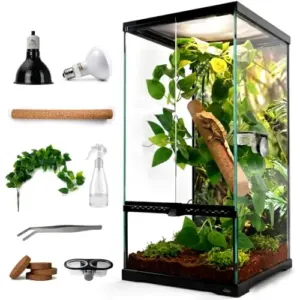
Need something compact that still feels sturdy? This vertical glass tank is pre-assembled, so you can set it up the same day it arrives. It measures 12 x 12 x 24 inches and weighs 24 pounds.
Double front doors with an escape-proof lock keep curious hands (and one sneaky python) in check. The sealed waterproof base controls spills, and the raised base leaves room for under-tank heating.
Heads up: no UVB bulb is included, and 15 gallons is too small for an adult ball python. It’s indoor-only, too.
| Best For | Keepers of small arboreal reptiles and amphibians, like geckos and chameleons, who want a sturdy, ready-to-use indoor enclosure with no assembly. |
|---|---|
| Dimensions | 12 x 12 x 24 inches |
| Material | Tempered glass |
| Assembly | Pre-assembled |
| Ventilation | Metal top screen |
| Security | Escape-proof double doors |
| Heating/Lighting | 75W daylight lamp, dome fixture |
| Additional Features |
|
- Arrives pre-assembled, so you can set it up the same day
- Double front doors with an escape-proof lock make access easy and keep your pet secure
- Sealed waterproof base contains spills, and the raised base leaves room for under-tank heating
- No UVB bulb is included, even though the screen top allows UVB penetration
- Indoor use only
- At 15 gallons, it may become too small for larger arboreal species over time
5. MCLANZOO 10 Gallon Reptile Tank Kit
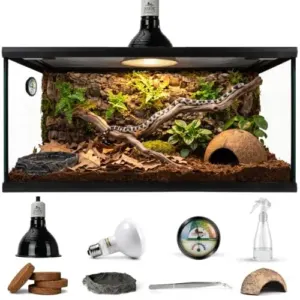
A 10-gallon tank is a smart pick if your classroom needs something compact and ready to go. It’s pre-assembled, so you can set it up right out of the box. The tempered glass gives students a 360° view through five sides, and the sealed base keeps leaks off your shelf.
Here’s the catch: 10 gallons won’t house an adult ball python (or a large snake of any kind). Think hatchling or juvenile only, and plan an upgrade.
The metal mesh lid locks, but add extra sealing if humidity runs high.
| Best For | Classrooms, beginners, and small-space keepers who want a compact, ready-to-use tank for a hatchling or juvenile reptile, amphibian, or insect. |
|---|---|
| Dimensions | 20 x 12 x 10 inches |
| Material | Tempered glass, black finish |
| Assembly | Pre-assembled |
| Ventilation | Metal mesh lid |
| Security | Escape-proof locking lid |
| Heating/Lighting | 75W daylight lamp, dome fixture |
| Additional Features |
|
- Comes pre-assembled, so it’s ready to use right out of the box.
- Tempered glass on five sides gives a clear 360° view of the animal.
- The waterproof sealed base helps keep leaks off your shelf.
- At 10 gallons, it’s too small for adult bearded dragons, ball pythons, or other large snakes.
- The metal mesh lid may need extra sealing for species that need high humidity.
- It’s designed for indoor use only.
Classroom Kit Sizing and Lifetime Costs
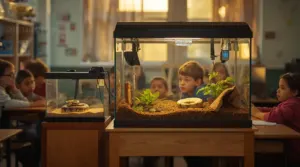
A smart classroom purchase starts with the snake’s adult size, not today’s cute hatchling. Babies under 300g do fine in a 10 gallon, but adults need at least 4’x2’x2′. Buy small now and you’ll buy twice. (Your budget will notice.)
Price tags only tell part of the story. Glass runs $50-100 for 40 gallons but lasts 3-5 years in classrooms. PVC and composite enclosures hold heat better and last 5-10 years, so your heating bill stays lower.
Budget for the extras too. A thermostat costs $25-50 and is non-negotiable. Heat mats last 3-5 years, ceramic emitters 2-3. Loose substrate needs swapping every 1-2 months at $10-15 a pop. Factor in humidity and temperature monitoring, and you’ve got a lifetime number. Whatever enclosure you choose, it should be large enough to create a proper thermoregulatory gradient so the snake can move between warm and cool zones.
Ball Python Terrarium Setup and Environmental Controls
Your classroom snake needs a home that’s safe, steady, and easy for students to care for. Below, you’ll find the two big pieces of that setup: a planted bioactive habitat and the temperature and humidity gradients your ball python relies on.
Get these right, and you’ll spend less time troubleshooting and more time teaching.
Building a Planted Bioactive Habitat
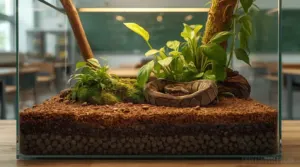
Think of your classroom terrarium as a tiny habitat, not just a cage. Start with 2-3 inches of clay balls for drainage, then add 6-8 inches of coir-and-mulch substrate.
Toss in springtails first, then isopods a few days later. Top it with leaf litter.
Plant pothos or snake plants and give them two weeks to settle before your snake moves in.
Establishing Safe Temperature and Humidity Gradients
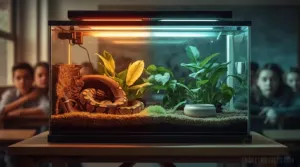
Picture a Monday morning: your ball python’s warm hide reads 98°F on the new gauge, and a few students are already worried.
Don’t panic (the snake’s fine, the setup isn’t).
Aim for 88-92°F on the warm side, 74-80°F on the cool side, and 50-60% humidity. Use a thermostat, and check both ends one inch above the substrate.
Classroom Terrarium Security and Student Safety
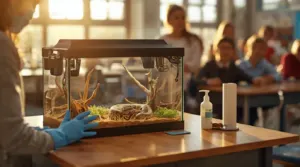
A snake that gets out of a classroom is a lesson nobody wants to teach. Luckily, a few smart habits keep your ball python secure and your students safe.
Keeping a classroom snake safely contained takes a few simple habits, because an escaped python is no one’s favorite teachable moment
Start with the enclosure itself. Front-opening designs are harder to escape and less startling for the snake than screen tops. Any ventilation gaps need stainless steel mesh with 1 to 2 millimeter openings, so even a juvenile can’t squeeze through.
Here’s your safety checklist:
- Collect signed parental consent forms before any handling.
- Have students wear gloves and long sleeves, with one student handling at a time for 2 to 5 minutes.
- Stop immediately if the snake hisses or coils defensively.
- Wash hands with soap or sanitizer after every contact (salmonella is no joke).
- Inspect latches and seals monthly.
Keep paper towel rolls handy for gentle redirection, too.
Classroom Terrarium Maintenance and Holiday Care
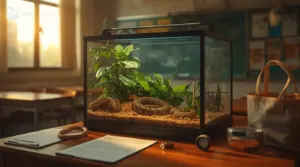
Weekends and holidays don’t have to spell trouble for your snake. (She won’t miss the bell schedule.) A little automation does the heavy lifting.
| Frequency | Task | Why it matters |
|---|---|---|
| Daily | Spot clean, check water | Prevents mold |
| Weekly | Check gradients, disinfect bowl | Keeps readings honest |
| Monthly | Replace substrate, calibrate thermostat | Fresh start |
| Before breaks | Fill bowl, test timers | Safe absence |
Put a thermostat on every heat source, then confirm readings on a temperature and humidity digital gauge. Use biobedding tropical mix at four inches deep, and springtails and isopods will tidy waste between your visits. Ball pythons handle 7 to 10 days without food, so skip feeding before you leave. Finally, fill the bowl, check the hides, and test each timer.
Frequently Asked Questions (FAQs)
Are ball pythons legal to keep in schools?
Relax, you don’t need a team of lawyers! Ball pythons are mostly legal, but Hawaii and New York City ban them. Illinois allows secure, supervised programs.
Check city or county ordinances first (animal control knows).
How often should classroom ball pythons be fed?
Feed hatchlings every 5 days and juveniles about once a week. Sub-adults eat every 10 to 14 days, and adults every 2 to 3 weeks. Weigh your snake regularly, then adjust the feeding schedule to match its body condition.
Can ball pythons live together in one enclosure?
Short answer: no. Ball pythons are loners, and sharing a tank means constant stress, feeding fights, and a higher chance of illness. Give each snake its own home, especially in a classroom.
What should students know about shedding and skin care?
Think of shedding as your snake’s wardrobe change. Eyes turn milky blue and skin looks dull, so skip handling. Keep humidity near 70%, offer a moist hide, and wash your hands afterward. Stuck shed? Use a warm humidity chamber.
Conclusion
Picture Ms. Alvarez on a Monday morning in January, finding her tank at 80 degrees and her python calmly coiled, because a thermostat and a locked door did their jobs over the break.
That’s the goal. When you shop for ball python terrarium kits for classroom use, pick security and stable heat first, then size, then looks. A snake that thrives teaches students patience, responsibility, and respect. Set it up right once, and lessons follow.