This site is supported by our readers. We may earn a commission, at no cost to you, if you purchase through links.

A ball python’s strength can shift a loose branch, and its nightly roaming can turn a rattling lid into a 2 a.m. alarm. Bedroom setups raise the stakes.
You sleep six feet from the enclosure, so heat, noise, and security matter more than decor. Solid-sided PVC dampens sound and holds a steady 88–92°F warm side, while glass leaks both heat and humidity. Most kits skip the enclosure or the heating gear entirely.
The best ball python terrarium kits for bedroom setups fix those gaps without wasting money. Here’s how four popular options compare, and what each still needs.
Table Of Contents
Key Takeaways
- Pick a solid-sided PVC enclosure of at least 36x18x18 inches (4x2x2 feet is better for adults), since it dampens noise and holds heat and humidity far better than glass or screen tops.
- None of these kits arrives complete: Josh’s Frogs is plants only, Kupor is decor only, Sanosy is too small for a ball python, and only the REPTI ZOO gives you a properly sized enclosure.
- Run every heat source through a thermostat with the probe in the warm hide, and aim for 88–92°F on the warm side, 76–80°F on the cool side, and 50–70% humidity.
- Budget $100 or more beyond the enclosure for a thermostat, heat emitter, UVB and substrate, and add snug hides plus a secure lock before your snake moves in.
Choosing Ball Python Enclosures for Bedroom Spaces
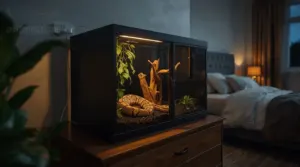
You’ll want an enclosure that controls a bedroom’s quirks: noise, light, and limited floor space. Start with the material. Solid-sided PVC or wood dampens sound better than glass and holds heat steadily, which matters in a small room.
Since mesh sections affect both airflow and escape risk, this guide to recommended snake enclosure materials can help you balance sealed panels with ventilation in a small bedroom.
Size next. Aim for at least 4x2x2 feet for an adult, since ball pythons use floor length and width, not height. Leave 2 to 3 inches of clearance behind the unit for cables and probes. As a general rule, the minimum enclosure size should be at least as long as the snake’s body, so a 5-foot ball python needs a 5-foot-long enclosure.
Choose a front-opening enclosure so you can reach in without looming over the snake, and so you’re not dragging a lid across a nightstand. Skip screen lids, since screen top humidity loss makes 55 to 65 percent humidity hard to maintain.
Use a stable, level surface.
4 Ball Python Terrarium Kits Compared
These four kits cover the main ways to house a ball python in a bedroom. Each one gets judged on size, heat control, and humidity retention, since those decide whether your snake thrives. Check every pick against the 4’x2’x2′ adult target before you buy.
1. Joshs Frogs Ball Python Terrarium Kit
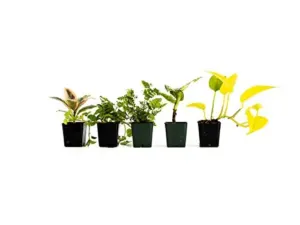
A plant-only kit from Josh’s Frogs gives you live greenery for a naturalistic setup, but it isn’t a complete terrarium. The enclosure isn’t included, so pair it with a 36x18x18 inch tank, which matches the kit’s listed dimensions.
You’ll get terrestrial ferns and foliage plants like Pothos and Sansevieria, chosen for ball python habitats. They support humidity and enrichment. Exact varieties vary.
The live arrival guarantee only applies when transit temperatures stay between 32°F and 85°F. Order accordingly.
| Best For | Ball python owners who already have a 36x18x18 inch enclosure and want to fill it with live, naturalistic plants. |
|---|---|
| Dimensions | 36x18x18 inches |
| Material | Live plants |
| Suitable Species | Ball pythons |
| Enclosure Included | No |
| Humidity Support | Supports humidity |
| Main Drawback | Plant varieties vary |
| Additional Features |
|
- Includes terrestrial ferns and foliage plants like Pothos and Sansevieria, chosen for ball python habitats
- Supports humidity and adds enrichment to the enclosure
- Easy to care for in captive reptile setups
- Enclosure not included, since the kit contains plants only
- Exact plant varieties vary and are not guaranteed
- Live arrival guarantee is void if transit temperatures fall outside 32°F to 85°F
2. REPTI ZOO 36x18x18 PVC Reptile Enclosure
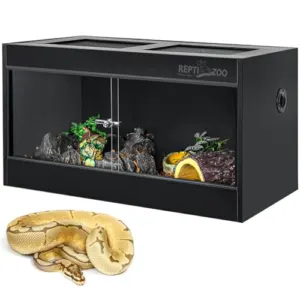
Unlike the plant-only kit, this one gives you the actual enclosure. It’s a black PVC enclosure measuring 36 x 18 x 18 inches, which is the minimum size for an adult ball python.
If you’d like a closer look at the build and sizing, this PVC snake enclosure for ball pythons shows how the 36 x 18 x 18 inch layout works in practice.
PVC insulates better than glass or wood, so it holds heat and moisture well. The removable tempered glass sliding door has a safety lock, and the detachable mesh top controls airflow. Cleanup is easy.
Check reviews before you buy. Some owners report leakage, and the lock can loosen over time. Test it before trusting it at night.
| Best For | Reptile keepers who need a ready-made 36 x 18 x 18 inch enclosure for an adult ball python or a similar-sized reptile and want solid heat and moisture retention. |
|---|---|
| Dimensions | 36 x 18 x 18 inches |
| Material | PVC |
| Suitable Species | Ball pythons, lizards, tarantulas |
| Enclosure Included | Yes |
| Humidity Support | Moisture resistant |
| Main Drawback | Leakage reports |
| Additional Features |
|
- PVC insulates better than glass or wood, so it holds heat and humidity well.
- The removable tempered glass sliding door has a safety lock, and the detachable mesh top lets in airflow and UVB/IR light.
- It is easy to clean and maintain.
- Some customers report leakage from the enclosure.
- The security lock may loosen over time.
- Build quality and value for money get mixed feedback.
3. Kupor 12-Piece Reptile Terrarium Kit
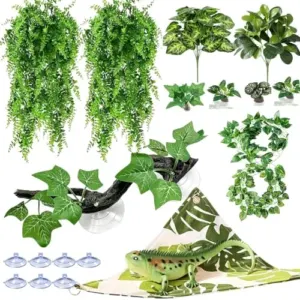
This kit is decor only, so you’ll still need a tank. It fits 10, 20, and 40-gallon glass or acrylic terrariums, which covers a 40-gallon breeder for an adult ball python.
If space is tight, this ball python setup for a small apartment shows how to fit proper heating zones and hiding spots into a 40-gallon tank.
You get a triangle rope hammock, hanging plants, a main trunk, bendable vines, and ground silk plants. That builds three layers: basking overhead, climbing in the middle, and foraging cover at the base. Seven suction cups hold it all, but they may slip on textured glass, so test them.
| Best For | Owners of terrestrial or semi-arboreal reptiles, like ball pythons, who already have a 10, 20, or 40-gallon glass or acrylic tank and want to add climbing, basking, and hiding layers. |
|---|---|
| Dimensions | N/A |
| Material | Plastic |
| Suitable Species | Terrestrial and semi-arboreal reptiles |
| Enclosure Included | No |
| Humidity Support | N/A |
| Main Drawback | Suction cup variability |
| Additional Features |
|
- Builds three habitat layers with a rope hammock and hanging plants up top, a trunk and bendable vines in the middle, and silk plants at the base
- Fits 10, 20, and 40-gallon glass and acrylic tanks, and comes with 7 high-strength suction cups for mounting
- Made with washable, color-stable plastic parts, and the hammock gives reptiles a scratch-free resting spot
- Decor only, so you still need to buy the tank separately
- Suction cups may slip on textured or non-smooth glass, so test them before relying on them
- Not suited to fully aquatic species, and it needs regular cleaning to stay hygienic and keep the suction cups gripping
4. Sanosy Reptile Terrarium Starter Kit
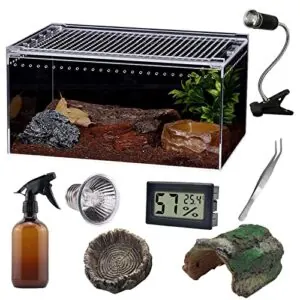
The Sanosy kit is an 8-piece polycarbonate set, and it’s too small for a ball python. At 11.8 x 7.9 x 5.9 inches, it sits far below the 36" x 18" x 18" minimum for adults. You can’t build a proper thermal gradient (88–92°F warm, 78–80°F cool) in that footprint.
Durability concerns follow: some units fall apart, and bulbs burn out within weeks. The lock helps, but it doesn’t fix the size. Skip it; buy a 40-gallon or larger enclosure.
| Best For | People who want an inexpensive all-in-one starter set for a small reptile, amphibian, or invertebrate such as a gecko, frog, or spider, or for a temporary habitat for a backyard-found invertebrate. |
|---|---|
| Dimensions | 11.8 x 7.9 x 5.9 inches |
| Material | Tempered polycarbonate |
| Suitable Species | Geckos, snakes, frogs, spiders |
| Enclosure Included | Yes |
| Humidity Support | Water-resistant |
| Main Drawback | Durability concerns |
| Additional Features |
|
- Includes eight pieces (tweezers, thermometer/hygrometer, hideaway cave, lamp, spray bottle, water bowl, and more), so you can set up right away.
- Made of tempered polycarbonate with a waterproof design, and works for both desert and rainforest setups.
- Has an anti-escape door lock and a top feeding cover to keep pets secure.
- At 11.8 x 7.9 x 5.9 inches, it is too small for a ball python and may feel cramped for other species.
- Some customers report it falls apart over time.
- Bulbs reportedly burn out within weeks in some cases.
Bedroom Terrarium Heating, Humidity, and Lighting
Even the best kit won’t keep a ball python alive without the right climate, so you need to get the setup inside the enclosure right.
Below, you’ll find three points that cover thermostat-controlled heating, humidity in glass versus PVC, and your lighting schedule.
Work through them in order, because each one affects the next.
Thermostat-Controlled Heating and Thermal Gradients
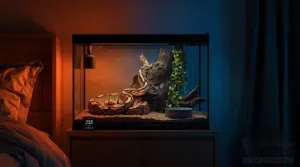
Your thermostat is the most important piece of safety gear in the enclosure. Run every heat source through one, and place the probe inside the warm hide, on top of the substrate, not on the mat.
Aim for a warm side of 88–92°F and a cool side of 76–80°F. Mount a ceramic heat emitter over one third of the floor, never the center.
Humidity Management in Glass Versus PVC
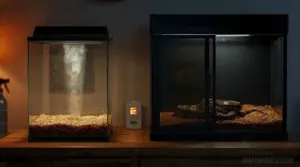
Glass looks easy, but it leaks moisture. PVC looks plain, but it holds it.
Plain PVC quietly keeps its humidity, while glass, however appealing, lets moisture slip away
In a glass vs PVC enclosure comparison, screen top humidity loss decides the winner. Rising warm air pulls dry room air through the mesh, so you’ll mist two or three times daily. PVC needs misting once or twice weekly.
Use a humidity-holding substrate like coconut husk in either one, and aim for 50-70%.
Daytime UVB and Darkness at Night
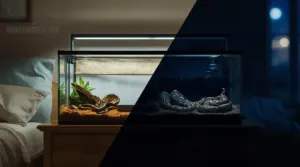
Ball pythons don’t need UVB to survive, but they do better with it. Skip it and your snake lives. Add it and you get vitamin D3 synthesis, more activity, and better overall behavior.
Use a low-intensity T5 HO tube, mounted 10 to 14 inches above the mesh. Run 12 hours on, 12 off. Keep everything dark at night, including heat.
Furnishing and Securing Your Ball Python Terrarium
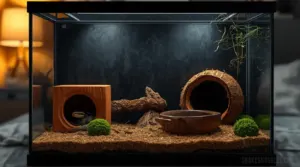
A bare enclosure is a stressful one. Your ball python needs places to hide, climb, and soak before it needs anything else.
Put at least two snug hide boxes inside, one on the warm side and one on the cool side. Pick hides just big enough for your snake to curl up in, since roomy ones cause stress. Pack moist sphagnum moss into one to create a humidity chamber for shedding.
Add climbing branches or cork rounds at different heights, and anchor everything firmly. Ball pythons are strong and can shift loose décor, which risks injury.
Use a heavy ceramic water bowl big enough for soaking, and set it on the cool side. Fill the floor with coconut husk or cypress mulch, never pine, cedar, or sand.
On glass tanks, cover three sides with opaque material.
Ball Python Terrarium Kit Costs and Extras
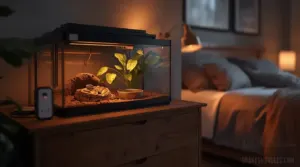
The sticker price rarely tells the whole story. Josh’s Frogs charges $321.91 for a complete ball python starter kit, while the REPTI ZOO 36x18x18 PVC enclosure runs $160 to $180 before extras. Generic 12-piece kits land between $20 and $130.
Build your terrarium budget around what a bare enclosure leaves out. Add these essentials:
- A thermostat, $12 to $40 for on/off models, is non-negotiable for safety.
- Ceramic heat emitters for night heat cost $20 to $36.
- UVB kits with a T5HO bulb cost $67 to $97.
Pair a thermostat-controlled overhead heat source with a humidity-holding substrate at $10 to $20 per bag. In any enclosure cost comparison, expect extras to add $100 or more. Buy the cheaper enclosure, fund safety.
Frequently Asked Questions (FAQs)
Can ball pythons live with other snakes?
No, house your ball python alone. They’re solitary in the wild, and sharing a terrarium risks stress, dominance, and feeding accidents. Keep males apart, feed separately, and give each snake its own enclosure.
How do I handle my ball python safely?
Approach from the side, then scoop with two hands: one behind the head, one under the midsection. Never grab the tail. Skip handling for 24-28 hours after feeding, during shedding, and the first few days at home.
What should I do if my snake refuses food?
Don’t let a fasting snake tie you in knots. Check your enclosure setup first: 88–95°F basking, 75–80°F cool side, 50–80% humidity.
Skip handling for 24 hours around meals. Weeks of refusal mean a vet visit.
How often should a ball python eat?
Feed hatchlings every 5 days and juveniles weekly. Sub-adults eat every 10-14 days, and adults over 500g every 2-3 weeks.
Weigh your snake monthly, and don’t panic over skipped meals if its weight holds steady.
How long do ball pythons live in captivity?
Plan on 20 to 30 years with solid care. Some ball pythons pass 30, and the oldest documented one reached 63 at the Saint Louis Zoo. In the wild, they live just 10 to
Conclusion
Solid sides, steady heat, and secure latches make a bedroom setup work. Pick the PVC enclosure if sleep matters, because it dampens noise and holds humidity better than glass.
Among the ball python terrarium kits for bedroom setups, none arrive complete. Budget for a thermostat, a lock, and a proper hide before your snake moves in.
Get those three items right and the 2 a.m. rattling stops. You’ll sleep soundly, and your python will thrive.