This site is supported by our readers. We may earn a commission, at no cost to you, if you purchase through links.

Most new ball python owners spend hours researching heating, substrate, and hides. The water bowl? It’s usually an afterthought. That’s a problem, because proper hydration directly affects whether your snake sheds cleanly, digests well, and stays healthy long-term.
Ball pythons drink more than you’d expect, and they soak when they’re about to shed or feeling stressed. A bowl that tips, scratches easily, or sits too high at the rim creates real barriers to both.
Picking the right terrarium water bowls for ball pythons takes more thought than it looks, and getting it right makes a noticeable difference from day one.
Table Of Contents
- Key Takeaways
- 6 Best Terrarium Water Bowls for Ball Pythons
- Choosing The Best Ball Python Bowl
- Ball Python Water Bowl Size Guide
- Comparing Water Bowl Materials
- Water Bowl Placement and Care
- Frequently Asked Questions (FAQs)
- What type of water bowl is best for a ball python?
- Do ball pythons need a large water bowl?
- What do ball pythons like in their terrarium?
- What is the best type of water for ball pythons?
- Can ball pythons drink too much water?
- How do I prevent mold around the bowl?
- Should hatchlings have constant water access?
- Do bowl colors affect python stress levels?
- Can shared water bowls spread disease between snakes?
- Conclusion
Key Takeaways
- Choose a heavy, wide-based bowl with a smooth, non-porous interior and low, easy-entry sides so your ball python can drink safely and soak when needed.
- Match the bowl to your snake’s size, giving adults enough room to coil or soak without using a dish that crowds the enclosure or tips easily.
- Place the bowl on the enclosure’s cool side, keep the path clear, and use clean dechlorinated water to support hydration and stable humidity.
- Replace water daily or every two to three days, scrub the bowl weekly, and replace scratched, cracked, chipped, or porous dishes that can trap bacteria.
6 Best Terrarium Water Bowls for Ball Pythons
A good water bowl gives your ball python reliable access to clean water and room to soak when needed. The best choice fits your snake’s size, stays stable, and is easy for you to clean. Here are six enclosure-friendly options.
For tips on sizing and placement, setting up a bioactive ball python enclosure walks you through how a well-chosen water bowl supports both hydration and humidity.
1. Zoo Med Reptile Rock Water Dish
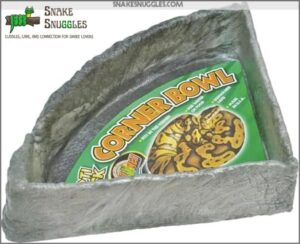
Although its rock-like finish looks natural, this bowl’s smooth, non-porous surface is the real advantage. It resists stains and bacteria better than rough, porous décor.
Molded stairs help smaller ball pythons enter and leave safely. Choose a size large enough for drinking and occasional soaking without crowding the enclosure.
Wash it with warm water and mild soap, then rinse and air-dry fully. Avoid harsh cleaners, which can damage the foam-based material. Color can vary, so expect slight differences from listing photos.
| Best For | Large reptile keepers who need a durable corner water dish for soaking, humidity support, or use as a substrate-filled dig box. |
|---|---|
| Material | Plastic |
| Dimensions | 13.8 x 13.2 x 3.2 in |
| Interior Surface | Smooth plastic |
| Species Suitability | Ball pythons, bearded dragons, turtles |
| Primary Use | Soaking and humidity regulation |
| Tip Resistance | Corner-fitting stability |
| Additional Features |
|
- Corner-fitting shape helps maximize usable terrarium space.
- Large 1-gallon capacity accommodates ball pythons, bearded dragons, and land turtles.
- Dishwasher-safe plastic construction is easy to clean and resistant to cracking.
- Deep sides can be difficult for smaller reptiles to access safely.
- Its large footprint may take up too much room in terrariums under 40 gallons.
- Assorted colors may differ from the product photos.
2. Exo Terra X-Large Reptile Water Bowl
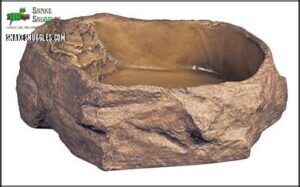
For adult ball pythons, this wide, low bowl gives drinking room and can support soaking. Its 9.7 by 10 by 2.5-inch footprint suits spacious enclosures, not compact setups.
The stone-textured food-grade resin exterior blends into habitats while the smooth interior wipes clean without grime. Built-in safety steps help smaller animals climb out, and the one-pound base stays put when a heavy snake leans against it. Check measurements before ordering, since dimensions can vary.
| Best For | Adult ball python owners and other keepers with spacious terrariums who need a stable, easy-clean bowl for drinking and occasional soaking. |
|---|---|
| Material | Stone-textured food-grade resin |
| Dimensions | 9.7 x 10 x 2.5 in |
| Interior Surface | Smooth non-pitted |
| Species Suitability | Tortoises, boas, snakes, frogs |
| Primary Use | Soaking and drinking |
| Tip Resistance | Heavy weighted base |
| Additional Features |
|
- Wide, low design provides ample drinking and soaking space for larger reptiles.
- Heavy, stable resin base helps prevent tipping and spills.
- Smooth, non-porous interior is easy to wipe clean, while safety steps help smaller animals exit.
- Large footprint is unsuitable for compact enclosures.
- One-pound weight can make frequent removal and cleaning less convenient.
- Actual dimensions may vary, so measure the enclosure before ordering.
3. Ceramic Reptile Food Water Dish
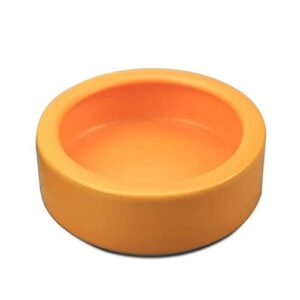
If the resin bowl feels oversized, this compact ceramic dish offers steady, tip-resistant weight for a small enclosure. At 2.75 inches wide and 0.85 inches tall, it works better as a feeding dish or extra water point than a primary bowl for a ball python.
Its smooth white, nonporous surface cleans easily and makes insects easy to spot. The inward-curved walls also contain mealworms and small roaches.
Use it for hatchlings only with close size checks. Adult ball pythons need a wider, deeper bowl for drinking and soaking.
| Best For | Small reptile and amphibian owners who need a compact, easy-clean feeder for mealworms, small roaches, or other small insects. |
|---|---|
| Material | High-density ceramic |
| Dimensions | 2.75 x 2.75 x 0.85 in |
| Interior Surface | Smooth ceramic |
| Species Suitability | Small lizards, geckos, small mammals |
| Primary Use | Insect feeder dish |
| Tip Resistance | Low-profile stable design |
| Additional Features |
|
- Smooth, bright white ceramic makes insects easy to see and the dish easy to clean.
- Inward-curved walls help keep mealworms and small insects contained.
- Dense ceramic construction is stable, durable, and resistant to tipping.
- Too small to serve as a primary water or soaking bowl for adult ball pythons and larger reptiles.
- Superworms and other climbing insects may still escape.
- Some buyers report bowls arriving damaged because of inadequate packaging.
4. OMEM Reptile Drinking Tray Large
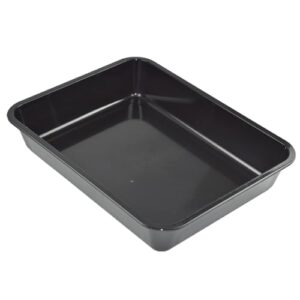
After a compact ceramic dish, this tray gives a ball python room to drink water. Its 12 5/8-inch by 6 1/2-inch footprint suits 20- to 40-gallon enclosures.
A well-sized dish like this can also aid in shedding and humidity regulation — habits worth understanding alongside what your ball python’s behavior reveals about its health.
The low-profile resin tray has smooth nonporous walls, rounded edges, and a rubber pad to limit shifting securely on substrate. Its half-inch water depth is easy to access, but it is too shallow for an adult soak. Hand-wash weekly despite claims, since high heat can warp bowls.
| Best For | Reptile owners who need a large, easy-clean water dish or shallow lounging tray for turtles, snakes, lizards, or ball pythons in medium-sized enclosures. |
|---|---|
| Material | Polyethylene (PE) |
| Dimensions | 35.4 x 5.3 x 26.3 cm |
| Interior Surface | Smooth, crevice-free |
| Species Suitability | Turtles, ball pythons, lizards, snakes |
| Primary Use | Drinking, bathing, and decor |
| Tip Resistance | Lightweight, tip-prone |
| Additional Features |
|
- Large open surface gives reptiles room to drink, bathe, or rest.
- Smooth, rounded polyethylene construction is sturdy, pet-safe, and easy to clean.
- Versatile design can serve as a water dish, food bowl, bathing pool, or terrarium decor.
- Lightweight tray may shift, tip, or spill when filled with water.
- Shallow profile may not provide enough depth for adult reptiles to soak fully.
- Can warp or melt when exposed to high heat, so it should not be dishwasher-cleaned.
5. 7. Exo Terra Reptile Water Dish
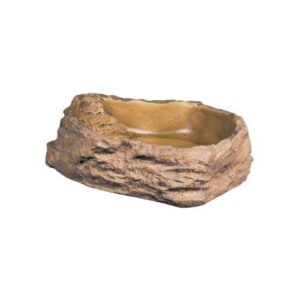
For a secure, natural-looking bowl, the Exo Terra Water Dish is a dependable choice. Its rock-textured exterior blends into desert, tropical, and bioactive setups, while the smooth non-porous interior wipes clean easily and limits residue.
At 8.7 by 6.7 inches and 2 inches deep, it suits many juveniles and smaller sub-adults. The weighted base resists tipping, and built-in steps help animals enter safely. Check the depth for your snake before buying, since larger adults may need more soaking room.
| Best For | Reptile and amphibian keepers who want a stable, natural-looking water dish for juveniles or smaller sub-adults in desert, tropical, or bioactive terrariums. |
|---|---|
| Material | Food-grade plastic resin |
| Dimensions | 8.7 x 6.7 x 2 in |
| Interior Surface | Smooth non-porous |
| Species Suitability | Reptiles and amphibians |
| Primary Use | Hydration and soaking |
| Tip Resistance | Stable weighted base |
| Additional Features |
|
- Smooth, non-porous interior is easy to wipe clean and helps limit residue buildup.
- Weighted base resists tipping, while built-in safety steps support easier entry and exit.
- Rock-textured exterior blends naturally into a range of terrarium styles.
- The 2-inch depth may not provide enough soaking space for larger adult reptiles.
- Textured exterior can take more effort to clean than a fully smooth dish.
- Very small species may still have difficulty navigating the entry or exit depth.
6. REPTI ZOO Magnetic Reptile Feeding Ledge
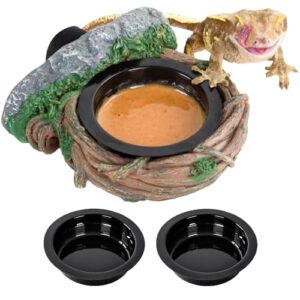
While this magnetic feeding ledge looks attractive in a planted terrarium, it is not a primary water bowl for a ball python. Its four 2.4-inch PVC cups are too small for drinking comfort or soaking.
Use it for occasional feeding or as a small secondary water source only. The resin base mounts securely to glass and holds up to 500 grams, but an adult snake can dislodge it. Keep a heavy, floor-level bowl on the cool side for daily hydration.
| Best For | Small to medium arboreal reptiles and amphibians that benefit from an elevated feeding station in a naturalistic glass terrarium. |
|---|---|
| Material | Resin with PVC cups |
| Dimensions | 1 x 1 x 1 in (nominal) |
| Interior Surface | Smooth PVC cups |
| Species Suitability | Geckos, chameleons, tree frogs |
| Primary Use | Elevated feeding and watering |
| Tip Resistance | Magnetic glass attachment |
| Additional Features |
|
- Strong magnetic mounting with anti-slip pads makes installation and removal easy.
- Four removable 2.4-inch cups are convenient for feeding, treats, or small supplemental water portions.
- Natural-looking hollow vine resin design blends well with planted and bioactive enclosures.
- Cups are too small to serve as a ball python’s primary drinking or soaking bowl.
- Not suitable for large, heavy-bodied, or especially active reptiles that may dislodge the ledge.
- PVC cups and resin construction may feel less durable than ceramic or metal alternatives.
Choosing The Best Ball Python Bowl
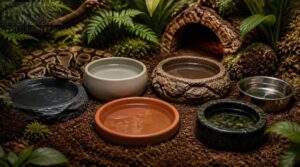
A good water bowl should stay put, feel safe against your snake’s skin, and be simple to keep clean.
Size matters, but material, rim shape, weight, and long-term durability also affect daily care.
Use the options below to find a bowl that fits your ball python and enclosure.
Stability and Tip Resistance
A spilled bowl can quickly soak substrate. Choose a wide, low-profile base with a flattened or oval shape, which resists tipping when your ball python climbs in or shifts its weight.
Look for thick, rounded rims and a recessed lip to limit wobble and spillover. A heavy reptile water bowl, ideally with a textured or rubberized bottom, improves water bowl stability on smooth enclosure floors. Avoid footholds that invite rim climbing. Regular observation helps a data-centered care approach when checking spills or bowl placement.
Safe Non-porous Materials
Choose a reptile water bowl with a nonporous interior so water, waste, and odors can’t soak into the material. Foodgrade resin, glazed ceramic, glass, stainless steel, and food-grade silicone all support cleaner reptile hydration.
Glass bowl benefits include easy stain checks. Ceramic glaze safety matters because sealed glaze blocks bacteria. Stainless steel durability suits repeated scrubbing. Choose chemical resistant reptile gear that washes clean.
Easy-access Bowl Edges
Easy-access edges let your ball python drink without awkward neck stretching. For any water bowl size, look for:
- even 1.5–2.5 cm rims
- wide mouths
- rounded, beveled interiors
- matte, nonporous textures
- raised spill lips
These details support filtered or dechlorinated water, enclosure humidity control, and easy clean reptile gear. Flush-fit dual-purpose edges also limit splashes and substrate intrusion during use.
Cleaning and Handling
A clean bowl protects your snake just as much as the right water bowl size does. Before refilling, wear disposable gloves and transfer water with a clean container.
Set the bowl on a flat surface, then wipe the exterior and check for cracks each time.
A weekly deep clean with diluted white vinegar (1:10) keeps your reptile water quality safe.
Price and Durability
Good cleaning habits matter, but the bowl still needs to hold up over time.
Plastic bowls run $5–$8 but may need replacing within a year. Spending more upfront saves money:
- Resin rock-texture ($12–$20) resists cracking and tipping
- Ceramic ($10–$25) lasts years with minimal wear
- Specialty reptile bowls ($15–$28) add anti-slip bases
Warranty coverage extends useful life further.
Ball Python Water Bowl Size Guide
Getting the bowl size right is one of the simplest ways to keep your ball python healthy and comfortable. As your snake grows, its water needs change — and so does the bowl it belongs in. Here’s a breakdown of what works at every stage.
As your ball python grows, so must its bowl — the right size at every stage is the simplest investment in its health
Hatchling Bowl Dimensions
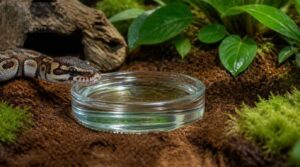
Hatchlings need surprisingly compact bowls.
| Measurement | Size | Purpose |
|---|---|---|
| Opening size | 1.0–1.5 in | Easy snout access |
| Bowl height | 0.5–0.75 in | Prevents overflow |
| Rim width | Under 0.25 in | No snag risk |
Your ball python water bowl needs only 2 oz water capacity. A clear bowl makes daily checks easy. The external footprint stays under 2.5 inches, not the 10-12 inch adult size.
Juvenile Bowl Dimensions
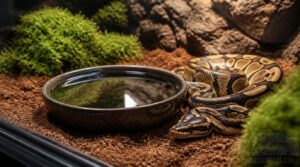
Once your ball python outgrows the hatchling bowl, size up soon.
A juvenile ball python water bowl needs a basin diameter of 25 to 40mm, with wall height capped at 25mm. The rim width stays slim at 6 to 12mm. A deepened base slows evaporation inside your reptile enclosure.
Skip the 10-12 inch wide, 2-4 inch depth bowls for now.
Sub-adult Bowl Dimensions
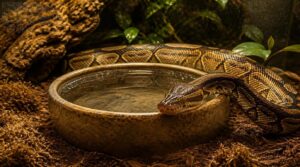
Once your snake crosses the 1.5-foot mark, it’s solidly in sub-adult territory.
These snakes need a ball python water bowl around 9 to 10 inches wide, with a depth of 2 to 3.5 centimeters for comfortable soaking. A stable, wide base reduces tipping risk. Non-porous materials like resin or ceramic make weekly cleaning easier and keep bacteria from settling in.
Adult Bowl Dimensions
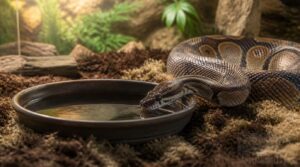
At this size, your ball python deserves a bowl that truly fits. Aim for an ideal bowl diameter of 4.5 to 6 inches, with a water depth capacity of 1.5 to 2.5 inches. A rim height under 0.75 inches gives easy head entry clearance. Keep exterior height between 1.75 and 2.5 inches so the bowl sits flush in your enclosure.
Soaking Space Requirements
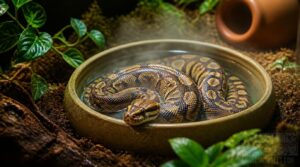
Every soaking bowl needs at least 6 inches of width so your ball python can stretch without touching the walls. A square or oval shape helps alignment.
Water depth varies by age: 1 to 2 inches for hatchlings, up to 4 to 6 for adults. Keep soaking water between 78 and 85°F, and use a non-slip base to prevent movement.
Comparing Water Bowl Materials
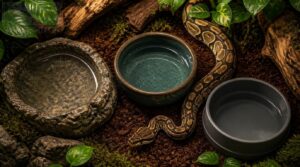
The bowl material you choose matters more than most keepers expect. Each option — resin, ceramic, and plastic — comes with its own trade-offs around safety, durability, and ease of cleaning. Here’s what you need to know before picking one for your ball python’s enclosure.
Resin Rock-texture Bowls
Resin rock-texture bowls look like they belong in a reptile habitat, not a pet store. Four key benefits:
- Non-porous surface blocks bacterial buildup
- Embedded color blends in gray and sandstone mimic real stone
- Grip and handling stay secure when wet
- Realistic rock finish suits any reptile decor
Your ball python gets a cleaner, natural-looking reptile water bowl.
Ceramic Water Bowls
Ceramic bowls feel solid in hand, and that weight works in your favor. A food-safe, lead-free glaze keeps your ball python’s drinking water clean, while the non-porous surface resists bacteria. Smooth rims protect mouth tissue.
Clean with warm water and mild soap. Watch for chips daily. A cracked glaze exposes porous clay that traps microbes, so replace it promptly.
Plastic Water Bowls
Plastic bowls are the budget-friendly pick in reptile enclosure setup. BPA-free, food-contact rated varieties keep your ball python’s water safe for long-term use. They’re lightweight, so swapping them out during cleaning takes seconds.
UV stabilized plastic resists color fading under terrarium lighting. Wide rims allow easy lapping access, and stackable designs save space when storing extras.
Scratch and Bacteria Risks
That scratch on your plastic reptile bowl is more than cosmetic. Surface scratch harbors bacteria in grooves too small to see.
Watch for these bacteria growth crevices in your reptile enclosure:
- Plastic bowl surface scratches over time
- Porous material trapping residue and slime
- Biofilm formation risks along rough edges
- Microbial contamination sources inside deep grooves
- Worn textures harboring invisible debris
Material Safety Considerations
Bacteria risk doesn’t end with scratches. The material your snake drinks from matters just as much.
Look for food-grade materials, non-porous surfaces, and toxin-free finishes when choosing any bowl. These qualities stop chemicals from leaching into drinking water. Low-grade plastic and unglazed ceramic both fail this test. When unsure, ask your reptile vet to avoid common reptile enclosure setup mistakes.
Water Bowl Placement and Care
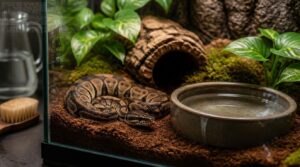
Where you place the water bowl and how often you clean it matter just as much as the bowl you choose. Getting these details right keeps your ball python healthy and your enclosure in good shape. Here’s what you need to know about placement, water quality, and upkeep.
Cool-side Bowl Placement
Place your reptile water bowl on the cool side of the enclosure. Cooler temperatures reduce evaporation, keeping water fresh longer and helping maintain a steady humidity gradient for shedding.
Ball pythons naturally seek this cooler area during the day, so cool side accessibility makes drinking feel instinctive. Keep the bowl free of decor that could block your snake’s path.
Choosing Safe Drinking Water
Once the bowl is placed correctly, what goes in it matters just as much.
- Use tap water conditioner to remove chlorine before filling.
- Choose bottled spring water if your tap has high minerals or PFAS.
- Offer water lukewarm to encourage drinking and safe soaking.
Sunken eyes or wrinkled skin signal dehydration in snakes. Clean water prevents both.
Water Replacement Schedule
Good water quality means nothing if it sits too long.
Change water every 2-3 days at minimum. If your enclosure stays above 80°F, switch to daily changes.
| Condition | Replacement Frequency |
|---|---|
| Below 80°F | Every 2-3 days |
| Above 80°F | Daily |
During shed, when humidity nears 90%, inspect the bowl daily for cloudiness or any odor. Replace it immediately if it smells off.
Weekly Deep Cleaning
Once a week, pull the water bowl out completely. Scrub it with a soft brush and hot soapy water, then rinse until no soap remains.
Soak it in mild disinfectant for 5 to 10 minutes to clear algae and mineral deposits. Dry it fully before returning it. If you spot deep scratches, replace the bowl every 6 to 12 months.
Humidity and Evaporation Effects
The water bowl has more influence on your enclosure than you might expect. Higher ambient humidity slows evaporation by narrowing the vapor pressure gradient, so your ball python’s water lasts longer between changes.
That’s helpful, but slower substrate drying around the reptile water bowl raises mold risk. If you notice condensation forming overnight, open the enclosure briefly to restore balance.
Frequently Asked Questions (FAQs)
What type of water bowl is best for a ball python?
The best option is a heavy, wide-based reptile dish made from non-toxic materials. A shallow rim design lets your snake drink and soak easily, while the weight keeps it stable when your python moves.
Do ball pythons need a large water bowl?
Yes, a large water bowl is ideal. Adults need room to soak fully, which aids shedding and hydration. A bowl allowing full coiling prevents splashing and helps healthy thermoregulation throughout each shed cycle.
What do ball pythons like in their terrarium?
Home is where the heat is for a ball python. They thrive with a temperature gradient, cozy hiding spots, humidity control near 55 percent, deep substrate for burrowing, and low climbing branches to explore safely.
What is the best type of water for ball pythons?
Fresh, clean water with a neutral pH (5-0) works best. Use dechlorinated tap water or bottled spring water. Avoid distilled water, as it strips the minerals your python needs for healthy hydration and digestion.
Can ball pythons drink too much water?
Like a rarely overflowing well, ball pythons self-regulate hydration.
Water intake signs, including persistent drinking behavior, may indicate dehydration, poor water quality, or overhydration risks. Check bowl size for shedding assistance and seek reptile health monitoring.
How do I prevent mold around the bowl?
Prevent mold by improving ventilation, wiping condensation daily, and replacing water every 24 hours. Raise the bowl on a silicone mat with a drip tray, dry spills promptly, and deep-clean weekly for bacterial prevention and reptile product durability.
Should hatchlings have constant water access?
Keep hydration on tap: hatchlings need constant water access. Offer daily dechlorinated water in a shallow reptile water bowl for bacterial prevention. Limit water volume for soaking, maintain humidity balance, and watch for dehydration signs.
Do bowl colors affect python stress levels?
Bowl colors rarely affect a ball python’s stress levels. Limited color perception makes contrast more useful than hue. Use a stable, cool reptile water bowl, maintain calm handling routines, and prioritize hides and proper temperatures.
Can shared water bowls spread disease between snakes?
Yes. Shared water bowls can spread disease transmission between snakes when biofilm traps germs. Give each ball python separate equipment, scrub every reptile water bowl, replace water frequently, and provide water volume and soaking space.
Conclusion
Don’t let hydration slip through the scales. A stable bowl with smooth edges and enough room to soak gives your ball python reliable access to clean water every day. Choose terrarium water bowls for ball pythons that match its current size, keep one on the cool side, and wash it before buildup becomes a health risk.
Fresh water helps with each shed, meal, and quiet resting day. Get this small detail right from the very start.