This site is supported by our readers. We may earn a commission, at no cost to you, if you purchase through links.

A filled 4x2x2 can top 250 pounds, and the shelf you planned to put it on probably won’t survive the first week.
Most buyers focus on whether the glass looks good or the price feels right. The real trouble starts later, when humidity drops to 40% through a screen top, or a wobbling stand leaves your ball python’s home sitting crooked on a dresser. A 4x2x2 snake enclosure rewards careful planning because the 8-square-foot footprint, the material, and the heat setup all have to work together.
Here’s how to match the enclosure to your snake, measure your space, and build it right.
Table Of Contents
Key Takeaways
- Pick your snake by its adult length, since a 48-inch enclosure suits ball pythons, corn snakes, kingsnakes, and other moderate-sized terrestrial species, while juveniles of larger species will outgrow it.
- Measure your space before you order, allowing for the 8-square-foot footprint, 3 to 4 inches of clearance on every side, 24 inches of headroom, and a path that lets a 48-inch box through your doors and stairs.
- Choose PVC with solid tops and a front-opening, lockable door over glass with screen tops, because it holds 60 to 80% humidity and temperature far better and is light enough for one person to move.
- Plan for a filled weight of over 250 pounds by using a purpose-built stand, and wire a heat source to a thermostat so you get a 88-92°F basking spot and a 74-80°F cool side before your snake moves in.
Match a 4x2x2 Enclosure to Your Snake
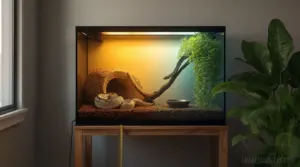
How do you know a 4x2x2 will actually suit your snake? Start with adult length, not the size of the animal in your hands. The enclosure should run at least as long as the snake does, and a 48-inch length covers adult ball pythons, corn snakes, kingsnakes, and rosy boas with room to spare.
Since every species grows at its own pace, a snake tank size guide by species helps you match the enclosure to your snake’s adult length.
Choose a snake’s home by the length it will grow into, because a 48-inch enclosure fits many popular adult species comfortably
Snake species compatibility goes further than length, though. Western hognose snakes, Kenyan sand boas, and milk snakes do well here long term because they’re terrestrial and moderate in size. Juvenile redtail boas fit too, but they’ll outgrow it.
Buying for a juvenile’s current size usually means upgrading later, so plan for adult size now. Pick the species first, then confirm the enclosure gives enough floor space for a proper warm side and cool side. Material matters for those temperature zones as well, since PVC enclosures maintain temperature and humidity more effectively than glass tanks.
Check 4x2x2 Dimensions Against Your Available Space
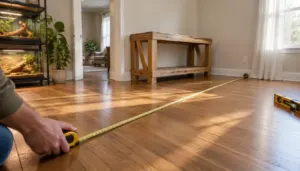
Once you’ve settled on a species, grab a tape measure before you order anything. A 4x2x2 needs a footprint of 8 square feet, or 48" by 24", plus 3 to 4 inches of clearance on every side for airflow, cables, and cleaning.
Since the enclosure is only one piece of the budget, this full ball python cost breakdown shows what year one typically adds up to.
Height matters just as much. Leave at least 24" above the top for ventilation, lighting access, and maintenance.
Do your room space measurement at several points, since floors and walls are rarely true. Then think about floor load capacity. The empty enclosure weighs about 70 pounds before substrate, decor, and water.
Check your access path too: doorways, stairs, and corners all have to clear a 48" box. Keep it away from sun, drafts, and foot traffic, near an outlet, and on a level surface.
Compare 4x2x2 Snake Enclosure Materials and Security
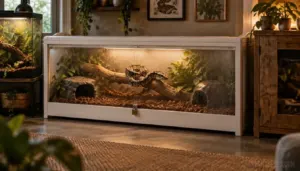
With your space measured, the next question is what the box is made of, because material decides how well it holds humidity and how well it holds your snake.
Glass looks great but leaks humidity through screen tops, so it struggles with ball pythons. PVC enclosures hold 60 to 80% with solid tops and smart ventilation. Wood needs sealing above 50% humidity or it warps and rots.
Since every species has its own humidity range, a species-specific snake humidity guide helps you match your enclosure material to the animal you keep.
For security, front-opening doors beat top-opening designs. Sliding glass doors on PVC work well, and you should still add a lock.
Structural weight differences matter too: PVC is lighter than glass, so one person can move it. Choose acrylic fronts to cut reflections, which stress snakes, and keep opaque hides on both ends.
Choose Compatible Accessories and Calculate Total Cost
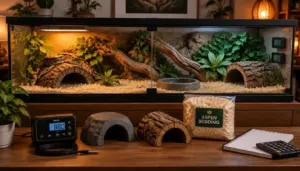
Once the box is chosen, fill it with gear that fits your snake, then price it out.
Start with heat, since it’s where mismatches cost the most. A ball python in a 4x2x2 needs a radiant heat panel covering about a third of the floor, plus a pulse thermostat ($40-60). Pair a dimming thermostat ($35-50) only with bulbs.
For a ball python, budget roughly:
- Two hides: cork bark runs $8-20 each, one warm and one cool.
- Substrate: aspen at $15 a bag, or paper towels at $2 a roll.
- Monitoring: digital combo units cost $20-30 each.
Add climbing branches ($10-25) and artificial plants ($5-15) for the enrichment budget breakdown. Place a hygrometer on the cool side for humidity gauge positioning.
Assemble and Set Up Your Snake Enclosure
Your enclosure arrives flat, but a safe setup takes more than snapping panels together. Two areas matter most here: safe assembly and placement, then the heating, humidity, and enrichment that suit your snake’s species. Work through them in order, and you’ll have a secure home ready before your snake moves in.
Safe Assembly, Support, and Placement
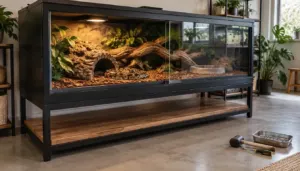
A filled 4x2x2 can top 250lb, so your stand matters more than the enclosure itself. Use a purpose-built stand or truly sturdy furniture that holds the entire footprint, not just the edges.
Build on a hard surface, not carpet. Check the frame posts for the main screws before you dig through the small parts bag. Slide in the acrylic panel before swinging a mallet, then confirm the doors glide smoothly.
Species-Appropriate Heating, Humidity, and Enrichment
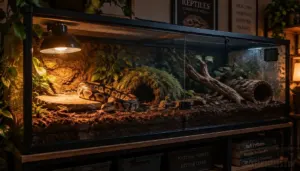
Mount a 50-75W halogen flood or deep heat projector over one end, and wire it to a thermostat. Aim for a basking spot temperature of 88-92°F, with the cool side at 74-80°F.
Pack 4 inches of cypress mulch and topsoil to hold 50-60% humidity. Add a moss-lined hide mid-enclosure, plus cork tubes and branches kept clear of the lamp.
Frequently Asked Questions (FAQs)
Can two snakes safely share a 4x2x2 enclosure?
Usually not. A 4x2x2 gives 8 square feet of floor, which is too tight for two adult snakes of most medium or large species. Most snakes are solitary, so sharing breeds stress, not companionship.
How often should the enclosure be deep cleaned?
Plan a full deep clean whenever you swap out the substrate, and don’t wait for a fixed date. Spot-clean waste as soon as you see it, so waste buildup never gets a chance to settle in.
How long does a 4x2x2 enclosure typically last?
You might assume all enclosures age the same, but they don’t. A well-built PVC unit with thick panels and solid hardware can last 15 to 20 years, while budget models usually manage 5 to 10 with proper care.
Conclusion
Measure the space, match the size to your snake, and test the heat before the animal ever moves in. That’s the whole job, and it’s more doable than it sounds.
A well-planned 4x2x2 snake enclosure gives your snake room to stretch, hide, and climb. It gives you steady temperatures, stable humidity, and a stand that won’t flinch under 250 pounds. Build it once, build it right, then enjoy watching your snake settle in.