This site is supported by our readers. We may earn a commission, at no cost to you, if you purchase through links.
One missed layer of urates can undo a week of careful husbandry. Salmonella doesn’t care how clean a tank looks, and a single contaminated scoop can carry it from one clutch to the next.
For breeders, reptile cleaning sanitizing supplies for breeding projects aren’t a housekeeping afterthought. They set your biosecurity baseline, protect hatchlings with immature immune systems, and keep your lines healthy. But the wrong product can leave residue that harms animals as surely as the germs it targeted.
Here are four tools worth stocking, plus the dilution and contact-time rules that make them work.
Table Of Contents
- Key Takeaways
- 4 Best Reptile Cleaning Sanitizing Supplies for Breeders
- Cleaning, Sanitizing, and Disinfecting Explained
- How to Choose Reptile-Safe Disinfectant
- Match Supplies to Your Enclosure Type
- Safe Dilution, Contact Time, and Residue Rules
- How to Sanitize Reptile Substrate and Décor
- Frequently Asked Questions (FAQs)
- Conclusion
Key Takeaways
- Clean first, because leftover feces, urates, and other organic matter use up the active ingredient in any disinfectant you apply afterward.
- Match each product to its job: scrub brushes and scoops remove grime, a disinfectant like Wipe Out 1 kills pathogens such as Salmonella, and a glass spray only polishes and doesn’t disinfect.
- Follow the label’s dilution and contact time exactly, keep the surface wet for the full time, then rinse and dry completely so no residue harms your animals.
- Choose tools and methods by enclosure material, and keep brushes, scoops, and bowls dedicated to each enclosure so contamination can’t travel between clutches.
4 Best Reptile Cleaning Sanitizing Supplies for Breeders
Keeping a breeding room clean means more than wiping down glass, because poor sanitation feeds skin, respiratory, and gut problems across every rack.
Tracking how often your snakes poop gives you a healthy baseline, making gut trouble from dirty enclosures easier to catch early across every rack.
The four products below cover scrubbing, disinfecting, and spot cleaning, so you can match each job to the right tool. Check each one against your enclosure type before you buy.
1. Flukers Super Scrub Brush Cleaner
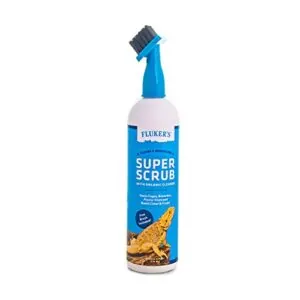
The enzyme formula and attached brush make this a practical pick when you’re dealing with caked-on grime. Its natural enzymes break down organic buildup and odor-causing matter, and the stiff bristles reach corners that wipes miss. It’s rated safe for bearded dragons, leopard geckos, snakes, and amphibians, and it can reduce the spread of bacterial infections.
Let it sit up to two minutes on tough stains, scrub, then rinse. At $14.99, it suits routine cleaning, but customers report brush leakage.
| Best For | Reptile and amphibian owners who want a single tool that scrubs and deodorizes terrariums with natural enzymes instead of harsh chemicals. |
|---|---|
| Dimensions | 2.5 x 2.5 x 11.5 inches |
| Weight/Volume | 1.19 pounds |
| Model Number | 44003 |
| Product Form | Brush with organic cleaner |
| Primary Use | Scrubbing and dissolving dirt |
| Pet Safety | Safe for reptiles and amphibians |
| Additional Features |
|
- Natural enzymes break down organic buildup and odor-causing matter
- Stiff bristles reach corners and hard-to-clean spots
- Safe for bearded dragons, leopard geckos, snakes, and amphibians
- Some customers report the brush leaks
- Priced at $14.99, which may feel steep for a cleaning brush
- No information on how long its cleaning effect lasts
2. Zoo Med Wipe Out 1 Disinfectant 32 oz
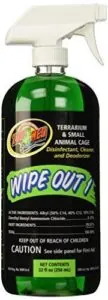
Scrubbing removes grime, but it doesn’t disinfect. That’s where Wipe Out 1 fits. It’s a ready-to-use spray, so there’s no dilution to get wrong. It kills Salmonella choleraesuis and Pseudomonas aeruginosa, and it carries EPA registration number 69814-4.
Remove the animals and substrate first. Spray hard, non-porous surfaces until saturated, wait five minutes, then wipe dry. Skip untreated wood and other porous materials. It’s unscented, so it won’t mask strong odors, and it’s indoor use only, so plan around that.
| Best For | Reptile and small-animal keepers who want a ready-to-use, unscented spray to disinfect hard, non-porous cage and terrarium surfaces during cleanouts. |
|---|---|
| Dimensions | 10.4 x 4.4 x 3.4 inches |
| Weight/Volume | 32 oz |
| Model Number | WO132 |
| Product Form | Liquid disinfectant |
| Primary Use | Disinfecting and deodorizing enclosures |
| Pet Safety | Safe alternative to harsh chemicals |
| Additional Features |
|
- Kills Salmonella choleraesuis and Pseudomonas aeruginosa, and carries EPA registration number 69814-4
- Ready-to-use spray, so there’s no dilution to get wrong
- Unscented, with a short five-minute contact time before wiping dry
- Unscented, so it won’t mask strong odors
- Indoor use only
- Not for untreated wood or other porous materials, and animals and substrate must be removed first
3. Zilla Terrarium Cleaner Spray
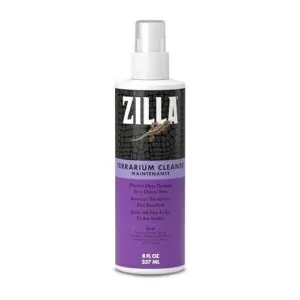
Wipe Out 1 controls pathogens, but it won’t leave glass clear. Zilla Terrarium Cleaner Spray covers that gap. It’s a cleaner, not a disinfectant, so it won’t kill bacteria, viruses, or fungi.
Spray it on glass, acrylic, bowls, plastic plants, or décor, then wipe with a soft cloth until polished. Its anti-static ingredient slows dust buildup, and the deodorizer helps on hard, non-absorbent surfaces. It’s unscented and reptile-safe. Some users say it struggles with heavy grime, so scrub it first.
| Best For | Reptile and terrarium owners who want a pet-safe spray to polish glass and acrylic enclosures and keep dust down between deeper cleanings. |
|---|---|
| Dimensions | 2 x 7.4 x 2 inches |
| Weight/Volume | 9.6 ounces |
| Model Number | 11507 |
| Product Form | Liquid spray cleaner |
| Primary Use | Cleaning glass and surfaces |
| Pet Safety | Safe around reptiles and pets |
| Additional Features |
|
- Leaves glass, acrylic, and plastic with a clear shine
- Anti-static ingredient helps control dust buildup, and the deodorizer works on hard, non-absorbent surfaces
- Unscented, safe around reptiles and other pets, and quick to apply with a soft cloth
- Is a cleaner, not a disinfectant, so it won’t kill bacteria, viruses, or fungi
- May not remove heavy dirt, so tough grime needs scrubbing first
- Some users feel it isn’t worth the price, with mixed feedback on tough-grime performance
4. Ashevix 5-Piece Reptile Tank Cleaning Set
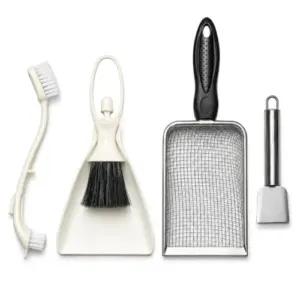
Cleaner spray works on glass, but you still need tools for the mess itself. The Ashevix 5-Piece Reptile Tank Cleaning Set covers daily spot cleaning with a stainless steel scoop, scraper, brush, broom and dustpan.
For a full routine beyond daily spot cleaning, these reptile enclosure maintenance tips show how to pair weekly upkeep with regular checks of basking and cool zones.
The scoop lifts waste, urates and soiled substrate. The dual-ended brush reaches food bowls, water dishes and hide entrances, and the broom sweeps shed skin and loose debris. At 10.2 ounces, it’s easy to handle.
It’s built for daily maintenance, not deep cleaning. Test the scraper on a small area first, and rinse and dry everything before storing.
| Best For | Reptile owners who want one compact set of tools for quick daily spot cleaning of their terrarium. |
|---|---|
| Dimensions | 12.44 x 4.92 x 2.52 inches |
| Weight/Volume | 10.2 ounces |
| Model Number | N/A |
| Product Form | Stainless steel tool set |
| Primary Use | Daily spot cleaning |
| Pet Safety | N/A |
| Additional Features |
|
- Includes a stainless steel scoop, scraper, brush, broom and dustpan, so daily spot cleaning is covered in one set
- The scoop lifts waste, urates and soiled substrate, while the broom sweeps up shed skin and loose debris
- The dual-ended brush cleans food bowls, water dishes and hide entrances
- Made for daily maintenance, not deep cleaning
- The scraper should be tested on a small area first, so it may not suit every surface
- Every tool needs to be rinsed and dried after use before storing
Cleaning, Sanitizing, and Disinfecting Explained
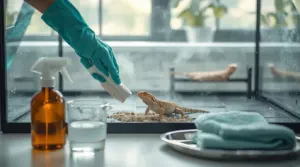
The three terms in your husbandry aren’t interchangeable, and mixing them up is how contamination survives a "clean" enclosure.
Contamination lingers in a spotless-looking enclosure when you confuse cleaning, sanitizing, and disinfecting, since each step does a different job
Cleaning physically removes feces, urates, shed skin, and biofilm. Do it first, because organic matter consumes the active ingredient in any chemical you apply afterward.
Sanitizing lowers microbe counts to a level public health standards consider safe. Disinfecting goes further, killing or inactivating most bacteria, viruses, and fungi on a clean surface.
Disinfectants work by damaging cell membranes, denaturing proteins, or breaking down DNA and RNA. A veterinary-grade concentrate such as f10sc veterinary disinfectant follows the same logic but demands accurate dilution.
Product label compliance sets contact time, disinfectant safety means rinsing residues, and cleaning routine frequency follows each new clutch. Remember that removing organic material first makes disinfectants more effective, and the enclosure should dry fully before the animal returns.
How to Choose Reptile-Safe Disinfectant
Why does the active ingredient matter more than the label’s marketing? Because it determines which pathogens die and which hazards stay behind in your enclosures. Start by picking a reptile-safe disinfectant, then match it to the threats you actually face.
Run every candidate through these checks:
- Check the active ingredient. Chlorhexidine (diluted 1:30 to 1:40) and F10SC are safe options once dry; avoid phenols, ammonia, and alcohol sprays.
- Confirm the spectrum. F10SC covers bacteria, viruses, fungi, and spores; chlorhexidine misses some fungal spores.
- Prefer a veterinary-grade concentrate. Precise dilution beats guessing with a ready-made spray.
- Read the label. Product label compliance covers dilution, contact time, and rinsing, so follow all three.
Always rinse and dry fully for chemical residue avoidance.
Match Supplies to Your Enclosure Type
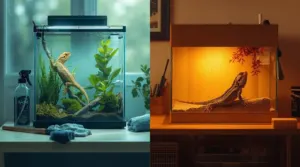
Picture a breeder with two setups: a glass terrarium housing a crested gecko and a wooden vivarium holding a bearded dragon. Using the same soaked cloth and spray on both would be a mistake. The glass tolerates nearly anything, but a coarse scrubber will scratch it. The wood will swell, warp, or grow mold if you saturate it.
Start with the material. For PVC and glass, the Zoo Med Wipe Out 1 and Zilla spray both work well. For wood, use light mist and dry it quickly.
Screen cages need the Flukers brush and a thorough rinse, so residue doesn’t settle in the weave. Rack tubs tolerate stronger solutions, and front-opening designs need a narrow brush for the door tracks.
Match tool to surface every time.
Safe Dilution, Contact Time, and Residue Rules
Measure it right, keep it wet, rinse it clean. Those three habits decide whether disinfecting solutions protect your animals or harm them.
Start with safe dilution. Household bleach works at 1:32, or ½ cup per gallon. F10SC runs 1:250 for general use and 1:100 after high-risk contamination. Always follow the product label exactly, and never mix cleaners.
Contact time matters just as much. Bleach needs 10 minutes of wet contact. Alcohol-based quaternary products like Wipe Out may need 20 minutes. If the surface dries early, reapply.
Then rinse thoroughly. Soap residue can inactivate quaternary compounds, and plastic enclosures absorb chemicals, so air them longer. Let everything dry completely and confirm there’s no chemical odor before reintroducing reptiles. Avoid pine-scent cleaners.
If you’d rather skip the guesswork, a reptile-safe terrarium cleaner made for enclosures is designed to rinse clean without leaving a harsh chemical smell.
How to Sanitize Reptile Substrate and Décor

Most contamination problems start with something you brought in yourself. A branch from the yard or a bag of sand can carry mites, mold spores, and bacteria straight into a clean enclosure.
For loose reptile substrate like sand, topsoil, or coconut fiber, bake it at 200–250°F for 30–60 minutes, or boil it for 15–20 minutes. Let it cool fully and restore moisture before use. Rinse sand first to remove debris.
Décor needs a different approach:
- Boil outdoor rocks for 30 minutes after scrubbing them.
- Bake cleaned branches and driftwood at 200–250°F for 30 minutes.
- Wash porous wood first, then bake it at about 225°F.
- Air dry everything completely before reassembly.
Skip all of this for a bioactive setup. Heat would wipe out your cleanup crew and the microbiology that keeps the enclosure stable.
Frequently Asked Questions (FAQs)
How often should breeding enclosures be fully disinfected?
One survey of keepers often cited in husbandry circles finds most breeders disinfect monthly. That’s a sound baseline, but your monthly full disinfection should shift weekly for messy, humid, or sick animals.
Should incubators and hatchling containers be disinfected differently?
Does one disinfectant fit both jobs? No. For incubator disinfection, use a non-corrosive quat. For hatchling container sanitation, choose a veterinary disinfectant or diluted bleach, then rinse. Proper dilution and drying also protect young reptiles.
Which cleaning tools should be kept separate between enclosures?
Keep scrub brushes, sponges, cloths, scoops, tongs, and water bowls dedicated to each enclosure. Quarantine tools stay fully separate, stored apart, until the 60 to 90 day period ends. Use fresh gloves between habitats.
How do you disinfect shared feeding and water dishes?
Scrape off food, feces and debris first, since organic matter weakens bleach and chlorhexidine. Wash in hot soapy water, soak in a 1:32 bleach solution for ten minutes, rinse thoroughly, and air dry completely before returning dishes.
How should cleaning supplies be stored safely?
Keep reptile cleaning supplies in a locked cabinet or on a high shelf, away from children, pets, food prep areas and sinks. Store them in original, sealed, labeled containers inside a spill-containment tray, in a ventilated, temperature-stable space.
Conclusion
Scrub first, rinse well, and let the contact time run. That sequence matters more than any brand on your shelf. Pick the right reptile-safe disinfectant, dilute it exactly, and never skip the rinse.
Stocking reptile cleaning sanitizing supplies for breeding projects gives you the tools, but your routine does the protecting. Each clean enclosure keeps hatchlings safer and your lines stronger. Build the habit, and biosecurity stops being a chore and becomes how you work.