This site is supported by our readers. We may earn a commission, at no cost to you, if you purchase through links.
Your snake’s thermometer says 88°F. The basking rock says 105°F.
Snakes absorb heat through contact, so surface temperatures can run 10 to 15°F hotter than the air you’re measuring. That gap decides whether your corn snake digests its meal or regurgitates it, and whether your ball python stays healthy or develops a respiratory infection. A single sticker thermometer on the glass can’t tell you any of that.
Learning how to monitor temperature gradients in snake habitats means reading the warm end, the cool end, and everything between. Start with the right tools, then place them where your snake actually lives.
Table Of Contents
- Key Takeaways
- How Do You Monitor Snake Habitat Temperature Gradients?
- Position Temperature Sensors Across Warm and Cool Zones
- Set Species-Specific Temperature Targets for Your Snake
- Verify and Log Habitat Temperatures Consistently
- Adjust Temperature Gradients as Conditions Change
- Frequently Asked Questions (FAQs)
- Conclusion
Key Takeaways
- Your snake feels surface heat, not air heat, so a basking rock can run 10 to 15°F hotter than your thermometer shows, and you need a temperature gun alongside digital probes to see the real number.
- Put probes at animal level on the warm basking surface, the cool-side substrate, and the middle, keep them an inch or more from heat sources, and run a proportional thermostat with its probe in the warm hide.
- Match your species’ targets, such as a 90°F basking surface and 75-80°F cool zone for corn snakes or 88-92°F warm-side air for ball pythons, and let nights drop about five degrees to 70°F.
- Check your thermostat against a separate thermometer, log warm, cool, and basking readings separately, and change one thing at a time when seasons or odd readings throw your gradient off.
How Do You Monitor Snake Habitat Temperature Gradients?
You can’t manage what you don’t measure, and a snake can’t tell you its enclosure is off. Monitoring comes down to two jobs: picking reliable equipment and knowing what each reading actually means. The two points below cover both, so you can trust every number you see.
Because a single reading can mislead you, it helps to understand how many thermometers a terrarium needs so you can cross-check your devices against each other.
Choose Accurate Thermometers and Thermostats
Buy a thermostat first, then a thermometer to check it. A thermostat’s own sensor can drift, and you won’t know.
Pick a proportional thermostat over an on-off thermostat. It dims the heat instead of cycling hard, so your gradient stays steady. This isn’t optional for under-tank heaters.
Pair it with digital thermometers that have an external probe. Their accuracy runs about ±1°C, which is fine. A Digital MIN-MAX Precision Thermometer can track your basking and cool-end temperatures so you can confirm the gradient holds from day to night.
Distinguish Air and Surface Readings
Your digital thermometers read air. A temperature gun reads surfaces. Those aren’t the same number, and your snake feels the surface.
For quarantine tanks, where you need an accurate reading without disturbing a resting snake, a reliable snake thermometer for quarantine setups keeps true air temperature in view at all times.
A thermometer measures the air around your snake, but only a temperature gun reveals the warmth of the surface it actually rests on
Snakes soak up heat through contact, so a basking rock can run 10 to 15°F warmer than the air above it. Check surface temperature on the hide roof, substrate, and basking spot. Never trust one reading.
Position Temperature Sensors Across Warm and Cool Zones
Now that you’ve got reliable gear, put it where the snake actually lives. Placement matters as much as accuracy.
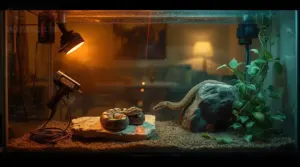
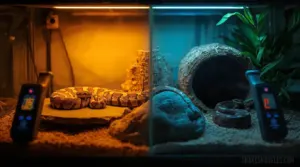
Set one probe on the warm-side basking surface, one on the cool-side substrate, and one in the middle for ambient air. Three readings show the full temperature gradient. Keep every probe at animal level, never stuck to glass or walls. Wall readings can miss reality by several degrees.
Stay at least one inch from heat sources and six inches from ceramic emitters. Radiant heat can skew a reading by up to 20°F.
Add sensors inside both hides. That’s where your snake rests. Put the thermostat probe in the warm hide, not on an exposed surface. Raise sensors higher in arboreal setups too.
Set Species-Specific Temperature Targets for Your Snake
Sensors only help if you know what numbers to chase. Your snake’s species sets those numbers, so don’t guess.
Once you know your species’ targets, a guide on how to read a terrarium thermometer helps you check each reading against them with confidence.
For a corn snake, aim for a basking surface of 90°F (32°C) and a cool zone of 75-80°F (24-27°C). Ball pythons run warmer. Keep the warm side air at 88-92°F, with a basking spot up to 95°F, and the cool side at 76-80°F.
Here’s what to set:
- Corn snake basking surface: 90°F.
- Corn snake cool zone: 75-80°F.
- Ball python warm side air: 88-92°F.
- Ball python cool side air: 76-80°F.
- Adult corn snake nights: 70°F minimum. Juveniles under one year need 75°F.
King snakes and constrictors fall between these ranges. A five-degree nighttime drop is normal and healthy.
Verify and Log Habitat Temperatures Consistently
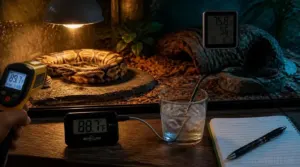
Check your thermostat against a separate thermometer before you trust it. The display only tells you what the probe senses, not what your snake feels. Test any digital thermometer in an ice-water bath too, and note the offset if it’s off by a few degrees.
Measure at the same labeled spots, at the same heights, at the same time each day. Log the warm side, the cool side, and the basking surface separately. Never average them. Write down the date, time, location, reading, instrument, and whether you measured air or surface.
Add a note whenever you change a heat source or thermostat setting. A min-max thermometer will catch overnight lows you’d otherwise miss. Ignore one odd reading, but act on repeated ones.
Adjust Temperature Gradients as Conditions Change
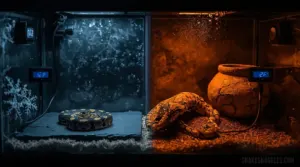
Your setup won’t stay perfect once the weather, the season, or the time of day shifts. A room that runs five degrees cooler in January can flatten your gradient without a single change on your end. The two points below show you how to adjust as conditions change and fix problems before your snake pays for them.
Manage Seasonal and Nighttime Changes
Your room changes with the seasons, and your snake’s habitat changes with it. Nudge the thermostat 2-5°F as the weather shifts, and lower basking temperatures a few degrees over several weeks in fall.
At night, let the whole enclosure drop to 70°F (21°C). Skip colored bulbs. If your room runs colder, use a thermostat-controlled ceramic heat emitter.
Troubleshoot Uneven Heating and Overheating
Your thermostat reads 90°F, yet the cool side sits at 88°F. Here’s your fix order:
- Check the room temperature first.
- Verify the probe with an infrared temperature gun.
- Lower the heat source’s wattage.
- Move the probe onto the basking surface.
- Upgrade the enclosure if it’s under four feet.
Change one thing at a time. Then recheck after a full day.
Frequently Asked Questions (FAQs)
What signs show my snake is too hot or cold?
Is your snake telling you something? Constant movement toward the coolest spot or repeated escape attempts point to overheating. Prolonged hiding and ignoring the warm side suggest chilling. Confirm either with measured temperatures.
What humidity level should accompany the temperature gradient?
Pair your heat gradient with a humidity gradient. Keep the cool side wetter and the warm side drier. For ball pythons, aim for 70-85% on the cool end and about 60% on the warm end. Never let it drop below 50% humidity.
How often should I replace my thermometer probes?
Replace your probes every two years as a baseline, or yearly if the enclosure runs hot or humid. Don’t wait for a date, though. If readings drift or differ by more than 2°F from an infrared check, replace it.
Can I use a heat lamp instead of an undertank heater?
The belief that every snake needs an undertank heater is a myth. Yes, a heat lamp works fine, and often better in larger enclosures. Just run it on a thermostat and check your temperature gradient.
Does my snakes size affect the ideal enclosure layout?
Think of a gradient as a ribbon of warmth laid across the floor. A short ribbon can’t hold both heat and shade. Match enclosure size requirements to your snake’s length, and your layout works.
Conclusion
Ready to stop guessing what your snake feels? Knowing how to monitor temperature gradients in snake habitats comes down to three habits: accurate probes, smart placement, and steady logging.
Check both surface and air readings, match your species’ targets, and adjust when seasons shift. Do it consistently and the numbers stop being a worry and start being routine.
Your snake can’t tell you it’s too cold. Your thermometers can. Listen to them, every single day.