This site is supported by our readers. We may earn a commission, at no cost to you, if you purchase through links.

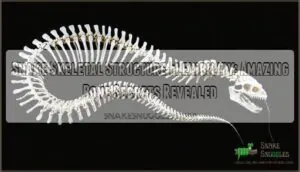
Picture a python with over 400 pairs of ribs, and not a single one of them closes into a cage. So do snakes have ribs? Yes, and they put them to work in ways your own ribs never could.
Every rib hangs off a vertebra and ends freely, with no breastbone to anchor it. That loose design lets a snake grip the ground with its belly scales, breathe while prey squeezes its chest, and stretch its body around a meal wider than its head!
Here’s how those hinged bones carry a snake through crawling, breathing and swallowing, and why they matter so much.
Table Of Contents
Key Takeaways
- Yes, snakes have ribs, and you’ll find a pair on nearly every body vertebra, from about 100 pairs in tiny threadsnakes to over 400 in big pythons.
- Your snake’s ribs never join at the front, since there’s no breastbone, and each one hinges loosely on its vertebra for a flexible body instead of a closed cage.
- Those free ribs do real work every day: they connect through muscle to the belly scales for crawling, swing back and forth to fill and empty the lungs, and spread wide so your snake can swallow prey bigger than its head.
- The trade-off is that ribs only partly protect the heart, lungs and gut, and they’re real bones that can crack from crushing or rough handling, so you’ll need a vet to confirm a suspected fracture.
Do Snakes Really Have Ribs?
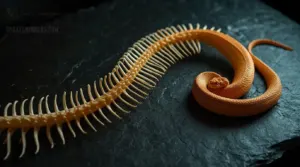
A snake looks like a long tube of muscle, but there’s a real skeleton inside, and yes, it includes ribs! Paired ribs branch off the vertebrae along most of the trunk, much like the ones in your own chest.
Some species even keep tiny vestigial pelvic bones, a leftover from their legged ancestors, so a few snakes do carry the faint remains of hips.
Here’s the twist. Your ribs curve around and meet at the front. A snake’s don’t. Each rib simply ends, so there’s no closed rib cage.
These ribs are busy, too. Through muscular attachment, they connect to the ventral scales on the belly, helping the snake crawl. They also move as the snake breathes and spread as it swallows food.
Near the tip of the tail, the vertebrae stop carrying ribs, so the rib-bearing part covers only the trunk and nothing more.
Snake Rib Counts and Distribution
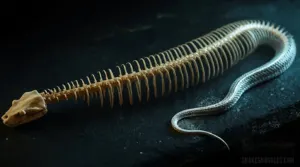
Ready for some numbers? A snake’s rib pairs match its vertebral count almost one for one, so a longer body means more ribs. Tiny threadsnakes carry roughly 100 pairs. Big pythons can top 400, and some species reach about 450!
Ribs don’t start right behind the skull, though. The first few neck vertebrae go without them. From there, nearly every body vertebra carries a pair, all the way down the trunk. Toward the rear, some ribs fork, especially near the cloaca.
Then comes the tail. Those vertebrae make up only 10 to 20 percent of the total and have no ribs at all. Burrowing and sea snakes often have fewer ribs than land snakes of similar size. Girth doesn’t matter.
Because the tail region has no ribs and sits right at the end of the column, a breakdown of snake backbone structure shows how that final stretch differs from the ribbed vertebrae before it.
Snake Rib Attachment Allows Flexibility
So how do all those ribs fit together without turning a snake into a stiff tube? It comes down to how they attach.
Each rib hooks onto its vertebra at a single point, called the capitulum. Think of it like a hinge on a door, not a bolted bracket. The ribs sit on the sides and upper body of each vertebra, so they swing freely.
Now look at the other end. Your ribs curl around to a breastbone. A snake’s don’t! They stay unfused at the ventral end, and there’s no sternum at all. Each rib is free.
Unlike our own, a snake’s ribs never join at the front, so each one swings free with no breastbone to hold it
Add the interlocking joints between neighboring vertebrae and stretchy ligaments, and you get wonderful spinal flexibility. Snakes bend sideways, up and down!
In the dice snake, every precloacal vertebra except the rib-less atlas and axis carries a pair of ribs.
Snake Ribs Support Movement and Breathing
Your snake’s ribs do more than hold its body together, because they help it crawl and breathe every single moment!
Below, we’ll look at two jobs they handle: how rib muscles and belly scales push the body forward, and how rib movement fills and empties the lungs.
Knowing both will help you read what your snake’s body is doing at a glance.
Rib Muscles and Belly-Scale Movement
Picture a tiny set of oars rowing under a snake’s belly, each one tugging a scale forward.
Your snake’s rib muscles do that work! They link ribs to skin, so scales lift, reach and grip.
- Each scale angles on its own.
- V-shaped trailing edges resist backward slip.
- Ribs stay still during rectilinear ventral locomotion.
- Grooves reduce friction along the body.
Rib Movement During Lung Ventilation
How do snakes breathe without a diaphragm? Your ribs help, but theirs do all the work! The muscles between their ribs swing each rib backward to widen the body, so air flows in passively. Then the ribs swing forward and squeeze, pushing air out.
Snakes can even run costal ventilation with just their rear ribs when prey squeezes the front.
Snake Ribs Accommodate Prey and Protect Organs

Your snake’s ribs do two big jobs at once, and you can see both in action at every meal. They stretch wide to fit prey bigger than the snake’s own body, and they also shield the organs packed along its length. Let’s look at each job, starting with how those ribs make room for dinner!
Body Expansion Around Large Meals
Ever seen a snake swallow something wider than its head? It’s wild! Here’s how your favorite constrictor pulls it off:
- Ribs aren’t fused to a sternum, so they swing outward freely.
- Ball-and-socket joints let each rib move in several directions.
- Intercostal muscles push ribs apart, widening the body.
- Stretchy skin controls the rest.
That’s ribcage expansion at work. Pretty great!
Structural Support for Internal Organs
Picture a corn snake coiled on your hand. Feel how firm its midsection is? That’s the rib-supported body wall doing its job, holding everything in place along a trunk that can hold well over 100 pairs of ribs. That muscular build is also why a well-sized corn snake starter kit enclosure matters, giving your snake room to stretch and climb safely.
Those ribs only partly shield the heart, lungs and gut. There’s no sternum, so protection is less complete than a mammal’s.
Frequently Asked Questions (FAQs)
Can snakes break their ribs?
Yes, they can! Snake ribs are real bones, so crushing, hard impacts, or rough handling can crack them. A big meal spreads the ribs apart, but that’s normal. Only a vet can confirm a suspected fracture.
Do snakes have collarbones or shoulder bones?
Think ribs must anchor to shoulders? They don’t! Snakes have no collarbones and no shoulder bones. Their forelimbs vanished long ago, and the pectoral girdle went with them. Those little vent spurs? Hind-limb leftovers, not shoulders.
How did snakes evolve their many ribs?
Think of a snake as a zipper that never stops. Faster somite clock ticking makes over 300 vertebrae, and Hox10’s rib-blocking job fails because an enhancer changed, so ribs keep growing nearly everywhere!
Do legless lizards also have snake-like ribs?
Legless lizards have roughly 50 to 60 ribs per side, far fewer than a snake’s 200 to Their ribs also lack that stretchy, mobile design, so they can’t expand around big meals.
Conclusion
Ever wonder how a legless animal crawls, breathes and swallows a whole rabbit? It all comes down to one question: do snakes have ribs? They do, and each loose, hinged pair works like a tiny lever.
Next time you watch a snake glide past, picture hundreds of levers pulling, rocking and stretching under its skin. That flexible rib cage isn’t a flaw. It’s the secret behind a body built to grip, breathe and swallow giants!