This site is supported by our readers. We may earn a commission, at no cost to you, if you purchase through links.
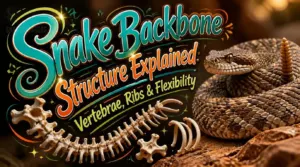
A rattlesnake can have over 200 vertebrae, and a few species push past 500. Each one is a small, precisely shaped bone, and together they let a limbless animal climb, swim, squeeze through gaps, and swallow prey wider than its head.
Most people picture the snake backbone structure as a flexible chain of identical beads. That’s a myth. Ball-and-socket joints, interlocking projections, and loosely attached ribs all do separate jobs, and they limit movement as much as they allow it.
Understanding how those parts fit together starts with a single vertebra, so that’s where you’ll begin.
Table Of Contents
- Key Takeaways
- The Basic Anatomy of Snake Vertebrae
- Vertebral Counts Vary Across Snake Species
- Structural Regions Along The Snake Backbone
- Vertebral Joints Balance Flexibility and Stability
- How Ribs Attach to The Snake Backbone
- Backbone, Ribs, and Muscles Work Together for Movement
- Frequently Asked Questions (FAQs)
- Conclusion
Key Takeaways
- Your snake’s backbone isn’t a chain of identical beads: every vertebra has a ball-and-socket joint plus interlocking projections that allow bending while limiting twist, so the spine is precisely limited rather than endlessly bendy.
- Vertebral counts vary widely, from roughly 130 to over 500 depending on species and even on temperature within a species, and the spine splits into four distinct regions (cervical, anterior thoracic, posterior thoracic, lumbar) whose bones differ in shape.
- Ribs attach to the vertebrae only at one end, with free tips and no sternum, which lets each rib move independently so your snake can swallow prey wider than its head, breathe, and slither.
- Vertebrae, ribs, and muscles work as one system, with ribs acting like miniature legs that press against surfaces to push the body forward, and a snake can often survive a broken spine if the spinal cord isn’t badly damaged.
The Basic Anatomy of Snake Vertebrae
A snake vertebra is a compact, interlocking bone built around a ball-and-socket centrum. The rounded condyle at the back of each centrum fits into the cotyle, the cup at the front of the next one.
This interlocking design is what lets a snake bend in nearly any direction, and you can see how it all works in this guide to snake skeletal structure and flexibility.
Above it, the neural arch encloses your snake’s spinal cord, and a neural spine rises from the top to anchor the muscles that drive movement.
Extra projections called zygapophyses, plus the zygosphene-zygantrum articulation, lock neighboring vertebrae together. The result is a dense outer shell with a lighter, spongy interior, strong yet light.
Because snake ribs are only loosely connected to the vertebrae and not attached to a sternum, they can expand to let the snake swallow prey much larger than its head.
Vertebral Counts Vary Across Snake Species
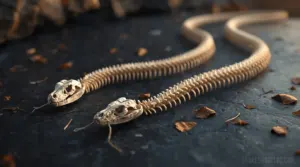
Every one of those interlocking units repeats along your snake’s body, and how many repeats there are depends heavily on the species. Vertebral count variation is wide: some snakes have roughly 130 vertebrae, while others top 500. Among European forms, Vipera ursinii has about 147, and Coluber leopardinus reaches 330. Don’t assume one number fits every snake.
Because ribs attach to nearly every one of those vertebrae, a snake’s bone structure and skeleton grows more elaborate the longer the animal gets.
Counts also shift within a species, and geographic variation often tracks temperature. Longer bodies usually carry more vertebrae, because length comes from segments.
Structural Regions Along The Snake Backbone
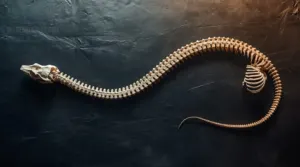
Those counts don’t tell the whole story, because your snake’s vertebrae aren’t all shaped alike. The vertebral column splits into four structural regions, and shape changes quickly where one zone meets the next.
- Cervical: short and ribless, it allows head movement.
- Anterior thoracic: long, curved ribs begin here.
- Posterior thoracic: most of the elongation happens here.
- Lumbar: short and ribless, with forked transverse processes.
Behind the lumbar zone, the tail takes over, where rib joining and haemapophyses replace ordinary ribs.
Vertebral Joints Balance Flexibility and Stability
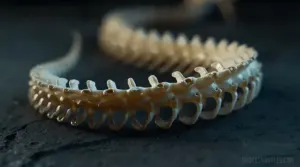
Your snake’s shape changes along the spine, but each joint follows the same design. Every vertebra has five articulation points, and together they allow bending while resisting twist.
The ball-and-socket joint between each condyle and cotyle is only the start, and this guide to how snake spines work shows how the remaining articulation points keep every bend smooth and controlled.
| Joint | Function |
|---|---|
| Centrum ball and socket | Permits broad movement |
| Zygapophyseal joints | Guide sideways bending |
| Zygosphene | Limits excess yaw |
| Zygantrum | Receives the zygosphene |
Roll stays under 2.5 degrees, so muscle force travels along the body. Because these parts depend on each other, removing one changes how the others behave, especially at extreme bends.
How Ribs Attach to The Snake Backbone
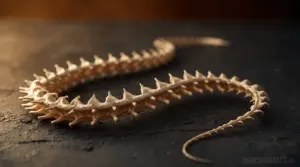
Each rib connects to your snake’s vertebrae through a single surface on a transverse process, a small side projection of the bone. Nothing else anchors it.
That minimal attachment is part of how snakes, as true vertebrates, twist, coil, and strike using hundreds of vertebrae and ribs.
Here’s what that setup looks like:
- Ribs attach only at the vertebral end.
- The distal tips stay free.
- No sternum closes the rib cage.
- Caudal vertebrae carry no ribs at all.
This loose connection lets each rib move on its own, supporting swallowing, locomotion, and breathing along the spinal column.
Because each rib hangs free and moves independently, a snake can swallow, slither, and breathe all at once
Backbone, Ribs, and Muscles Work Together for Movement
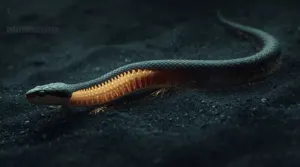
Movement starts with a partnership you can trace through three structures. The vertebrae form the flexible axis, the ribs act as miniature legs that press against surfaces, and muscles drive both. In lateral undulation, large dorsal muscles fire on one side, and that wave of muscular contractions travels toward the tail.
Rib-spine coordination ties it together. Ribs deform to irregular surfaces and transmit force, so thrust stays forward. Concertina movement demands heavy bracing and costs up to seven times more energy.
Frequently Asked Questions (FAQs)
Can a snake survive a broken backbone?
Yes, often. A snake can survive a broken backbone if the fracture doesn’t sever or badly compress the spinal cord. Healing is slow, usually several months, and the spine may keep a permanent bend.
Do legless lizards have the same spine structure?
Picture a glass lizard slithering through grass, easily mistaken for a snake. Its backbone looks similar, but it isn’t identical. Many keep a sternum and pelvic remnants, and their ribs don’t run nearly the whole body.
Did snake spines evolve from four-legged ancestors?
A snake’s spine carries the memory of legs it no longer owns.
Yes, snakes descend from four-legged lizards. Fossils like Tetrapodophis show limbs vanishing, while vestigial structures such as pelvic spurs remain in some species.
How does a snakes backbone develop before hatching?
Most snakes build over 300 vertebrae before hatching, while mice manage about A genetic clock paces each somite, a block of tissue, as the embryo’s body axis extends.
Do snakes have a skull-to-spine connection like mammals?
Yes, they do. Your snake’s single occipital condyle, a knob at the back of the skull, fits into the first vertebra, the atlas, forming a ball-and-socket joint. Mammals use two condyles instead.
Conclusion
Still picturing a chain of identical beads? Drop that image. Snake backbone structure explained shows a column of specialized parts: ball-and-socket joints that guide motion, interlocking projections that block twisting, and ribs that anchor muscle. Each trades freedom for strength.
That trade is the real lesson. A snake isn’t endlessly bendy, it’s precisely limited, and those limits are what let it climb, swim, and swallow. Watch one move and you’ll see engineered flexibility at work.