This site is supported by our readers. We may earn a commission, at no cost to you, if you purchase through links.
A gopher snake’s spine can twist about 2 degrees at each joint, and with 400 joints, that adds up to a body built for controlled bending. Every slither you’ve seen depends on this chain of bones, plus ribs that move freely and belly scales that grip in one direction and slide in the other.
Snake vertebrae function and movement work as one system. Bones set the limits, muscles time the pull, and scales handle friction. Miss any piece and the animal stalls.
The sections ahead break down the count, the joints, the rib mechanics, and the four gaits that put them to work.
Table Of Contents
- Key Takeaways
- Snake Vertebrae: Anatomy and Count
- Snake Vertebral Joints Balance Flexibility and Stability
- Movable Ribs and Muscles Power Snake Movement
- Ventral Scales Provide Traction for Movement
- Four Main Modes of Snake Locomotion
- Snake Vertebrae Support Feeding and Striking
- Frequently Asked Questions (FAQs)
- Conclusion
Key Takeaways
- A snake’s spine packs 130 to over 500 vertebrae (versus about 33 in yours), and each joint moves only a couple of degrees, so flexibility comes from adding up hundreds of small bends rather than one big hinge.
- Each vertebra locks into its neighbors at five contact points, and the wedge-and-socket zygosphene-zygantrum joint acts as a bony stop that blocks twisting while still allowing side-to-side and up-and-down bending.
- Snake ribs float free with no sternum, so oblique and hypaxial muscles can swing each rib pair on its own nerve timing, letting the body grip along its whole length and stretch to swallow oversized meals.
- Ventral scales create directional friction—about 3 to 4 times more resistance sliding toward the head than the tail—which is what converts sideways pushes into forward motion across the four gaits: lateral undulation, rectilinear, concertina, and sidewinding.
Snake Vertebrae: Anatomy and Count
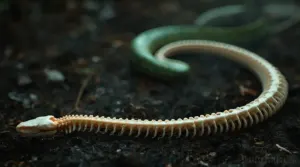
How many bones does it take to make a snake? Far more than you’d guess. Most species carry 130 to over 500 vertebrae, split between 100 to 450 precaudal bones ahead of the tail and 10 to 205 behind it. That range dwarfs the roughly 33 in your own spine.
Those extra vertebrae aren’t just for show—each one links through five joints that let a snake bend sideways while blocking the twisting that would corkscrew its body, as this closer look at how snake spines work explains.
The column isn’t uniform, either. It divides into five regions: cervical, anterior thoracic, middle thoracic, posterior thoracic, and lumbar. The neck stays short, about 5% of body length, or roughly 7 to 12 vertebrae. Earlier researchers assumed longer necks; modern counts corrected that.
This architecture gives snakes enormous spinal flexibility. Each intervertebral joint moves only slightly, but hundreds together add up. Think of a chain of short links rather than one long hinge. The whole musculoskeletal system is built for it.
Snake Vertebral Joints Balance Flexibility and Stability
All those links need a way to move without coming apart. Each vertebra meets its neighbors at five points: a ball-and-socket centrum, two pairs of zygapophyses, and the zygosphene-zygantrum joint, where a wedge on one bone seats into a depression on the next. This five-point articulation is part of the elongated vertebral column, which can contain up to 600 vertebrae in the Australian python.
That arrangement lets the vertebral column bend sideways and up and down while blocking nearly all twisting. The zygosphene-zygantrum acts as a bony stop, limiting yaw before roll can start. Remove it in experiments, and yaw range grows; pitch stays the same.
Torsion isn’t zero, though. Gopher snake trunk vertebrae allow about 1.64 to 2.89 degrees of twist per intervertebral joint, highest near the front and lower toward the tail. Spread across hundreds of joints, that small allowance matters for locomotion.
Movable Ribs and Muscles Power Snake Movement
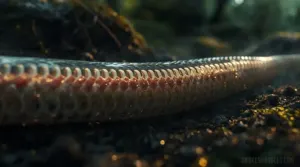
That rigidity protects the spine, but it leaves the ribs to do the reaching. Each rib floats free at its ventral end, with no sternum anchoring it, and meets the vertebra at a ball-and-socket-like joint.
That flexibility lets a snake’s ribcage move independently of a sternum, a key reason these creatures can swallow meals far wider than their own heads.
Paired oblique and hypaxial muscles run from rib to ventral scale, so contraction swings the rib forward, and that pull reaches the belly.
Segmental spinal nerves fire in a traveling wave, letting each rib pair act on its own timing. Think of dozens of tiny legs under the skin, each taking a step.
Segmental nerves fire in waves, letting each rib pair step independently like dozens of tiny legs beneath the skin
- You get grip from the whole body, not one spot.
- Force transmission spreads load across hundreds of rib-scale links.
- Rib motility continues during ventilation, so breathing doesn’t stall.
- Elastic recoil in connective tissue cuts metabolic cost by 20 to 40 percent.
Ventral Scales Provide Traction for Movement
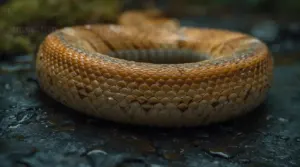
Those rib-driven pulls land on ventral scales, and the scales decide whether the body slips. Each one carries nanostructures about 2.46 μm long, angled toward the tail, plus sawtooth ridges 30 to 80 nm high. That geometry creates frictional anisotropy: sliding toward the head meets 3 to 4 times more resistance than sliding toward the tail. Engineers study this same geometry when designing directional friction tape, which grips firmly one way and releases smoothly the other.
That directional grip is the same principle behind how snake scales create anisotropic friction, letting the body push against the ground without sliding backward.
Your takeaway is that grip comes from direction, not stickiness. Ventral scales show roughly 26% directional difference in friction, against about 5% on the flanks and back. Muscles tilt the scales forward, then press them flat, so muscle activation pattern and scale angle work as one system. On rough ground the edges catch asperities; on smooth ground the nanostructures carry the load. During undulatory movement, that asymmetry converts sideways pushes into forward travel.
Four Main Modes of Snake Locomotion
Snakes don’t rely on a single gait. They switch between four main locomotion modes, depending on terrain, speed, and body shape. Here’s how each one works and what it demands from your setup.
Lateral Undulation: Moving in Curves
Lateral undulation is the slither you picture: waves of bending travel head to tail, and each curve pushes against rocks or sticks. Those contact forces cancel sideways and leave net forward thrust.
- Curves start at the head, and every rear segment tracks that path exactly.
- Muscle activation patterns ripple down one side, then the other.
- Ventral scales grip; on frictionless ground, you go nowhere.
- More contact points don’t add speed.
Rectilinear Locomotion: Moving Without Body Bending
A snake moving in a straight line barely bends its vertebral column. Instead, waves of costocutaneous muscles lift its ventral scales, pull them forward, then press them back against the ground for grip.
| Trait | What Happens |
|---|---|
| Muscle wave | Travels head to tail |
| Scale grip | Lifts, reaches, anchors |
| Spine | Nearly straight |
| Speed | Tuned by wave rhythm |
This is slow but nearly silent, which is why heavy-bodied snakes favor it in tight spaces.
Concertina Locomotion: Anchoring and Extending
Picture a snake in a narrow burrow, bracing its body against both walls like a climber wedging into a chimney. It grips with one bend, then extends forward to grip again. Each anchoring region alternates sides, keeping it stable as it advances. A snug-fitting snake hide burrow mimics that narrow, wall-bracing squeeze, giving your snake a secure place to anchor and advance just like in the wild.
In tunnels, this concertina locomotion costs far more energy than open-ground slithering, and gets harder as the passage narrows.
Sidewinding: Coordinating Lift and Contact
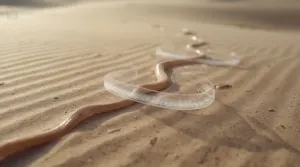
Picture a sidewinder on a dune: its body touches down at two or three points while the rest lifts clear. Lateral flexion pairs with dorsal arching, driven by bilateral trunk muscles, so each segment plants briefly and swings forward. Tracks come out as disconnected diagonal dashes. That dune-like loose sand is easy to recreate in captivity with a fine, dust-free reptile sand substrate that lets burrowers and sidewinders grip and plant just as they would in the wild.
This suits hot, loose sand, where ordinary pushing fails, and can hit 18 mph.
Snake Vertebrae Support Feeding and Striking

A snake’s spine does more than carry it forward. It also drives the strike and the swallow. Zygosphene-zygantrum joints lock neighboring vertebrae against twisting, so the force of a rapid strike travels straight to the head instead of leaking into a wobble. With 200 to 400 vertebrae, each one a small pivot, your snake can fine-tune head position mid-lunge and hit prey at varying distances.
Feeding leans on the same hardware. In egg-eating species, hypapophyses on rear vertebrae grow forward-facing, enamel-tipped spines that pierce shells as an egg passes down the throat, letting the snake crush it internally and spit out the fragments. Other snakes use those long, flexible columns to fold and maneuver large prey, one controlled bend at a time. Keepers of egg-eating snakes often pair that internal shell-crushing anatomy with a dedicated snake egg feeder to keep meals clean and consistent.
Frequently Asked Questions (FAQs)
How do sea snakes swim without ventral scale traction?
Sea snakes swim by undulating their entire bodies, pushing against water instead of relying on ventral scales for grip. A laterally compressed body and paddle-shaped tail generate thrust, so reduced scales barely matter.
How do keeled and smooth scales affect climbing ability?
Run a fingernail along a rough green snake and you’ll feel ridges. Those keels catch bark like tread on a tire, boosting grip. Smooth scales slip more, limiting arboreal climbing and favoring burrowing or swimming.
How do flattened tails help aquatic snakes reduce drag?
A flattened tail cuts drag in water. Its lateral compression lowers frontal area, while the tapered oar shape keeps flow attached and shrinks the turbulent wake. The wider surface also boosts thrust per body undulation.
Conclusion
Think of a snake’s body as a chain of tiny levers, each one passing the pull along. That’s snake vertebrae function and movement in its simplest form: bones set the range, muscles supply the force, and scales decide where grip holds.
Understand one link and you can read every slither, from a slow crawl to a sidewinder’s lift. Watch the body, and the mechanics become visible.