
This site is supported by our readers. We may earn a commission, at no cost to you, if you purchase through links.

A ball python sees the world at roughly 0.13 cycles per degree. You see it at 30. Picture trying to read a street sign through a frosted shower door, and you’re close to what that snake works with.
Yet snakes hunt, dodge predators, and navigate branches with precision. Their snake eye sight ability looks weak on paper, but it’s only one tool in a layered system. Eyes sealed behind clear scales, lenses that slide instead of flex, and senses that detect heat and ground vibrations all pick up what vision misses.
Here’s how each piece works, and why a snake’s blurry view still gets the job done.
Table Of Contents
Key Takeaways
- Your snake’s eyes resolve far less detail than yours (ball pythons manage about 0.13 cycles per degree versus your 30), so it mostly picks up motion and shapes, though sharpness varies by lifestyle, with water and gliding snakes seeing much better than pythons.
- Instead of flexing like yours, a snake’s lens slides forward and back to focus, and each eye sits behind a clear, fused spectacle scale that protects it, which is why a damaged one needs a reptile vet rather than home treatment.
- Snakes fill in what vision misses with heat-sensing pits, stereo-style smell through the tongue and Jacobson’s organ, and jaw bones that carry ground vibrations to the inner ear, so standing still won’t hide your scent or warmth.
- Your snake’s vision temporarily clouds before each shed as the spectacle fills with fluid, making it hide, strike defensively, or refuse meals until its eyes clear and sharp sight returns after the shed.
How Snake Eyes Focus and Stay Protected
A snake doesn’t focus the way you do. You squeeze a ciliary muscle to reshape your lens, but snakes lack that muscle entirely. Instead, muscles in the iris push the round lens forward toward the cornea, and it slides back when they relax. Think of a magnifying glass moved closer to or farther from an object.
Because the lens glides rather than flexes, a snake’s focus works more like a camera sliding on rails, and how snakes see the world explains what that means for them.
Each eye also sits behind a clear spectacle scale, fused in place of eyelids. It blocks debris and dryness, and it sheds with the skin. Because this scale seals the eye completely, external flushing or drops can’t reach the cornea, so a damaged spectacle needs a reptile vet rather than home treatment.
How Sharp Is a Snake’s Eyesight?
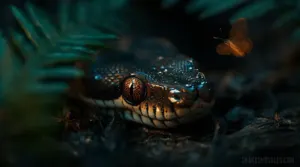
Clear scales protect the eye, but they don’t sharpen it. Snake visual acuity is poor: ball pythons resolve about 0.13 cycles per degree, far below the 30 you manage, so fine detail blurs into shapes.
Lifestyle changes the picture:
- Ball pythons: rod-heavy retinas favor motion sensitivity over detail.
- Water snakes: roughly 30 times sharper than pythons.
- Gliding snakes: best vision, with depth perception for judging branches.
- Vine snakes: forward-facing eyes give true binocular vision.
- Blind snakes: eyes only detect light.
Color and UV Perception in Snakes
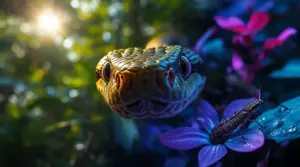
Blurry detail doesn’t mean a dull world. Most snakes are dichromatic, with two cone types, so their color perception is simpler than yours. One cone peaks in the UV or violet range, the other near 550 nm, in the green-yellow zone. Without a red-sensitive cone, they see a compressed slice of the blue and green spectrum.
Researchers studying how snakes see color have found that this UV-sensitive, two-cone setup helps them pick out prey and navigate their surroundings, as explained in this guide to how snakes see in color.
Diurnal hunters like golden tree snakes have UV-blocking lenses that sharpen contrast, like yellow ski goggles. Garter snakes’ UV cones hint at chromatic vision.
Snake Vision in Low Light
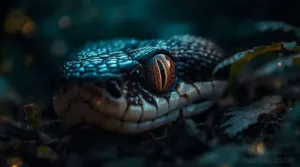
That UV-blocking lens has a downside once the sun sets. Nocturnal and crepuscular snakes skip the yellow filter, so extra short-wavelength light reaches the retina. Their eyes also lean heavily on rod cells, which make up roughly 90% of some viper retinas.
Wide-opening vertical pupils team up with those rod-rich retinas to gather every available photon, as this guide to how snakes see at night explains.
Their pupils do much of the rest. A vertical slit opens to a near-circle in dim light, then narrows again at dawn to protect the retina. Nocturnal eyes are surprisingly small, though, so sharpness takes a hit.
Heat, Scent, and Vibrations Supplement Vision

Even in good light, a snake’s eyes only tell part of the story. Your snake also reads the world through infrared heat sensing, scent, and ground vibrations. Here’s how the first two of those senses, and the third, fill in what the eyes miss.
Heat Detection With Pit Organs
Snakes don’t need light to find a warm meal. Pit vipers carry a deep pocket on each side of the face, and inside it hangs a membrane about 15 micrometers thick. Warm prey heats it almost instantly, and TRPA1 channels in the membrane switch on, firing a nerve signal.
Pit vipers sense warmth through a paper-thin facial membrane that fires a nerve signal the instant prey’s body heat touches it, no light required
It’s heat, not light, that does the work. Your snake can pick out a target 10°C warmer than its surroundings from roughly 40 centimeters away in half a second. The picture is blurry, though, more of a warm blob than a sharp image.
That sensitivity comes from specialized pit organs between the eye and nostril, which you can read about in this guide to how snakes sense body heat.
Scent and Vibration in Prey Detection
How does a snake find a mouse it can’t even see? It combines two senses. Each tongue flick drops particles into Jacobson’s organ, where the left and right forks report separate readings, so it works like stereo smell, steering the snake toward the stronger trail.
Vibrations add the second clue. Because snakes have no outer ear, jaw bones carry ground vibrations straight to the inner ear. Royal pythons sense footsteps up to about 128 cm away, and the two jaw halves help pinpoint direction.
Snake Eyesight Temporarily Blurs Before Shedding
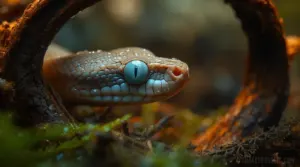
Young snakes can shed up to 12 times a year, so cloudy eyes aren’t unusual.
During each molting period, the brille, or spectacle, fills with fluid and turns milky blue. Your snake sees far less during this stretch:
- Hiding more often
- Striking defensively at sudden movement
- Refusing meals
- Clearing eyes days before shedding
- Seeing sharply again after the shed
Handle your snake as little as possible and keep the enclosure humid. Those visual limitations are temporary, and clarity returns.
Frequently Asked Questions (FAQs)
Can a snake see you if you stand still?
A frozen figure is a closed book to a snake’s eyes, since stillness sends them almost no signal. Standing still hides you visually, but your scent and warmth still give you away.
Can snakes recognize their owners by sight?
No, your snake doesn’t know you by your face. Its eyes mostly pick up movement and shadows, not fine detail. It recognizes you through scent, which its tongue collects and delivers to the Jacobson’s organ.
Are there snakes that are completely blind?
No, not completely. Even blind snakes, the burrowing species with eyes reduced to dark pigment patches under head scales, can still sense light intensity. They can’t see images, but they can tell when they’re exposed above ground.
Do snakes see better underwater or on land?
Snakes see better on land. Water erases the refractive boost from their eye spectacle, shifting focus behind the retina and shrinking the pupil’s apparent size. Dice snakes offset this by shifting their flexible lenses.
Conclusion
So does a snake really need sharp eyes to rule its world? Not at all. Its snake eye sight ability is one voice in a chorus of senses, joined by heat-sensing pits, a flicking tongue, and a body tuned to ground vibrations.
Think of vision as the rough sketch and the other senses as the detail work. Together, they give a snake a complete picture of its surroundings, and that’s why blurry never means helpless.