This site is supported by our readers. We may earn a commission, at no cost to you, if you purchase through links.
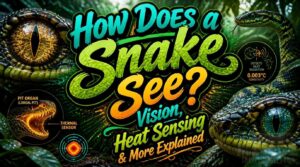
A snake doesn’t blink. Not once, not ever — and that’s just the beginning of how different their world looks compared to yours.
While you rely on crisp, color-rich vision to navigate your day, a snake experiences something far stranger. Motion registers before shape. Warmth outlines prey in the dark before eyes even register it. A flicker of movement triggers the hunting instinct faster than conscious thought. Their sensory world isn’t inferior to ours — it’s built for an entirely different game.
Snake vision combines optics, heat detection, chemical signals, and seismic sensitivity into one tightly wired system. Understanding how it all fits together changes how you see these animals entirely.
Table Of Contents
- Key Takeaways
- How Does a Snake See?
- Snake Eye Anatomy: What Makes Their Vision Different?
- How Well Can Snakes See?
- Do Snakes See Heat?
- How Snakes Combine Sight With Other Senses
- Frequently Asked Questions (FAQs)
- Do snakes see with their eyes or tongue?
- What US state is home to no snakes?
- Which smell do snakes hate?
- How does a snake see humans?
- What does a snakes vision look like?
- How do snakes see humans?
- Do snakes have good eyesight?
- What is the purpose of a snakes pit organ?
- Why do some snakes have eyes on top of their heads?
- How does a snakes sense of smell work?
- Conclusion
Key Takeaways
- Snakes prioritize detecting motion over sharp detail, using rod-packed retinas to catch the faintest flicker of movement long before shapes or colors register.
- Instead of blinking, snakes protect their eyes with a permanent transparent scale called the brille, which sheds with their skin during molting.
- Pit vipers, pythons, and boas can hunt in total darkness by sensing the infrared heat signatures of warm-blooded prey through specialized pit organs. Because snakes rely on these senses more than sight, how snake sensory organs work explains why approaching slowly and letting your pet notice you first keeps handling calm.
- Snakes build a full picture of their world by layering vision with tongue-based scent mapping, ground vibration detection, and thermal sensing into one coordinated system.
How Does a Snake See?
Snake vision is a fascinating mix of sharp instincts, clever anatomy, and sensory tools you might not expect. Their eyes don’t work quite like yours, and understanding the difference starts with a few key ideas. Here’s what’s actually going on when a snake looks at the world.
From the way light hits their fixed pupils to how snake eyelids evolved into transparent scales, every detail of snake eye anatomy tells a story about survival.
Eyes, Brain, and Senses
When a snake locks onto something, it’s not just the eyes doing the work. Visual signals travel through the optic nerve to the thalamus, then reach the occipital lobe, where edges, motion, and color take shape.
What makes snakes wonderful is sensory data connectivity — the brain weaves together sight, scent, and vibration into one clear picture of the world. This process relies on transduction mechanisms to convert physical stimuli into electrical impulses.
Motion Over Fine Detail
Once the brain has all that sensory data flowing in, it prioritizes one thing above everything else: movement. A snake’s retina is packed with rod cells that excel at temporal motion cues, catching the flicker of a mouse darting through grass long before any fine detail registers.
That’s why snakes don’t need sharp, high-resolution eyesight. Motion contrast sensitivity does the heavy lifting instead.
Wide Peripheral Vision
While motion detection is the priority, the sheer width of a snake’s visual field is worth appreciating. With eyes positioned on the sides of the head, snakes can monitor roughly 180 degrees or more around them without moving at all.
That wide sweep helps with situational awareness — spotting approaching threats before they get close. The trade-off is that visual acuity drops sharply toward the edges, making peripheral detail pretty rough.
Limited Depth Perception
That wide field of view comes at a cost. With eyes on the sides of the head, lateral eye placement means both eyes rarely point at the same target, so binocular disparity — the slight difference each eye sees — is almost useless for judging distance.
Snakes rely heavily on monocular cues instead, which makes spatial relationship errors fairly common when striking at prey.
Snake Eye Anatomy: What Makes Their Vision Different?
Snake eyes aren’t just for poker — they’re genuinely one of nature’s more clever design solutions. The structure behind a snake’s vision is surprisingly different from what you’d find in most vertebrates, and those differences explain a lot about how snakes experience the world. Here’s what’s actually going on beneath that glossy, unblinking gaze.
No Movable Eyelids
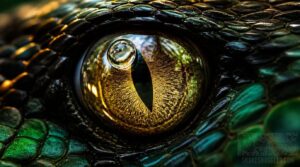
Unlike you, a snake can’t blink. Its eyes stay permanently open, exposed to dust, debris, and dry air every moment of the day.
So how does it cope? Through a system that’s quietly wonderful:
- Ocular muscles compress the eye during rapid movement
- Meibomian-like glands secrete a lipid layer, preventing dehydration
- A thin conjunctival sac controls lubrication beneath the surface
Protective Spectacle Scale
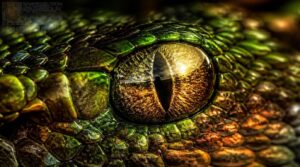
Covering each eye is a transparent protective scale called the brille — or spectacle scale. Think of it as a built-in goggle, fused permanently to the skin.
Since the brille is sensitive to light intensity, matching your snake’s natural activity pattern — day or night — matters more than you might expect, as explored in this guide to natural vs. artificial lighting for snakes.
This reptilian eye shielding keeps the delicate cornea safe from scratches, debris, and friction as the snake pushes through tight spaces. It’s seamlessly clear, so light passes through without distortion, maintaining ocular clarity at all times.
Shedding The Eye Cap
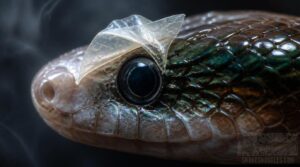
The brille doesn’t last forever — it sheds along with the rest of the snake’s skin during molting. Watch for these signs that shedding is near:
- Eyes turn cloudy or bluish
- The skin loses its usual sheen
- Appetite often dips temporarily
Low humidity is the main culprit behind retained eye caps, which can irritate the cornea and cause lasting damage if ignored. When in doubt, consult a vet.
Lens-Based Focusing

Snake lenses are more spherical than human lenses and focus by physically shifting back and forth, adjusting the optical path length to shift where light converges. Think of it like internal focusing in a camera — the outer structure stays still while inner elements slide. No motorized lens elements here, just muscle-driven movement that nudges image plane convergence with surprising precision.
| Feature | Snake Lens | Camera Lens |
|---|---|---|
| Focusing method | Lens moves forward/backward | Motorized elements shift |
| Lens shape | Spherical | Variable (aspherical) |
| Control type | Muscle-driven | Electronic focus control |
| Optical path adjustment | Physical lens displacement | Internal element groups |
| Visual outcome | Motion-sensitive convergence | Sharp image plane |
Rods and Cones
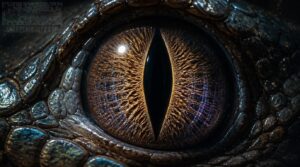
Snake retinas are packed with rod cells, trading fine detail for raw light sensitivity. Rods detect single photons, making dim environments manageable. Cones handle color and sharpness, but snakes keep far fewer of them.
What snake photoreceptors prioritize:
- Motion detection over sharp spatial resolution
- Low-light sensitivity through rod dominance
- Basic color via dichromatic cone pairs
- Continuous photopigment regeneration to maintain function
- Rapid light-to-electrical signal conversion
How Well Can Snakes See?
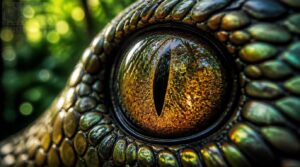
Snake vision isn’t one-size-fits-all — it shifts dramatically depending on the species, the time of day, and the environment a snake has evolved to survive in.
Some snakes are surprisingly capable hunters by sight, while others can barely make out more than shadows and movement. Here’s a closer look at what shapes how well a snake actually sees.
Species-by-Species Differences
Not every snake sees the world the same way. Retinal cell proportions shift the balance — some species pack in more rods for low-light hunting, others keep more cones for daytime tasks. Vipers add thermal sensing on top of that. Coral snakes lean on color contrast, arboreal species develop depth cues, and sea snakes evolved spherical lenses built for underwater focus.
| Species Type | Vision Strength | Key Adaptation |
|---|---|---|
| Vipers | Thermal + visual | Pit organ connectivity |
| Coral snakes | Color discrimination | Cone-rich retina |
| Sea snakes | Underwater clarity | Spherical lens structure |
Daytime Snake Vision
When daylight floods in, diurnal snakes shift into high gear. Their rod and cone cells work together, with cones handling color and rods catching rapid movement across a wide visual field.
Three things sharpen daytime hunting:
- UV contrast benefits help snakes spot prey on sunlit surfaces
- Pupils constrict to boost sunlight glare resistance
- Daytime hunting windows peak during morning and late afternoon light
Nighttime Snake Vision
After dark, nocturnal snakes rely on low-light rod dominance, while twilight melanin protection guards the eye at dusk.
| Feature | Function | Benefit |
|---|---|---|
| Nocturnal pupil dilation | Widens for more light | Better low-light sight |
| Infrared prey tracking | Detects thermal radiation | Hunts in near darkness |
| Thermal overlay processing | Combines infrared vision with sight | Full nocturnal image |
Infrared sensing fills any gaps where sight fades.
Color and UV Perception
Most snakes are dichromatic, meaning they work with two color channels instead of three like you do — so rich hues matter far less than contrast and brightness. What they prioritize is spotting movement against a background, not painting a full color picture.
What’s even more fascinating is that many species detect ultraviolet light, helping them track prey trails through UV-reflective urine invisible to human eyes.
Visual Acuity Limits
Color perception only tells part of the story. Even with functional eyes, snake visual acuity stays modest — rod-packed retinas trade fine detail for motion sensitivity, and pupil shape limits how precisely light focuses on the retina.
Most species can’t resolve sharp edges the way you can. What they catch is movement, contrast, and shadow — enough to survive.
Do Snakes See Heat?

Some snakes don’t just see the world — they feel its heat. Pit organs, found in vipers, pythons, and boas, let these snakes detect the warmth of nearby prey even in total darkness. Here’s how that astonishing system actually works.
Infrared Pit Organs
Pit organs work like tiny biological heat cameras. A delicate pit membrane absorbs infrared radiation, warming by just a few millikelvin. Ion channels fire, sending signals through trigeminal nerve pathways to build a rough thermal outline — the foundation of infrared vision.
Infrared sensing detects:
- Millikelvin-level temperature shifts
- Heat converted via TRPA1-like receptors
- Coarse spatial maps of IR wavelengths
Pythons, Boas, and Vipers
Not every snake has this superpower. Pythons, boas, and pit vipers are the three groups that evolved heat-sensing organs — though their pit locations differ slightly.
Pythons usually lay eggs and guard them, while boas give birth to live young. Both are non-venomous constrictors, yet both carry these biological heat detectors, proving the adaptation transcends reproductive strategy and venom entirely.
Whether you’re buying your first snake or your fifth, finding a reputable boa constrictor breeder who prioritizes health and proper quarantine is just as important as understanding the biology behind your new pet.
Handlers often notice this difference firsthand, as boas tend to explore their surroundings more actively than pythons, a behavioral contrast explored further in this python vs boa constrictor temperament comparison.
Detecting Warm-Blooded Prey
Warm-blooded animals are basically walking heat signatures. A mouse, a rabbit, a sleeping bird — each radiates infrared radiation that rises above the surrounding air temperature, often by several degrees.
That contrast is exactly what pit organs detect, translating those heat differences into neural signals the brain can act on, even when the prey isn’t moving at all.
Thermal Images and Hunting
What the snake’s brain receives isn’t a crisp photograph — it’s more like a thermal contrast map, with warm shapes glowing against cooler backgrounds. That heat signature is enough to time a strike accurately, even in total darkness.
Pit organs make nocturnal hunting remarkably efficient, turning infrared radiation into useful targeting information without the snake needing to see its prey at all.
Heat Sensing Humans
You’re actually a pretty easy target for a heat-sensing snake. Your body continuously emits infrared radiation, peaking between 9.5 and 14 micrometers — a range pit organs detect with astonishing precision.
That warm signature glows against cooler surroundings, giving a snake enough thermal contrast to track your location, even without seeing you at all.
How Snakes Combine Sight With Other Senses

A snake’s eyes are just one piece of a much bigger sensory puzzle. To really understand how a snake experiences the world, you have to look at everything it’s working with — not just sight. Here’s how each of those senses plays its part.
Tongue Flicking and Scent
That flickering tongue isn’t tasting the air — it’s mapping it. Each fork tip collects odor molecules from slightly different spots, feeding two separate streams into the vomeronasal organ. This stereoscopic olfaction lets the snake detect which direction a scent comes from, building a spatial picture of its surroundings.
Rapid flicking even generates tiny air vortices to pull faint chemical traces closer.
Jacobson’s Organ
Those molecules the tongue collects don’t just drift away — they get delivered to the Jacobson’s organ, a paired chemosensory structure tucked into the roof of the mouth. Receptor cells there bind chemical signals and send them straight to the brain.
The result is something closer to 3D scent mapping than simple smell.
Ground Vibration Detection
Scent gives snakes a map, but the ground gives them a warning system.
Through their lower jaw bone, snakes pick up seismic vibrations traveling through the earth — tiny waves that connect directly to the inner ear. Even the faintest footstep registers. Think of it as built-in geophone technology, tuned to detect ground motion long before anything comes into view.
Hunting and Navigation
Put all those senses together — scent trails, thermal gradients, ground vibrations — and you get a remarkably coordinated hunter. A snake doesn’t rely on any single input. It cross-references chemical plumes with heat signatures, then confirms prey location visually during the final approach.
A snake hunts by fusing scent, heat, and vibration into one precise, coordinated strike
Terrain plays a role too. Snakes use logs, ridgelines, and damp microhabitats as navigational handrails, steering their hunt without ever losing orientation.
Recognizing Their Keeper
Your snake may not greet you with a wagging tail, but it does recognize you. Through chemical memory and scent familiarity, it registers your presence as safe.
Consistent handling builds that trust — reliable routines and calm energy matter. A snake that tolerates your touch without stress isn’t indifferent; it’s simply telling you, in its own quiet way, that you’ve earned it.
Frequently Asked Questions (FAQs)
Do snakes see with their eyes or tongue?
Eyes do the seeing — the tongue controls chemical scent mapping, flicking particles to the Jacobson’s organ for rich sensory perception. Some species add UV or infrared to the mix, making snake vision surprisingly layered.
What US state is home to no snakes?
Alaska and Hawaii are the only two U.S. states with no native snakes. Alaska’s Arctic cold makes survival impossible, while Hawaii’s island isolation and strict biosecurity keep terrestrial snakes from ever gaining a foothold.
For prospective owners elsewhere, researching snake species before buying helps ensure appropriate care and handling.
Curious visitors can explore how to identify and learn about snake species, from venomous Elapidae like cobras to the rattlesnakes of family Viperidae—none of which call Alaska or Hawaii home.
Which smell do snakes hate?
Like a living nose on legs, a snake’s forked tongue and Jacobson’s organ make chemoreception razor-sharp — which is exactly why strong pungent vapors from ammonia, sulfur, citrus, and cinnamon oil will send them retreating fast.
How does a snake see humans?
To a snake, you’re mostly a blurry moving shape — noticed first through motion, then confirmed by scent and heat. Your thermal signature and upright silhouette together tell the snake whether you’re a threat worth retreating from.
What does a snakes vision look like?
Seeing through rose-colored glasses isn’t an option here. Snake vision relies on motion detection and low light sensitivity, with most species catching movement and shapes rather than sharp detail or rich color.
How do snakes see humans?
When a snake notices you, it’s rarely just your face it’s reading. Snakes piece together your human silhouette, thermal body signature, and scent trail simultaneously — building a layered picture of you as one large, potentially dangerous presence.
Do snakes have good eyesight?
Most snakes have poor visual acuity — they can distinguish shapes and movement, but fine detail escapes them. A few species, like the golden tree snake, buck that trend with surprisingly sharp daytime vision.
What is the purpose of a snakes pit organ?
Think of the pit organ as a built-in thermal camera — it detects infrared heat signatures from warm-blooded prey, letting certain snakes hunt with precision in complete darkness by tracking heat gradients and estimating prey distance.
Why do some snakes have eyes on top of their heads?
Some snakes position their eyes on top of their heads to scan for overhead threats and prey while keeping their body buried or hidden. Viperids, with their pronounced brow ridges, are a clear example of this ambush-ready adaptation.
How does a snakes sense of smell work?
A forked tongue does more than taste the air — it’s a stereo scent collector. Each tip samples chemicals from two separate points, then delivers them to Jacobson’s organ, which decodes those moistureborne chemical cues into a precise directional trail.
Conclusion
A chameleon changes color to communicate — not to hide. That kind of mismatch between assumption and reality is exactly what understanding how does a snake see delivers.
Snakes don’t experience a blurry, broken version of your world. They inhabit a completely different one — stitched together from motion, heat, scent, and vibration. Every sense has a job. Strip away the human lens, and what’s left is a predator engineered to be incredibly efficient.