This site is supported by our readers. We may earn a commission, at no cost to you, if you purchase through links.
Most snakes would rather not bite you. That might sound odd given their reputation, but venom production costs a snake significant metabolic energy—energy that can’t be recouped once spent on a defensive strike.
So before a rattlesnake ever opens its mouth, it rattles. Before a cobra lunges, it spreads its hood. These aren’t random behaviors; they’re a complex, layered communication system refined across millions of years of predator-prey dynamics.
Snakes warn predators through visual displays, acoustic signals, and chemical cues that work together to deter threats without physical contact. Understanding how snakes warn predators reveals a surprisingly strategic animal—one far more interested in negotiating than fighting.
Table Of Contents
- Key Takeaways
- Snakes Warn Predators Before Striking
- Visual Warning Displays
- Sound-Based Snake Warnings
- Chemical and Vibrational Alerts
- Why Snake Warnings Work
- Frequently Asked Questions (FAQs)
- Why do rattlesnakes warn their prey?
- Can snakes warn each other across long distances?
- Do snakes ever fake warning displays to bluff?
- How do humans accidentally trigger snake warning behavior?
- Which snake species have the most complex warning systems?
- Do warning displays vary between male and female snakes?
- Conclusion
Key Takeaways
- Snakes rely on a layered system of visual, acoustic, and chemical warnings—hood spreading, rattling, pheromone release—because biting is genuinely their last resort, not their first instinct.
- Venom is metabolically expensive to produce and takes days to replenish, so every successful bluff or display is essentially a snake protecting its most finite resource.
- These warning signals aren’t random aggression; they’re a refined evolutionary negotiation, giving both the snake and the predator a chance to walk away unharmed.
- Once you can read the signals—a flattened body, an S-curve posture, a buzzing tail—a tense encounter becomes a conversation you already know how to answer.
Snakes Warn Predators Before Striking

Before a snake strikes, it almost always gives you fair warning. These signals aren’t random—they’re a complex system of communication shaped by millions of years of evolution, designed to avoid conflict rather than start it. Here’s what those warnings actually mean, and why snakes rely on them so heavily.
Understanding exactly what each posture signals can help you stay calm and respond correctly—defensive snake body language explained breaks down the most common displays and what snakes are actually trying to tell you.
Defensive Signals Explained
When a snake perceives a threat, it coordinates visual displays, acoustic warnings, and chemical cues to deter predators. Multimodal threat signals—such as a cobra’s hood, rattlesnake’s tail, or cottonmouth’s gape—increase effectiveness. Mimicry and signal intensity adjust to the environment, balancing energy costs and predator perception. Defensive displays provide clear warnings, reducing risk and conserving resources.
- Visual intimidation
- Acoustic warning
- Chemical signals
Avoiding Unnecessary Fights
Every warning display a snake produces is, at its foundation, a negotiation. Rather than escalating to a physical confrontation, defensive signaling gives both parties a chance to reassess.
A predator that recognizes the signal backs off; the snake conserves energy and avoids injury. Conflict avoidance isn’t weakness — it’s a finely tuned survival strategy shaped by millions of years of predator-prey interaction.
Conflict avoidance isn’t weakness — it’s a survival strategy millions of years in the making
Saving Venom and Energy
That same restraint protects something costly: venom. Venom metering matters because glandular replenishment takes days, slows further in cold, and a wasted strike means days without defense. The high metabolic cost of venom drives snakes to use it frugally, reinforcing the importance of venom metering.
- losing irreplaceable venom reserves
- days spent on metabolic replenishment
- slower recovery in cold weather
- depleted defenses against new threats
- exhausted energy with nothing gained
Every saved drop quietly sustains predator deterrence for tomorrow.
Warning Versus Attacking
Conserving venom only matters if striking stays the last resort. A coiled, hissing snake runs a quiet cost-benefit analysis: warning first, strike only past a clear defensive threshold.
That strike hesitation reflects calculated risk, not fear.
Predators reading the defensive display correctly avoid conflict escalation entirely.
This is why understanding carpet python threat display behaviors matters—most encounters end peacefully when both sides read the signals right.
Aposematic signaling works precisely because warning beats striking.
Visual Warning Displays
Before a snake ever makes a sound, it tries to talk with its body. You’ll find these signals are often the first line of defense, built to look bigger, scarier, or more dangerous than they actually are. Here’s a closer look at the visual tricks snakes pull out when they want you to back off.
Cobra Hood Spreading
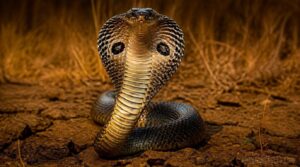
Few sights freeze you faster than cobra’s hood snapping open. Rib expansion mechanics drive this: neck ribs spread outward, flattening skin into a wide intimidation silhouette.
Hood pattern variability means eye-spot mimicry on some species misdirects strikes toward less critical areas. Timing matters too—the cobra hood display flashes before any bite, a deliberate warning signal within snakes’ broader visual signaling toolkit.
Body Flattening

Body flattening transforms a snake into something far harder to dismiss. Rib buckling mechanics drive this shift: spinal muscles contract to push the rib cage outward, dramatically widening the cross-sectional profile into a pancake-like shield. The skin stretches taut, creating a smooth, unbroken silhouette that reads unmistakably as "larger than you want to handle."
- Anterior emphasis targets the most visible zone
- Ground contact improves postural stability during confrontation
- Silhouette expansion signals defensive intent before any strike
- Water snakes deploy aquatic flattening variations when approached near shorelines
Predator deterrence efficiency peaks because flattening costs almost no energy — it’s pure body language, posture gestures and movement working together without venom expenditure.
S-shaped Strike Posture

The S-shaped posture is fundamentally a loaded spring. Muscles along each curve store elastic energy, releasing it as explosive forward propulsion during a strike.
The tail anchors against the ground, creating a fulcrum that drives neck and head velocity far beyond what a straight-bodied lunge can achieve — reaching roughly half to two-thirds of the snake’s total body length in a single motion.
Bright Warning Colors

Color is one of nature’s most effective warning systems. Aposematic coloration — the red, yellow, and black banding seen in coral snakes — tells predators instantly: back off. These high-contrast patterns work as cognitive shortcuts, reducing unnecessary attacks before any venom is spent.
Mimicry pattern evolution extends this protection. Non-venomous species copy warning coloration, borrowing credibility without possessing actual defenses.
Cottonmouth Mouth Gaping

Few warning signals in the animal kingdom match the sheer visual impact of the cottonmouth’s defensive gape. Agkistrodon piscivorus opens its jaws wide, exposing a stark white oral cavity that contrasts sharply against its dark body — a high-contrast signal your visual system registers instantly.
That white mouth display communicates danger without requiring physical contact.
Sound-Based Snake Warnings

Snakes don’t need to strike to get their message across — sound does a lot of the heavy lifting. From the iconic rattle to a low, resonant growl, each species has its own acoustic signature worth knowing. Here are the key sound-based warnings you’re likely to encounter.
Rattlesnake Tail Rattling
The rattlesnake’s rattle is fundamentally a chain of hollow keratin segments — the same material as your fingernails — that interlock at the tail tip. Three specialized shaker muscles contract at up to 90 times per second, driving segments to collide and produce that unmistakable buzzing.
Younger snakes start with a single button segment, adding new pieces with each shed, so an older snake’s longer rattle signals both age and experience.
Loud Defensive Hissing
Where the rattle relies on hardware, the hiss is pure mechanics.
A snake forces air through the glottis, that narrow opening in the throat, producing a sharp burst reaching 70–90 decibels — comparable to a lawnmower at close range.
Combined with mouth gaping and neck expansion, it signals one unmistakable message: back off, now.
Saw-scaled Viper Rasping
Saw-scaled vipers, Echis carinatus, favor rasping displays—a harsh, abrasive sound produced by rubbing sharply keeled scales together as the body coils tightly. This stridulation warns threats in arid habitats, conserving venom and energy for true emergencies.
- Compact figure-eight coil
- Audible rasp from scale friction
- Flattened, intimidating posture
- Serrated scales visible during threat
King Cobra Growling
The king cobra, Ophiophagus hannah, takes acoustic warning to a different register entirely — literally.
Unlike the high-pitched hiss of most snakes, its tracheal resonance chambers produce a deep, guttural growl that carries genuine menace.
When threatened, the cobra inhales deeply, hood fully spread, amplifying this low-frequency vocalization so it travels farther and lands harder.
Tail Buzzing in Leaves
Tail buzzing, especially on dry leaf litter, turns the last inches of the snake’s tail into a warning beacon. Rapid muscle contractions create a buzzing sound amplified by the leaves, mimicking rattlesnake cues and startling predators.
As the threat intensifies, the buzzing grows louder, signaling both danger and readiness to defend. This tactic conserves venom, pairing sound with visual displays for maximum deterrence.
Chemical and Vibrational Alerts

Not all snake warnings are loud or visible—some work entirely below the threshold of human perception. Snakes have evolved an intricate chemical and vibrational communication system that operates through scent molecules, tongue flicks, and ground tremors. Here’s how each of these hidden signals actually functions.
Alarm Pheromone Release
When a snake perceives a threat, specialized cloacal or cutaneous glands release a blend of volatile semiochemicals into the surrounding environment — a chemical alarm signal that spreads before any strike occurs:
- The signal is a multi-compound blend, not a single molecule
- Highly volatile components guarantee rapid environmental dispersal
- Wind and humidity control how far the pheromone travels
- Stress-induced gland activity synchronizes with visual threat postures
- The chemical mix integrates with acoustic and visual cues, forming a multi-modal defense strategy
Jacobson’s Organ Detection
While pheromone signals disperse through the environment, a snake’s Jacobson’s organ — the vomeronasal organ — is what actually decodes them.
Specialized sensory neurons housing V1R and V2R receptors bind chemical compounds that standard olfactory receptors miss entirely.
These signals travel directly through the accessory olfactory system to the limbic system, triggering near-instant behavioral responses to chemical threats.
Forked Tongue Sampling
The forked tongue isn’t just anatomical quirk — it’s a precision chemical detection system. By sampling two spatial points simultaneously, snakes achieve stereo chemical perception, feeding bilateral data into the vomeronasal organ for near-instant comparison.
This tropotaxis navigation method guides directional movement along a scent trail with impressive bilateral sampling accuracy, allowing the snake to locate threats, prey, or mates through continuous tongue flicking alone.
Ground Vibration Sensing
Imagine feeling the earth’s tremors before danger appears — that’s ground vibration sensing in action. Snakes rely on mechanoreception via jaw and body scales to detect vibrations, much like geophones monitor seismic shifts.
With triaxial motion capture and spectral analysis, they interpret approaching threats as vibration signals decay. Real-time alerts prime their muscles, ensuring rapid escape from predators.
Tail Drumming Signals
Tail drumming works like a seismic telegram — the snake repeatedly strikes its tail against firm substrate, sending low-frequency ground vibrations outward in all directions. Tempo varies by species and perceived threat level, with rapid cadences signaling escalating danger.
On dry, compact ground, these vibrations travel farther and more clearly, reaching predators and nearby conspecifics simultaneously, effectively extending the snake’s multimodal warning reach without a single physical strike.
Why Snake Warnings Work

Snake warning displays don’t just look and sound impressive—they’re backed by real evolutionary logic that makes them genuinely effective. Understanding why they work helps you see these behaviors for what they are: remarkably efficient survival strategies, not random aggression. Here’s what drives the success of these signals.
Predator Learning
Predators don’t need to be bitten twice. Once a hawk or mongoose experiences the rattling, hooding, or vivid banding of a venomous snake, memory consolidation locks that association firmly in place.
Future encounters trigger immediate avoidance — no hesitation, no testing. Social learning accelerates this further, as younger predators observe and inherit caution without ever risking contact themselves.
Venom Conservation
That avoidance learning matters beyond individual safety — it directly protects the snake’s most finite resource.
Venom production is metabolically expensive, drawing heavily on the snake’s metabolic resources to synthesize complex enzymes and peptides. Every successful warning display is, effectively, an energy conservation strategy: the snake deters a predator without triggering the venom delivery system at all.
Juvenile Defense Signals
Young venomous snakes face a stark disadvantage: limited venom reserves paired with smaller fangs mean a failed strike can leave them genuinely defenseless.
That’s why juveniles rely heavily on deimatic displays — body flattening, S-shaped posturing, and tail vibration — to bluff their way past threats, conserving what little venom they’ve for encounters that truly demand it.
Day Versus Night Warnings
After juveniles bluff danger with vivid displays, the rhythm of warning shifts with the sun.
Diurnal snakes rely on bright coloration and body posture—signals best seen in daylight.
When night falls, nocturnal species switch to acoustic cues like hissing, rattling, or tail-buzzing, as visual warnings fade. Chemical signals and vibration detection fill the gap, sustaining defense when darkness prevails.
Frequently Asked Questions (FAQs)
Why do rattlesnakes warn their prey?
Rattlesnakes warn their prey with tail vibration and a distinct rattle, giving animals a chance to escape. This danger communication conserves venom and energy, reduces risky encounters, and teaches predators to recognize defensive displays as a clear warning sign.
Can snakes warn each other across long distances?
Snakes can warn each other across moderate distances using chemical scent trails and ground vibrations, though effectiveness depends on habitat transmission factors like soil texture and wind, which influence how far multi-modal signals and scent longevity reach conspecifics.
Do snakes ever fake warning displays to bluff?
Over 70% of kingsnake encounters involve deceptive color patterns mimicking coral snakes. These bluff displays, including mock strikes and false hooding, prompt predator avoidance.
Mimicry effectiveness relies on predator learning, allowing nonvenomous species to deter attacks without expending venom.
Bull snakes show how learned mimicry blends with a robust bluff to deter predators without venom, reinforcing the pattern described.
How do humans accidentally trigger snake warning behavior?
Quick footsteps or footwear noise on dry leaves, strong fragrance scent, abrupt shadow movement, and vegetation disturbance often trigger warning displays.
Sudden looming approaches may provoke defensive postures, raising the risk of misinterpretation and potential human-wildlife conflict.
Which snake species have the most complex warning systems?
Among living serpents, king cobras and rattlesnakes stand out for combining visual, acoustic, and chemical signals simultaneously — a rare multimodal sophistication that reflects millions of years of evolutionary refinement in defensive communication.
Do warning displays vary between male and female snakes?
Yes — male and female snakes differ subtly. Males display more frequently during territorial encounters, while females use broader, slower postures to protect reproductive organs and conserve energy for offspring.
Conclusion
Every warning signal a snake sends is a door left open—an invitation to back away before the situation becomes irreversible. Understanding how snakes warn predators transforms a chance encounter from a crisis into a conversation you already know how to read.
The rattle, the hood, the flattened body—these aren’t threats. They’re a language refined across millions of years, and now that you speak it, you’ll never look at a defensive snake the same way again.