This site is supported by our readers. We may earn a commission, at no cost to you, if you purchase through links.

A ball python sheds badly, and the owner blames the snake. Nine times out of ten, the real problem sits on the wall of the tank, misread or misplaced. Humidity gauges look simple, but a bad reading throws off every care decision you make after it.
Learning how to read a humidity gauge correctly means understanding placement, timing, and calibration, not just glancing at a number. Get it wrong and you’ll chase shed problems or mold growth for months without knowing why.
The steps ahead cover exact placement, accuracy checks, and how to correct readings that drift off target.
Table Of Contents
Key Takeaways
- Let your gauge settle for five minutes, away from drafts or handling, before trusting any reading.
- Mount hygrometers at snake level on both the warm and cool sides, kept clear of heat sources, water bowls, and blocked airflow.
- Test your gauge’s accuracy with a saturated salt solution, which should read 75% RH after 24 hours, and recalibrate every six months. If your gauge keeps drifting or you mist often, choosing a reliable humidity gauge for bioactive enclosures can save you from replacing it every year. If you keep several snakes in a rack system, humidity gauges suited to multi-snake racks make it easier to test each unit and log every reading.
- Match humidity to your snake’s species needs, log readings several times daily, and raise or lower moisture gradually to fix drift and prevent mold.
How to Read a Humidity Gauge
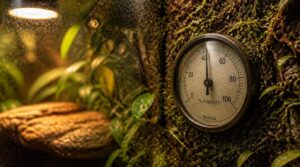
Your gauge only helps if you know how to read it right. A wrong reading can send you chasing a problem that doesn’t exist. Here’s how to get an accurate number every time you check.
For a deeper dive into placement, calibration, and upkeep, this guide to reptile humidity gauges for boa constrictor keepers walks you through avoiding the most common reading mistakes.
Let The Gauge Stabilize
Before you check your reptile enclosure’s humidity, give the gauge time to settle. Wait five full minutes before reading. Drafts and recent handling throw off readings, so keep the enclosure closed.
If your readings stay consistently low, exploring natural methods for raising enclosure humidity can help you build a stable environment rather than constantly chasing numbers.
- Don’t breathe on the sensor
- Don’t touch the gauge
- Use a timer for accuracy
A steady reading only comes after this settling period. Rushing gives you false numbers. Clear, methodical documentation matters here too, much like researchers rely on structuring papers for clarity to make sure their results are accurate and reproducible.
Find The Humidity Percentage
Once the gauge settles, look for the number showing relative humidity, the percentage of water vapor in the air compared to what it can hold. This is your humidity percentage reading.
Every reptile enclosure humidity check comes down to that single value. A reading of 70 means 70% relative humidity, whether the gauge shows it on a screen or a dial.
Read a Digital Display
Digital hygrometers display relative humidity as a clear number on an LCD or LED screen, using seven segment or dot matrix digits for quick reading.
Most screens include a backlight for dim enclosures and adjust contrast automatically for legibility.
Look for a splash resistant cover, since enclosure moisture can damage exposed digits during daily home humidity monitoring.
Check an Analog Needle
Not every hygrometer runs on a screen. Analog models use a needle and dial instead, and reading one takes a steadier eye.
Line your eye up level with the dial to avoid parallax errors. The needle should sit still on smooth needle movement, not jump or stick, and its needle resting position should land inside the printed range for accurate relative humidity in a reptile enclosure.
Record Temperature and Humidity
Numbers only matter if you write them down. Log the relative humidity and temperature together, every hour, since temperature correlation affects RH readings directly.
- Time of reading
- Humidity percentage
- Temperature reading
- Notes on behavior or shedding
Store your humidity data logging in a spreadsheet. This trend analysis reveals patterns a single glance at the hygrometer never will.
Before you trust any reading, double-check your device’s accuracy against ideal reptile humidity level guidelines so your logged data actually reflects reality.
Place The Gauge Inside The Enclosure
Placement matters as much as the gauge itself. Put it in the wrong spot, and your reading won’t tell you anything useful about your snake’s actual environment. Here’s where to mount it, and where to keep it away from, for a number that you can actually trust.
Mount It at Snake Level
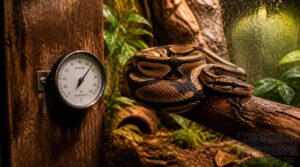
Where you mount the gauge changes what it tells you. Mount it at snake level, right where your snake rests or moves most, not up near the screen top or down on the floor.
Attach it to a vertical wall using non-skid tape or a small bracket. Keep it clear of hides and shelves so airflow stays steady around the sensor.
Check Warm and Cool Sides

A single gauge won’t tell the full story. Reptile enclosures need dual sensor placement, one hygrometer on the warm side and one on the cool side, to capture the true humidity gradient.
Warm side humidity often runs slightly higher and helps with shedding, while the cool side gradient stays balanced to prevent condensation. Compare both readings, checking temperature and airflow, to confirm gradient stability across the enclosure.
Avoid Water Bowl Splashes
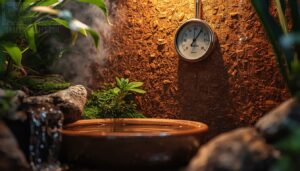
A splashed gauge gives you a false humidity reading. Keep your hygrometer at least six inches from the water bowl, out of direct spray range.
Bowl design solutions like raised rims and slow flow inserts cut down splash zones. Combine this with smart placement strategies, and your sensor reads actual moisture in the air, not stray water vapor from the bowl.
Keep Away From Heat

Heat throws off your humidity gauge fast. Keep it at least 12 inches from any heat source, whether that’s a ceramic emitter or heat mat.
- Add thermal shielding between the sensor and heat source
- Balance ventilation to stop hot air pooling near the gauge
- Check enclosure insulation so heat doesn’t concentrate unevenly
- Monitor temperature daily near your hygrometer’s location
Allow Air Around Sensors

A blocked sensor gives you a false reading every time. Don’t tuck your hygrometer behind decor or press it flush against glass, walls, or bark.
Give it open space for airflow so it reads true air humidity, not trapped pockets. Balance ventilation, avoid drafts near vents, and do a quick circulation check monthly.
| Placement | Airflow | Reading Accuracy |
|---|---|---|
| Behind decor | Poor | False high |
| Flush to wall | Blocked | Unreliable |
| Open space | Good | True RH |
Compare Readings With Species Needs
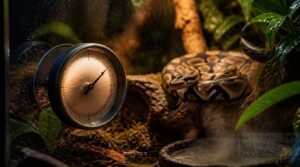
A number on the gauge means nothing on its own. You need to know what your snake actually requires, then check your reading against it. Here’s how to line the two up correctly.
Check Your Snake’s Ideal Range
Every species reads its normal humidity range differently, so match your hygrometer reading to the snake in the tank.
Ball pythons want 50 to 60 percent RH, corn snakes hold steady between 40 and 60, and boas prefer 60 to 70.
Tree pythons need 70 to 90 percent, desert species stay comfortable near 20 to 40.
Adjust Humidity During Shedding
Once your snake shows signs of shedding, cloudy eyes, dull skin, start your Humidity Ramp-Up Strategy. Raise the reading 5 to 10 points daily until you hit 65 to 70 percent RH.
Check your humidity gauge each morning. Set up a Moisture Gradient Setup with a damp hide, adjust Water Dish Placement to the warm side, and run a Substrate Dampness Check for Shedding Progress Tracking.
Monitor Daily Fluctuations
Shed cycles pass, but your hygrometer never stops working. Daily humidity peaks hit in early morning; evening humidity drops follow as temperatures cool. Track this fluctuation pattern for two full peaks and valleys:
- Morning spike (highest reading)
- Midday dip
- Evening drop
- Overnight low
Log readings 3 to 4 times daily. A stable weekly range beats one lucky number.
Account for Seasonal Changes
Weekly patterns shift with the calendar too. Winter heating dries indoor air, so you’ll likely need to raise humidity targets to keep your enclosure comfortable. Summer cooling and better ventilation often lower readings instead.
Watch substrate moisture closely during these swings, and remember slower metabolic rates in cooler months can change how fast your snake reacts to humidity adjustments.
Keep a Humidity Log
If you want real answers, write them down. Log each humidity reading with the date, time, and temperature, using the same format every entry.
Record daily, and back up the file to a second location. Flag odd readings, note calibrations, and run monthly trend analysis to guide humidity control decisions. Share summaries with other caretakers too.
Check Your Gauge for Accuracy

A gauge that reads wrong can send your whole care routine off track. Trust starts with a simple check, not a guess. Here’s how to test your gauge and know for sure it’s telling you the truth.
Trust starts with a simple check, not a guess—test your gauge before you trust its numbers
Perform The Salt Test
Trust your gauge before you trust the numbers on it. The salt test checks your hygrometer’s accuracy using a saturated salt solution as a known 75% RH reference point.
For reliable calibration guidance, compare accurate greenhouse humidity gauges designed for precise automated control.
- Mix table salt with distilled water
- Seal it inside a small container
- Place your hygrometer inside, not touching the solution
- Close the container fully
- Set it somewhere at stable room temperature
Wait Twenty-Four Hours
Now comes the hard part: doing nothing. Set the sealed container aside and don’t touch it for a full 24 hours. This equilibration period lets substrate, air, and the hygrometer itself reach a steady state.
Sensor stabilization takes time. Checking early gives you a false humidity reading, not true reference accuracy for a repeatable measurement.
Compare With 75 Percent
Open the container and check the display. A properly calibrated gauge should read 75 percent after 24 hours, matching the salt solution’s known relative humidity, RH.
This number is your accuracy baseline, not just a random target. If your reading lands close to 75, hygrometer calibration is solid for tracking daily humidity trends and shedding cycle needs.
Adjust or Record Differences
A gauge dead-on 75 percent needs no action. Off by a few points? Adjust the calibration screw or digital offset until it matches.
Can’t adjust it? Log the difference and date instead. Track sensor drift over time, note enclosure conditions, and flag any deviation past 3 percent as a discrepancy, not normal fluctuation.
Recalibrate Every Six Months
Six months. Mark it on your calendar and stick to it. This calibration frequency keeps sensor drift from creeping into your reptile enclosure’s readings.
Run the salt test again, using a fresh reference solution each time. Follow manufacturer guidelines for your specific hygrometer model. Regular calibration means every RH percentage you record actually reflects reality, not a slowly drifting humidity sensor.
Correct High or Low Readings
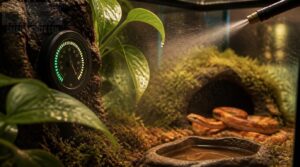
Once you know your gauge is accurate, the next step is fixing what it tells you. A reading outside your snake’s ideal range calls for quick, safe action. Here’s how to bring humidity back in line, without causing new problems.
Raise Enclosure Humidity Safely
When your hygrometer reads too low, don’t panic and blast a mister. Raise humidity in 5 percent increments using a wide pore humidifier with automatic shutoff, placed away from heat mats.
- Mist for 10-30 seconds
- Add a shallow water bowl
- Check moisture-retentive substrate
Recheck your humidity reading within 15 minutes to confirm gradual, safe progress.
Lower Enclosure Humidity Safely
Too much moisture calls for the opposite approach. Use limited air exchange by cracking a vent briefly, and keep temperature steady to avoid rapid cooling.
| Do | Avoid |
|---|---|
| Dry splash zones fast | Cold drafts |
| Place a moisture pad | Sudden vent openings |
Recheck your humidity reading within an hour to confirm a stable drop.
Prevent Saturated Substrate
Damp bedding causes more trouble than a high reading alone. Saturated substrate blocks airflow, breeds odor, and can push enclosure humidity 5 to 15 percent above target for hours.
- Improve substrate drainage by adding a dry base layer
- Boost enclosure ventilation near wet spots
- Follow a substrate replacement schedule every few weeks
Check moisture content by hand. Compacted, sticky substrate means it’s overdue for a swap.
Check for Mold
Wet substrate isn’t the only risk. Check surfaces for mold growth signs: fuzzy patches, discoloration, or a slimy texture on walls, decor, or bedding. Colors range from black and green to white or orange.
A musty smell often means hidden mold under substrate or behind decor. Replace porous materials like wood or foam immediately, then improve ventilation to cut moisture sources.
Recheck After Each Adjustment
Never trust a single number. After you raise or lower humidity, wait five minutes, then check the gauge again. This adjustment verification step confirms the reading matches your target within 2%. Sensor response time varies, so give hygrometers a moment to catch up. Log each result to track drift and keep enclosure equilibrium steady over time.
Frequently Asked Questions (FAQs)
What type of hygrometer is most accurate?
Capacitive sensors with dew point precision offer the best accuracy, usually within ±1 to ±3 percent RH. Digital hygrometers using stable sensor materials outperform analog dials and psychrometers, especially with regular calibration.
Can humidity levels affect snake shedding problems?
Yes. Humidity below 60 percent often causes stiff, stuck sheds, while a humid hide with damp moss loosens skin around the head. Keep moisture steady and ventilated to prevent mold and support clean, single-piece shedding.
How often should I replace my hygrometer?
Most units drift after 3-5 years. Check replacement intervals yearly using the salt test. If readings stay off by more than 3 percent RH after calibration, replace the hygrometer to protect your snake’s humidity and comfort levels.
Do digital hygrometers need batteries to work?
Your digital hygrometer runs on replaceable or rechargeable batteries to power its sensor and display. Battery life often spans months to a year. Watch for the low battery indicator, since a dying power source throws off wireless transmission and humidity readings alike.
Whats the difference between humidity and temperature control?
Your dehumidifier changes moisture in the air, while your heater or fan changes heat. They interact through dew point, but humidity affects comfort and mold risk on its own, separate from whatever the temperature reads.
Conclusion
A thousand shed problems trace back to one small dial on the wall. Once you master how to read a humidity gauge, that dial stops lying to you.
Placement matters. Calibration matters. Timing matters. Run the salt test twice a year, log your readings daily, and trust the numbers over your gut. Your snake can’t tell you what’s wrong, but a properly calibrated gauge always will. Read it right, and the guesswork finally ends.