This site is supported by our readers. We may earn a commission, at no cost to you, if you purchase through links.

Grab a tape measure before you grab a tank size chart. Most sizing charts online use gallons or generic "adult size" labels, and that’s how snakes end up cramped in enclosures that look fine on paper but feel like a shoebox in real life.
Your snake’s actual length and girth tell the real story, not some product label. A 4-foot corn snake and a 4-foot ball python don’t need the same footprint, and guessing costs you money and stresses your snake out.
Get this part right, and every other decision, from floor space to climbing height, falls into place fast.
Table Of Contents
Key Takeaways
- Skip the generic size charts and use a tape measure to record your snake’s actual length and maximum girth, since those real numbers—not gallon labels—should drive every enclosure decision you make.
- Rechecking measurements regularly matters too, so plan on every 4-6 weeks for young snakes and every 2-4 weeks for hatchlings, since growth happens fast and yesterday’s fit won’t last.
- Interior space gets eaten up quickly by wall thickness, substrate depth, hides, water bowls, basking platforms, and climbing branches, so always calculate usable room rather than trusting the tank’s outer dimensions.
- Before buying, sketch your layout to scale and double-check door swing clearance, heat source spacing, and ventilation, since catching sizing mistakes on paper beats discovering them after your snake’s already moved in.
Measure Your Snake Accurately
Before you shop for an enclosure, you need real numbers, not guesses. Grabbing a tape measure and checking your snake the right way makes all the difference. Here’s exactly how to get those measurements right.
For a full breakdown of length, girth, and enclosure sizing ratios, this guide to choosing the right snake tank walks you through turning those measurements into the perfect fit.
Measure From Nose to Tail
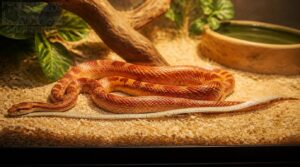
A tape measure is your first real tool here, not a guess. Run it from nose tip to tail tip while your snake rests naturally, never stretched.
- Measure twice for consistency
- Record inches and centimeters
- Recheck after a cooldown period
Skipping this step means guessing at enclosure size later, and that’s a mistake worth avoiding.
Record Maximum Body Girth

Length only tells half the story. Your snake’s maximum girth, the widest point around its body, decides how much floor space it needs to turn and coil.
Wrap a flexible tape around the thickest section, usually mid-body, and check a few spots to confirm you’ve found the true peak. Log this number alongside length for accurate tracking. Understanding the circumference versus width distinction helps make sure you’re measuring the right dimension for enclosure sizing.
Measure Without Stretching
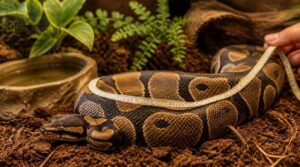
Girth done, now grab a natural resting measurement instead of stretching your snake taut, which inflates the number.
- Let it rest calmly
- Lay tape gently along curves
- Keep it hydrated for stability
- Take three readings
- Average them, avoiding overestimation
This mirrors internal usable space planning, no false stretching to fudge the fit.
Recheck Growing Snakes Regularly
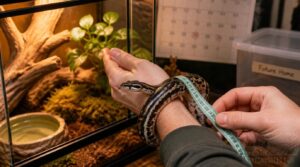
One measurement won’t cut it, snakes grow fast. Recheck every 4-6 weeks in year one, or every 2-4 weeks for hatchlings under six months. Pair rechecks with health checks and feeding schedule reviews.
If you’re unsure how often your snake should actually be eating between measurements, this guide to safe snake feeding schedules breaks it down by age and species.
| Age Stage | Recheck Frequency |
|---|---|
| Hatchling ( The label lies a little—always check interior specs, since your snake only cares about usable space, not the outside shell |
Account for Wall Thickness
Those walls eat more space than you’d think. Material thickness varies a lot, glass runs 6 to 8mm while wood hits 12 to 24mm, so always measure the actual panel, not the nominal spec. Manufacturing tolerance means real thickness can shift slightly too.
When calculating usable room for hides, water bowls, or basking spots, use the smallest expected wall thickness for safe clearance.
Check Substrate Depth
Substrate steals more floor space than beginners expect. Keep substrate depth at 2 to 4 inches for most terrestrial snakes, covering heat sources by 1 to 2 inches to prevent burns.
Burrowing species need 3 inches minimum, and depth also drives humidity regulation. Factor this into your maintenance routine too, since weekly spot-cleaning needs room to work without disturbing buried heat zones.
Measure Door Opening Clearance
Once substrate depth is set, check the door itself. Your door swing space needs at least 32 inches clear, growing to 36 if frame depth passes 24 inches. Watch hinge placement, threshold clearance, and handle reach too.
- Door swing clearance
- Hinge side offsets
- Frame depth
- Cable entry room
- Mounting constraints
Confirm Escape-Proof Gaps
With the door swinging clear, check every seam next. Run your hand along joints and hinges, feeling for gaps over 2mm. Test gasket compression at the door, and check cable grommets and vent mesh too.
Snakes push through surprisingly small openings, so this closure gap analysis matters as much as size.
Allow Room for Furnishings
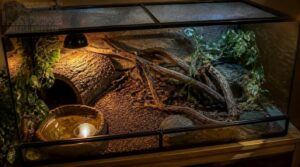
Empty floor space is only half the equation, so now it’s time to think about what goes inside it. Your snake needs hides, water, heat, and room to actually move around, and each one takes up real space. Here’s what to fit in, and how to size it right.
Fit Two Secure Hides
Give your snake two hides, one warm and one cool, with a 2 to 3 inch gap between them.
Each needs a 2.5 inch entry, smooth nonporous walls, and room to coil fully without crowding. Size hides at 1.5 to 2 times girth, with 1 to 2 inches headspace so entry stays easy, not a squeeze.
Size The Water Bowl
With hides sorted, water comes next. Pick a 4 to 6 inch diameter bowl, no deeper than 1.5 inches, so your snake drinks easy without drowning risk.
Set it on the cool side, 2 inches from hides. Ceramic resists tipping and cleans well.
Rinse daily, scrub weekly with dilute vinegar, no worries.
Reserve Basking Area Space
Once bowls are set, think about basking. Reserve at least 20 percent of floor space for a stable platform, 12 to 18 inches wide for a 4 foot snake.
Keep it within 6 to 8 inches of your heat source. Use non-skid, heat tolerant material that holds full body weight without wobbling or tipping.
Include Climbing Enrichment
For climbing, a branch that’s 1.25 to 2 inches thick works best so your snake can’t slip. Place it vertically, reaching at least 18 inches up, with secure mounting points and 2 inches of wall clearance.
Add rough, natural texture for grip and stack a couple levels for layered movement without crowding the basking zone.
Preserve Open Movement Paths
Walk the layout in your head before your snake ever does. Keep a path width of at least 8 inches with a 12-inch turning radius, no gaps over an inch.
Align the corridor end to end, round off sharp edges, and route cords and heater wires outside the lane so nothing snags mid-crawl.
Verify Fit Before Buying
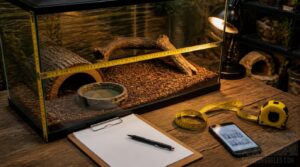
You’ve got the measurements, so now it’s time to put them to work. Before you swipe your card, run through a few quick checks to make sure everything actually fits together. Here’s what to look at before you buy.
Sketch The Enclosure Layout
Grab paper before cash. Draw your enclosure’s footprint to scale, then mark hide, water, basking, and climbing zones plus door swing. Add a quick legend.
- Outer rectangle (exact dimensions)
- Zone boundaries
- Access points
- Cable entry paths
- Legend key
This catches sizing mistakes early, before you’re stuck with a tank that doesn’t fit your setup.
Check Heating Equipment Clearance
Heat sources need breathing room, not a tight squeeze. Keep 6 inches of clearance on all sides of your heater.
| Check | Minimum Space |
|---|---|
| Heat Source Spacing | 6 inches, all sides |
| Flammable Material Distance | 12 inches |
| Ceiling/Lid Clearance | Unobstructed above |
Route cords away from hot surfaces before you commit to buying.
Confirm Ventilation and Humidity
Good air movement keeps humidity stable, so check your airflow path design before buying anything.
- Vents on opposite walls for cross ventilation
- A digital hygrometer to monitor levels
- Clear exhaust routing away from the enclosure
Most snakes need 50 to 70 percent humidity depending on species, and proper ventilation placement prevents mold without drying things out.
Placing your hygrometer correctly matters just as much as the number it shows, so use this step-by-step guide to reading a humidity gauge to position sensors where airflow keeps readings accurate.
Test Cleaning Access
Ventilation matters, but so does reaching every corner with a scrub brush.
Before buying, test your cleaning access point by opening the door fully. Check door swing clearance, interior neck space (aim for 12 inches), and sealing spill prevention gaskets. Make sure cleaning tools compatibility works too, brushes up to 12 inches should fit without jamming during maintenance access.
Avoid Common Sizing Mistakes
Cleaning access checked, so now scan for the mistakes that trip up most first-time buyers.
Common Mistakes to Avoid:
- Ignoring growth projections for adult length
- Underestimating clearance around heat sources
- Neglecting substrate depth when measuring interior space
- Forgetting door swing during placement planning
- Overlooking ventilation needs in your box fill calculation
Skip these, and your snake’s home fits right the first time.
Frequently Asked Questions (FAQs)
How much clearance does a heat lamp require?
Clearance depends on lamp wattage, generally 12 to 24 inches from the basking surface. Use a guard, check surface temps with a thermometer, and keep good airflow around the fixture to support proper thermal management and cooling space.
Can enclosure size affect snake feeding response?
As the old saying goes, size matters. Yes, space-to-body ratio directly affects feeding, with proper thermal gradient, hiding spots, and vertical room boosting strike response by 20-60%, while cramped tanks trigger stress-driven feeding refusal.
How often should enclosure dimensions be reassessed?
Check dimensions every six months for growing snakes, or sooner if growth rate monitoring shows a 10% size jump, species life stage changes, enrichment impact alters space, or after relocation assessment and upgrade verification confirm continued fit.
Does enclosure shape matter more than volume?
Yes, shape can matter more than a giant empty box. Wide, shallow layouts boost airflow efficiency and horizontal movement, matching natural snake behavior better than tall, cramped shapes with identical volume but poor space utilization.
Conclusion
Goldilocks knew the feeling: not too small, not too big, just right, and that’s exactly the standard your snake deserves. Once you master how to measure enclosure size needs, every single choice after gets easier, from hide placement to basking spots.
Your tape measure matters far more than any glossy chart ever could. Trust the actual numbers, not the label. Build the space your snake truly needs, and watch it thrive instead of just survive.