This site is supported by our readers. We may earn a commission, at no cost to you, if you purchase through links.

Your studio apartment has 400 square feet, and your ball python needs a microclimate as precise as a greenhouse. That’s a tough ask when your enclosure sits three feet from a radiator and your landlord won’t let you cut vents in the wall. Get the humidity wrong by even 10%, and you’re looking at retained shed or respiratory infections down the line.
The good news? You don’t need a bulky weather station to solve this. Reptile humidity gauges for small apartments come in compact, wall-mounted designs built for exactly this kind of space-strapped setup. Some fit two sensors on a single unit, others sit flush against glass with no cords in sight, and the right pick depends on how many enclosures you’re managing and how much precision your species demands.
Table Of Contents
- Key Takeaways
- Top 6 Reptile Humidity Gauges
- Comparing Compact Humidity Gauge Features
- Accuracy and Calibration Essentials
- Placement in Small Snake Enclosures
- Choosing Your Apartment-Friendly Humidity Gauge
- Frequently Asked Questions (FAQs)
- How can I measure the humidity in my apartment?
- What is the best humidity gauge for reptiles?
- Are inexpensive hygrometers accurate?
- What are some cheap hygrometers available?
- Do humidity gauges affect a reptiles stress levels?
- How often should apartment terrariums be misted for humidity?
- Can humidity gauges be used in bioactive setups?
- Conclusion
Key Takeaways
- Digital gauges beat analog for small apartment enclosures since they update in real time and hold tighter accuracy (often within ±1-2%), even though you’ll need to swap batteries every few months.
- Placement matters as much as the gauge itself, so keep sensors mid-tank at snake height, 8-12 inches from water bowls, and at least 6 inches from heat lamps to avoid skewed readings.
- You can verify any gauge’s accuracy at home with a simple salt test: seal a damp salt slurry next to the gauge in an airtight container for 8-12 minutes and it should read 75% RH.
- Match your gauge choice to your setup by checking your snake’s species requirements (ball pythons need 50-60% humidity), choosing a single unit or multipack based on how many enclosures you’re managing, and replacing any gauge once drift passes 5% over two weeks.
Top 6 Reptile Humidity Gauges
Living in a small apartment doesn’t mean you have to guess at your snake’s humidity anymore. You just need a gauge small enough to fit your space but accurate enough to trust with your reptile’s health. Here are six compact options worth checking out.
Once you’ve nailed the humidity readings, pair that data with the right best snake bedding options for small apartments to keep both odor and moisture levels in check.
1. JEDEW Digital Hygrometer Thermometer 2 Pack
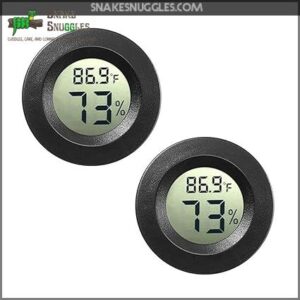
Two gauges for the price of one? That’s the appeal here. The JEDEW 2 pack gives you a round LCD unit for each end of the tank, reading 0-70°C and 10-99% RH off a single LR44 battery per device.
Accuracy runs about ±1°C and ±5% RH, tight enough for most snakes. Double-sided tape mounts it to glass in seconds, and its compact, round shape tucks into corners without crowding a small apartment enclosure.
| Best For | This 2-pack is best for reptile owners and hobbyists who want to monitor temperature and humidity in small enclosures like terrariums, humidors, or filament storage jars. |
|---|---|
| Display Type | Digital LCD |
| Mounting Method | Freestanding |
| Power Source | 2x LR44 battery |
| Reptile Suitable | Yes |
| Unit Count | 1 |
| C/F Switchable | Yes |
| Additional Features |
|
- Updates temperature and humidity readings every 10 seconds for near real-time monitoring
- Compact, lightweight design (1.78" W x 0.6" H, 40 g) fits easily into small spaces
- Includes dual LR44 button cells rated to last up to 10 months, plus easy one-button °F/°C switching
- Humidity accuracy is only ±3% RH, which may not be precise enough for sensitive applications
- Some users report sluggish humidity readings when ambient temperatures are high
- Temperature accuracy feedback is mixed, with occasional reports of inconsistent readings
2. Serundo Mini Digital Hygrometer Thermometer
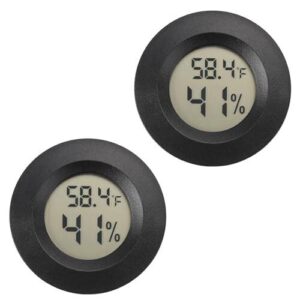
If corner space is your real problem, the Serundo mini solves it by going small instead of doubling up. This single sensor packs both readings into a pocket-sized shell, light enough to tuck anywhere without crowding your setup.
The LCD stays readable despite the compact size, and switching between Celsius and Fahrenheit takes one button press. For studio apartments where every inch counts, this lightweight, single-unit design beats bulkier gauges without sacrificing daily usability.
| Best For | Anyone with a small space—like a studio apartment, closet, or single terrarium—who wants a compact, no-fuss way to keep an eye on temperature and humidity. |
|---|---|
| Display Type | Digital LCD |
| Mounting Method | Adhesive tape |
| Power Source | 2x LR44 battery |
| Reptile Suitable | Yes |
| Unit Count | 1 |
| C/F Switchable | Yes |
| Additional Features |
|
- Compact, single-unit design that fits easily into tight spaces without crowding a setup
- Easy-to-read LCD display with simple one-button Fahrenheit/Celsius switching
- Automatic readings refresh every 10 seconds, so data stays current without manual checks
- Doesn’t measure humidity below 10% RH, so it’s not ideal for very dry environments
- Not lab-grade precision, making it better suited for general monitoring than scientific use
- Adhesive backing may loosen over time, potentially requiring reattachment
3. Reptile Thermometer Humidity Gauge 2 Pack
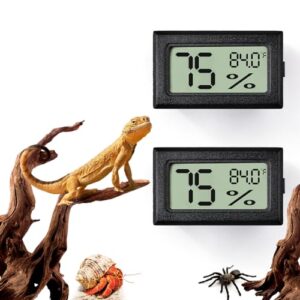
Got two enclosures side by side? This 2 pack makes more sense than buying duplicates of a single unit. Each gauge reads temperature and humidity together, with ±1°F and ±5% RH accuracy, close enough for daily habitat checks.
Adhesive backing sticks to glass fast, though it can loosen over time, so keep some extra mounts on hand. The button cell battery lasts roughly 90 days, and since both units aren’t drawing power together, you won’t face a dead gauge in every tank at once.
| Best For | Reptile owners with multiple enclosures, like bearded dragons, geckos, or snakes, who need consistent temperature and humidity monitoring in each tank. |
|---|---|
| Display Type | Digital |
| Mounting Method | Adhesive backing |
| Power Source | Button cell battery |
| Reptile Suitable | Yes |
| Unit Count | 1 |
| C/F Switchable | Not specified |
| Additional Features |
|
- Combined temperature and humidity readings on one digital display for quick habitat checks
- Two units let you monitor separate enclosures or warm and cool zones without buying multiples
- Long-lasting button cell battery (about 90 days) keeps upkeep minimal
- Adhesive backing can loosen over time and may need reapplication or a different mounting method
- Some users notice inconsistent readings between the two units or drift from actual conditions
- Battery isn’t user-replaceable in all cases, which can limit the gauge’s long-term convenience
4. Reptile Terrarium Thermometer Hygrometer Dual Gauges
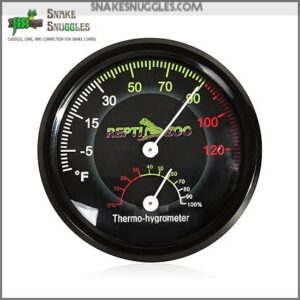
Want more range than a basic dual gauge offers? This one uses two separate sensing elements in one housing, so temperature and humidity don’t cross-contaminate each other’s readings.
Because both readings come from the same spot, you get accurate data for setting up desert reptile humidity gauges without guessing where to place separate sensors.
A remote probe reaches tight corners, like behind hides, without moving the whole unit. Manufacturer tolerance sits around ±1 to ±2°C for temperature and ±3 to ±5% RH for humidity, solid for daily checks. Built-in brackets skip the sticky adhesive problem entirely, giving apartment tanks a cleaner, more secure mount.
| Best For | Reptile owners who want a simple, no-battery gauge to keep an eye on basic temperature and humidity levels in their terrarium. |
|---|---|
| Display Type | Analog Dial |
| Mounting Method | Adhesive backing |
| Power Source | No battery needed |
| Reptile Suitable | Yes |
| Unit Count | 1 |
| C/F Switchable | Not specified |
| Additional Features |
|
- Monitors both temperature and humidity at a glance with easy-to-read color-coded segments
- Requires no batteries, making it energy-efficient and low-maintenance
- Compact and easy to mount with adhesive backing, fitting into tight enclosure spaces
- Adhesive mount can weaken over time, especially in humid conditions
- Analog readings are less precise than digital gauges and may lag behind actual changes
- Manufacturer doesn’t specify exact temperature or humidity ranges, making accuracy hard to verify
5. PAIZOO LED Reptile Thermometer Hygrometer
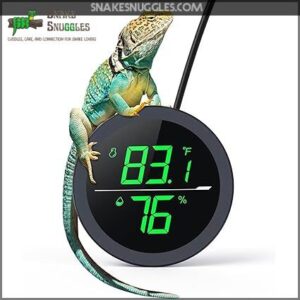
Bright screens matter more than you’d think when your snake’s tank sits across a dim apartment room. This unit’s 3 inch LED display solves that, showing readings in Fahrenheit or Celsius with a toggle switch.
The backlight stays legible even through foggy, humid glass, and you can set it to sleep mode if constant glow bothers you at night.
Readings refresh every few seconds, so you’re never checking stale numbers, just current conditions at a glance.
| Best For | Reptile and terrarium owners who want a bright, easy-to-read display for monitoring temperature and humidity from across the room. |
|---|---|
| Display Type | Digital LED |
| Mounting Method | Adhesive tape |
| Power Source | USB powered |
| Reptile Suitable | Yes |
| Unit Count | 1 |
| C/F Switchable | Not specified |
| Additional Features |
|
- Large 3 inch LED display with backlight stays visible day or night, even through foggy enclosure glass
- Simple setup with included USB power cable and 3M adhesive tape for flexible mounting
- Dual-sensor design with a high-precision chip helps track both temperature and humidity in one unit
- Some users report inconsistent or unreliable humidity readings, especially in high-moisture environments
- Several reports of units failing after just weeks or months of use
- Requires constant USB power, which can limit placement options near outlets
6. Reptile Thermometer Humidity Gauge Dual Pack
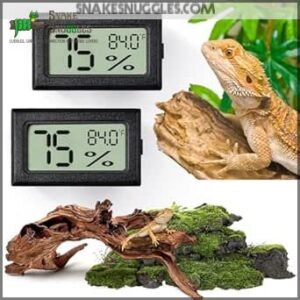
When one gauge just isn’t enough, this dual pack from Vodolo covers both ends of a split enclosure without buying two separate products. Each unit reads temperature and humidity with 0.9°F accuracy, switching easily between Fahrenheit and Celsius.
Adhesive backing means tool-free mounting on glass or plastic, though some owners find the stick wears off over time. Probes sit inside while displays stay outside, so you’re reading real conditions, not guesswork, updated every few seconds.
| Best For | Reptile and amphibian owners who need reliable multi-zone monitoring across large or split enclosures, from bearded dragons and leopard geckos to snakes and plant terrariums. |
|---|---|
| Display Type | Digital LED |
| Mounting Method | Adhesive backing |
| Power Source | Replaceable battery |
| Reptile Suitable | Yes |
| Unit Count | 2 |
| C/F Switchable | Yes |
| Additional Features |
|
- Two units let you monitor both ends of a split habitat without buying separate products
- Easy tool-free adhesive installation with switchable Fahrenheit/Celsius display
- Accurate readings within 0.9°F, with probes inside and displays outside for real-time conditions
- No backlight, making the display hard to read in low light
- Adhesive can wear off or leave residue over time
- Some units show inconsistent accuracy, sensor failures, or faster battery drain
Comparing Compact Humidity Gauge Features
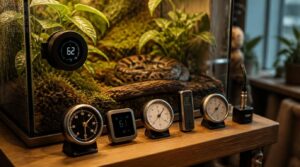
Not all humidity gauges are built the same, and in a small apartment, those differences matter more than you’d think. Screen size, battery type, and mounting style can make or break your daily check-in routine. Here’s what to look for before you pick one for your snake’s enclosure.
Digital Versus Analog Gauges
Digital or analog, which wins for your snake’s tank? Digital gauges update in real time and hold tighter tolerance, often within 2%, while analog needles need no batteries but drift as parts wear. Digital needs periodic battery swaps; analog just sits there, rugged and simple.
Analog units also tend to hold up better in high-vibration environments, since their simple mechanical needle design requires no electronic processing to function. For small enclosures, digital’s accuracy usually earns its keep.
Display Size and Readability
Squinting at a tiny screen across the room won’t help your snake, or your eyes. Look for numeral size around 2 inches, high contrast clarity, and an adjustable backlight for night checks.
- LCD screens for daylight clarity
- LED, color-coded displays for glare
- Shielded screens resist condensation fog
Readable from 18 to 24 inches keeps checks quick and stress-free.
Combination Temperature Humidity Readings
Why check two gauges when one does the job? A quality mini hygrometer thermometer digital unit gives dual readings, temperature and humidity, from the same spot, same second.
| Feature | Benefit |
|---|---|
| Dual sensor combination | Synchronized data output |
| Dual-unit display | Environmental correlation tracking |
Adhesive mounting keeps combination gauge units fixed wherever you need them.
Battery Life and Replacement
Nobody wants to swap batteries every month, so here’s what actually matters.
- LR44 or CR2032 coin cells are standard
- Alkaline or lithium cells last longer than generic ones
- Low battery warnings appear around 10-25% power
- Cold or humid enclosures cut life by 20-40%
Replace with correct polarity, clean contacts first, and store spares in original packaging to avoid leakage.
Space-Saving Mounting Options
Battery savings won’t matter if the gauge clutters your terrarium. Look for a compact form factor with hook or adhesive mounting, like Magnetic Mount Solutions, Adhesive Disk Attachments, or Clamp and Rod Systems for discreet installation.
| Mount Type | Best For | Weight Limit |
|---|---|---|
| Magnetic | Metal stands | 150-200g |
| Adhesive Disk | Glass fronts | Light gauges |
| Clamp/Rod | Rims to 1.5cm | Adjustable |
Reusable Mounting Pads suit small to midsized enclosures perfectly.
Accuracy and Calibration Essentials
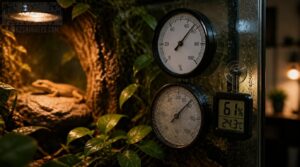
A cheap gauge that lies to you is worse than no gauge at all, since you’ll trust a number that’s flat-out wrong. Good news: spotting a reliable reading, and catching one that’s drifted off track, only takes a few simple checks. Here’s what you need to know before you trust that display.
A cheap gauge that lies to you is worse than no gauge at all
Manufacturer Tolerance Ratings
Ever wonder why two gauges in the same tank disagree? It’s all about tolerance, the wiggle room manufacturers allow, often ±2 to ±5 percent RH. Cheaper models loosen that band, while pricier ones promise ±1 to ±2 percent under ideal conditions.
Check specs for calibration validity and temperature compensation, since drift creeps in as sensors age.
Simple Salt Test Calibration
So how do you actually know your gauge is telling the truth? Grab table salt, water, and a cap: mix roughly 1 teaspoon into a damp slurry, seal it beside your humidity gauge in an airtight container, and wait 8 to 12 minutes. It should settle at 75% RH.
Off by a few points? That’s your offset correction factor for daily readings.
Detecting Long-Term Sensor Drift
That salt test catches errors today, but drift creeps in slowly, often after 12 to 18 months in humid enclosures.
- Compare readings monthly to a reference hygrometer
- Watch for offsets beyond 2% across 30 days
- Note if drift reverses at night (temperature artifact)
- Log calibration dates for traceability
- Flag deviations over 1% for review
Sensor drift rarely announces itself, so tracking beats guessing.
When to Replace Gauges
So when’s the actual retirement party? Once drift exceeds 5% over two weeks, or calibration accuracy loss makes salt tests useless, replace it.
| Warning Sign | Action |
|---|---|
| Display dead zones | Replace now |
| Battery life indicators dim | Swap battery first |
| Humidity-induced failure | Replace immediately |
For multitank monitoring, stagger replacements so you’re never guessing blind across enclosures.
Placement in Small Snake Enclosures
A great gauge only tells you the truth if you put it in the right spot. Even in a small apartment tank, a few inches of placement can mean the difference between an accurate reading and a guess. Here’s exactly where your gauges need to go to keep your snake’s humidity honest.
Measure Mid-Enclosure Humidity
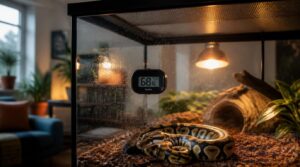
Where should your gauge actually sit? Dead center, at snake height, not jammed in a corner.
MidTank readings capture the real air your snake breathes, skipping skew from dishes or heat lamps.
Mount with adhesive backing on a vertical wall, 2 to 4 inches below the lid, cord tucked away from clutter.
Avoid Water Bowl Proximity
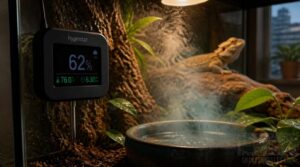
Would you trust a bathroom scale sitting next to a running shower? That’s basically what happens with water bowl proximity, humidity halos skew readings 15% higher. Keep 8 to 12 inches of bowl distance placement. Ceramic bowls worsen this more than plastic.
Run calibration checks monthly, and check substrate moisture and sensor maintenance for corrosion near splashes.
Prevent Heat Lamp Interference
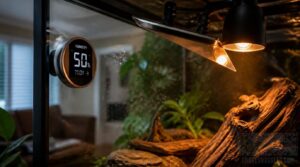
Heat lamps throw off more than warmth, they throw off your readings too. Keep gauges at least 6 inches from the bulb’s path, since heat lamp interference inflates numbers fast.
A small heat shield or reflective hood redirects that stray heat elsewhere. Check lamp mounting stability monthly. Wobbly brackets shift hot spots right onto your sensor, skewing everything.
Secure Gauges Without Clutter
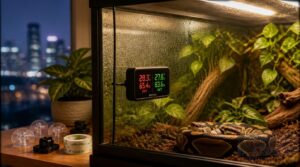
Small tanks fill up fast, so mounting matters. Try magnetic mounts, sticky tape, suction cups, or clip-on brackets, whatever suits your glass or mesh.
- Tangled cords brushing your snake
- Loose gauges falling into water
- Adhesive residue ruining sightlines
- Clutter blocking feeding access
A compact LCD with color-coded dual readings and a long USB cable keeps things tidy and readable.
Monitor Warm and Cool Zones
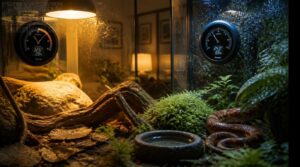
Your snake needs options, not just a warm room. A proper thermal gradient spans 15 to 25°F between zones, so set one sensor probe right on the basking surface and another mid-tank for the cool end.
Shield probes from direct lamp exposure, that radiant heat skews readings badly. Check both zones daily with a reliable reptile thermometer.
Choosing Your Apartment-Friendly Humidity Gauge
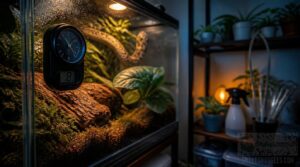
So how do you actually pick the right gauge for your setup, instead of just grabbing whatever’s cheapest at the pet store? A few small factors, like your snake’s species and how much room you’re working with, make a bigger difference than you’d think. Here’s what to weigh before you settle on one.
Match Your Snake Species
Every species has its own humidity rulebook. Ball Python humidity sits at 50-60%, Corn Snake and King Snake needs run similar, while Milk Snake setups and Garter Snake requirements skew drier.
Buying a Reptile Humidity Gauge without checking your Snake Species first is like guessing shoe size, technically possible, rarely comfortable for anyone involved.
Consider Enclosure Size
Bigger tanks hold more air, and more air means humidity swings slower, that’s basic enclosure volume impact. Tiny setups heat and dry out fast.
Look for:
- Room for a humid hide plus water bowl
- Vertical humidity zones for climbing species
- Airflow that avoids stale microclimates
- Space for proper sensor placement accuracy
- Adhesive backing options for tight terrarium monitoring
Compare Single and Multipacks
One reptile humidity gauge or a matched pair, which suits your studio setup best? A single pack cuts upfront cost and storage clutter, perfect for testing one enclosure first.
| Factor | Single Pack | Multipack Form Factor |
|---|---|---|
| Cost | Lower upfront | Better per-unit value |
| Storage | Minimal | More space needed |
| Best for | Beginners testing fit | Multiple enclosures |
Prioritize Quiet Compact Designs
Apartment walls are thin, so a beeping gauge or buzzing fan is a dealbreaker. Look for a quiet operation footprint under 18 dB, plus compact wall mounting at 2 by 1.8 inches.
- Slim enclosure fit under 0.6 inches
- Adhesive backing or magnetic mount
- USB powered option for continuous use
- Dual-unit, real-time LCD readout
Balance Price With Reliability
Cheap gauges tempt you, but drift beyond 3% within six months means replacing them anyway, so accuracy beats a low price tag.
Multi-packs cut per-unit cost up to 18%, and subsidized replacements keep long-term spending down. Check for solid warranty support and consistent user reviews.
A slightly pricier digital thermostat with dual unit measurement, USB power, and adhesive backing pays for itself.
Frequently Asked Questions (FAQs)
How can I measure the humidity in my apartment?
Grab a digital hygrometer for apartment-wide monitoring, placed centrally at chest height, away from heat sources and drafts. Check readings at different times of day; aim to keep indoor humidity between 30 and 60 percent for healthy conditions.
What is the best humidity gauge for reptiles?
Look for a digital LCD with color-coded display and 9°F accuracy, easy sensor placement, solid battery life, and secure adhesive mounting. That combo gives you reliable, skimmable readings without babysitting your snake’s enclosure daily.
Are inexpensive hygrometers accurate?
Honestly, budget hygrometers wander like a toddler with no bedtime. Expect ±3 to 5% tolerance, minimal temperature compensation, and gradual sensor drift, so check calibration every few months to keep readings trustworthy.
What are some cheap hygrometers available?
JEDEW and PAIZOO offer budget hygrometer brands with digital LCD or LED displays, F/C switching, and ±3-5% accuracy under $ Compact analog dial options need no batteries, while digital units run 6-12 months per charge.
Do humidity gauges affect a reptiles stress levels?
Yes. Steady humidity prevents dry-air coughing and cuts behavioral stress signs like hiding or refusing food.
Swings force constant regulation, raising alertness.
Accurate, calibrated gauges support microclimate stability, keeping shedding smooth and stress genuinely low.
How often should apartment terrariums be misted for humidity?
Mist once or twice daily during dry spells, or 3-4 times weekly if your room humidity runs high. Check condensation and substrate moisture first, since your terrarium climate control depends more on relative humidity than a fixed misting schedule.
Can humidity gauges be used in bioactive setups?
Absolutely, gauges offer non-invasive monitoring for bioactive tanks, tracking ambient RH without disturbing isopods or soil life. Keep probes clear of water sources for condensation avoidance, and use several for accurate gradient mapping across microhabitats.
Conclusion
Small spaces demand smart solutions, and your python’s health hinges on the numbers you trust.
The right reptile humidity gauges for small apartments turn a cramped studio into a controlled microclimate, no vents or weather stations required.
Pick a gauge that fits your enclosure, calibrate it with the salt test, and check it daily like clockwork.
Your snake can’t tell you it’s struggling. The gauge can, if you’re watching.
- https://www.zenhabitats.com/blogs/reptile-care-sheets-resources/complete-humidity-and-hydration-guide-for-crested-geckos
- https://www.merckvetmanual.com/all-other-pets/reptiles/providing-a-home-for-a-reptile
- https://www.thebiodude.com/blogs/reptile-and-amphibian-lighting-faqs-and-help/how-to-place-thermometer-and-hygrometer-probes