This site is supported by our readers. We may earn a commission, at no cost to you, if you purchase through links.

Your ball python sits in a shed that won’t finish. Humidity reads 48%, the skin tears in patches, and you’re misting twice a day. The enclosure isn’t the problem. The substrate is.
The substrate that retains humidity best does the work for you: it holds water in the bottom layer, releases it slowly, and resists mold. Choose wrong and you’re fighting dry air or rotting bedding. Ball pythons need 60-80%. Sand boas need 30-40%. Depth, material, and species all matter.
Here’s what holds moisture, what breeds mold, and which four products earn a place in your setup.
Table Of Contents
- Key Takeaways
- Best Humidity-Retaining Substrates for Pet Snakes
- Matching Substrates to Your Snake’s Humidity Needs
- Top 4 Products Compared for Humidity Retention
- DIY Substrate Mixes, Depth, and Moisture Management
- Safe Substrate Maintenance and Mold Prevention
- Frequently Asked Questions (FAQs)
- What substrate holds humidity?
- Is 75% of humidity too high for hatching?
- What can I put under my house to absorb moisture?
- What snakes like high humidity?
- Can bioactive setups help maintain humidity naturally?
- Which hygrometer placement gives the most accurate humidity readings?
- How deep should substrate be for burrowing reptiles?
- Why should cedar and pine substrates be avoided?
- How often should humid hides be refreshed?
- Conclusion
Key Takeaways
- Match your substrate to your snake’s humidity range: cypress mulch or coconut fiber for ball pythons and boas at 60-80%, a coconut fiber and dry aspen mix for corn snakes at 50-60%, and dry sand only for arid species like sand boas at 30-40%.
- Pack your substrate deep, at least 4 to 6 inches for most setups and 3 inches or more for burrowers, and layer coconut fiber under cypress mulch so the bottom stays wet and the top stays drier.
- Skip sphagnum moss as a base and keep it in one damp hide, avoid cedar and pine because their oils harm your snake’s lungs, and don’t use desert sand for humidity-dependent snakes since it holds almost no moisture.
- Keep humidity from turning into mold by spot-cleaning daily, running cross-ventilation, refreshing the top inch monthly, and checking a hygrometer at substrate level on both the warm and cool sides.
Best Humidity-Retaining Substrates for Pet Snakes
Substrate does most of your humidity work. Choose poorly, and no misting routine will rescue you. Three materials lead the field: orchid bark, cypress mulch, and coconut husk.
Because each python species needs a different humidity range, it’s worth checking humidity differences between python species before settling on a substrate.
Cypress mulch is your best all-rounder: it offers strong moisture retention and resists mold, even when it stays wet. Coarse coconut husk holds far more water than fine grade, so buy coarse. Coconut husk chips also need pre-soaking and buffering to remove tannins and salts before use. Coconut fiber works too: it holds water, breathes, and breaks down slowly.
Skip sphagnum moss as a standalone base. It holds the most water, but it’s wrong for snakes. Use it only as a damp hide. Avoid desert sand: it absorbs humidity from the air instead of keeping it. For humidity regulation in a bioactive substrate, mix in coconut fiber.
Matching Substrates to Your Snake’s Humidity Needs
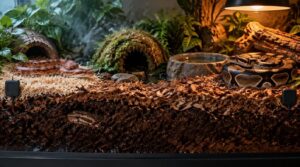
Match the substrate to the species. Humidity retention needs differ, so one setup won’t fit every snake.
Ball pythons and boas need 60-80%. Use cypress mulch or coconut fiber, and keep a damp sphagnum hide for shedding. Corn snakes want 50-60%. Mix coconut fiber with dry aspen to dial in the level. Sand boas thrive at 30-40%, so keep their substrate dry.
Burrowers like hognose snakes need a substrate depth recommendation of at least 3 inches. Deeper is better: they should vanish completely.
Build a gradient. Layer coconut fiber under cypress mulch so the bottom stays wet and the top stays drier. In a bioactive substrate, the same layering works.
Measure at substrate level, on both the warm and cool sides. One wall gauge lies to you.
Top 4 Products Compared for Humidity Retention
Four substrates follow, ranked by how well they hold moisture. You’ll see where each one works and where it fails: humidity retention is the test. Pick the one that fits your snake’s needs.
1. Bio Dude Terra Firma Substrate 36qt
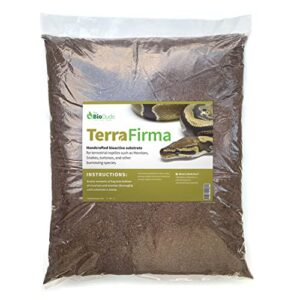
Picture a ball python sliding into a tunnel that stays open, walls firm, air cool and damp around its coils. That’s what Terra Firma does.
Pairing that bark and stone with a proper temperature gradient is easier with these reptile habitat design tips, which cover hide placement, ventilation, and basking zones.
It holds 50-75% humidity. Surface stays dry. Moisture sits in the middle and lower layers. No drainage layer needed. The 36-quart bag weighs 35 pounds. Fill deep enough for burrowing.
Watch your readings: some keepers report low numbers, and it may behave like plain organic potting mix. Mist the lower layers. Stir occasionally. Check daily.
| Best For | Reptile keepers building bioactive enclosures for burrowing species like ball pythons and kingsnakes who want a substrate that holds tunnels and supports live plants. |
|---|---|
| Material | Bioactive soil mix |
| Weight | 35 pounds |
| Burrowing Support | Holds tunnels and burrows |
| Species Compatibility | Ball pythons, kingsnakes |
| Humidity Performance | Optimal range 50-75% |
| Volume | 36 quarts |
| Additional Features |
|
- Holds tunnels and burrows without collapsing
- Keeps good aeration and drainage, so it resists clogging
- Supports a wide range of plants and a balanced bioactive ecosystem with a clean-up crew
- May perform much like standard organic potting mix, according to some user testing
- Needs regular humidity monitoring to stay in the 50-75% range
- Requires enough substrate depth for burrowing species, and some keepers report low humidity readings
2. Zoo Med Forest Floor Bedding 4qt
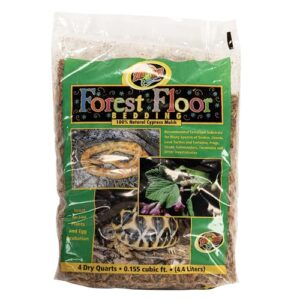
Forest Floor is natural cypress mulch for smaller setups. The 4-quart bag weighs 2 pounds. It holds moisture and releases it slowly, so your enclosure stays humid between mistings. Your snake can burrow and dig in it. Ball pythons and corn snakes suit it well, but skip it for any arid desert species.
Know the downsides: the black color hides waste, so inspect daily. Some keepers report pests. It can also produce dust, so rinse and dry it before use.
| Best For | Keepers of snakes, frogs, and other humidity-loving reptiles or invertebrates in smaller terrariums who want a natural-looking substrate that holds moisture and allows burrowing. |
|---|---|
| Material | Cypress mulch |
| Weight | 2 pounds |
| Burrowing Support | Suitable for burrowing and digging |
| Species Compatibility | Snakes, lizards, turtles, frogs, tarantulas |
| Humidity Performance | Retains moisture for humidity |
| Volume | N/A |
| Additional Features |
|
- Holds moisture and releases it slowly, keeping humidity steady between mistings
- Gives a natural forest floor look in the enclosure
- Lets reptiles and amphibians burrow and dig
- The black color hides waste, so daily inspection is needed
- Some keepers report pest problems
- Can produce dust, so it should be rinsed and dried before use
3. ReptiChip Loose Coconut Chip Substrate
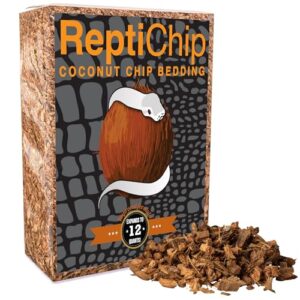
Coconut husk chips hold moisture and release it slowly: that’s the heart of ReptiChip. You get 12 quarts of triple-washed, dust-free, 100% organic chips for ball pythons and other humidity-loving species.
Add water to your desired level. Deeper layers suit tropical setups; thinner layers dry faster. Mix in sphagnum moss to raise humidity.
The chips resist compaction, so airflow stays good and mold risk drops. Spot-clean waste. Re-wet and reuse.
Expect reddish discoloration on bellies. Bags run smaller than expected.
| Best For | Owners of ball pythons and other humidity-loving reptiles, geckos, tortoises, or tarantulas who want a natural, dust-free substrate that supports burrowing and holds moisture. |
|---|---|
| Material | Coconut husk |
| Weight | 2.29 pounds |
| Burrowing Support | Facilitates burrowing |
| Species Compatibility | Ball pythons, geckos, tortoises, tarantulas |
| Humidity Performance | Ready to use dry or with water |
| Volume | 12 quarts |
| Additional Features |
|
- Made from 100% organic coconut husk, with dust-free, debris-free chips that can be used dry or with added water
- Absorbs odor from waste and regurgitation while encouraging burrowing and natural behaviors
- Resists compaction, so airflow stays good and mold risk drops
- Can leave reddish discoloration on the undersides of reptiles
- Some users find the bag smaller than expected
- May need frequent replacement after absorbing waste
4. Zoo Med Desert White Reptile Sand
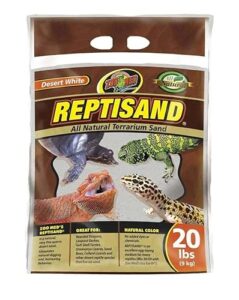
The weakest humidity performer on this list: Zoo Med Desert White Reptile Sand. It drains fast and holds almost no moisture. Don’t use it for ball pythons or other humidity-dependent snakes.
Use it for arid species like sand boas. The 20 lb (9 kg) bag of all-natural sand conducts heat well and encourages burrowing. Need more moisture? Mix in Eco Earth or coconut fiber.
Spot clean waste daily. Expect some kicked-out sand, and check your bag for tears on arrival.
| Best For | Owners of arid species like sand boas and bearded dragons who want a bright, heat-conducting substrate that encourages natural digging and burrowing. |
|---|---|
| Material | Natural sand |
| Weight | 20 lb |
| Burrowing Support | Stimulates digging and burrowing |
| Species Compatibility | Bearded dragons, sand boas, softshell turtles |
| Humidity Performance | N/A |
| Volume | N/A |
| Additional Features |
|
- All-natural sand with no dyes or chemicals
- Conducts heat well, which suits basking species
- Encourages natural digging and burrowing behaviors
- Holds almost no moisture, so it is a poor choice for ball pythons and other humidity-dependent snakes
- Active animals may kick it out of the enclosure
- Needs daily spot cleaning, and the bag may arrive torn or leaking
DIY Substrate Mixes, Depth, and Moisture Management
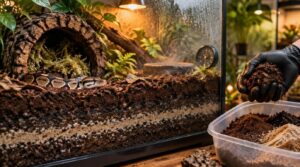
Picture a ball python keeper in Dresden who misted twice a day and still watched humidity sink to 40% by noon. The culprit: 1.5 inches of substrate.
DIY Substrate Mixes fix this cheaply. Mix 40% organic soil mix, 40% coir, 20% play sand. Rehydrate coir in stages. Squeeze it: it should hold shape without dripping.
Go deeper. Aim for 4 to 6 inches of substrate depth. Deep layers store water and cut your misting.
Three things you’ll feel if you skip this:
- Your snake stuck mid-shed, skin clinging in dry rings.
- A hygrometer that never climbs, no matter how hard you spray.
- The guilt of watching a burrower scratch at bone-dry bedding.
Layer damp sphagnum in one hide for a humid zone. Rewet it for enclosure moisture recharge when it dries.
Safe Substrate Maintenance and Mold Prevention
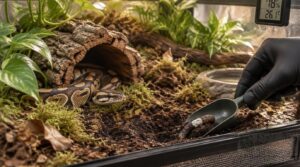
Think of your enclosure as a sponge: it holds water until it turns sour. Humidity retention only helps while the substrate stays clean.
A snake enclosure is like a sponge: it holds humidity beautifully until neglect turns it sour
Run a spot cleaning routine daily. Remove feces, urates, and uneaten prey the moment you see them. Don’t wait: mold needs decaying matter to start.
Check your hygrometer every morning. Readings stuck above your snake’s target range mean trouble. Inspect corners and under hides for fuzzy white or green growth.
Refresh the top inch of an organic soil mix every month. If mold appears, replace all of it. Disinfect hard surfaces, fix the moisture problem, then rebuild.
Keep cross-ventilation active: low intake, high exhaust. Add springtails for mold prevention and better substrate safety. They clean up leftovers.
Frequently Asked Questions (FAQs)
What substrate holds humidity?
Think of a sponge: it drinks, holds, and lets go slowly. Coconut fiber and cypress mulch work the same way. They give you steady humidity retention. ReptiChip holds moisture well too. Mist until damp, not soaked.
Is 75% of humidity too high for hatching?
Ironically, fearing 75% harms hatches more than 75% does. It’s fine: 65-80% suits lockdown. Calibrate your hygrometer, vent for moisture control, and stop condensation. Good enclosure setup and humidity retention beat plain guesswork every time.
What can I put under my house to absorb moisture?
Irony: your crawl space needs less humidity retention than any reptile enclosure setup. Lay a 20-mil vapor barrier as your ground substrate: it’s top moisture control. Forget any naturalistic habitat. Seal seams, add a dehumidifier.
What snakes like high humidity?
Ever wonder which snakes crave damp air? Emerald tree boas need 75-90% humidity. Green tree pythons want 50-80%. Ball pythons need above 60%. Pair them with cypress mulch or coconut fiber for solid humidity retention.
Can bioactive setups help maintain humidity naturally?
A bioactive enclosure breathes like a small forest floor. Yes, it helps.
Substrate depth, leaf litter, and live plants boost moisture retention and humidity retention. Keep hygrometer monitoring on; you’ll need ventilation for mold resistance.
Which hygrometer placement gives the most accurate humidity readings?
Does one reading anywhere work? No. Set your hygrometer on top of the substrate, mid-enclosure.
Keep it away from misters and water bowls: they skew ambient humidity. Add a second probe for cool-side hygrometer monitoring.
How deep should substrate be for burrowing reptiles?
Your Kenyan sand boa vanishes under 4 inches of coconut fiber. That’s the substrate depth recommendation: 3–5 inches helps burrowing behavior.
Deeper bedding boosts humidity retention and moisture retention. Stick to a substrate replacement schedule.
Why should cedar and pine substrates be avoided?
Why risk it? Cedar and pine release toxic wood oils: phenol toxicity damages your snake’s respiratory health.
Small enclosures trap those fumes. Damp bedding raises mold risk too. Skip both. Choose aspen or paper instead.
How often should humid hides be refreshed?
Say your ball python goes opaque on Monday. Swap the humid hide moss that day. Refresh it every 1-2 weeks normally, and twice weekly during shedding. Check your hygrometer: dropping humidity means replace it.
Conclusion
Why fight dry air every morning when the right bedding can hold the line for you? The substrate that retains humidity best acts like a reservoir: it stores water below, releases it slowly, and stays mold-free when you maintain it.
Match the material to your species. Pack coconut and soil blends deep for ball pythons. Keep sand dry for boas. Spot-clean weekly, check the bottom layer, and trust your hygrometer. Stable humidity means clean sheds.