This site is supported by our readers. We may earn a commission, at no cost to you, if you purchase through links.
A boa that sits on a bare branch under a hot lamp isn’t relaxed. It’s exposed, and that stress shows up in refused meals, rough sheds, and sometimes burns.
The right boa constrictor cage decoration does more than make the enclosure look good. A branch set 11 to 14 inches below the heat lamp keeps your snake warm without scorching it. A snug hide at 86 to 90°F lets it digest in peace, and a heavy water dish stays put when 6 feet of muscle climbs in.
You control every one of these details. Start with the layout, because everything else depends on where you place it.
Table Of Contents
- Key Takeaways
- Plan Your Boa’s Cage Decoration Layout
- Choose Safe Substrate for Humidity Control
- Add Essential Boa Cage Decorations
- Choose Snake-Safe Live or Artificial Plants
- Clean, Secure, and Refresh Boa Cage Decorations
- Frequently Asked Questions (FAQs)
- Which type of Boa constrictor cage should I buy?
- Can Boa constrictor cages be used for Pythons?
- How do I choose a boa enclosure?
- Why should you buy a red tail Boa cage?
- What makes a good Boa setup?
- How often should I rearrange cage decorations?
- Can I use rocks from outside safely?
- What lighting schedule works best for boas?
- How do I sanitize decorations between cleanings?
- Should baby boas have different decoration styles?
- Conclusion
Key Takeaways
- Set your climbing branches 11 to 14 inches below the heat lamp and anchor them securely, so your boa basks without burns and never has to deal with a wobbly perch.
- Give your boa a snug, dark hide in the warm spot at 86 to 90°F and another in the cool spot, so it can digest, shed, and relax without stress.
- Lay 2 to 3 inches of cypress mulch or coconut fiber, skip cedar, pine, and sand, and keep humidity at 60 to 70% (raising it to 70 to 80% during sheds) to prevent stuck skin.
- Choose a heavy water dish, nontoxic and pesticide-free plants, and reptile-safe materials, then spot-clean daily and deep-clean weekly so everything in the enclosure stays safe.
Plan Your Boa’s Cage Decoration Layout
A great boa habitat starts with a plan, not a shopping cart. Before you buy a single branch or hide, you’ll want to map out your cage decoration layout so every piece earns its spot. Here are the two key points to guide your setup.
Pairing a snug hide box with sturdy climbing branches gives your boa both security and exercise, and this beginner boa constrictor owner guide walks through how to arrange them.
Space for Movement and Climbing
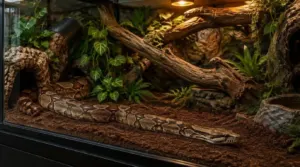
Floor area comes first. Give your adult boa a length-plus-width total at least equal to its body length, and keep a clear central lane for crawling and turning. Space for movement and climbing works best when climbing structures hug the walls.
Anchor natural wood branches for terrariums, since thin vines and branches bend. PVC pipe tunnels for snakes add routes.
Decor Placement Around Heat and Humidity
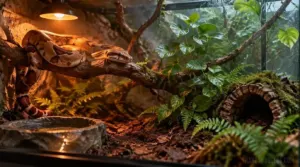
Those wall-hugging climbing structures now need smart positioning around your heat and humidity zones. Set branches 11 to 14 inches below the heat lamp so your boa basks without burns. Keep dense foliage off the heat source so warmth spreads evenly.
Put moist hiding spots on the cool side first. Lay naturalistic substrates beneath them for steady, reliable humidity control. Keeping humidity around 60-70%, and raising it to 70-80% during shedding, helps prevent stuck shed.
Choose Safe Substrate for Humidity Control
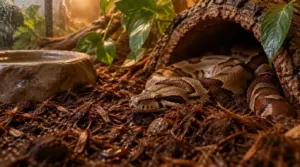
Once your layout is mapped, the floor comes next, and it does more than you’d think. A good moisture-retaining substrate keeps humidity steady so your boa sheds cleanly and breathes easy.
Layering the substrate a few inches deep also lets moisture settle evenly, and these emerald tree boa humidity requirements show how to fine-tune your setup.
Cypress mulch and coconut fiber both hold moisture well and release it slowly. Aim for a substrate depth of 2 to 3 inches so your boa can burrow and humidity stays even.
- Use cypress mulch or coconut fiber for steady 55 to 75% humidity.
- Mix water into the substrate, then mist one end once or twice weekly.
- Skip cedar, pine, and sand. They’re unsafe.
- Choose naturalistic substrates, but watch young boas for impaction during feeding.
Lift humidity to 75 to 85% while shedding by keeping substrate damp, not muddy.
Add Essential Boa Cage Decorations
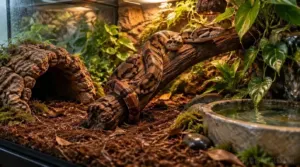
Your substrate is down, so now it’s time to make the enclosure feel like a real home. Three essential decorations turn a bare box into a space where your boa feels secure and stays healthy. Here’s what to add, and why each one earns its spot.
Snug Hides and Visual Barriers
Picture your boa tucked into a dark, tight hollow, flanks touching every wall. That’s security.
A snug hide like that also pairs well with the best substrate to prevent mites, which stays dry underfoot while holding enough humidity for healthy shedding.
A boa curled in a dark, snug hollow, flanks pressed against every wall, is a snake that feels truly secure
Use snug hides and visual barriers so your snake can relax. Strategic hide placement turns hiding spots into real, lasting environmental enrichment.
| Spot | Setup | Goal |
|---|---|---|
| Warm | Under heat | 86-90°F |
| Cool | Far end | Calm retreat |
| Humid | Moss inside | Easy shedding |
| Glass | Cover three sides | Less stress |
Secure Climbing Branches and Platforms
A sturdy climbing structure gives your boa exercise and control over temperature gradients. Choose mopani wood or cork bark, then anchor everything with screws or epoxy, your secure locks against shifting.
Since garter snakes have different climbing habits and size needs than boas, this garter snake care guide helps you scale perches and enclosure security to the species.
- Pick branches 1.5 to 2 inches thick.
- Keep falls away from water and hiding spots.
- Leave 9 to 11 inches below UVB.
- Recheck stability after any substrate depth change.
Heavy, Easy-Clean Water Dishes
A Heavy Water Dish or Tub keeps your boa’s soaking spot steady, even when 40 pounds of muscle climbs in. Aim for 2-3 pounds empty, 8-10 inches wide, and 2-4 inches deep.
The Zoo Med Repti Rock Corner Bowl or Exo Terra Water Dish both fit the bill. Match your enclosure cleaning frequency to weekly scrubs with a reptilesafe disinfectant.
Choose Snake-Safe Live or Artificial Plants
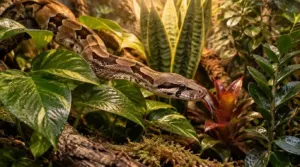
Picture a boa sliding through a green canopy, scales brushing leaves, tongue flicking at the damp air. You can build that scene, and you can build it safely.
Start with nontoxic plants for snake enclosures. Pothos, snake plant, bromeliads, ficus, and ZZ plant all handle warm, humid conditions, so you’re covered if your boa nibbles a leaf. Keep every live plant away from direct heat.
Here’s your quick checklist:
- Choose safe live plants for reptiles that thrive at 60-70% humidity.
- Confirm pesticide-free foliage for reptiles before anything goes in.
- Inspect artificial foliage for sharp points, edges, or exposed wires.
- Rinse new artificial plants in boiling water to remove dyes.
Juveniles love live greenery. Adults tend to flatten it, so pick sturdy artificial plants for them.
Clean, Secure, and Refresh Boa Cage Decorations
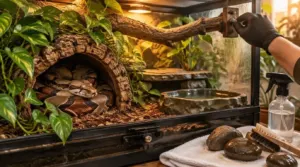
Think of your boa’s enclosure as a living room that never gets a day off. Clean, Secure, and Refresh Boa Cage Decorations on a steady schedule, and it stays comfortable for years.
Spot-clean daily. Remove feces, urates, and shed skin the moment you spot them. For a full clean, move your boa to a secure temporary enclosure, then wash each piece with hot water and a reptilesafe detergent. Rinse well and dry completely.
Disinfect hard, nonporous décor separately, following the label’s contact time. Replace porous pieces that stay moldy or soiled.
Before returning your snake, check every branch and platform. Tighten fixtures, and confirm escapeproof enclosure features still hold. Refresh gradually and keep familiar hides in place, so it settles.
Frequently Asked Questions (FAQs)
Which type of Boa constrictor cage should I buy?
Buy PVC enclosures with front-opening doors and secure locks. They hold humidity and clean easily.
Choose expandable enclosures for real enclosure scalability, so your boa’s adult-sized home grows with it. You’ll upgrade only once, confidently.
Can Boa constrictor cages be used for Pythons?
Picture a ball python moved into your boa’s old cage. The hides are huge, the air is dry, and it stalls its shed. Boa cages can work for pythons, but only after careful adjustments.
How do I choose a boa enclosure?
Pick a locking, escape-resistant enclosure that lets your boa stretch fully along one side. PVC enclosures hold heat well and support steady thermal gradients. Leave room for climbing structures, plus enough substrate depth for humidity.
Why should you buy a red tail Boa cage?
A purpose-built red tail boa cage gives you control. PVC enclosures hold steady humidity levels and precise temperature gradients, while leaving room for Boa constrictor cage decoration and environmental enrichment. You’ll cut stress, protect shedding.
What makes a good Boa setup?
Picture a jungle floor in miniature: warm on one side, cool on the other.
Build temperature gradients with snug hides at both ends, steady humidity levels, sturdy climbing structures, secure locks, and substrate enrichment materials.
How often should I rearrange cage decorations?
A shifting forest keeps a boa curious. Rearrange every one to two months for environmental enrichment and habitat complexity, protecting reptile behavioral health in your naturalistic terrarium setup.
Always recheck your temperature monitoring systems afterward.
Can I use rocks from outside safely?
Say you grab a smooth creek stone near a lawn and drop it in your boa’s cage. Pesticide residue could sit inside it. Skip outdoor rocks. Choose reptilesafe materials instead.
What lighting schedule works best for boas?
Think of your timer as your boa’s sunrise. Run a twelve-hour day-night cycle, lights off at night.
UVB lighting is optional, aimed at the basking spot. Pair it with humidity control methods and thermoregulation support.
How do I sanitize decorations between cleanings?
Scrub decor in hot soapy water, soak 15 minutes in 1:32 bleach solution, rinse until nothing feels slippery, then air dry. Bake stones for rock sterilization. Toss cypress mulch, coconut fiber, or sphagnum moss bits.
Should baby boas have different decoration styles?
A baby boa is a small sapling in a big forest. Yes, use age-specific decor: snug hides, visual barriers, and anchored vines. Add humidity-retaining, burrowing substrates and safe decorative accessories that won’t hurt curious climbers.
Conclusion
Picture your boa at dusk, coiled in a snug hide, warm belly against the substrate, water dish steady beside it. Nothing wobbles. Nothing burns. That calm is what thoughtful boa constrictor cage decoration builds, one secure branch and one tight hide at a time. You know where each piece belongs and why it matters.
Check the anchors, wash the dish, and rotate the plants. Your snake will reward you with regular meals and clean sheds.