This site is supported by our readers. We may earn a commission, at no cost to you, if you purchase through links.
A rattlesnake can detect a temperature change of 0.003 °C. That’s a mouse-sized warm spot against a cool background, registered in total darkness, with no light involved at all.
Only three groups of snakes pull this off: pit vipers, boas, and pythons. Each built the hardware independently, which explains why the pits sit in different places and work in different ways. Rain, humidity, and distance all cut the signal, so the system has hard limits too.
Snake infrared detection anatomy comes down to three parts: a suspended sensory membrane, a heat-triggered ion channel, and a brain that merges thermal and visual maps. You’ll see how each one works.
Table Of Contents
Key Takeaways
- Only pit vipers, boas, and pythons can sense heat, and each lineage evolved the ability on its own, so your viper’s single facial pit works differently from the many labial pits on a boa or python.
- A thin membrane suspended over an air-filled chamber catches the heat, and a dense capillary network cools it fast enough that your snake can register contrasts as small as 0.003 °C.
- The TRPA1 channel in the pit’s nerve endings opens directly to warmth rather than light, and pit-bearing snakes tuned it to open at much lower temperatures than a non-pit snake’s channel does (27.6 °C in rattlesnakes versus 37.2 °C in rat snakes).
- Your snake’s brain layers the thermal map over the visual one in the optic tectum, but the system tops out near 1 meter and weakens in rain and humidity, so cold, dry nights give the best results.
Which Snakes Have Infrared-Sensing Organs?

Few snakes can sense heat, and you’ll find that ability in just three lineages: pit vipers, boas and pythons. Each evolved its infrared receptor independently, and the groups diverged over 30 million years ago.
Each group’s pits sit in slightly different spots, and this guide to how snakes see explains how those heat signals combine with vision.
Pit vipers (Crotalinae) evolved the trait once. The subfamily spans 23 genera and 155 species, from the 30-45 cm hump-nosed viper to the 3.65 m bushmaster. In these snakes, the optic tectum combines infrared and visual input from the facial pit organs to help them orient or strike toward prey.
Boas and pythons took a messier route. Within each family, the trait arose multiple times, so labial pit counts and arrangements vary widely between species.
Don’t expect it elsewhere. Rat snakes and other non-pit snakes lack functional snake pit organs. Their thermal sensors are too insensitive for prey detection, so they mostly rely on scent, vision and ground vibration instead.
Facial Pit Anatomy and Thermal Insulation
Your snake’s pit organ is a heat sensor built from a few precise parts. Two features set the design apart: suspended membrane structure and thermal insulation around the receptors.
You’ll see both below, starting with how pit vipers differ from boas and pythons, then how blood flow keeps the receptors accurate.
Because the membrane in a viper’s pit is suspended over an air-filled chamber, it picks up tiny temperature shifts, which pit viper heat-sensing capabilities explains in more detail.
Suspended Membranes Versus Labial Pits
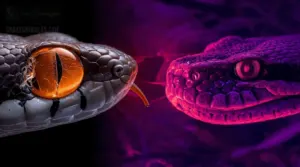
Why does a pit viper out-sense a python? Pit vipers carry one large loreal pit per side, and a 0.010 mm suspended sensory membrane hangs inside it, insulated by an air-filled cavity.
Boas and pythons have 3 to 13 pairs of labial pits. Their infrared receptors line the pit walls and floor, so thermal detection relies on a simpler design.
Blood Supply and Receptor Cooling

That thin membrane has a problem: it holds almost no heat, so it warms fast and cools slowly unless something pulls the heat out. A dense capillary network does it. Vasculature here is finer and flatter than in skin or retina, so it exchanges heat across more surface.
Blood flow shifts with the radiant source’s strength and angle. Without it, you’d get lingering afterimages.
TRPA1 Channels Convert Heat Into Nerve Signals
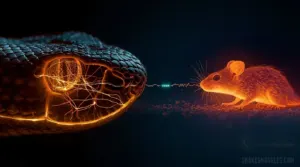
Those blood-flow tricks keep the membrane’s baseline steady, but the membrane still needs a sensor. That job falls to TRPA1, an ion channel packed into the nerve endings of your snake’s pit.
Infrared warms the tissue, and that warmth opens the channel directly. It’s heat, not light. Thresholds tell the story:
- Rattlesnake: opens at 27.6 °C.
- Boa: 29.6 °C.
- Python: 32.7 °C.
- Non-pit rat snake: 37.2 °C, too warm to help.
Pit-bearing lineages lowered the activation threshold independently, so the channel fires at temperatures a warm mouse produces against a cooler background. Mammalian TRPA1 mostly senses cold, and swapping the human N-terminal domain for a rattlesnake’s makes it heat-activated. Block it with ruthenium red and the pit’s heat currents stop.
Snakes that sense heat tuned an ordinary cold-detecting channel to trigger at body-warm temperatures, and blocking it silences their thermal sense entirely
Neural Pathways Behind Snake Infrared Detection
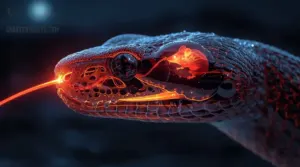
Heat detected at the pit doesn’t become a usable image until it reaches the brain. You’ll follow the neural route in two stages: how the signal travels from the pits to the brain, and how it combines with vision. Keep both in mind as you read the points below.
Trigeminal Signals From Pits to Brain
Your snake’s facial pits don’t wire into the ordinary touch pathway. Three branches carry the signal: one ophthalmic (V1) and two maxillary (V2), with no mandibular input.
Their cell bodies sit in the trigeminal ganglia. Central projections run ipsilaterally to the LTTD in the medulla, separate from the sensory trigeminal system handling touch and pain. Terminals map the membrane topographically.
Visual and Infrared Signal Integration
How does a blurry thermal image become a precise strike? Your snake’s optic tectum fixes it. Infrared input lands in a layer just beneath the visual layer, so both maps align.
Thermal receptive fields run larger than visual ones, so heat highlights a broad zone, then vision sharpens the target. Bimodal "or" and "enhanced" neurons fire harder to both cues together.
Infrared Detection Sensitivity and Anatomical Limits

Pit organs resolve temperature contrasts as small as 0.003°C, though that figure shifts with season and with the gap between prey and background.
Don’t expect long reach, though. With a 5°C differential, detection tops out near 1 meter, and your odds fall to roughly 50% at 0.5 meters.
Weather matters just as much. Rain and humidity let water vapor absorb infrared, shrinking a 5-15°C prey contrast to 2-4°C, and wet surfaces cool fast, erasing more signal. Cold, dry nights give you the best results.
Anatomy sets the ceiling. A viper’s facial pit delivers thermal acuity 5 to 10 times better than a boa’s labial pits. TRPA1-driven sensory transduction can’t beat physics: infrared pit receptors only read the contrast they’re handed.
Frequently Asked Questions (FAQs)
Can snakes with heat-sensing pits see in complete darkness?
Yes, but they don’t see light. Your snake’s facial pit detects heat, so warm prey stands out in darkness. The optic tectum merges that thermal contrast with vision. It fails if the background is hotter.
Do baby pit vipers have working infrared organs?
Carnegie stage 28 is when the facial pit first shows up in the embryo, long before birth. So yes, newborn pit vipers strike warm prey in total darkness from day one, with TRPA1 channels already active.
Can pit organs detect predators as well as prey?
Yes. Your pit organs aren’t just prey finders. They image warm-bodied threats too, such as mammals and birds that hunt snakes. Thermal contrast flags a looming predator, so you can freeze, retreat, or strike defensively.
How do pit organs help snakes regulate their body temperature?
Why would a snake’s heat detector double as a thermostat? Because rapid vascular cooling resets the membrane, and that same blood flow helps shift heat. You’re seeing local vascular control that aids thermoregulation, not just prey detection.
Do snakes show up on infrared cameras?
Yes, but not reliably. Infrared cameras read surface temperature, and snakes are ectotherms, so they match their surroundings. You’ll spot one only when it differs from the background, like a sun-warmed snake on cool ground.
Conclusion
So what does a snake see when the lights go out? Snake infrared detection anatomy answers it with three parts: a thin membrane that catches heat, a TRPA1 channel that turns warmth into spikes, and a brain that lays thermal maps over visual ones.
Each piece depends on the others, and each fails in rain, humidity, or distance. If you remember one thing, make it this: heat becomes a picture only after the whole chain works.