This site is supported by our readers. We may earn a commission, at no cost to you, if you purchase through links.

A garter snake has about 150 vertebrae. A python can top 400, and some Australian pythons reach roughly 600. Every vertebra behind the head carries its own pair of ribs, which means a large snake owns more than 300 of them.
Most people picture a snake as a bendy tube of muscle, but the snake skeletal system overview tells a different story. Your own spine locks together at a few joints per segment. A snake’s locks at five contact points, including a ball-and-socket and a zygosphene-zygantrum pair, so it can coil without twisting apart.
Start at the backbone, where those bone counts begin.
Table Of Contents
Key Takeaways
- Your spine has far fewer segments than a snake’s, which stacks 130 to 500 vertebrae (up to about 600 in some pythons), each locked to its neighbors at five contact points that allow bending but block twisting.
- Nearly every body vertebra carries its own pair of ribs that never meet a sternum, so the free tips let the body widen around big prey and keep working during constriction.
- A snake doesn’t dislocate its jaw to swallow large prey; instead, unfused lower jaw halves joined by elastic ligaments and a swinging quadrate bone let each side move independently and walk the meal down.
- Snake skeletons vary by species and habitat, from sturdy burrower vertebrae to flattened swimmer ones, and they still carry traces of the past, like pelvic bones in pythons and boas that show up as spurs.
Snake Backbone: Vertebrae, Regions, and Bone Counts
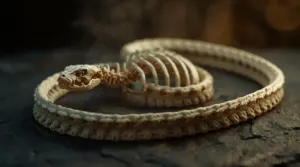
A snake’s backbone is its main structural feature, and it’s built from far more vertebrae than yours. Most species have between 130 and 500, and some Australian pythons reach about 600. Nearly all of them sit in the body, with 100 to 450 in the precaudal section and 10 to 205 in the tail.
Ribs attach to nearly every precaudal vertebra, so this backbone also shapes how snake organs work inside the body.
Each vertebra locks to its neighbors at five contact points, including a ball-and-socket joint and a zygosphene-zygantrum pair. That pair lets the spine bend sideways and up but blocks twisting. Researchers measuring the shape of every vertebra in Australian species found that the column is divided into five distinct regions, starting with a short neck of roughly 7 to 12 vertebrae.
Snake Ribs: Body Support Without a Sternum
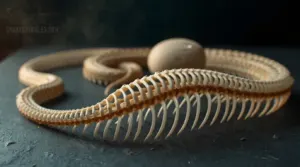
Every body vertebra carries a pair of ribs, which is why a snake can have well over 300 pairs. Unlike yours, they never meet a sternum, so their ventral tips simply float free.
That gap gives you a body that can bend and stretch:
- Ribs attach only to the spine.
- Ball-and-socket joints move them in several directions.
- Muscles control each rib independently.
- Free tips let the body widen around large prey.
- Sections can shift during constriction, keeping the lungs working.
Snake Skull and Jaws: Feeding Adaptations
A snake’s skull is built to handle prey far wider than its head, and you can see why once you know how it’s put together. Two features do most of the work, and they’re covered next. Here’s a look at how flexible joints and teeth and fangs shape the way a snake feeds.
Because the quadrate bone swings and the two halves of the lower jaw can move independently, how a snake’s jaw stretches without dislocating is easier to picture than most people expect.
Flexible Joints and Whole-Prey Swallowing

Picture a six-foot rat snake facing a rat nearly as wide as its head. It doesn’t bite off pieces. It walks its jaws over the meal. Keepers who want to see this up close should start with a pet rat snake enclosure kit roomy enough for feeding.
Each side of the upper jaw ratchets forward in turn, which is how snakes swallow prey nearly as wide as their heads.
A rat snake never tears its food apart; it simply ratchets each side of its jaw forward until a whole rat disappears
That works because the two lower jaw halves aren’t fused. Elastic ligaments join them at the chin, so each side moves on its own. This ligament elasticity lets the mouth stretch far past what you’d expect.
The quadrate bone swings like a hinge, and the upper jaw bones shift independently. Contrary to the myth, snakes never dislocate anything while swallowing.
Teeth, Fangs, and Their Attachment
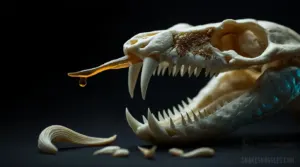
Those jaws only work because of what they hold. A snake’s teeth are slender, sharp, and curve backward, so prey can slide in but can’t back out. They sit in rows on the upper and lower jaw bones, and the left and right sides advance alternately to walk food down the throat. Handling a snake skull anatomy model makes it easier to see how the loosely linked jaw bones and backward-curving teeth work together.
Fangs come in three layouts: hinged hollow fangs in vipers, short fixed ones in cobras, and grooved rear fangs in some other snakes.
Teeth fuse to bone as the attachment ligament calcifies, so they’re fragile. Snakes replace them continuously.
Their conical teeth are made for gripping prey that might escape, and this guide to how snake teeth work and regrow explains the rest.
How The Snake Skeleton Supports Movement
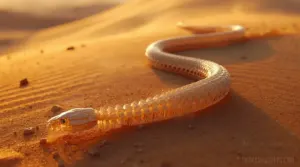
Snakes travel without limbs because the spine works as a hinged chain of up to 450 precaudal vertebrae. Each ball-and-socket joint bends sideways and vertically but resists twisting, so muscle force transfers cleanly. Here’s how the pieces work together:
- Lateral undulation: traveling waves push against ground irregularities.
- Concertina: tight bends anchor the front, rear advances.
- Sidewinding: lifted body sections touch down at two points.
- Rectilinear crawling: muscles slide skin over stationary ribs.
- Anisotropic friction: scales resist sideways slip, glide forward.
Vestigial Pelvic Bones and Specialized Tail Structures
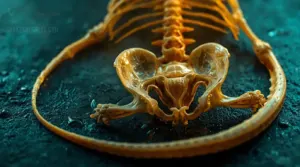
Why do some snakes still carry leg remnants? Vestigial pelvic bones, left over from lizard-like ancestors, persist in pythons and boas. You’ll see their tips as pelvic spurs beside the cloaca, which males use to grip females during mating.
| Structure | Location | Job |
|---|---|---|
| Pelvic spur | Near cloaca | Courtship grip |
| Ilium remnant | Inside body | Muscle anchor |
| Caudal break plane | Between vertebrae | Tail release |
Tail anatomy adds a trick: snakes shed the tail between vertebrae, and it regrows as an unsegmented, hollow cartilage cone.
Frequently Asked Questions (FAQs)
Can snakes break or fracture their bones?
A snake’s bones are anything but indestructible. Falls, crushing, and bites can fracture ribs, vertebrae, skull, and jaws, and weak bones from metabolic disease break far more easily. Handle yours gently.
How do snake bones grow as they age?
Snakes shed their skin to grow, yet their bones quietly do the real work. Cartilage templates turn to bone, lengthening the vertebrae at growth plates until they ossify. After that, bones only remodel and thicken.
Do snake skeletons differ between species and habitats?
Some people assume all snakes share one identical skeleton. That’s false. Species variation is real and tied to habitat: burrowers have short, sturdy vertebrae, swimmers have flattened ones, climbers have longer grip-enhancing projections, and vertebral count ranges from about 100 to over
How strong are snake bones compared to other reptiles?
Think of a snake’s spine as a braided rope, not a steel rod. Its vertebrae pack more bone density than a lizard’s, and that density stays remarkably uniform across habitats, favoring versatility over specialization.
Conclusion
Count the vertebrae, count the ribs, count the joints, and the same pattern repeats: a simple design, multiplied. That’s the heart of any snake skeletal system overview. A single repeating unit, locked at five contact points and fitted with its own ribs, lets a body coil, climb, swim, and swallow prey wider than its head.
Every snake you meet carries this bony blueprint. Watch one move, and you’re watching hundreds of bones work as one.