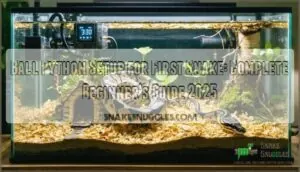
This site is supported by our readers. We may earn a commission, at no cost to you, if you purchase through links.

A hatchling ball python looks perfectly happy in a 20"x11"x13" tub. Give it a year, and that same snake needs a 4’x2’x2′ enclosure at minimum, or 5’x2’x2′ if she’s a female over 1.5 kg.
Most first-time owners learn this after buying a tank that’s already too small. Glass tanks with screen tops also struggle to hold humidity, and standard aquariums are often only 12" wide.
The best ball python terrarium kits for first time owners solve size, heat, and humidity before the snake comes home. Here are seven options, plus the setup details that keep your python secure.
Table Of Contents
- Key Takeaways
- Choosing Ball Python Enclosure Sizes and Materials
- 7 Ball Python Terrarium Kits and Alternatives
- Essential Hides, Water Bowls, and Enclosure Furnishings
- Safe Heating, Thermostats, and UVB Lighting
- Humidity Control, Substrates, and Digital Monitoring
- Starter Kit Costs Versus Buying Components Separately
- Frequently Asked Questions (FAQs)
- Conclusion
Key Takeaways
- Your ball python will outgrow a hatchling tub fast, so buy for adult size: at least 4’x2’x2′, or 5’x2’x2′ for a female over 1.5 kg.
- Most of the 36"x18"x18" kits you’ll see fit juveniles and small males only, and PVC or composite enclosures with front-opening doors hold heat and humidity better than glass tanks with screen tops.
- Run every heat source through a proportional thermostat, keep the warm side at 88–92°F and the cool side at 76–80°F, and skip heat rocks, since unregulated heat can kill your snake.
- Keep humidity at 50–60% (65–70% during a shed) with a deep, damp substrate and a digital hygrometer, and give your snake two snug hides, since buying quality gear separately costs more upfront but saves you from buying twice.
Choosing Ball Python Enclosure Sizes and Materials

A ball python terrarium works best when it matches your snake’s length, not just its age. Hatchlings under 300g do fine in a 20"x11"x13" tub, but juveniles need about 36"x18"x12". Adults need at least 4’x2’x2′, and females over 1.5 kg need 5’x2’x2′. As a general rule, a 5-foot ball python needs a 5-foot long enclosure so it can stretch out fully.
Choose a front-opening design whenever you can. Top-only access mimics a predator’s approach and can trigger defensive behavior.
If you’re setting up a new home for a boa, this step-by-step boa snake habitat setup guide shows how to choose an enclosure that keeps both of you comfortable.
Enclosure materials matter as much as dimensions. PVC holds humidity well and was built for reptiles. Glass tanks with screen tops struggle with humidity regulation, and standard aquariums are often only 12" wide, which is too narrow for adults. A proper temperature gradient also needs floor space, so don’t skimp on length. Measure your snake first, then buy to fit.
7 Ball Python Terrarium Kits and Alternatives
You’ve got the size and material basics down, so now it’s time to look at real options.
The seven enclosures below range from complete kits to larger alternatives, and each one is judged on heat and humidity retention and how well it fits your snake’s needs.
Use them to match your budget and space to a setup you can keep safe and stable.
1. Joshs Frogs Ball Python Terrarium Kit
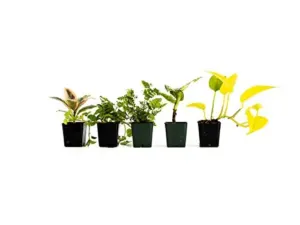
A kit that ships plants instead of plastic décor is a different kind of starter purchase, and it’s worth knowing exactly what you’re getting. This 36x18x18 inch set from Josh’s Frogs contains live plants only, including terrestrial ferns, Pothos, and Sansevieria. The enclosure isn’t included.
Those plants help with humidity and enrichment, and they’re easy to keep alive. Varieties vary and aren’t guaranteed. The Live Arrival Guarantee applies only when transit temperatures stay between 32°F and 85°F, so avoid ordering during extreme weather.
| Best For | Ball python keepers who already have a 36x18x18 inch enclosure and want live plants to give it a natural look, added humidity, and enrichment. |
|---|---|
| Dimensions | 36x18x18 in |
| Suitable Species | Ball pythons |
| Materials | Live plants |
| Door Type | N/A |
| Top Ventilation | N/A |
| Capacity | N/A |
| Additional Features |
|
- Live plants like ferns, Pothos, and Sansevieria add humidity and enrichment to the enclosure
- Easy to care for, which suits captive reptile habitats
- Live Arrival Guarantee applies when transit temperatures stay between 32°F and 85°F
- The terrarium enclosure is not included, since the kit contains plants only
- Specific plant varieties may vary and are not guaranteed
- The Live Arrival Guarantee is void if transit temperatures fall outside 32°F to 85°F
2. REPTI ZOO 50 Gallon PVC Enclosure
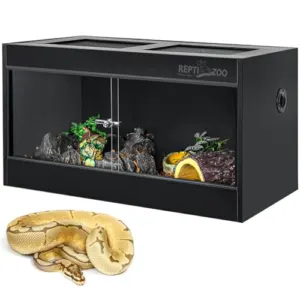
Since the Josh’s Frogs set leaves out the enclosure, this one covers that gap. The PVC build measures 36 x 18 x 18 inches and holds heat and humidity better than glass.
It’s a good fit for juveniles and small adult males. Adult females eventually need 4 feet of floor.
You get a removable tempered glass sliding door with a safety lock, plus a detachable mesh top. Check the lock, since some loosen. Seal the bottom for bioactive substrates.
| Best For | Keepers of juvenile or small adult ball pythons, bearded dragons, geckos, and similar reptiles who want an enclosure that holds heat and humidity well. |
|---|---|
| Dimensions | 36 x 18 x 18 in |
| Suitable Species | Ball pythons, bearded dragons, geckos, snakes |
| Materials | PVC |
| Door Type | Sliding tempered glass |
| Top Ventilation | Detachable mesh screen |
| Capacity | N/A |
| Additional Features |
|
- PVC insulates better than glass, so heat and humidity stay stable
- Removable tempered glass sliding door with a safety lock gives secure access
- Smooth PVC surfaces are easy to clean, and the detachable mesh top lets airflow and UVB/IR light through
- The bottom may need sealing to prevent leaks with bioactive substrates
- Sliding door locks can loosen over time
- Factory debris such as fiberglass strands may be present during assembly, and at 36 x 18 x 18 inches it is too small for adult females that need 4 feet of floor
3. Herture 60 Gallon Reptile Terrarium Stand
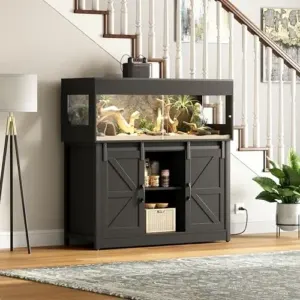
If you want the full 4 feet of floor length, the Herture steps up from the previous pick. At 48 x 18.11 x 47.63 inches, it’s a tall stand-and-tank combo, and it includes four built-in AC outlets plus storage shelves for heating gear.
If a 4-foot footprint suits your boa or python, it’s worth comparing other boa constrictor enclosures for snake enthusiasts on a budget too.
Know the trade-offs. Customers report it doesn’t hold humidity well, and the 18-inch depth falls short of the 24 inches adult females need. Expect slow, confusing assembly. Cover the lid and run every heater through a thermostat.
| Best For | Reptile keepers who want an all-in-one 60-gallon setup with built-in storage and power outlets for a single bearded dragon, ball python, or leopard gecko. |
|---|---|
| Dimensions | 48 x 18.11 x 47.63 in |
| Suitable Species | Bearded dragons, ball pythons, leopard geckos |
| Materials | Wood, acrylic, metal |
| Door Type | Sliding acrylic |
| Top Ventilation | Flip-open wire mesh |
| Capacity | 60 gallons |
| Additional Features |
|
- Full 4-foot floor length gives medium reptiles plenty of room to move
- Stand has side compartments, center shelves, and four built-in AC outlets for heat lamps, UVB lights, and thermostats
- Sliding acrylic doors and a flip-open mesh lid make viewing, feeding, and cleaning easy
- Customers report it doesn’t hold humidity well
- At 18 inches deep, it falls short of the 24 inches adult females need
- Assembly is slow, and the instructions can be confusing
4. SCALYKIN 68 Gallon Reptile Enclosure
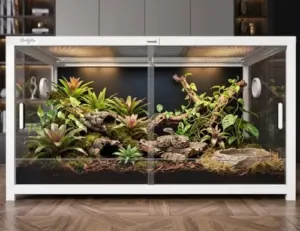
The SCALYKIN measures 39.4 by 19.7 by 19.7 inches and weighs 35 pounds, so it’s manageable to move during setup. That footprint suits juveniles and small adult males, but an adult female needs closer to four feet by two. Treat it as a right-sized home for a male, not a lifetime fit for every snake.
Front sliding tempered glass doors with an anti-escape lock keep access secure. Dual-sided wire holes route probes cleanly. It’s for indoor use and needs assembly.
| Best For | Keepers of juvenile or small adult male snakes who want a stackable, eye-level enclosure with clean routing for bioactive setups. |
|---|---|
| Dimensions | 39.4 x 19.7 x 19.7 in |
| Suitable Species | N/A |
| Materials | Acrylic, aluminum, PVC, tempered glass |
| Door Type | Sliding tempered glass |
| Top Ventilation | N/A |
| Capacity | N/A |
| Additional Features |
|
- Front sliding tempered glass doors with an anti-escape lock keep access secure.
- Stackable design saves floor space by letting you add units vertically.
- Dual-sided wire holes make it easy to route tubes and cables for environmental controls.
- At 39.4" x 19.7" x 19.7", it is too small for an adult female, who needs closer to four feet by two.
- It requires assembly, and the glass panels need careful handling to avoid damage.
- It is designed for indoor use only.
5. SUKEOPET 50 Gallon Reptile Enclosure
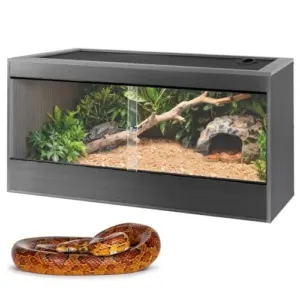
A 36" x 18" x 18" footprint makes this enclosure a fit for hatchlings, juveniles, and small adult males, but not for a full-grown female, who needs 4′ x 2′.
You’ll get composite wood-plastic walls with roughly three times the heat retention of glass, so holding a steady gradient is easier. The sliding glass doors lock, which keeps escape artists in. Because the mesh top lets heat escape, cover most of it to hold humidity. Assembly is also entirely tool-free.
| Best For | Owners of hatchlings, juveniles, or small adult male reptiles, such as ball pythons, who want an escape-proof enclosure that holds heat well. |
|---|---|
| Dimensions | 36 x 18 x 18 in |
| Suitable Species | Ball pythons, bearded dragons, geckos, snakes, turtles |
| Materials | Composite wood-plastic |
| Door Type | Sliding glass |
| Top Ventilation | Ventilated mesh top |
| Capacity | 50 gallons |
| Additional Features |
|
- Composite wood-plastic walls retain roughly three times more heat than glass, making a steady temperature gradient easier to maintain.
- Locking sliding glass doors keep escape artists safely inside.
- Assembly is tool-free, and the lightweight design makes it easy to move and clean.
- At 36" x 18" x 18", it is too small for a full-grown female, who needs 4′ x 2′.
- The mesh top lets heat escape, so you need to cover most of it to hold humidity.
- It isn’t glass, so it looks different from a traditional tank, and it comes in only three sizes.
6. FMATOZ 50 Gallon Reptile Tank
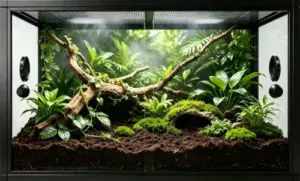
Picture a young male ball python, 2.5 feet long, settling into his first permanent home. This FMATOZ model suits him well. At 36 x 18 x 18 inches, it matches the size recommended for juveniles and small adult males.
Front sliding glass doors let you feed and clean without reaching from above, which keeps stress lower. The 4mm tempered glass, aluminum frame, and waterproof base make setup simple, and assembly takes about 15 minutes.
Adult females will eventually outgrow it.
| Best For | Owners of juvenile or small adult male ball pythons, or similar-sized reptiles like leopard geckos, crested geckos, and bearded dragons, who want a front-opening enclosure that is easy to set up and maintain. |
|---|---|
| Dimensions | 36 x 18 x 18 in |
| Suitable Species | Bearded dragons, ball pythons, leopard geckos, crested geckos |
| Materials | Tempered glass, aluminum, polycarbonate |
| Door Type | Sliding tempered glass |
| Top Ventilation | UVB-transmitting mesh |
| Capacity | N/A |
| Additional Features |
|
- Front sliding glass doors let you feed and clean without reaching in from above, which keeps reptile stress lower.
- The integrated waterproof base means no silicone sealing, and assembly takes only about 15 minutes.
- The UVB-transmitting mesh top supports bioactive setups, and the 4mm tempered glass and rust-proof aluminum frame are built to last.
- Adult female ball pythons will eventually outgrow the 36 x 18 x 18 inch size.
- The top can hold a maximum light fixture load of only 16 pounds.
- The warranty covers parts and transit damage for just 1 year.
7. ToxiRium 230 Gallon Reptile Enclosure
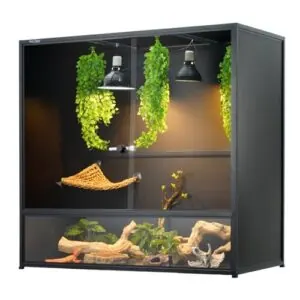
Picture a keeper with a 4-foot ball python and a spare corner, who wants one enclosure that will outlast every upgrade. That’s the case for this model. It measures 48.03 x 24.02 x 46.06 inches, so the floor space suits an adult.
The PVC side panels and insulated top help hold heat and humidity, and the sliding front doors lock with a key.
Be cautious, though. Some owners report shattering glass doors, confusing assembly instructions, and mixed durability. Check the glass on arrival.
| Best For | Keepers of adult bearded dragons, ball pythons, or leopard geckos who want a spacious, tall enclosure with good heat and humidity retention and are willing to inspect the glass and put up with tricky assembly. |
|---|---|
| Dimensions | 48.03 x 24.02 x 46.06 in |
| Suitable Species | Bearded dragons, ball pythons, leopard geckos |
| Materials | Aluminum, PVC, tempered glass |
| Door Type | Sliding tempered glass |
| Top Ventilation | Heavy-duty top screen |
| Capacity | 230 gallons |
| Additional Features |
|
- Large 48.03 x 24.02 x 46.06 inch size with 230-gallon capacity gives plenty of floor space and height for adult reptiles.
- PVC side panels and an insulated top help hold heat and humidity, and the setup supports both bioactive and desert habitats.
- Sliding tempered glass doors have a keyless lock, and adjustable crossbars allow for hanging lighting and substrate heaters.
- Some customers report the glass doors shattering, so the glass should be checked on arrival.
- Assembly instructions are described as hard to follow by some users.
- Feedback on sturdiness and long-term durability is mixed.
Essential Hides, Water Bowls, and Enclosure Furnishings

A bare enclosure feels exposed to a ball python, and that quickly breeds stress.
Start with two identical, snug hides. Put one on the warm side and one on the cool side, so your snake can pick its temperature without giving up security. Its body should touch the walls inside. Oversized hides invite avoidance.
Choose a heavy ceramic water bowl that won’t tip. Keep it no deeper than 1 inch for juveniles, yet wide enough for a full soak. Disinfect it weekly.
Add climbing branches and cork flats. Cork bark and plants break up sightlines and add overhead cover. Leave routes between hides and water bowl. After cleaning, return items to their spots and inspect textured decor for trapped debris.
Safe Heating, Thermostats, and UVB Lighting
Heat is where first-time owners make their costliest mistakes. A bare heater with no controller can cook a snake in hours, so treat temperature control as non-negotiable.
Without a thermostat to regulate it, a heat source can quickly turn a new owner’s costly oversight into a tragedy for the snake
Run every heat source through a proportional thermostat, and put the probe directly on the warm-side substrate where your snake rests. Keep warm-side air at 88–92°F and the cool side at 76–80°F. Basking surfaces shouldn’t pass 95°F. These temperature ranges mirror how snakes rely on external heat for digestion, immunity, and movement, which is why a proper gradient matters so much.
Here’s the setup that works:
- Cover only one-third to one-half of the floor with an under-tank heater or heat tape.
- Add a ceramic heat emitter if your room drops below 70°F at night, since it gives heat without light.
- Mount a T5 HO tube above mesh, 10–14 inches from the basking area.
Skip heat rocks entirely. They burn snakes.
Humidity Control, Substrates, and Digital Monitoring

Heat and humidity work against each other, so your heating setup shapes everything here. A thermostat-controlled overhead heat source dries the air, and the warm side reads lower than the cool side.
Aim for 50–60% humidity, and raise it to 65–70% during a shed. Sustained readings under 60% cause stuck shed, while anything above 80% invites respiratory infections.
Choose a humidity-holding substrate like cypress mulch or coconut fiber, 3–4 inches deep, for steady substrate moisture retention. Mix water in rather than spraying the surface. A handful should clump without dripping.
Place a digital hygrometer probe on the cool side at substrate level. Skip analog dials, which can be off by 10–20%. Cut enclosure ventilation with HVAC tape if readings drop.
Starter Kit Costs Versus Buying Components Separately

Once your humidity and heat are dialed in, the next question is what it costs to get there. A ball python starter kit runs $150–$200, but the thermostat is usually an inaccurate on/off type, and the hides are too small.
Buying components separately lands at $280–$680 before the snake. That range buys gear you won’t replace in three months.
Here’s where the money matters most:
- Proportional thermostat: $50–$100, and it prevents thermal burns.
- Adult-sized enclosure: a used 60–70 gallon PVC cage costs around $100, versus $200+ new.
- Bulk substrate: $15–$40 for a 60-quart bag that lasts months.
Kits rarely include enclosures sized for adults, so you’ll buy twice. Spend first on safety gear, then fill in the rest.
Frequently Asked Questions (FAQs)
When can I start handling my new snake?
Waiting feels harder than it is, but patience protects your snake. Leave it alone for 7 to 10 days, until it eats its first meal. Then handle for 5 to 10 minutes, with two hands.
Can I put a baby ball python in a 120 gallon terrarium?
Hatchlings up to 300g fit comfortably in a 10 gallon tank, so 120 gallons is a big jump. You can use it, but only if you fill it with dense cover and multiple hides.
How often should I feed my ball python?
Wondering how often your snake should eat? Hatchlings need a meal every 5-7 days, juveniles every 7-10, and adults every 10- Offer prey matching body width in the evening, and skip feeding during shedding.
What do ball pythons eat?
Ball pythons eat rodents, and frozen mice or rats are the easiest staple. Match prey size proportionality to your snake: about 10% of its body weight, never wider than 5 times its thickest point.
How do I thaw frozen prey safely?
Think of frozen mice as tiny ice blocks that need patience, not shortcuts. Thaw them in the fridge overnight, then warm the sealed bag in 98–100°F water for 10–15 minutes. Never microwave them.
How long do ball pythons live in captivity?
Ball pythons usually live 20 to 30 years in captivity, and some reach 40 or more. Your husbandry quality matters most, so plan for decades of care. In the wild, they average just 10 to 15 years.
Conclusion
Measure the snake, then measure the enclosure. Check the heat, then check the humidity. Those habits matter more than any brand name on the box.
The best ball python terrarium kits for first time owners give you a secure, sized home from day one. Pick one that fits your snake’s adult length, add a reliable thermostat, and verify every reading. A snake that feels safe eats well, sheds cleanly, and stays calm. That’s your goal.