This site is supported by our readers. We may earn a commission, at no cost to you, if you purchase through links.
A snake that gulps down a mouthful of loose substrate with its dinner can end up with a serious impaction. Plenty of keepers learn this the hard way.
The right liner solves that problem and shrinks your waste at the same time. Coconut fiber holds 70-80% humidity and breaks down completely within 6-12 months, while washable recycled polyester carpet gets reused 50+ times. Ball pythons, corn snakes, and hognose snakes each need something different underfoot, so one material won’t suit every enclosure.
These eco friendly terrarium liner alternatives for snakes keep your pet safe, your humidity steady, and your trash bin lighter.
Table Of Contents
- Key Takeaways
- Eco-Friendly Snake Liner Materials and Trade-Offs
- Matching Liner Alternatives to Snake Care Needs
- 7 Snake Terrarium Liners and Substrate Alternatives
- Cutting and Installing Terrarium Liners Safely
- Cleaning and Drying Reusable Snake Liners
- Replacing and Disposing of Liners Responsibly
- Frequently Asked Questions (FAQs)
- Conclusion
Key Takeaways
- Loose substrate can cause serious impaction if your snake swallows it at feeding, so a solid liner or a separate feeding surface keeps your pet safer.
- Coconut fiber holds 70-80% humidity and fully biodegrades in 6-12 months, while washable recycled polyester can be reused 50+ times, so you’re trading moisture control against long-term waste reduction.
- Your snake’s species sets the right choice: ball pythons need 50-60% humidity (up to 70% when shedding), corn snakes do well at 40-60%, and burrowing hognose snakes suit deeper loose substrate better than flat mats.
- Keeping two liners in rotation, cleaning them weekly, and replacing them only when they fray, thin, or keep smelling after a wash keeps the setup hygienic and cuts waste.
Eco-Friendly Snake Liner Materials and Trade-Offs
A liner’s material decides how it controls moisture, how long it lasts, and what happens when you’re done with it.
Because liners resist seepage and dry quickly, they pair well with the easy-to-clean substrate options that keep routine upkeep simple.
Coconut fiber, made from processed coir, is biodegradable and holds moisture well. Kept damp, it helps 70-80% relative humidity, which suits tropical species. It breaks down completely in 6-12 months under composting conditions, though loose fibers can cause impaction if your snake swallows them during feeding. Coconut fiber such as Eco Earth turns dusty if it dries out, so keeping coconut fiber moist is essential.
Recycled polyester works differently. It wicks water away from the surface, can’t be ingested, and keeps about 8 bottles per square foot out of landfills. It won’t biodegrade, but washable reptile carpet can be reused 50+ times, so the $15-25 upfront cost pays off.
Check dye certifications before buying, since some green and brown liners contain trace heavy metals.
Matching Liner Alternatives to Snake Care Needs

The right liner depends on who lives in your enclosure. Start with your snake’s humidity range, then match the material to it.
- Humidity needs: Corn snakes do well at 40-60%, while ball pythons need 50-60%, rising to 70% during shedding.
- Burrowing habits: Hognose snakes want depth, so loose eco-friendly reptile substrate suits them better than flat mats.
- Feeding style: Strikers can swallow loose material, so feed on a separate surface.
- Cleaning routine: Washable reptile liners suit keepers, but humid tanks can grow mold in fibers.
- Bioactive plans: Only soil-like materials support isopods and springtails.
Cut-to-fit terrarium mats work for drier species, while a reptile-safe substrate alternative like coconut fiber suits humid ones. Your reptile habitat setup should reflect these factors.
7 Snake Terrarium Liners and Substrate Alternatives
The seven options below cover coconut fiber carpets, a reusable floor liner, and loose coconut substrate. Each one is chosen for eco-friendly materials and a safe, stable footing for your snake. As you read, check the sizing and format so you can pick what fits your enclosure and your cleaning routine.
1. ZeeDix Coconut Fiber Reptile Carpet

Say you’re setting up a quarantine tank for a new corn snake. You want a floor you can lift out, check for waste, and wash without starting over.
This set gives you three 24 x 48 x 0.27 inch mats, so you can keep one in use, one drying, and one spare. Each is made from non-toxic coconut fiber that holds water and breathes, and you can cut it to fit any enclosure.
Shake it out, rinse with cold water, and air dry. Expect a musty smell at first, and some buyers report tearing within a week.
| Best For | Reptile keepers who want a reusable, cuttable substrate liner for terrariums housing bearded dragons, tortoises, lizards, or geckos, and who don’t mind a short break-in period for odor. |
|---|---|
| Material | Coconut fiber |
| Format | 3 rolls of mats |
| Size | 24 x 48 inches each |
| Weight | 4.07 pounds |
| Reusability | Reusable, washable |
| Moisture Handling | Water-retaining |
| Additional Features |
|
- Made from non-toxic, water-retaining, breathable coconut fiber
- Reusable and easy to clean by shaking out, rinsing with cold water, and air drying
- Comes as three 24 x 48 inch mats that can be cut to fit any enclosure, so you can rotate one in use, one drying, and one spare
- Some customers report the carpet rips apart within a week of use
- Mixed feedback on durability underfoot
- May have a musty or pungent odor when first used
2. Rliguanrui 6-Pack Coconut Fiber Reptile Carpet

Where the last set covers a full floor, this one works in smaller pieces. You get six pre-cut squares, each 12 x 12 inches, made from 100% natural coconut fiber that’s biodegradable and chemical-free.
For boa keepers weighing their options, this guide to the best substrate for boa constrictors shows where coconut fiber fits in.
Squares suit small enclosures and humid corners. They hold moisture, so they fit tropical setups, and they work as a hygienic egg incubation medium. Each pack weighs 1.44 ounces.
The listing doesn’t state a lifespan or washing steps, so check mats often and replace worn ones.
| Best For | Reptile, tortoise, or small-pet owners who want a natural, pre-cut coconut fiber liner for small enclosures, humid corners, or egg incubation. |
|---|---|
| Material | 100% natural coconut fiber |
| Format | 6-pack of pre-cut sheets |
| Size | 12 x 12 inches each |
| Weight | 1.44 ounces per pack |
| Reusability | N/A |
| Moisture Handling | Moisture-retentive |
| Additional Features |
|
- Made from 100% natural coconut fiber that is biodegradable and chemical-free
- Comes as six pre-cut 12×12 inch squares, so it fits small enclosures without trimming
- Holds moisture well, making it a good match for tropical habitats and hygienic egg incubation
- The listing gives no information on how long each mat lasts or when to replace it
- No cleaning or washing instructions are provided
- It doesn’t mention mold resistance or humidity retention limits
3. SunGrow Reptile Terrarium Floor Liner

A soft felt liner can make your snake’s enclosure feel gentler underfoot. This green option is made of non-abrasive felt that cushions your snake’s belly, and it helps prevent ingestion of loose substrate.
It absorbs urine to keep the habitat hygienic, and it’s washable and reusable, so you can rotate in a clean piece. It fits 30BR, 40BR, 50 and 65 gallon terrariums, though it may need trimming. Some owners report shedding and mixed durability, so check it.
| Best For | Reptile owners with a 30BR, 40BR, 50 or 65 gallon terrarium who want a soft, washable, reusable floor liner that absorbs urine and keeps loose substrate from being swallowed. |
|---|---|
| Material | Felt fabric |
| Format | Single felt liner |
| Size | 17.09 x 3.27 x 2.68 inches |
| Weight | 7 ounces |
| Reusability | Washable and reusable |
| Moisture Handling | Absorbs urine |
| Additional Features |
|
- Soft, non-abrasive felt cushions reptiles’ feet and belly
- Washable and reusable, so you can rotate in a clean piece
- Absorbs urine to keep the habitat hygienic and helps prevent ingestion of loose substrate
- May need trimming to fit your tank
- Some users report shedding over time
- Durability gets mixed customer feedback
4. MCLANZOO Reptile Carpet Terrarium Liner
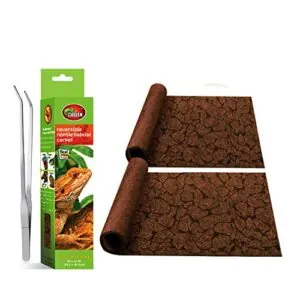
A soft, non-abrasive fabric surface makes this liner a gentle option for your snake’s belly, and the moss and solid print pattern looks natural in most setups. Each set includes two pieces, so you can rotate a clean one in while the other dries.
Each piece measures 30 by 12 inches, which suits a 20-gallon terrarium. Trim it to fit your tank’s exact dimensions.
Cleaning is simple. Shake out loose debris, rinse with cold water, and air dry it completely. Skip the machine dryer.
| Best For | Owners of snakes, geckos, bearded dragons, or other reptiles in a 20-gallon terrarium who want a soft, reusable, easy-to-clean substrate they can trim to fit. |
|---|---|
| Material | Non-abrasive moss-print fabric |
| Format | 2-piece set |
| Size | 30 x 12 inches |
| Weight | N/A |
| Reusability | Reusable, rinse and air dry |
| Moisture Handling | N/A |
| Additional Features |
|
- Soft, non-abrasive fabric is gentle on reptiles’ feet, bellies, and teeth.
- The 2-piece set lets you rotate a clean liner in while the other air dries.
- Waste stays on top of the surface, so removing it and keeping the tank tidy is easy.
- It needs a cold-water rinse and complete air drying after each wash, and it can’t go in the machine dryer.
- It may need trimming to fit your terrarium’s exact dimensions.
- At 30 by 12 inches per piece, it is sized for 20-gallon terrariums, so it may not suit other tank sizes without cutting.
5. ReptiChip Coconut Substrate 72 Quart
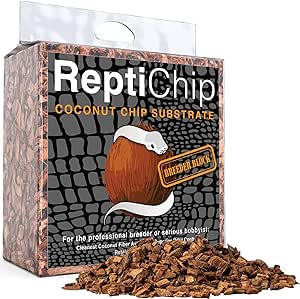
Picture a ball python owner who wants a deeper, damper hide floor without a pile of bagged bedding. One compressed brick can do that, expanding to 2.5 cubic feet once hydrated.
Made from 100% organic coconut husk, this block measures 30.48 x 15.24 x 30.48 cm and weighs 4.51 kg. It holds humidity well, absorbs odors, and works for burrowing or bioactive setups.
Check yours before use, since some buyers report plastic pieces. Without a stated water ratio, add water gradually.
| Best For | Reptile and invertebrate keepers, especially ball python, tortoise, or hermit crab owners, who want a humidity-holding, burrow-friendly substrate that can also work in bioactive setups. |
|---|---|
| Material | Coconut husk |
| Format | Compressed brick |
| Size | 30.48 x 15.24 x 30.48 cm |
| Weight | 4.51 kg (10 lbs) |
| Reusability | N/A |
| Moisture Handling | Superior humidity retention |
| Additional Features |
|
- Expands to 2.5 cubic feet from one compact 4.51 kg brick, so it’s easy to store and gives plenty of substrate.
- Holds humidity well, which suits tropical reptile habitats.
- Absorbs odors and encapsulates waste, and it supports burrowing and bioactive use.
- Some customers report plastic pieces in the substrate, so it needs a close check before use.
- No water-to-expansion ratio is given, so hydration takes some trial and error.
- Feedback on consistency and purity is mixed, so quality may vary from brick to brick.
6. Riare 2 Pack Coconut Fiber Reptile Substrate
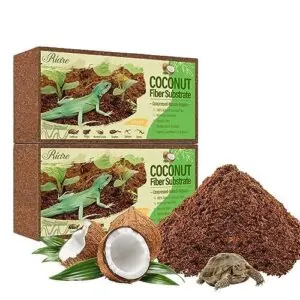
Two compressed bricks weighing 2.86 pounds in total make up this Riare set, and each one measures just 7.8 x 3.9 x 1.97 inches.
Soak them in water and they expand into a fluffy, moisture-retentive substrate that holds humidity for your snake.
The natural, odorless fiber absorbs liquids, waste, and odors, and it encourages the burrowing your snake does by instinct.
Some users do report crumbling, a sour smell after first use, and drying times of one to two weeks.
| Best For | Reptile, amphibian, and invertebrate keepers, such as owners of tortoises, hermit crabs, snakes, bearded dragons, geckos, and frogs, who want a natural, humidity-holding substrate that encourages digging and burrowing. |
|---|---|
| Material | Coconut fiber |
| Format | 2 compressed bricks |
| Size | 7.8 x 3.9 x 1.97 inches each |
| Weight | 2.86 pounds |
| Reusability | Biodegradable, compostable |
| Moisture Handling | Retains humidity, absorbs liquids |
| Additional Features |
|
- Expands when soaked into a fluffy, moisture-retentive substrate that helps maintain humidity and warmth in the terrarium
- Absorbs liquids, waste, and odors, which helps keep the enclosure cleaner
- Biodegradable and compostable, so it can go into the garden or be used as plant fertilizer
- Some users report that it breaks apart easily during use
- A few customers notice a sour smell after the first use
- It can take one to two weeks to dry completely, depending on conditions
7. Coconut Fiber Reptile Substrate 5 Pack

Think of this one as a build-it-yourself floor. Each of the five packs holds a brick measuring 8.2 x 4 x 2 inches and weighing about 1.3 pounds, so you control exactly how much substrate your enclosure gets.
Soak a brick in water and stir it until it loosens into fluffy, natural-like soil. Skip the stirring and you’ll end up with dense clumps.
The fiber is highly absorbent, which helps with liquids and waste. Keep it indoors only.
| Best For | Reptile, amphibian, and invertebrate keepers, as well as indoor gardeners, who want a natural, absorbent substrate they can prepare themselves. |
|---|---|
| Material | 100% natural coconut fiber |
| Format | 5 compressed bricks |
| Size | 8.2 x 4 x 2 inches each |
| Weight | 1.3 LB per brick |
| Reusability | N/A |
| Moisture Handling | Highly absorbent |
| Additional Features |
|
- Made from 100% natural coconut fiber that expands into fluffy, soft soil
- Highly absorbent, so it soaks up liquids and pet waste
- Works for reptiles, amphibians, invertebrates, and indoor plants or herbs
- Needs to be soaked in water before every use
- Has to be stirred to fully expand and loosen, or it stays in dense clumps
- Meant for indoor pet and gardening use only
Cutting and Installing Terrarium Liners Safely

A liner that fits well protects your snake, and a poor cut can snag claws or trap scales. Start by measuring the tank’s length and width with a flexible tape, then match the liner within 2 mm. Check the corners first, and remeasure after placing bowls or hides.
Measure twice, then cut. Use a sharp utility knife instead of scissors for cleaner edges, and clamp the liner and a straight guide in place so nothing slips. Aim for a bevel with a 0.5 to 2 mm radius so edges sit flat and stay gentle on skin.
Wear gloves, a dust mask, and safety glasses, and cut in a ventilated space. Before installing, inspect each piece for loose fibers or curls. Skip adhesives and tape. A precise, cut to fit liner stays put through friction alone.
Cleaning and Drying Reusable Snake Liners

Once your liner is cut and seated, keeping it clean protects your snake as much as the fit does. Reusable reptile liners stay safe only when you remove waste promptly, so spot clean daily with a damp cloth and a reptile-safe disinfectant.
Follow this weekly routine:
- Soak the liner in warm water with mild soap or a 1:1 vinegar-water solution.
- Rinse thoroughly until no trace of cleaner remains.
- Sterilize coconut fiber by baking at 200-250°F for 30-60 minutes, or boiling for 15-20 minutes.
- Let it cool completely before it touches your snake.
- Air dry in a ventilated spot, out of direct sun, using a fan if needed.
Keep two liners in rotation so one always has time to dry fully.
Replacing and Disposing of Liners Responsibly

Even with careful reptile habitat maintenance, every liner wears out eventually. Replace yours only when you see fraying, thinning, or an odor that lingers after cleaning, since those signs mean the fabric can’t stay hygienic for your snake.
Swap out your snake’s liner only when it frays, thins, or keeps smelling after a wash, because those are the signs it can no longer stay clean
Worn liners still have a second life. Here’s how to handle each type:
| Liner type | Best option | Quick tip |
|---|---|---|
| Washable reusable | Weed barrier or shelter donation | Wash first |
| Certified compostable | Industrial composting | Check the label |
| Worn synthetic | Textile recycling or trash | Cut into small pieces |
Never flush liner scraps. They clog pipes and add microplastics to waterways. Home composting rarely breaks down synthetic fibers, so save compostable liners for industrial facilities.
Replace only when needed: you’ll protect your snake while cutting waste.
Frequently Asked Questions (FAQs)
Can eco-friendly liners work with heat mats?
Think of a liner as a winter blanket between the heat mat and your snake. Yes, they work together, but add a thermostat and keep the liner thin, flat and dry so warmth still reaches your snake.
Are eco-friendly liners safe for baby snakes?
Yes, when you choose solid, non-ingestible liners, they’re a smart pick for hatchlings. Reptile-safe materials like untreated coconut fiber prevent impaction, so rinse before first use, trim edges flush, and replace anything frayed right away.
Do eco-friendly liners help prevent snake mites?
Not by themselves, and no liner is a magic shield. Mites arrive on new animals or gear, so your best defense is a non-absorbent liner you can wash hot, plus steady quarantine and habits.
Conclusion
Picture a keeper who swaps loose bark for a washable polyester carpet in her hognose’s tank. Impaction risk drops, and the same liner survives 50 washes instead of ending up in the trash each month.
That’s the real payoff of choosing eco friendly terrarium liner alternatives for snakes. Match the material to your species, cut it to fit, and clean it on schedule. Safer feeding, steadier humidity, and a lighter bin follow. Your snake thrives.
- https://shunwaste.com/article/what-is-the-use-of-coconut-waste
- https://www.walmart.com/ip/Natural-Coconut-Coir-Liner-Roll-3-Sizes-Cuttable-Coconut-Fiber-Mat-Reptile-Carpet-Pet-Pad-Terrarium-Planter-Liner-Garden-Flower-Basket-Home-Decoratio/20178011472
- https://growwithhydroponics.com/coconut-fiber-microgreens