This site is supported by our readers. We may earn a commission, at no cost to you, if you purchase through links.

Most sick snakes don’t get sick from disease. They get sick from their homes. A tank that runs a few degrees too cold or too dry can quietly wreck a snake’s digestion, its shed, even its immune system, long before you spot anything wrong.
That’s the tricky part. Snakes hide stress well, so by the time you notice open-mouth breathing or a stuck shed, the habitat’s probably been off for weeks.
A solid snake habitat maintenance guide fixes that by giving you a routine, not guesswork. Get the daily, weekly, and monthly habits down, and your snake’s tank practically runs itself.
Table Of Contents
- Key Takeaways
- Select and Secure The Right Enclosure
- Regulate Temperature, Humidity, and Lighting
- Maintain Safe Substrate and Enrichment
- Follow a Consistent Cleaning Schedule
- Monitor Health and Habitat Safety
- Frequently Asked Questions (FAQs)
- How do you keep a snake safe?
- Do snakes need heating pads?
- Do snakes need a hygrometer?
- What should a snake enclosure contain?
- How do you keep snakes from shedding?
- What type of enclosure do you need for a pet snake?
- How to care for snakes for beginners?
- What does a snake habitat need?
- How often do you need to clean a snake substrate?
- How to set up a snake habitat?
- Conclusion
Key Takeaways
- Most snake illness actually comes from a habitat that’s slightly off—too cold, too dry, or poorly ventilated—not from disease, and since snakes hide stress well, problems can brew for weeks before you notice anything wrong.
- A safe enclosure depends on getting the basics right together: proper size for your snake’s species, secure locks and seals, a warm-to-cool temperature gradient, and species-specific humidity levels checked with a digital hygrometer.
- Substrate choice matters more than people think—skip cedar, pine, sand, and loose wood chips, and stick with species-appropriate materials at the right depth to support both safety and healthy humidity.
- A simple, consistent cleaning routine (daily spot cleaning, weekly surface wipes, monthly deep cleans) paired with regular health checks—like tracking feeding, shedding, and waste—catches problems early and keeps your snake thriving long-term.
Select and Secure The Right Enclosure
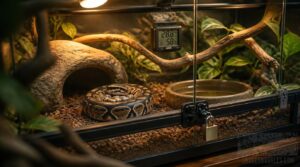
Your snake’s enclosure is home base—get it wrong, and everything else gets harder. The good news? Setting it up right comes down to a handful of simple checks. Let’s walk through exactly what to look for, piece by piece.
If you want a deeper breakdown before shopping around, this guide to choosing the right snake cage and habitat setup covers sizing, materials, and ventilation in detail.
Match Size to Snake Species
Before buying anything, size up your snake, literally. Corn snakes do fine in 40 to 60 gallon setups, while ball pythons need 60 to 125 gallons or more. Smaller species want room that’s 1.5 times their girth in length.
Big boas? Think custom, sometimes over 8 feet, with space to coil and stretch comfortably. For perspective on sizing needs, some largest snake species in North America grow up to 8.5 feet long, requiring especially spacious enclosures.
Choose Accessible Enclosure Materials
Once you’ve got the right size picked out, think about what the enclosure’s actually made of.
Glass terrariums with front opening doors give you easy access plus solid visibility.
Look for food grade, non-toxic materials like sealed wood or ABS plastic. They resist humidity, wipe clean fast, and won’t leach anything nasty into your snake’s home.
Install Locks and Safety Clips
A snake that wants out will find any weak spot, so locks matter as much as materials. Cylindrical locks or push-button styles work great for quick, one-handed access.
Add metal safety clips on lid corners since they resist corrosion in humid setups. Align hardware at the top, tighten screws to spec, then test the latch with light pressure. That’s your escapeproof enclosure right there.
Check Ventilation and Seals
Locks keep your snake in, but bad airflow can make them sick anyway. Good enclosure ventilation needs vents on multiple sides, high ones let warm air escape, low ones bring cooler air in.
Check seals monthly for tears or gaps. Worn gaskets? Replace every 12-24 months. Pick corrosion-resistant vent materials like powder-coated metal, and your secure enclosure stays truly escapeproof.
Inspect for Escape Gaps
Even a snake with zero escape history can find one gap on the wrong day. Run your hands along seams, check mesh panels, and test corners with light pressure.
- Feeler-gauge door edges (under 1mm)
- Light-test hatch seams
- Check for loosened brackets
- Scan substrate near seals
- Log wear monthly
That’s real enclosure security, not guesswork.
Regulate Temperature, Humidity, and Lighting
Your snake can’t tell you when it’s too hot or too cold, so it’s on you to get the setup right. Temperature, humidity, and lighting all work together to keep your snake healthy and stress-free. Here’s what you need to know to dial in each one.
Getting these fundamentals right from day one matters more than most new owners realize, because as any experienced keeper knows, small snake tank health mistakes can quietly snowball into serious problems long before your snake shows any outward signs of stress.
Since temperature needs vary so much by species, pairing your heat mat with a reliable controller is essential — this guide on using a thermostat with a reptile heat mat walks you through keeping those gradients stable and safe.
Lighting matters just as much, since choosing the right UVB bulb type and mounting distance for your snake’s species helps replicate the natural sun exposure they’d get in the wild.
Create Warm and Cool Zones

Think of your snake’s tank like two rooms in one house, a thermal gradient matters. Keep the warm side 88-95°F for basking, cool zone 75-80°F. That gap lets your snake pick its comfort spot naturally.
| Zone | Temp Range | Purpose |
|---|---|---|
| Warm | 88-95°F | Basking, digestion |
| Cool | 75-80°F | Resting, recovery |
Connect Heat Sources to Thermostats
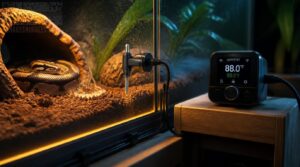
Never plug a heat mat straight into the wall, that’s asking for burns or fires.
A thermostat cuts power once your warm side hits setpoint, protecting against overheating. Pick one rated for your heater’s wattage, place the probe at snake level (not the wall), and check wiring monthly for damage or moisture near humid zones.
Monitor Conditions With Digital Gauges
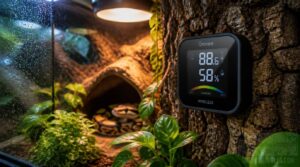
Your thermostat controls the heater, but a digital gauge double-checks the truth. Get one with a hygrometer built in, accurate to about ±0.5°C and ±3-5% RH.
Set alert thresholds so it pings your phone if things drift. Wireless models save wiring hassle, just watch battery life and export data occasionally to spot trends.
Maintain Species-Specific Humidity
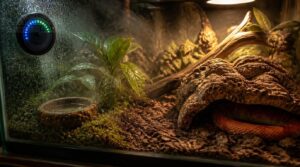
Humidity isn’t one-size-fits-all. Species Humidity Targets vary widely:
- Ball pythons: 50-60%
- Corn snakes: 40-50%
- Stimson’s pythons: 30-40%
- Tropical species: up to 85%
Set up a Humidity Gradient Setup with damp and dry zones. Check substrate moisture control weekly, and keep water bowl placement away from heat. Calibrate hygrometers monthly for accurate humidity monitoring.
Evaluate Lighting and UVB Needs

Does your snake actually need UVB? Probably yes, even nocturnal species use it for vitamin D.
Match bulb type (T5, T8, or mercury vapor) to your snake’s Ferguson zone, then check Uvi with a meter near the basking spot.
Run a 10-12 hour photoperiod on timers, and inspect bulbs monthly for cracks or fading output.
Maintain Safe Substrate and Enrichment

Once your temperature and humidity are dialed in, the ground floor matters too. What your snake lives on—and hides in—plays a bigger role in its health than you might think. Here’s what to know before you pick a substrate or add enrichment.
Choose Species-Appropriate Substrate
What’s underneath your snake matters as much as what’s inside its bowl. Substrate species matching keeps things safe: aspen for corn snakes, coco fiber for tropical burrowers, cypress mulch for humidity lovers. Skip cedar and pine, period.
Think humidity-based selection too, dry species need dry ground. Curious about a bioactive substrate? It’s a living, self-cleaning setup, pretty cool once dialed in.
Provide Proper Substrate Depth
Once you’ve picked the right substrate, depth is what actually makes it work. Aim for 2-4 inches for most snakes, but burrowers need 6-12 inches for full body coils.
- Check depth weekly for compaction
- Keep escape burrows accessible
- Build gradual slopes at entrances
- Retest moisture at burrow depth
Deeper layers hold humidity better too, so don’t skimp.
Avoid Toxic or Risky Materials
Getting depth right doesn’t mean much if what’s underneath is dangerous. Skip cedar and pine, their oils are toxic. Ditch sand and loose wood chips too, they cause impaction if swallowed.
Safe material selection matters everywhere: nonporous, inert plastics, non-toxic finishes, lead-free paint, and rust-proof hardware. Your snake’s home should stay chemical-free and safe, always.
Place Warm and Cool Hides
Safe materials matter, but your snake also needs somewhere to disappear. Give it two hides, one warm, one cool, placed at opposite ends for a real thermal gradient. Make entry holes snug but easy to access, stable, and non-porous. Size each hide to fully enclose your snake without cramping its movement.
Add Secure Climbing Enrichment
Even a snake needs a jungle gym. Cork bark ramps, sturdy branches, and rated vines give vertical enrichment without sharp edges.
- Anchor climbing structures with corrosion-resistant screws
- Match branch height to species size
- Round all edges, avoid soft foam
- Check weekly for wobble
- Clean fixtures with reptile-safe solution
Secure mounting stops surprise escapes and keeps exploration safe.
Follow a Consistent Cleaning Schedule
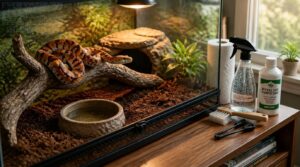
A clean enclosure isn’t just about looks—it keeps your snake healthy and stress-free. The good news? You don’t need to overhaul everything at once. Here’s how to break the routine into simple daily, weekly, and monthly steps.
Choosing the right base layer makes daily upkeep easier, so it’s worth comparing substrate liners versus loose substrate options before settling into a routine.
Complete Daily Spot Cleaning
Two minutes a day beats two hours of scrubbing later. Grab your reptile tongs, pull out feces and shed skin, then wipe hides and decor with a damp cloth. Check the water bowl for grime, sift substrate for hidden waste, and glance at your snake, calm and alert is what you want. Sanitize tools before you put them away.
Refresh Water Every Day
Plain and simple, your snake needs fresh water daily. Dump the old bowl, rinse with a clean container, and refill with room temperature water, cold water can shock their system.
Water quality testing isn’t complicated here: cloudy or grimy water means bacteria and algae are creeping in. Keep the bowl in a stable spot, away from heat lamps, for easy hydration monitoring.
Perform Weekly Surface Cleaning
Once a week, go beyond spot cleaning and give surfaces real attention. Wipe enclosure surfaces, glass, corners, and heater housings, with a cloth. Disinfect with reptile cleaner, then rinse surfaces thoroughly to ditch residue.
Dry surfaces completely, mold loves leftover moisture. Wear protective gloves throughout, and toss soiled substrate or waste in a sealed bag before disposal.
Deep Clean The Enclosure Monthly
Once a month, take everything apart. Move your snake to a secure backup container, then strip the enclosure bare, decor, water bowl, substrate, all of it.
Deep cleaning means sanitizing every surface with reptile-safe disinfectant or a 10% bleach solution, rinsing well, then checking seals for cracks. Bag waste for disposal, replace substrate fresh, and calibrate your thermometer and hygrometer before reassembly.
Maintain Bioactive Substrate Properly
A bioactive substrate is basically a tiny living community, isopods and springtails as your cleanup crew, breaking down waste so you don’t have to.
Skip full teardowns, just top with fresh leaf litter and check moisture so microbes thrive without drowning.
Watch for odor or discoloration, that’s your cue.
Gently aerate the surface to keep waste breakdown and bioactive cycling humming along.
Monitor Health and Habitat Safety
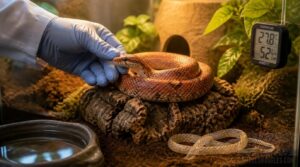
A clean cage is a great start, but it’s not the whole picture. Your snake’s body and behavior tell you a lot too, if you know what to look for. Here’s what to keep an eye on, from feeding habits to that yearly vet visit.
Track Feeding and Shedding Patterns
Ever notice patterns your snake follows like clockwork? Keep a simple feeding log tracking dates, prey size, and refusals. Note shedding cycles too, cloudy eyes mean skip that meal.
Track these:
- Feeding frequency (every 7-14 days)
- Weight trends weekly
- Shed timing (4-12 weeks)
- Refusal patterns
Two or three skipped meals? Time to investigate, not panic.
Examine Waste for Abnormalities
Your feeding log tells half the story, the other half is sitting right there in the enclosure.
Do a quick fecal exam during daily spot cleaning: healthy droppings are dark brown to black, firm, with white urates on top. Gray, green, or bloody waste means something’s off. Watery texture or no droppings for five-plus days? Time to watch closer.
Watch for Illness Signs
A fecal exam only tells you so much, so give your snake a once-over too.
Watch for open-mouth breathing or wheezing, that’s respiratory distress. Check scales for discoloration or crusty patches, and eyes for cloudiness. Lethargy, hiding more than usual, or skipping meals for two weeks are red flags worth tracking closely.
Recheck Equipment and Decor
Your snake’s body isn’t the only thing worth checking, gear matters too.
- Test equipment accuracy: thermostats within ±1.5°C
- Verify decor safety: stable hides, secure branches
- Check enclosure seals: no gaps, tight ventilation
Confirm substrate stability and inspect ventilation function weekly. A wonky heating system or blocked lighting cycle can undo weeks of good care fast.
Schedule Annual Veterinary Exams
Once a year, book a checkup, even if your snake seems totally fine.
Vets do a full body condition assessment, dental check, and behavior evaluation, plus review vaccine and parasite prevention needs.
It’s not paranoia, it’s early detection.
Catching issues before symptoms show up is how you keep your slithery buddy around for the long haul.
Catching issues before symptoms appear is the secret to a long, healthy life for your snake
Frequently Asked Questions (FAQs)
How do you keep a snake safe?
Locked lids, checked seals, secure hides: safety starts before you ever open the door. Focus on escape prevention, gentle handling safety, and a solid emergency escape plan, so injury and stress stay off the table entirely.
Do snakes need heating pads?
Yes, most species benefit from one. Paired with a thermostat for burn prevention, under tank heaters create belly heat that helps digestion better than heat lamps alone, as part of a proper temperature gradient with clear basking spots.
Do snakes need a hygrometer?
Skipping a moisture gauge is a bit like guessing your home’s thermostat setting. A digital hygrometer tracks humidity levels precisely, guiding misting and substrate moisture control so shedding, breathing, and overall climate control stay right on target.
For app-based tracking and trend analysis, explore digital greenhouse humidity gauges that log conditions over time.
What should a snake enclosure contain?
Your setup needs the right enclosure size, safe substrate, and a solid temperature gradient with basking spots on the warm end. Add warm and cool hides, proper humidity, and good ventilation, everything your snake needs to feel safe and thrive.
How do you keep snakes from shedding?
Trick question, like asking a VCR to stop rewinding tapes. You can’t stop shedding, but humidity control (60-70%), a snug water bowl, and rough decor for shedding assistance make the cycle smooth and stress-free.
What type of enclosure do you need for a pet snake?
Go for a glass or acrylic tank at least two thirds your snake’s length, with cross ventilation, secure locking lids, species-safe substrate, warm and cool hides, and a spot for temperature monitoring.
How to care for snakes for beginners?
Baby steps win the race here. Start with proper enclosure size, a warm-to-cool temperature gradient, safe substrate, and correct humidity.
Add a steady feeding schedule, gentle handling, shedding support, and weekly deep cleaning to keep your snake calm and thriving.
What does a snake habitat need?
Your snake needs a secure, right-sized enclosure with good ventilation, a proper temperature gradient, species-correct humidity levels, safe substrate, hides, enrichment, and a steady cleaning routine to stay healthy and stress-free.
A full breakdown of each variable—from hide placement to locking mechanisms—is covered in this step-by-step snake enclosure setup guide so nothing gets overlooked.
For a deeper walkthrough of each of these essentials, this snake care basics guide breaks down setup, heating, and daily routines step by step.
How often do you need to clean a snake substrate?
Go with daily spot cleaning for waste and shed skin, weekly surface cleaning for soiled substrate, and a full deep clean monthly. Bioactive setups stretch that out to every one to three months, since the environment does more upkeep on its own.
How to set up a snake habitat?
Ever seen a snake attempt yoga in a shoebox? That’s what a cramped tank looks like. Real terrarium setup means enclosure sizing at 2-3x body length, a solid temperature gradient, proper humidity levels, safe substrate, and cozy hiding spots.
Conclusion
Your snake isn’t asking for a five-star hotel with room service and mood lighting. It just wants steady warmth, clean digs, and water that isn’t growing a science experiment.
Follow this snake habitat maintenance guide, and those daily and weekly checks become second nature, not chores. Skip them, and you’re basically running a slow-motion emergency room visit. Keep the routine simple, stay consistent, and your snake will thank you the only way it knows how: by staying healthy and boring.