This site is supported by our readers. We may earn a commission, at no cost to you, if you purchase through links.

A snake that escapes isn’t just a problem—it’s a sign the habitat failed before anything else did. Ball pythons, corn snakes, and kingsnakes are escape artists by instinct, and a poorly built enclosure puts both the animal and your household at risk.
Getting the snake cage habitat right from day one means fewer emergencies, healthier animals, and a setup that works with your snake’s biology instead of against it. The details matter more than most keepers expect—from floor dimensions to substrate moisture to hide placement.
Here’s exactly how to build it correctly.
Table Of Contents
- Key Takeaways
- Choose The Right Snake Enclosure
- Set Up Heating Zones
- Control Humidity and Ventilation
- Add Hides and Enrichment
- Maintain a Healthy Habitat
- Frequently Asked Questions (FAQs)
- Can a snake know its owner?
- Do you need a large snake cage?
- How long should a snake cage be?
- What materials do snake cages & enclosures come in?
- What is a large hybrid snake cage?
- Who manufactures custom snake cages & enclosures?
- How do you house a snake in a cage?
- What water features work best for snakes?
- How often should snake enclosures be upgraded?
- Can multiple snakes share one large enclosure?
- Conclusion
Key Takeaways
- Floor space is your top priority — your snake needs at least two-thirds of its body length in enclosure footprint, and PVC enclosures hold up best over time.
- A thermostat isn’t optional — without one, heat sources run unchecked and can seriously hurt your snake.
- Humidity control starts with the right substrate — a 60/40 coconut-fiber and sphagnum moss mix holds moisture far better than either material alone.
- Two snug hides, one on each side, give your snake the security it needs to stay calm and regulate its own temperature naturally.
Choose The Right Snake Enclosure
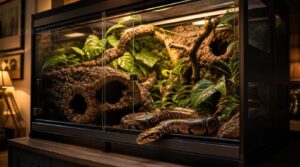
The enclosure you choose sets the tone for everything else in your snake’s habitat. Get it wrong, and no amount of hides, branches, or careful misting will fix it.
A good starting point is understanding what tank size a boa actually needs before you invest in hides, branches, or any other setup.
Your snake’s enclosure is the foundation — get it wrong, and nothing else will save it
Here’s what to look for before you buy.
Match Size to Species
Matching size to species starts with a simple body-length ratio: the floor space should cover at least two-thirds of your snake’s total length.
A ball python requires a minimum footprint of 4×2×2 feet, while larger females may need custom reptile terrarium dimensions up to 6×2×2 feet.
Species-specific enclosure sizing isn’t optional — it’s the foundation of good care.
Prioritize Floor Space
Floor space matters more than height for most snakes. Footprint dimensions drive open movement — aim for a 4x2x2 habitat at minimum, scaling up through large enclosures ranging from 60 to 240 gallons as your snake grows.
Keep enrichment layout along the perimeter, spacing so the center stays clear. This arrangement ensures unobstructed movement.
An expandable cage system simplifies planning for your snake’s future size. For reference, adult ball pythons require a minimum 4 × 2 × 2 ft enclosure minimum ball python size.
Use Escape-proof Doors
Once you’ve nailed down the floor space, the next critical step is securing your door setup. Front-opening doors on a quality snake enclosure simplify feeding and maintenance tasks.
Prioritize safety features like tamper-resistant fasteners, fail-safe electronics, and panic bar design to meet compliance labeling standards. These elements ensure the enclosure remains secure and functional.
Adhering to a door maintenance schedule is essential to sustain the integrity of your reptile enclosure design over time.
Compare PVC, Glass, Wood
PVC enclosures win on UV stability, weight differences, and easy cleaning — no warping, no rot.
Heavy-duty sliding glass panels look sharp and resist scratching but cost more and conduct heat differently than other materials.
A 120-gallon wood snake terrarium holds heat retention well yet needs sealing.
For material longevity and cost comparison, PVC leads.
Plan for Adult Growth
Plan ahead — your snake won’t stay small for long. Most species require a species-specific enclosure within 12 to 18 months, so integrate an upgrade path timeline into your budget from the start. Choose expandable, stackable, modular cage designs with customizable options initially to simplify future transitions.
Growth forecast modeling, based on shedding frequency, helps time the enclosure switch accurately. This proactive approach ensures your snake’s habitat evolves alongside its growth, avoiding unnecessary stress or space constraints.
Opt for large enclosures with modular expansion options and future thermostat-calibration support. These features maintain simplicity in adult health monitoring while accommodating your snake’s long-term needs.
Set Up Heating Zones
Getting the temperature right is one of the most important things you can do for your snake. A proper heating setup means your snake can regulate its body temperature naturally, the way it would in the wild.
Here’s how to build heating zones that actually work.
Create Warm and Cool Sides
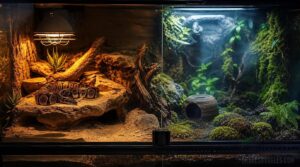
Your snake needs options — a warm side to digest and a cool side to recover.
Set up clear heat gradient zones by placing your heat source at one end only. This creates a natural thermal gradient with a strong temperature differential across the enclosure.
Zone insulation and smart heat source placement keep that gradient length stable, giving your snake full control over its own temperature regulation.
Use Thermostat-controlled Heat

A high-quality thermostat is your best defense against dangerous temperature swings. Without thermostat control, heat sources run unchecked — and that’s a real risk.
- Programmable thermostats use proportional control to gradually adjust heat distribution instead of cycling on and off
- Weather-compensated settings stabilize thermal regulation when room temperatures shift
- Remote temperature alerts with high-limit safety cut power before overheating occurs
Place Probes Correctly
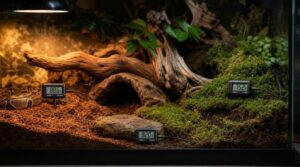
Probe placement makes or breaks your thermal regulation. For warm-side placement, position your probe two to three inches below the surface, away from the lamp. Cool-side placement should sit at the animal’s height.
Add a substrate probe near the floor to catch ground heat. Keep probes at least two inches from vents to avoid interference.
Calibrate monthly to maintain an accurate temperature gradient.
Avoid Dangerous Hot Spots
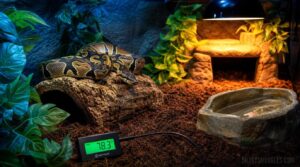
Hot spots burn. A single misplaced heat source can cook your snake without warning. Smart Heat Source Placement prevents this. Map your Temperature Gradient Mapping zones before adding any animal. Use a Radiant Bulb Shield to direct heat downward, not sideways.
- Choose low-surface-conductivity materials near heat zones.
- Add a heat exchange fan for even heat gradients in various zones.
- Follow a Probe Calibration Schedule monthly for reliable temperature control for reptiles.
Monitor Daily Temperatures
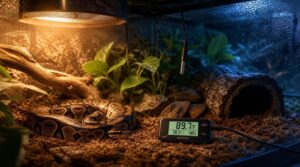
Check temperatures every morning and evening — consistency is everything in climate control for reptiles. Use a calibrated digital thermometer for Ambient-Substrate Comparison and log both readings daily. This routine keeps your heat gradients stable and your snake safe.
Smart Data Logging catches drift before it becomes danger. Set Temperature Alerts for out-of-range readings. These practices ensure proactive monitoring and prevent hazardous fluctuations.
Confirm Probe Placement stays accurate after each cleaning. Proper maintenance guarantees reliable measurements, safeguarding your reptile’s environment.
Control Humidity and Ventilation
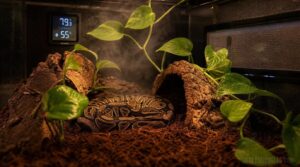
Humidity and ventilation can make or break your snake’s health — get either one wrong and problems follow fast.
The good news is that dialing both in doesn’t have to be complicated. Here’s what you need to focus on.
Pick Moisture-safe Substrate
Substrate choices make or break your humidity regulation. Coconut fiber and sphagnum moss are your go-to substrate options—mix them at a 60/40 ratio to hold moisture up to 40% better than fiber alone.
Add coco coir for depth, leaf litter for a bioactive substrate feel, and a touch of perlite additive to prevent waterlogging in high-humidity setups.
Add Secure Air Vents
Good substrate holds moisture — but without airflow, that moisture turns stale fast. Your ventilation system is what keeps the air fresh and your snake healthy.
- Use standard back vents and Side Vents with fine Screen Mesh Type to block escapes
- Apply Locking Vent Latches to prevent tampering
- Practice a weekly Vent Cleaning Routine and use Cross Vent Placement for steady Airflow Rate
Track Humidity With Hygrometers
Once your vents are dialed in, you need to actually measure what’s happening inside. A digital hygrometer with a probe provides real data—not guesswork. Probe positioning matters: place it at mid-height, away from heat sources.
Capacitive sensor types read fastest in high-humidity setups. Calibrate every six months to maintain accuracy.
Log readings daily and use trend analysis to catch humidity swings before they stress your snake.
Mist Only When Needed
Your hygrometer data tells you when to act. Don’t mist on a schedule — mist when readings drop below your target range. Smart Misting Controllers automate this perfectly, pausing when sensors hit the upper threshold.
Particle Size Selection matters too; aim for 5–20 micrometers for Targeted Microclimate Mist without soaking bedding.
Watch for these Condensation Alerts:
- Droplets on walls signal over-misting
- Humidity spiking past species maximum by 5+ percent
- Poor ventilation trapping moisture in high-humidity setups
Prevent Mold and Odors
Mold moves fast in high humidity setups—don’t give it a foothold. A removable tray system simplifies weekly cleanouts, while adhering to an enzyme cleaning schedule prevents waste buildup and odors.
| Problem | Solution |
|---|---|
| Mold growth | Antimicrobial coating + enclosure ventilation |
| Lingering odor | Odor‑absorbing charcoal insert |
| Excess moisture | Passive dehumidifier use |
| Waste buildup | Enzyme cleaning schedule |
Your vent system does the heavy lifting—keep it clear to maintain airflow and system efficiency.
Add Hides and Enrichment
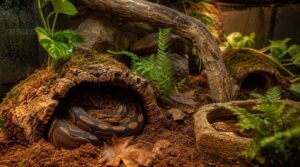
A bare enclosure isn’t enough — snakes need places to hide, climb, and feel secure. Getting this part right makes a real difference in how calm and healthy your snake stays.
Here’s what to add.
Provide Two Snug Hides
Every snake needs two hides — one on the warm side, one on the cool side. Strategic placement lets your snake thermoregulate without ever feeling exposed.
Choose thermal-specific hides with cozy dimensions — small enough for full body contact against all walls. Material durability matters too; smooth, non-porous plastic resists mold and cleans fast.
Easy removal makes weekly inspections simple, supporting genuine stress reduction for snakes and smarter pet reptile care.
Include a Humid Hide
A humid hide is your snake’s shedding sanctuary. Fill it with damp Moss Substrate and place it in a Warm-Side Position — heat boosts evaporation and keeps moisture flowing. Choose a hide with an Access Lid Design so you can do Regular Mist Checks without stress.
Every snake owner needs a Sanitation Schedule: inspect weekly, swap substrate monthly, and keep mold out of your reptile habitat.
Add Branches and Clutter
Branches transform a bare enclosure into a living reptile habitat. Choose branches with a Diameter Range of 1–3 cm for easy gripping, and use secure Anchor Methods to prevent shifting.
Texture Diversity — cork bark, driftwood, vine sections — drives environmental enrichment and natural behavior.
Commit to a Monthly Rotation and Safety Inspection to keep habitat enrichment fresh and every snake owner’s setup safe.
Use Shallow Water Dishes
Water is a basic need — don’t overlook it. A shallow dish, kept between 0.5 and 1 inch deep, gives your snake safe access without drowning risk. This simple piece of reptile terrarium design facilitates hydration behavior and habitat enrichment at once. Choose the right setup with these Dish Depth Guidelines:
- Ideal Placement: Set the dish on the cool side to slow evaporation
- Safe Materials: Use glazed ceramic or food-grade plastic — nonporous and easy to disinfect
- Cleaning Routine: Rinse daily; sanitize every one to two weeks
- Depth limit: Never exceed 1.5 inches for hatchlings or small species
- Accessibility: Smooth, rounded rims protect your snake during drinking
Support Natural Snake Behavior
Your snake isn’t just sitting there — it’s constantly reading its environment. A species-specific enclosure with proper terrarium zoning gives it real choices: warm or cool, exposed or hidden.
Rotate enriching accessories and use feeding puzzles to trigger natural foraging instincts. Behavioral monitoring tells you when something’s off.
Scent marking, seasonal simulations, and bioactive terrarium setups all support stress reduction for reptiles living under your care.
Maintain a Healthy Habitat
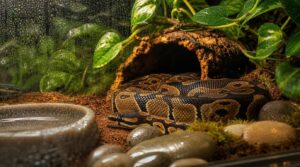
A clean enclosure isn’t just nice to have — it’s what keeps your snake healthy long-term.
Choosing the right setup from the start — like a ball python starter kit with a front-opening enclosure — makes routine cleaning far less stressful for both you and your snake.
Small daily habits make a bigger difference than one big cleanup every month.
Here’s what a solid maintenance routine actually looks like.
Spot-clean Waste Daily
Every time you spot waste, remove it immediately. Immediate feces removal protects habitat stability and keeps bacteria from spreading.
Wipe the area with a reptile-safe cleaning solution, rinse well, and replace the soiled patch with fresh substrate.
Seal waste and wash your hands thoroughly—hand hygiene matters more than most keepers realize.
Log each clean in a cleaning logbook to track patterns.
Replace Substrate Regularly
Spot-cleaning manages the daily mess, but fresh substrate is a reset your enclosure truly needs. Replace it every 6 to 12 months for most species — every 4 to 6 months for heavy producers or humid setups.
Your fresh substrate choice matters: coconut fiber controls moisture; cypress mulch reduces odor.
Remove all decor first, complete your removal process thoroughly, then do a quick condition check on walls and vents before reintroducing your snake.
Disinfect With Reptile-safe Cleaners
Fresh substrate sets the stage — now disinfection keeps it safe.
- Cleaner Selection: Choose reptile-safe options like diluted chlorhexidine, F10SC, or HOCl sprays.
- Contact Time: Let cleaners dwell on surfaces before wiping.
- Rinse Protocol: Always rinse with fresh water after disinfecting.
- Post-Clean Ventilation: Air out the enclosure fully before returning your snake.
- Cross-Contamination Prevention: Use separate cloths for each surface.
Inspect Locks and Vents
A clean enclosure means nothing if a door swings loose. Test lock functionality every month — try opening it with force to confirm it holds. Check seal wear around front-opening doors for gaps that invite escapes.
Inspect side vents and all cage ventilation features for corrosion, blockages, or loose grilles. Good reptile enclosure ventilation only works when vent integrity stays solid.
Refresh Decor and Hides
Rotating hides and decor isn’t optional — it’s real habitat enrichment. Swap out modular hide designs every few months and rearrange branches to break up predictable layouts. Update background scenery with custom background scenery panels to keep things visually stimulating.
Reptile accessories and habitat enrichment products work best when refreshed regularly. Don’t let the setup go stale — your snake notices.
Frequently Asked Questions (FAQs)
Can a snake know its owner?
Yes — through scent recognition and visual cues, your snake learns who you are. Regular handling builds trust, reduces stress, and improves their memory retention.
Species variations affect bonding speed, but consistency always wins.
Do you need a large snake cage?
Size matters more than you think. A Luxury Ball Python Cage with proper habitat zoning promotes coiling capacity, stress reduction, and future size forecast needs — all in one enclosure.
This species-specific enclosure is built for various heat gradient zones, ensuring optimal care tailored to the python’s requirements.
How long should a snake cage be?
Your snake’s cage should be at least as long as its body. For a ball python, 4–5 ft is standard. That full stretch length lets it move, thermoregulate, and stay stress-free.
What materials do snake cages & enclosures come in?
Snake cages come in PVC, glass, wood, HDPE, acrylic, and polycarbonate. Each material balances heat retention, visibility, and durability differently — so your choice depends on your species and setup goals.
What is a large hybrid snake cage?
A "scale" above the rest — a large hybrid snake cage is a custom terrarium built with UV-stable materials and a reinforced frame.
It offers modular expansion, stackable and expandable design, and habitat customization for mixed or oversized species.
Who manufactures custom snake cages & enclosures?
Several trusted brands build premium custom enclosures, including Hybrid Majestic, Cagemasters Custom, Snakesnuggles DIY, Toad Ranch, and Vision Modular. Each offers American Made Reptile Enclosures tailored to diverse setups.
Their expertise spans hand-crafted HDPE/PVC builds and custom luxury reptile enclosures, ensuring quality and customization for reptile enthusiasts.
How do you house a snake in a cage?
Think housing a snake is just tossing it in a box? Reptile husbandry laughs at that. You need a species-specific enclosure, proper cage placement, and health monitoring from day one.
What water features work best for snakes?
A low-profile bowl works best for most species. Keep water depth around 2–3 centimeters. Larger snakes benefit from an immersive soak area. Refill daily and keep it clean.
How often should snake enclosures be upgraded?
Bigger isn’t always better — until it is. Upgrade when your snake hits Growth Milestones, shows Stress Signals, or outgrows its Feeding Cycle space. Upgrade Timing matters more than age.
Can multiple snakes share one large enclosure?
Most snakes are solitary. Species compatibility is rarely guaranteed, and territory partitioning doesn’t eliminate stress indicators like restlessness or aggression.
For cleaner feeding management and disease transmission control, individual housing is always the safer choice.
Conclusion
"The cage builds the keeper." Old keepers used to say. Every choice you make in your snake cage habitat—the hides, the heat gradient, the substrate—tells your snake whether you understand it or not.
Get those details right, and you won’t just avoid problems. You’ll build an environment where your animal genuinely thrives.
Lock the enclosure, check the temps, and trust the system you’ve built. Your snake already has.
- https://www.stumpscustomwood.com/keeping-up/find-the-perfect-fit-your-reptile-enclosure-size-guide
- https://reptifiles.com/corn-snake-care-guide/corn-snake-terrarium-size/
- https://www.realaussiereptiles.com.au/what-enclosure-should-i-get-for-my-snake?srsltid=AfmBOoqn56hUJRIl5jO30NK-gI9cOx1SyDTFG-hccADSqzxxIzrlgCuh