This site is supported by our readers. We may earn a commission, at no cost to you, if you purchase through links.
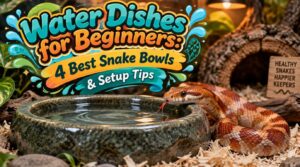
Your corn snake flips its water bowl at 2 a.m., soaks the bedding, and leaves your enclosure humidity spiking by morning. Wet substrate breeds bacteria, and bacteria means trouble.
Most water dishes for beginners fail for the same reasons: they’re too light, too small, or made from materials that crack, scratch, or leach. Snakes also seek out bigger bowls before shedding, so a dish that works in January may tip in March.
The right bowl takes the right material, size, and spot. Here’s how to pick one that stays put, stays clean, and keeps your snake drinking safely.
Table Of Contents
- Key Takeaways
- Choose Safe, Stable Snake Water Dish Materials
- Match Bowl Size and Depth to Your Snake
- Top 4 Products: Snake Water Dish Suitability
- Position Your Snake’s Water Dish Safely
- Keep Snake Drinking Water Fresh and Bowls Clean
- Frequently Asked Questions (FAQs)
- Why do people with ADHD struggle with dishes?
- Can I wash dishes with Dawn and cold water?
- How to do dishes with little water?
- What is the most hygienic thing to wash dishes with?
- Why does my snake soak in its water dish?
- How often should I refill the water bowl?
- Can snakes drink tap water safely?
- What causes bubbles or cloudy film in water?
- How do I tell if my snake is dehydrated?
- Conclusion
Key Takeaways
- Choose a heavy, nonporous bowl, such as stainless steel with a rubber base or lead-free glazed ceramic, because it won’t tip, leach chemicals, or trap bacteria the way scratched plastic does.
- Size the bowl to your snake: an adult corn snake needs one 6 to 8 inches across so it can soak and climb out, while babies need shallow dishes so they can’t drown.
- Set the bowl in a corner on the cool side, at least 12 inches from heat sources and off the path between hides, so it stays put and doesn’t flood the enclosure.
- Change the water and scrub the bowl every day, add a weekly chlorhexidine soak, and note that most of the listed products are built for poultry rather than snakes, so only a heavy ceramic dish suits larger snakes.
Choose Safe, Stable Snake Water Dish Materials
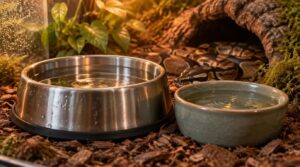
Material matters more than most beginners think. Your snake’s water dish sits in a warm, humid reptile enclosure setup, and that’s exactly where bad materials break down fast.
Ceramic and glazed stone bowls tend to hold up best against constant moisture, and this guide to the best snake water dishes for humid climates shows which materials resist bacteria buildup and daily scrubbing.
Stick with nonporous materials. Stainless steel is the safest all-around pick: it won’t leach BPA, phthalates, or lead, it won’t chip, and you can sterilize it in boiling water. Food-safe, lead-free glazed ceramic works too, and its heft gives you real weighted stability. Skip cracked or chipped ceramic. Sharp edges injure snakes. Glaze integrity is critical, since damaged or low-quality glaze can compromise a ceramic bowl’s chemical safety.
Avoid plastic for long-term use. Scratches trap bacteria, and heat can push chemicals into the water.
Steel slides and tips, so choose a rubber-bottomed bowl or weigh it down. Pair a stable bowl with species-appropriate depth and daily water changes.
Match Bowl Size and Depth to Your Snake
Size is where beginner reptile care goes wrong most often. A snake water bowl that’s too small can’t support soaking, and one that’s too deep can drown a baby.
Match water bowl sizing to your snake’s length. An adult corn snake at 4 to 5 feet needs a bowl 6 to 8 inches across, wide enough to slither in, coil, and climb out easily. Larger species can take 30 cm by 20 cm by 8 cm.
Depth matters just as much. Baby hognose snakes need shallow dishes, while a green tree python drinks best from a narrow, deeper bowl. Go with species-appropriate depth every time.
Snakes seek bigger bowls before a shed. Add a weighted base so it never tips.
Top 4 Products: Snake Water Dish Suitability
Not every bowl sold for snakes belongs in your enclosure. The four products below are judged on snake water dish suitability, meaning material, size, and stability. Check each one against your snake’s length and your setup before you buy.
1. Harris Farms Quart Jar Watering Base
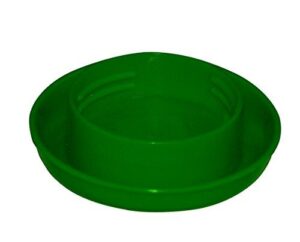
Picture a clear quart jar flipped upside down, water pooled in a shallow plastic dish at its base. That’s the Harris Farms Quart Jar Watering Base, model 1000286. It suits chicks, not snakes.
Keepers of snakes or lizards will want one of these reptile water bowls for humidity control, which also help stabilize enclosure moisture.
The BPA-free plastic screws onto glass or plastic quart jars, fits standard mason jars, and cleans and disinfects easily. It measures 6 x 0.13 x 1.35 inches and weighs 0.64 ounces.
You can repurpose it for reptile watering, but a loose or overtightened lid risks jar detachment.
| Best For | Anyone raising baby chicks or small game birds who wants a simple, easy-to-clean waterer that screws onto a standard quart jar. |
|---|---|
| Material | BPA-free plastic |
| Dimensions | 6 x 0.13 x 1.35 inches |
| Weight | 0.64 ounces |
| Model Number | 1000286 |
| Cleaning | Easy to clean and disinfect |
| Color | N/A |
| Additional Features |
|
- Made of BPA-free plastic that is safe for watering and easy to clean and disinfect
- Screws onto glass or plastic quart jars, including standard mason jars
- Can be repurposed for hummingbird feeders or reptile watering
- Not advisable for daily use with adult hens or roosters
- The jar can detach if the lid is too loose or overtightened
- Chicks may outgrow it within a few weeks and roost on the jar, contaminating the water
2. Coloch 6 Pack Flip Top Feeder
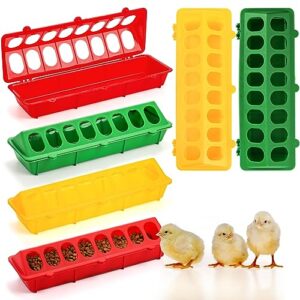
The Coloch 6 Pack Flip Top Feeder is built for birds, not reptiles. It measures 11.9 x 3.9 x 2.8 inches, and the 16-hole design lets several chicks, quail, or ducklings feed at once.
The plastic is durable and odorless, with smooth edges and a tool-free flip-top lid. It comes in red, green, and yellow, two of each.
For snakes, skip it. Those 16 holes make a poor drinking surface, and some users call the plastic flimsy under regular use.
| Best For | Backyard keepers and small farmers who raise chicks, quail, ducklings, pigeons, or other small birds and want a multi-bird feeder that cuts down on spilled feed. |
|---|---|
| Material | Durable, odorless plastic |
| Dimensions | 11.9 x 3.9 x 2.8 inches |
| Weight | N/A |
| Model Number | N/A |
| Cleaning | Requires periodic cleaning |
| Color | Red, green, yellow |
| Additional Features |
|
- The 16-hole design lets several birds eat at the same time and helps reduce feed spillage and waste.
- The flip-top lid makes refilling and maintenance easy without any tools.
- The durable, odorless plastic has smooth edges, and the feeder works in home, farm, or cage setups.
- The holes may be too large for very young chicks, which risks entrapment.
- Some users report the plastic feels flimsy under regular use.
- It needs periodic cleaning to stay hygienic and work properly.
3. Premier 1 Red Bowl Drinker 3-Pack
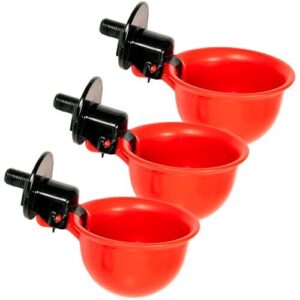
A poultry drinker isn’t an obvious snake bowl, but this one works for small species. The cup measures 3" high with a 2" pan diameter and 1.5" pan depth, so only hatchlings and small colubrids fit comfortably.
You’ll need a bucket or barrel with a 3/8" hole drilled 1" up from the base. Gravity keeps the pan half full as long as the container holds water. Cleaning is simple: partially unthread the cup.
Skip it in winter. Freezing’s a risk.
| Best For | Keepers of hatchling snakes or small colubrids who want a low-maintenance, self-filling water bowl that hooks up to a bucket or barrel. |
|---|---|
| Material | Plastic |
| Dimensions | 3″H x 2″ pan diameter x 1.5″ pan depth |
| Weight | 3.84 ounces |
| Model Number | 530020 |
| Cleaning | Manual cleaning required |
| Color | Red |
| Additional Features |
|
- Fills itself from the bucket or barrel and keeps the pan half full as long as the source has water
- Wide opening is easy for small snakes to reach, and there are no drips from faulty nipples
- Simple to clean by partially unthreading the cup
- Not safe for winter use because the water can freeze
- Needs a container where a 3/8" hole can be drilled 1" up from the base
- Small 2" pan is too tight for larger snakes, and there is no automated sanitation, so cleaning is manual
4. Farberware Bakers Advantage Ceramic Pie Dish
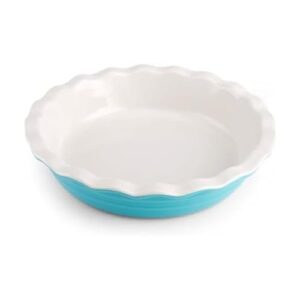
A 10 inch ceramic stoneware pie dish isn’t made for snakes, but it works as a snake water bowl for larger species. The extra depth and diameter give your snake room to drink and soak. Its heavy weight helps keep it from tipping, though it’s tougher to lift during cleaning.
Low-porosity ceramic resists stains and odors. Hand wash it, and check the glazed exterior for chips. Thermal shock can crack it, so avoid temperature swings. Skip it for small snakes.
| Best For | Owners of larger snakes who want a sturdy, easy-to-clean water bowl that is deep and wide enough for drinking and soaking. |
|---|---|
| Material | Ceramic stoneware |
| Dimensions | 10 inch diameter |
| Weight | N/A |
| Model Number | N/A |
| Cleaning | Hand washing recommended |
| Color | Teal and ivory |
| Additional Features |
|
- The extra depth and diameter give a larger snake room to drink and soak.
- Its heavy weight helps keep it from tipping over.
- Low-porosity ceramic resists stains and odors.
- The heavy weight makes it harder to lift during cleaning.
- The glazed exterior can chip from impact and can crack from thermal shock, so temperature swings should be avoided.
- It is not a good fit for small snakes, and hand washing is recommended.
Position Your Snake’s Water Dish Safely
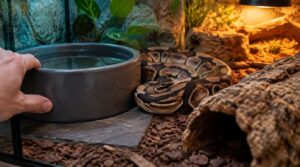
Picture a 3 foot ball python mid-patrol, her coils sweeping a bowl across the enclosure and flooding the substrate. One shove, and your setup becomes a swamp.
Don’t let that happen. Use cool side placement and lock the dish down:
- Set the dish in a corner so two walls brace it.
- Stay at least 12 inches from heat lamps, mats, and tape.
- Keep it off the route between your warm and cool hides.
- Choose a weighted base with a broad, flat bottom.
- Sit it on a substratefree surface like tile, never loose bedding.
A steady dish makes every daily water change simple, and a smooth ceramic bowl stays easy to clean. Push it firmly with your hand to test it.
Keep Snake Drinking Water Fresh and Bowls Clean
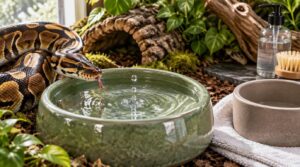
Imagine this: you lift your ball python’s bowl on a Tuesday morning and find a cloudy, slimy film coating the inside. That’s biofilm, and it forms within hours as microbes travel from your snake’s mouth into the water.
Within hours, a cloudy, slimy biofilm can coat your snake’s water bowl as microbes travel from its mouth into the water
Make daily water changes non-negotiable. Dump the bowl, scrub it with hot water and unscented dish soap, rinse thoroughly, and refill with filtered water. Check for feces and shed skin while you’re there.
Add a weekly chlorhexidine soak to catch what scrubbing misses, then rinse well. Never mix bleach and vinegar, because the combination releases toxic gas.
Keep a second bowl in rotation so fresh water’s always available during cleaning. Foodgrade resin and glazed ceramic wipe clean fast, making them snake care essentials.
Frequently Asked Questions (FAQs)
Why do people with ADHD struggle with dishes?
Ever stare at a sink and freeze? ADHD blocks task initiation, and dull chores give little reward.
Make it easier: pick a shallow profile basin, stable design racks, BPAfree plastic, nonporous bowl, easy to clean.
Can I wash dishes with Dawn and cold water?
Dawn Platinum removes up to 99% of grease, so cold water works on easy to clean glass or BPAfree plastic bowls. Rinse well to avoid chemical leaching, protect reptile hydration, and keep your disinfection routine.
How to do dishes with little water?
Scrape plates, then soak them. Fill one basin with soapy water and another with clean rinse water. Turn the faucet off while you scrub. Wash in batches, then air-dry. Never pre-rinse under running water, either.
What is the most hygienic thing to wash dishes with?
Use a one-minute bleach soak: 1 tablespoon unscented bleach per gallon of cool water. It kills 9% of germs. Rinse well, then air dry. Towels spread bacteria, so always skip them for bacterial contamination prevention.
Why does my snake soak in its water dish?
You find your ball python curled in the water dish at 2 a.m. Check humidity levels first. Below 50%, snake hydration needs push it to soak. Constant soaking can also signal mites.
How often should I refill the water bowl?
Your snake’s water turns into swamp soup faster than you’d think. Good water bowl refill frequency means a fresh pour every day, plus an instant swap when it’s soiled.
That’s just basic beginner snake care.
Can snakes drink tap water safely?
Yes, tap water works if it’s safe for you to drink. Good water quality management matters, though. Skip softened and distilled water. Change the bowl twice weekly to prevent bacterial biofilm and support reptile hydration.
What causes bubbles or cloudy film in water?
Ever wonder why your snake’s water turns murky? Bacterial biofilm from saliva, chemical leaching from cheap plastic, or mold growth. Tighter water quality management fixes it, especially in reptile water dishes for beginner snake keepers.
How do I tell if my snake is dehydrated?
A snake that skin-tents for five seconds is seriously dehydrated. Pinch gently: if skin stays tented over two seconds, check your snake water bowl, then look for sunken eyes, stuck shed, and yellow urates.
Conclusion
Imagine this: you wake up at 7 a.m., find the heavy ceramic bowl exactly where you left it, and the bedding bone dry. Your snake drank, soaked, and never tipped a thing.
That’s what good water dishes for beginners deliver. A heavy, non-porous bowl sized to your snake’s coil, set on the cool side, and scrubbed weekly keeps humidity steady and bacteria out.
Get those three choices right once. Then your snake can stop redecorating.