This site is supported by our readers. We may earn a commission, at no cost to you, if you purchase through links.

Your snake just tipped its water bowl for the third time this week, and now the substrate is soaked. That’s not defiance. It’s a sizing problem.
A bowl that’s too small can’t hold a coiled ball python, so water sloshes out and humidity spikes. Too big or too light, and it becomes a tipping hazard. Too shallow, and your boa can’t soak through a shed. Getting water bowl size right affects hydration, shedding, and bacteria growth.
So what size water bowl does my snake need? The answer depends on coil width, species, and age, and you can measure it in minutes.
Table Of Contents
- Key Takeaways
- What Size Water Bowl Does My Snake Need?
- How Deep Should Your Snake’s Water Be?
- Match Water Bowl Size to Snake Species
- Choose Safe, Stable Snake Water Bowl Materials
- Position and Clean Your Snake’s Water Bowl
- Frequently Asked Questions (FAQs)
- Do snakes need a big water bowl?
- What is the best water bowl for snakes?
- Do snakes need water daily?
- Is a 10 gallon tank big enough for a snake?
- Can a snake live in a 10 gallon tank?
- Is a 20 gallon tank too small for a ball python?
- Can a snake live in a 20 gallon tank?
- Can a ball python live in a 50 gallon tank?
- Can snakes drink too much water daily?
- Should water bowls be covered or left open?
- Conclusion
Key Takeaways
- Match your bowl to your snake’s coiled width and species, from about 3 inches for ball python hatchlings to 12 to 16 inches for adult boas, and size up as your snake grows.
- Keep water shallow for drinking (1 to 3 cm), but make it deep enough for a full soak (about as high as your snake’s thickest body width) during shed, while avoiding deep, slick-sided bowls that can trap small snakes.
- Choose a heavy, non-porous ceramic or stainless steel bowl, since light plastic tips, scratched surfaces harbor bacteria, and thin metal heats the water.
- Place the bowl on the cool side or in the middle zone, leave it uncovered, change the water daily, and scrub and disinfect it weekly.
What Size Water Bowl Does My Snake Need?
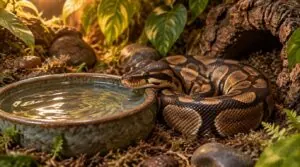
The right bowl keeps your snake hydrated, comfortable, and safe. Two quick checks will get you there: how wide your snake sits when coiled, and how that number changes as it grows. Here’s how to size the bowl with confidence.
If you keep a boa constrictor, this guide to water dish size for boa constrictors explains why a bowl big enough for a full soak is worth having.
Measuring Your Snake’s Coiled Width
A snake’s coiled width decides whether your bowl works or becomes a hazard. Measure your snake’s midbody girth at its thickest point with a soft tape or string.
Then check the coil on the belly side, not the back, because dorsal readings run high.
Your bowl footprint should match that number, so your snake can turn and settle without overhang.
Resizing as Your Snake Grows
Your snake won’t stay the size you measured. Plan growth stage adjustments early, and recheck your water bowl whenever you see these:
- Coils spill water when it turns
- Body overhangs the rim
- Shedding speeds up
- Bowl empties by midday
- Soaking looks cramped
Hit any capacity thresholds and upsize. Juvenile water snakes can more than double their length between three and eighteen months, so each enclosure upgrade should include a water feature large enough for full submersion. Species specific setups differ, so remeasure and pick the next bowl size.
How Deep Should Your Snake’s Water Be?
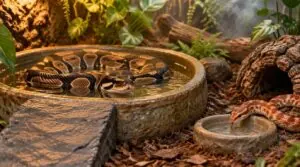
Size gets you halfway there. Depth finishes the job.
Most snakes need enough bedding to burrow and hold humidity, and this guide to how deep snake substrate should be breaks down the right depth for each species.
For drinking, 1 to 3 cm is plenty. Your snake just needs to reach the surface with its snout. For soaking behavior, the water should reach about as high as your snake’s thickest body diameter, so it can curl up with its nostrils clear.
Too deep is a real hazard. Steep, slick sides can trap a small snake that falls in.
Water that’s too deep is a real hazard, because steep, slick sides can trap a small snake that falls in
Here’s your quick depth guide:
- Hatchlings and juveniles: 2 to 4 cm, with easy entry and exit.
- Adult corn snakes: 1 to 5 cm, mostly for drinking.
- Ball pythons and boas: 7 to 15 cm, scaled to girth.
Adjust during shed. Snakes in shed cycle seek deeper water, so top it up then. Hot enclosures call for more water too.
If a shed leaves caps stuck over the eyes, it’s worth checking this guide to common snake eye problems and how to fix them.
Match Water Bowl Size to Snake Species
Not every snake drinks, soaks, or sprawls the same way. Your snake’s species decides how big the bowl should be, so the "one size fits all" dish won’t cut it. Here’s what to look for with three of the most popular pet snakes.
Ball Python Water Bowl Sizing
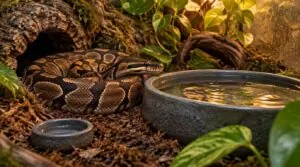
Adult female ball pythons, 32 to 64 inches long, have a coiled width of 5 to 7 inches. Your water bowl size has to match that.
Hatchlings need a 3-inch bowl with water an inch deep or less. Adults want 6 to 8 inches. That larger bowl also helps enclosure humidity control, holding 50 to 60% in a 48×24 enclosure.
Corn Snake Water Bowl Sizing
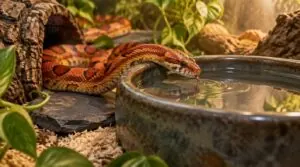
Hydration comes first for this species, with soaking a distant second. Aim for a 6 to 8 inch bowl diameter for an adult corn snake, and size up slightly if yours is still growing.
Keep the water shallow and choose a heavy ceramic bowl that won’t tip. Proper humidity of 40 to 60 percent means extra soaks are rarely needed.
Boa Constrictor Water Bowl Sizing
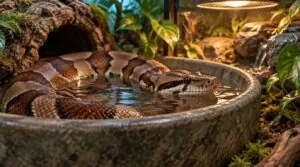
How big should a boa’s bowl be? Bigger than you’d guess. Adult species like the boa constrictor need a 12 to 16 inch bowl, scaled to body length.
A 5 to 6 foot snake can start at 10 to 12 inches. Keep water depth about halfway up its body when it soaks.
Check your enclosure, too. Heavy ceramic won’t tip.
Choose Safe, Stable Snake Water Bowl Materials
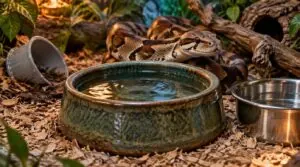
Imagine this: you walk in and find your 5-foot boa soaked, the flimsy plastic bowl flipped, bedding drenched. That’s why bowl material safety matters as much as water bowl size.
Choose reptilesafe materials, and test each one against these four risks:
- Tipping: a light bowl flips, and your snake sleeps in a swamp.
- Bacteria: scratched, porous surfaces hide germs that make your snake sick.
- Heat: thin metal warms water fast, so your snake drinks something unpleasantly warm.
- Toxins: cheap silicone can leach chemicals into every sip.
Heavy ceramic or stainless steel wins on bowl stability. Glazed, non-porous surfaces clean easily. For bowl tipping prevention, pick a wide, weighted base. Skip anything that wobbles when you nudge it with one finger.
Position and Clean Your Snake’s Water Bowl
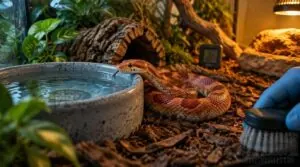
Picture a corn snake named Biscuit who soaks in a bowl parked under the heat lamp. By Friday, the water’s warm, scummy, and she’s avoiding it.
Smart water bowl placement fixes that. Set the bowl on the cool side or in the middle zone, away from direct heat. Choose a heavy ceramic dish for bowl tipping prevention, and check humidity with a hygrometer.
Follow this routine:
| Task | Frequency | How |
|---|---|---|
| Water change | Daily | Use dechlorinated water |
| Scrub bowl | Weekly | Remove biofilm and mineral deposits |
| Disinfect | Weekly | Use reptile-safe disinfectant, rinse well |
| Check stability | Daily | Confirm bowl doesn’t wobble |
Stick to daily water changes and weekly deep cleaning, and your bowl disinfection routine will keep your snake hydrated, safe, and shedding cleanly.
Frequently Asked Questions (FAQs)
Do snakes need a big water bowl?
Yes, but only big enough to soak in. Your water bowl should fit a coiled snake, so bowl size follows species specific needs.
Adult snakes need room to submerge, while juvenile snakes need easy exits.
What is the best water bowl for snakes?
Picture a ball python tipping a flimsy plastic dish at midnight.
Choose a heavy ceramic water bowl instead. Match bowl size to species specific needs: small for juvenile snakes, wide and shallow for adult snakes.
Do snakes need water daily?
Yes, your snake needs daily access to fresh water, but that doesn’t mean it drinks every day. Most snakes sip when they need to, and prey covers part of their hydration needs.
Is a 10 gallon tank big enough for a snake?
Most hatchling corn snakes start life in a 10-gallon tank, but they outgrow it within a year. For adult snakes, it’s too small. Only hatchlings, juveniles, and rosy boas fit.
Can a snake live in a 10 gallon tank?
Yes, but only some species. A 10-gallon enclosure suits small adult snakes like Kenyan sand boas (males), rosy boas, and rubber boas. Corn snakes outgrow it fast. Keep the water bowl small and stable.
Is a 20 gallon tank too small for a ball python?
Picture an adult ball python stretched out like a garden hose in a shoebox. That’s a 20-gallon tank. It’s fine for juveniles under 800 grams, but adults need a 40-gallon, 36" x 18" floor.
Can a snake live in a 20 gallon tank?
Yes, but only temporarily.
A 20-gallon suits juvenile snake care, yet adults of most species need far more enclosure floor space. Upgrade early, before it’s cramped, and let water bowl size follow the bigger enclosure.
Can a ball python live in a 50 gallon tank?
Yes, an adult ball python can live in a 50-gallon tank. It’s a workable enclosure for a snake up to five feet, if you add two snug hides, a gradient, and humidity control.
Can snakes drink too much water daily?
Rarely. Healthy snakes sip slowly and only when they need to, so water intoxication risk is very low. If your snake seems glued to its water bowl, check for dehydration, kidney trouble, or infection.
Should water bowls be covered or left open?
A keeper once told me her ball python refused water for a week. The culprit? A lid. Leave your water bowl open. Snakes need easy entry, full soaking space, and fast escape routes.
Conclusion
Last spring, a keeper named Dana swapped her ball python’s cramped dish for one just wider than his coil. No more spills, no more soggy substrate, and his next shed came off in one clean piece.
That’s the payoff. When you wonder what size water bowl does my snake need, measure the coil, match the species, and check again as growth kicks in. Choose a heavy, stable bowl, keep it clean, and your snake thrives.