This site is supported by our readers. We may earn a commission, at no cost to you, if you purchase through links.
Most keepers obsess over enclosure size, substrate depth, and feeding schedules—then drop a cereal bowl of water in the corner and call it done. That small dish might look fine sitting there, but for a boa constrictor, it’s closer to offering a glass of water to someone who needs a bath.
Boas aren’t passive drinkers. They soak. They use water to regulate hydration at a cellular level, loosen pre-shed skin, and maintain the ambient moisture their enclosures need. A bowl too small to submerge in isn’t a water source—it’s decoration.
The right dish does a lot of quiet, unnoticed work: nutrient transport, electrolyte balance, successful sheds, and even ambient humidity all trace back to one piece of equipment most keepers underestimate. Getting the dimensions, material, and placement right changes outcomes you can measure.
Table Of Contents
- Key Takeaways
- Why Water Dish Size Matters
- Yes, Boas Need Large Water Dishes
- Best Boa Water Bowl Dimensions
- Safest Water Dish Materials
- Keeping Boa Water Clean
- Frequently Asked Questions (FAQs)
- Do Boas need a water dish?
- Do boa constrictors need water?
- What do boa constrictors eat?
- Do boa constrictors need hides?
- How big should my snakes water dish be?
- How long can a boa survive without water?
- What size tanks do boas need?
- Can boa constrictors share a water dish safely?
- How often should juvenile boas be monitored drinking?
- Do boas drink more water after feeding?
- Conclusion
Key Takeaways
- A boa’s water dish must be 1.5–2× its midbody girth in diameter and 5–15 cm deep so the snake can fully submerge — anything smaller fails the animal’s basic hydration and shedding needs.
- Soaking for 20–30 minutes softens retained skin evenly, making a properly sized dish your first line of defense against stuck sheds around eyes and tail tips.
- A large, centrally placed water bowl passively raises enclosure humidity by 10–20% through evaporation, reducing your reliance on misting and keeping the hygrometer steady between 55–75%.
- Food-grade ceramic or stainless steel are the only materials worth using — both are non-porous, tip-resistant, and tolerate daily disinfection without harboring the bacterial load that scratched plastic bowls can’t shed.
Why Water Dish Size Matters
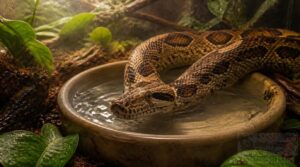
The size of your boa’s water dish does more than just hold water — it directly shapes how well your snake eats, sheds, and stays healthy.
Getting the dish size right is just one piece of the puzzle — how you set up your boa constrictor’s enclosure as a whole plays a big role in keeping your snake comfortable, hydrated, and stress-free.
Getting the dimensions right touches four key areas of boa care that most keepers don’t fully connect to the water bowl. Here’s what each one actually means for your setup.
Hydration Support
Boas drink — they don’t absorb water through their skin. That means bowl size directly controls how much your snake hydrates per visit. Water helps with:
- Nutrient transport across every organ system
- Electrolyte balance for muscle and nerve function
- Metabolic regulation and stable body temperature
A dish too small discourages drinking. Consistent fluid intake frequency keeps digestion running smoothly. Maintaining proper hydration levels is essential for supporting overall biological functions.
Safe Soaking Space
A dish too small leaves your boa coiled awkwardly at the rim. Full-body soaking means the snake lies flat — no part pressed against the edges. That’s the standard your water bowl size needs to meet.
Submergence helps scale health — skin stays supple and hydrated. A bowl depth of 5–15 cm suits adult boas over 1.5 meters.
| Bowl Feature | Requirement |
|---|---|
| Diameter | 1.5–2× midbody girth |
| Water depth (adult) | 5–15 cm |
| Immersion time | 20–30 minutes |
| Clearance from walls | 2.5 cm minimum |
| Container size (large adults) | 14-liter minimum |
Healthy Shedding Help
Soaking is where shedding success begins. When your boa submerges for 20–30 minutes, old skin softens evenly — reducing the risk of stuck shed patches that can tighten around eyes or tail tips.
Skin elasticity depends on consistent hydration. A proper boa constrictor water bowl size — deep enough to submerge the body — helps each shedding cycle without intervention.
Enclosure Humidity Boost
Your water dish does double duty. A large bowl releases 10–20% more ambient moisture into the air through evaporation — acting as a passive humidity regulator without extra misting. Place it centrally, and the moisture spreads evenly rather than pooling in one corner.
Pair that with moist substrate like sphagnum moss, and your hygrometer should hold steady between 55–75%.
For deeper tips on substrate layering and humidity management on the road, boa constrictor travel enclosure guides walk you through keeping conditions stable wherever you go.
Yes, Boas Need Large Water Dishes
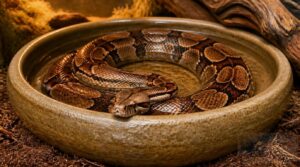
Not every water dish cuts it for a boa — size, weight, and depth all matter more than most keepers realize. The right bowl checks several specific boxes to keep your snake hydrated, safe, and comfortable at every life stage. Here’s what to look for.
Big Enough to Soak
Think of the bowl as a bathtub — it needs room for your snake to fully submerge and coil without forced contortions. A dish 1.5–2× your boa’s midbody girth lets the body settle naturally during a soak.
Four features define a soak-ready bowl:
- Wide enough for natural coiling postures
- Smooth, rounded rims to prevent scale snagging
- Moderate depth for safe, easy exits
- Full-body immersion without cramping
Heavy Enough to Stay Put
A large water bowl — filled to proper depth — weighs 2 to 5 kg, giving it the natural resistance your boa can’t easily overcome. That mass works in your favor every time your snake pushes against the rim or coils inside.
Ceramic and stainless steel outperform lightweight plastics here. Non-slip bases cut sliding on smooth enclosure floors, keeping the bowl exactly where you placed it.
Shallow Enough for Safety
Depth is a safety line, not just a dimension. Keep water depth under 15 cm for adults — enough to soak comfortably, not enough to trap a disoriented or weakened snake. Even large boas can struggle to right themselves in overly deep water.
Water depth is a safety line: keep it under 15 cm so your boa can soak without getting trapped
Non-slip surfaces around the dish matter too. A snake exiting wet will slide on smooth substrate.
Sized for Snake Growth
Your boa won’t stay hatchling-sized for long. Proportional expansion planning means choosing a dish sized at least 50% larger than current norms — one that matches midbody girth as the subadult stage approaches.
A bowl with optimized interior clearance reduces snagging risks and stays proportionally appropriate longer, cutting replacement cycles and keeping adult boa requirements — including adequate water depth — consistently met without constant upgrades.
Best Boa Water Bowl Dimensions
Getting the dimensions right isn’t guesswork — it comes down to your boa’s size and life stage. The right bowl fits the snake, not the shelf. Here’s what to look for across five key measurements.
Diameter by Body Girth
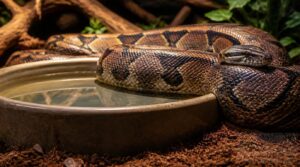
Start by measuring your boa’s midbody girth — the circumference at the widest point. Divide that number by pi (roughly 3.14) to get the true body diameter.
Your water bowl size should measure 1.5 to 2 times that diameter. A thicker snake needs a wider dish — scaling dish size to body width keeps soaking practical and safe.
Depth by Life Stage
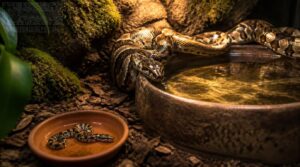
Your boa’s water bowl depth should match its life stage. Water depth isn’t one-size-fits-all.
- Hatchling: 1–2 cm — prevents drowning risks
- Juvenile: 3–5 cm — helps with shedding cycles
- Subadult: 4–6 cm — balances soaking with safe access
- Adult: 5–8 cm — allows for full reptile hydration
- Senior: 4–6 cm — eases accessibility
A baby boa constrictor needs drowning protection; an adult needs room to fully immerse.
Hatchling Bowl Safety
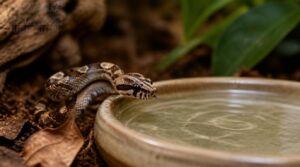
Hatchlings are small but surprisingly exploratory — a bowl that’s too deep becomes a drowning risk fast. Keep water depth between 1–2 cm and choose a dish with smooth, rounded edges to protect their delicate mouths.
A non-slip base prevents sliding during investigation. Place the bowl away from heat sources. Watch for sunken eyes or loose skin — early signs your hatchling isn’t drinking enough.
Adult Soaking Needs
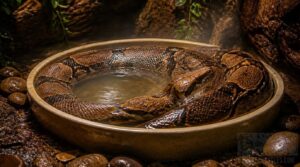
Once your boa crosses 1.5 meters, water depth should sit between 5 and 15 cm — enough to support full-body soaking without forcing the snake to strain upward.
Adults over 1.8 meters need 14-liter containers at minimum. A proper soak runs 20–30 minutes, loosening retained skin during shedding cycles. That immersion volume also keeps organ function stable between feeding sessions.
Spill-Reducing Clearance
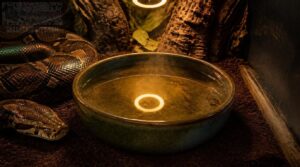
Placing a 14-liter bowl inside a tight enclosure corner invites trouble. 2.5 cm of perimeter clearance around the dish reduces spillage by roughly 40% — enough room for water to settle rather than slosh onto bedding or toward heat equipment.
That gap also keeps your maintenance access clean, letting you swap, scrub, and inspect the bowl without wedging tools against enclosure walls.
Safest Water Dish Materials
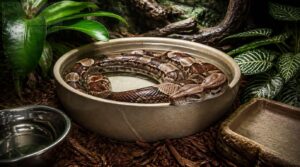
The material your boa’s water dish is made from matters more than most keepers realize. The wrong choice can harbor bacteria, tip under a heavy snake, or degrade faster than expected. Here are the safest options worth your attention.
Food-Grade Ceramic Bowls
Food-grade ceramic is one of the safest choices for a boa constrictor water bowl size that demands daily hygiene.
- Non-porous surface blocks bacterial colonization
- Lead-free glaze meets strict glaze safety standards
- Withstands regular disinfection without degrading
- Heavy construction resists tipping during soaking
- Durability testing confirms long-term sanitation protocols
The nonporous materials keep microbial load low — exactly what your boa needs.
Stainless Steel Options
Stainless steel is the workhorse of boa water bowls. 304 and 316 food-grade steel won’t leach chemicals, resist corrosion from waste and water, and tolerate daily disinfection without degrading.
The nonporous materials keep bacterial loads low — matching ceramic’s sanitation protocols but outlasting it. Heavy-gauge bowls hold their ground when a large boa climbs in, making weight stability a built-in feature.
Avoid Scratched Plastic
Plastic water bowls carry a hidden risk — microscopic scratches trap bacteria that bleach solutions can’t fully reach. Even hard plastic degrades under claws, bedding, and repeated scrubbing, creating surface grooves that drive up microbial load over time.
Replace any scratched plastic bowl immediately. For boa constrictor tanks, pathogen control depends on smooth, cleanable surfaces — scratched plastic simply can’t deliver that.
Tip-Resistant Designs
A large boa entering a water bowl applies serious lateral force — tip-resistant designs counter that directly.
Look for these stabilizing features:
- Weighted base keeps the bowl grounded even when your boa coils inside
- Non-skid rim technology grips enclosure surfaces, preventing sliding during activity
- Low center of gravity reduces toppling risk in any enclosure size
Friction pad benefits and stabilizing weight inserts give boa constrictor tanks reliable, spill-free water depth.
Heat Source Placement
Where you place your heat source matters more than most keepers realize — especially near the water dish.
Keep heating elements at least 15 cm away from the bowl. Proximity raises water temperature, accelerates evaporation, and disrupts your temperature gradient. A thermostat with a high-temperature cutout protects against overheating. Mount heat sources on enclosure walls, never substrate — that’s basic thermal zone discipline.
Keeping Boa Water Clean
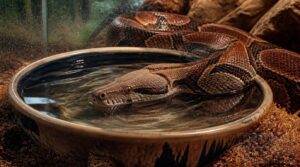
Clean water isn’t optional — it’s a non-negotiable part of keeping your boa healthy. Boas defecate in their dishes regularly, which means contamination happens faster than most keepers expect. Here’s what a solid maintenance routine actually looks like.
Daily Water Changes
Change your boa’s water every single day — no exceptions. Boas defecate in their dishes regularly, and stale water becomes a breeding ground for bacteria within hours.
Daily water changes also dilute waste, prevent biofilm buildup, and keep enclosure humidity stable. Swap the water at the same time each day; you’ll quickly spot any cracks, debris, or cloudiness that signal a problem.
Weekly Bowl Disinfection
Daily water changes handle the surface — but weekly disinfection goes deeper.
Rinse the bowl with warm water first to break up biofilm, then apply a fragrance-free, reptile-safe disinfectant and let it dwell for the full contact time specified on the label. Skipping that dwell time ruins the whole point.
Keep things tight with three habits:
- Dedicate one sponge solely to bowl cleaning to prevent cross-contamination
- Log each disinfection date in a notebook or app — consistency is the whole point
- Align bowl cleaning with your weekly enclosure maintenance to reduce boa stress
Cleaning After Soaking
Once your boa finishes soaking, act quickly. Remove it to a secure, dry area, then rinse the bowl with hot water to flush organic residue before it sets.
Apply a reptile-safe disinfectant — avoid anything containing phenols or essential oils — and let it contact the surface fully before rinsing clean. Dry the bowl completely. Residual moisture feeds bacterial growth faster than most keepers expect.
Replacing Damaged Bowls
Cracks deeper than 1 mm — especially those reaching the lip or base — mean the bowl is done. Inspect for sharp chips too; smooth any rough edges before they cut your boa’s mouth during drinking.
Swap in a food-grade ceramic or stainless steel replacement, rinse it with warm soapy water, and place it in the same spot. Consistency reduces stress. Watch drinking behavior for the first week.
Watching for Health Issues
Swapping the bowl types equipment — but the boa still tells you when something’s wrong. Watch for persistent soaking, lethargy after routine dips, or appetite drops; these signal husbandry problems, not just quirks.
Cloudy eyes or patchy shed point to humidity gaps. Wheezing or open-mouth breathing needs a vet — fast. Slime along the rim means microbial load is climbing before you’ve noticed.
Frequently Asked Questions (FAQs)
Do Boas need a water dish?
The animal that can go weeks without eating can’t survive even a few days without water. Your boa must drink orally — skin absorption isn’t an option, making fresh water access non-negotiable for its health.
Do boa constrictors need water?
Yes — boas must drink water orally to survive. They consume 10–20% of their body weight weekly, supporting digestion, organ function, and healthy shedding. Unlike some reptiles, they can’t absorb moisture through their skin.
What do boa constrictors eat?
Boas eat whole prey animals — mice, rats, and rabbits — sized no wider than their midbody girth. Juveniles feed every 7–10 days; adults every 3–4 weeks. Always offer frozen-thawed prey.
Do boa constrictors need hides?
Hides are essential for boa constrictors. Without a secure retreat, boas stay exposed, raising stress and disrupting feeding. Place one hide on each side of the enclosure to support full thermoregulation.
How big should my snakes water dish be?
The dish should be 5–2× your snake’s midbody girth in diameter, with depth between 5 and 4 inches depending on size — deep enough to soak, shallow enough to exit safely.
How long can a boa survive without water?
A boa without water can show dehydration signs within days. Most won’t survive beyond one to two weeks. Daily access isn’t optional — it’s what keeps their organs, skin, and shedding cycles working.
What size tanks do boas need?
Juveniles start in 2×5×1 ft enclosures, but adults reaching 6–8 feet need at least 6×3×3 ft — with many keepers upgrading to 7–8 ft tanks for adequate movement and climbing enrichment.
Can boa constrictors share a water dish safely?
Technically, yes — but it’s risky. Shared bowls raise cross-contamination risks and trigger territorial stress. If you must, use a wide, stable bowl, change water daily, and watch closely for aggression.
How often should juvenile boas be monitored drinking?
Like a nurse logging vitals, monitor juvenile boas daily. Watch for zero-drinking days and track weekly totals. If drinking drops for two consecutive days, boost humidity and refresh the water immediately.
Do boas drink more water after feeding?
Some boas do drink more after a large meal, though it’s not guaranteed. Post-feeding thirst depends on meal size, enclosure humidity, and temperature — fresh water should always be available.
Conclusion
Don’t let your boa’s setup be all coil, no care. The question of whether boa constrictors need large water dishes answers itself the moment you watch a 6-foot snake try folding into a cereal bowl — it doesn’t work, and neither does the husbandry.
Dish size drives outcomes: better sheds, stable humidity, and genuine hydration. Get the dimensions right, keep the water clean, and that one overlooked piece of equipment quietly does everything.