This site is supported by our readers. We may earn a commission, at no cost to you, if you purchase through links.

A 20-gallon tank eats up more nightstand real estate than most people expect, and in a small bedroom, that’s a problem. Corn snakes don’t need a warehouse to thrive, but they do need room to stretch, a proper thermal gradient, and a setup that won’t take over your whole room. Get the sizing wrong and you’ll deal with a stressed snake or a cramped, cluttered space, neither of which makes for good roommates.
The good news: corn snake enclosures for small bedrooms come in shapes and styles built for exactly this challenge. Front-opening doors, stackable modules, PVC builds that shrug off humidity swings. Once you know what to look for, fitting a full enclosure into a tight footprint gets a lot easier.
Table Of Contents
- Key Takeaways
- Best Enclosure Sizes for Small Bedrooms
- Best Space-Saving Enclosure Designs
- Glass Versus PVC Compact Enclosures
- Essential Heating and Humidity Features
- Best Bedroom-Friendly Safety Features
- Frequently Asked Questions (FAQs)
- Do corn snakes like small enclosures?
- What is the minimum enclosure size for a corn snake?
- What is the best enclosure for corn snakes?
- What is the biggest trouble with corn snakes as pets?
- Will my roommate or landlord notice any snake odor?
- Can I keep a corn snake in a rental apartment legally?
- How do I childproof or pet-proof the enclosure area?
- What documentation should I give my landlord beforehand?
- Conclusion
Key Takeaways
- Size your enclosure to your snake’s life stage—hatchlings need just 12-16 inches of floor space, but adults require at least 36"x18" with 12 inches of depth for coiling.
- Floor space matters more than height, so when your bedroom’s tight on room, prioritize width and length over a taller tank.
- A stable thermal gradient (28-32°C warm side, 24-26°C cool side) paired with 40-60% humidity is what actually keeps your corn snake healthy, not just the size of the tank.
- Space-saving features like front-opening doors, stackable modules, and low-odor substrate let you fit a fully functional, escape-proof enclosure into a small bedroom without sacrificing your snake’s comfort or your landlord’s approval.
Best Enclosure Sizes for Small Bedrooms
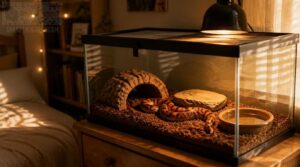
Small bedroom, big snake someday — sizing this right from the start saves you a headache later. Corn snakes grow fast, and their housing needs change right along with them. Here’s what to look for at every stage, from hatchling to full-grown adult.
If you’re weighing similar setups for other pet snakes, this Honduran milk snake care sheet breaks down enclosure sizing for another popular beginner species.
If you’re just starting out, this roundup of affordable snake housing options can help you find a budget-friendly hatchling setup without skimping on quality.
Hatchling Space Requirements
A hatchling corn snake doesn’t need much room, just 12 to 16 inches of floor space, solid substrate for grip, and one snug hide.
Keep the water bowl stable and easy to clean. Balance ventilation with humidity (40-60%) so shedding stays smooth.
Small, secure, escapeproof, that’s the formula for a hatchling enclosure that actually works.
Juvenile Enclosure Dimensions
Once your snake outgrows that first tub, it’s time to think bigger. A 20-gallon long tank (24"x12"x16") works for snakes up to 24 inches, giving proper clearance and basking zone space.
- Floor space: 360 sq inches minimum
- Height: 12-18" clearance
- Basking zone: 8-12" of warmth
- Access: front-opening design
Adult Minimum Floor Space
By adulthood, that 20-gallon tank is history. Full-grown corn snakes need at least 36"x18" of footprint, with 12" depth minimum for coil formation.
Snakes pushing past 4 feet do better in 48"x24" setups. Aim for 40-60 linear inches of total length as your baseline for a secure enclosure with real room to explore.
Floor Space Versus Height
Numbers matter more than square footage alone. Hatchlings need roughly 0.25 square meters, a 30x30cm footprint, but floor space beats height every time for movement.
Height still counts though. Give 45cm of clearance above resting coils, and when floor room’s tight, add 15-25cm vertical instead.
- Prioritize width over height
- Keep clearance at 45cm minimum
- Trade height for cramped floors
- Match space to growth stage
Signs an Upgrade is Needed
How do you know it’s time? Watch for space crowding when your corn snake can’t stretch full length without hitting a wall.
Other red flags: temperature fluctuations past 5°F, humidity swings outside 40-60%, glass-bumping (escape attempts), and daily cleaning turning into a chore. Any of these means enclosure expansion beats cramped compromise.
Best Space-Saving Enclosure Designs
Once you’ve got the right dimensions figured out, the next challenge is fitting all that space into a small bedroom. Good news — smart design solves that problem. Here are the features worth looking for.
Front-Opening Doors
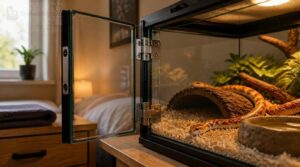
Ever try reaching over a snake to grab crickets? Not fun. Front-opening doors fix that, swinging open flush against the wall so you skip side clearance entirely.
These doors also make it easier to check your hygrometer and adjust humid microclimates without disturbing your snake, and this guide to snake enclosure setup covers other design tweaks that simplify daily maintenance.
Look for three things:
- Magnetic latch security for tight seals
- Reinforced hinges that won’t sag
- Replaceable seals for easy upkeep
Solid door swing plus escape prevention means less stress for your corn snake, more room saved for you.
Stackable Habitat Systems
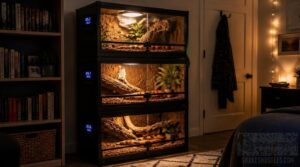
When floor space runs out, go vertical. A stackable terrarium setup lets you house multiple corn snakes without eating up more bedroom real estate.
Each module runs its own independent climate controls, so a hatchling and juvenile stay comfortable side by side. Interlocking base stability keeps things solid, and quick disconnects make cleaning painless. That’s real vertical space optimization.
Modular Expandable Designs
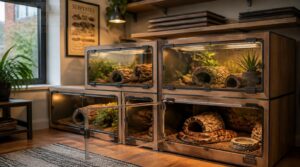
Snakes grow. Your enclosure should too, without you buying a whole new tank.
Quick-release latches and interlocking rails let modules connect in under two minutes each, building true modular expandable setups. Every section shares a uniform footprint, so horizontal expansion never means reconfiguring what’s already built.
Tool-free panels swap out fast for cleaning or upgrades. That’s real space optimization with front access design and solid escape prevention, apartment-friendly through and through.
Built-in Accessory Storage
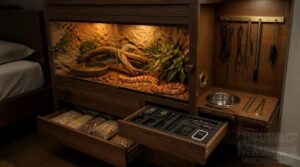
A cluttered bedroom setup is nobody’s idea of a good time.
Built-in drawer compartments hold thermometers and probes, each with a label slot for quick checks. A hidden panel slides out on ball bearings for tools and water bowls. The tool rail keeps probes magnetic-ready and cord hooks handy. Add a grommet system for cable management and under enclosure storage for spare substrate, and everything stays put.
Compact Bedroom Placement
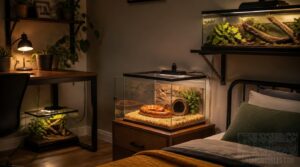
Where you put the enclosure matters as much as the enclosure itself.
- Nightstand corner fit for hatchling tubs
- Under-desk clearance for juvenile tanks
- Closet shelf placement with airflow gaps
- Bed frame fit for stackable units
- Wall-mounted stability brackets for larger tanks
Check ventilation clearance and keep front-opening doors swinging freely, this apartment-friendly space optimization keeps your room livable.
Glass Versus PVC Compact Enclosures
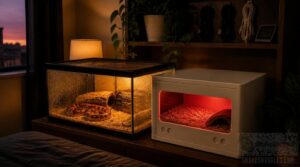
Once you’ve settled on a size, the next call is glass or PVC — and it’s not just a matter of taste. Each material has heat, humidity, and weight differently, which matters a lot in a tight bedroom setup. Here’s what to weigh before you pick one.
Heat Retention
PVC holds heat better than glass, hands down. Its thicker walls add real insulation effectiveness, while glass sheds warmth fast, disrupting your thermal gradient.
| Material | Heat Retention |
|---|---|
| PVC | High, stable |
| Glass | Low, drafty |
| Foam-backed | R-2 to 6.5/inch |
| Reflective foil | Redirects heat inward |
Thermal mass and reflective barriers keep hotspots steady, cutting energy waste.
For example, materials like Eps Slab offer strong thermal resistance with low conductivity, as seen in insulation data thermal conductivity values.
Humidity and Ventilation
Good insulation cuts both ways. PVC traps warmth, but it also traps moisture, so your humidity control methods matter more.
- Keep coconut coir 2-3" deep for moisture retention
- Add cross vents to fight condensation
- Check glass panels for fogging daily
- Match airflow to your substrate’s dampness
Glass breathes easier; PVC needs planned ventilation.
Weight and Portability
Fogging aside, ventilation isn’t the only thing that changes with material. Weight does too, and if you’re hauling this enclosure up a flight of stairs, that matters.
PVC and acrylic enclosures run 6 to 20 pounds. Glass equivalents weigh noticeably more, cutting easy relocation and single-handed repositioning. Casters help, but lightweight, stackable, modular setups with grips just make apartment-friendly living simpler.
Stress-Reducing Solid Panels
Weight matters, but so does what your snake sees. Solid sided panels cut down reflections that trigger stress and false strikes.
They also dampen noise, up to 8 decibels less ambient sound, and resist heat loss at the edges. Smooth, rounded corners mean fewer bumps, and moisture resistant finishes stop warping from routine misting. Combined with front-opening doors, it’s a calmer setup.
Watertight Base Construction
Since spills happen, base material selection matters most. PVC and sealed concrete resist water better than raw wood, with sloped drainage and gasket-sealed access ports keeping moisture out.
- Watertight base with 2-3° slope
- Sealed joint integrity at corners
- Waterproof surface finishes resist algae
- Cable ports use silicone grommets
- Apartment-friendly, modular drainage design
Essential Heating and Humidity Features
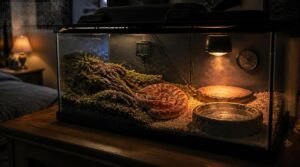
Size and safety only get you so far — heat and humidity are what actually keep your corn snake healthy in a small bedroom setup. Get the gradient wrong and you’re looking at digestion issues, stuck sheds, or worse, nobody’s idea of a good time.
Get the heat and humidity gradient wrong, and your corn snake pays for it in digestion issues or stuck sheds
Here’s what your enclosure needs to get right.
Safe Thermal Gradients
A snake without options is a stressed snake. Your enclosure needs a warm basking zone around 28-32°C and a cool side near 24-26°C, a 4-8°C spread. Use dual thermometers at both ends. Check readings often. Insulated walls keep things stable overnight, so your corn snake always has somewhere comfortable to settle.
Thermostat-Controlled Heating
Skip the guesswork. A reptile thermostat does the heavy lifting, cycling your heating element on and off automatically.
Look for:
- PID temperature control
- Proper heat mat placement
- Regular thermostat calibration
- Energy-saving schedules
- Overheat protection
Set it, calibrate it, trust it. That’s how you maintain a stable thermal gradient without hovering over the tank all day.
Dual Temperature Monitoring
One thermostat isn’t enough eyes on the job. Run a dual thermometer setup: warm probe 2-4 inches above substrate, cool probe on the other end.
| Zone | Alert Threshold | Log Frequency |
|---|---|---|
| Warm | 30.5°C | Every 60 sec |
| Cool | 21.5°C | Every 60 sec |
Auto-shutdown protects against power loss, keeping your thermal gradient stable overnight.
Balanced Humidity Levels
Too dry and shedding turns messy. Too damp and mold moves in. Keep humidity between 40 and 60 percent, checked daily with a digital hygrometer.
Place your humidifier outside the enclosure, not directly on substrate. Balance moisture retaining bedding with ventilation. If it spikes past 65 percent, crack a vent. Below 35, mist lightly and monitor.
Low-Profile Lighting and UVB
UVB isn’t optional, it’s how your snake makes vitamin D.
Mount a narrow band 306-313nm bulb 12-14 inches from the basking spot.
Slim fixtures run under 1.5 inches thick, so they won’t eat headroom.
Swap bulbs every 9-12 months.
Add a low-heat ceramic emitter for nighttime warmth, keeping your thermal gradient intact without extra glow.
Best Bedroom-Friendly Safety Features
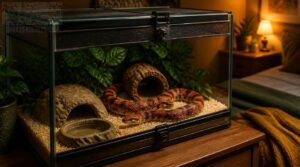
Corn snakes are escape artists with a reputation to match, and a bedroom setup gives you zero room for error. The right enclosure controls that pressure quietly, without turning your room into a jailhouse. Here’s what actually keeps things secure and livable.
Escape-Proof Locking Latches
A corn snake’s escape drive is strong, especially at feeding time. Lockable latches matter most here, think slide bolt or cam driven designs paired with a magnetic catch for backup security. Stainless steel resists corrosion, and hidden screws add tamper resistance.
Front-opening doors with sliding front designs seal tight without gaps, giving you a genuinely escape-proof enclosure your snake can’t nudge open.
Secure Cable Ports
Latches keep the door shut, but what about the wires running in? Every heat mat and thermostat needs a sealed cable port, ideally IP66-rated with grommets, to block gaps a snake can exploit. Choose low, rear-placed ports with strain relief and corrosion-resistant fittings.
Inspect seals monthly, apartment walls won’t forgive a midnight escape.
Quiet Heating Equipment
Ports sealed, cables tucked. Now think about noise. A fanless heat mat paired with a solid-state thermostat runs near silent, no motors, no hum through thin apartment walls.
For quiet operation:
- Choose radiant mats over fan-forced heaters
- Add vibration insulation under mounting feet
- Route cable management away from enclosure walls
Result: apartment-friendly warmth your neighbors never notice.
Low-Odor Substrate Options
Quiet heat solves one problem. Smell solves another, and in a small bedroom, that’s the one guests notice first.
Paper bedding and coconut coir stay low-dust and control odor well. Aspen shavings wick moisture but need weekly attention.
| Substrate | Odor Control | Dust Level |
|---|---|---|
| Paper | Good | Low |
| Coir | Strong | None |
| Aspen | Fair | Low |
Easy Daily Cleaning
Nobody wants to smell a snake tank from the hallway. A quick wipe down takes sixty seconds: hides, glass, done.
Daily waste removal and spot cleaning routine keep odor in check. Rinse the water bowl daily. Weekly, run a full disinfectant cycle with reptile-safe cleaner. Check cable port sealing while you’re at it, since front-opening doors make every step faster.
Frequently Asked Questions (FAQs)
Do corn snakes like small enclosures?
Snug spots suit snakes, but size still matters. Corn snakes need enough floor space for natural movement, a proper thermal gradient, and hides on both ends, otherwise stress and escape risk climb fast.
What is the minimum enclosure size for a corn snake?
Start hatchlings around 10 gallons, minimum floor space near 12×6 inches. Adult corn snakes need at least a 40-gallon breeder or 36"x18"x18", prioritizing floor space over height as your snake grows through each enclosure stage.
What is the best enclosure for corn snakes?
There’s literally no single "perfect" enclosure, but the closest thing: a 4x2x2 foot PVC or glass tank with front-opening doors, solid side panels, tight thermal gradient control, and low-odor substrate for easy upkeep.
What is the biggest trouble with corn snakes as pets?
Honestly, it’s temperature and humidity control. Miss the 85-90°F gradient or let humidity swing, and you’ll face refused meals, stuck sheds, and stress. Add in escape attempts through loose lids, and it’s a juggling act for beginners.
Will my roommate or landlord notice any snake odor?
Not unless you’re hiding a swamp under your bed. With low-odor substrate, daily cleaning, and decent ventilation, humidity control keeps things fresh, your roommate won’t smell a thing, and your landlord stays clueless.
Can I keep a corn snake in a rental apartment legally?
Legally, yes, but check your local city ordinances first. Get written landlord permission, review lease agreement terms for reptile bans, budget for pet deposits, and confirm insurance liability coverage before setting up an escape-proof, apartment-friendly enclosure.
How do I childproof or pet-proof the enclosure area?
Picture tiny fingers testing every gap. Lockable latches, cable covers, and a 12 inch clutter-free zone stop that fast. Add pet barriers and a monitoring camera, and your escape-proof enclosure stays exactly that.
What documentation should I give my landlord beforehand?
Give a written packet: enclosure specifications (dimensions, materials), heating details with safety data sheets, a monitoring plan for temps and humidity, lockable latches proving escape-proof setup, and your contact information plus supplier verification for a truly rental-friendly arrangement.
Conclusion
An adult corn snake needs at least 4 square feet of floor space, yet plenty of bedroom setups shortchange that number.
The best corn snake enclosures for small bedrooms prove size and efficiency aren’t opposites. Pick front-opening doors, dial in your thermostat, and lock down that humidity, and you’ve built a home that works for both the snake and the room.
Your snake settles in. Your nightstand stays yours.