This site is supported by our readers. We may earn a commission, at no cost to you, if you purchase through links.

A snake that mimics one of the most venomous animals in the Americas, yet turns out to be one of the calmest species you can keep in a glass box, often raises eyebrows in our exam room. Owners bring in Honduran milk snakes expecting fragility, and instead find an animal that can top six feet and outlive most dogs.
That mismatch between reputation and reality causes real problems, from undersized enclosures to feeding schedules copied off the wrong care sheet. This honduran milk snake care sheet draws on what we see go right, and wrong, in clinic: proper housing, feeding intervals, and the early warning signs that separate a thriving snake from one headed for trouble.
Table Of Contents
- Key Takeaways
- Honduran Milk Snake Overview and Care Expectations
- Honduran Milk Snake Enclosure Setup
- Temperature, UVB, Humidity, and Hydration
- Diet, Feeding Schedule, and Safe Handling
- Cleaning, Shedding, and Health Monitoring
- Frequently Asked Questions (FAQs)
- What do I need to take care of a milk snake?
- What is the best bedding for milk snakes?
- What is the lifespan of a Honduran milk snake?
- How long can my milk snake go without food?
- Are Honduran milk snakes venomous or dangerous to humans?
- Whats the average cost of a Honduran milk snake?
- Can Honduran milk snakes be housed with other reptile species?
- Conclusion
Key Takeaways
- Despite their coral-snake-like bands, Honduran milk snakes are completely non-venomous and calm once handled regularly.
- Adults need a spacious 48"x24"x24" enclosure with a proper thermal gradient (85-90°F basking, 70-80°F cool side) and 60-80% humidity to truly thrive.
- Feeding adults every 7-14 days with correctly sized prey, then waiting 48-72 hours before handling, prevents regurgitation and other stress-related issues.
- Regular monitoring of weight, shedding, and behavior helps you catch early warning signs, like over 10% weight loss or respiratory trouble, before they become serious health problems.
Honduran Milk Snake Overview and Care Expectations
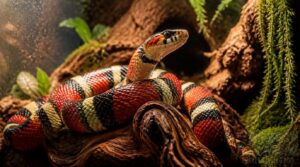
Before you bring home a Honduran milk snake, it helps to know what you’re signing up for, since this species asks for specific conditions to truly thrive.
From heat gradients to humidity levels, this guide to popular milk snake varieties and care basics breaks down exactly what your new pet needs to feel at home.
We’ve treated enough of them to know that good care starts with realistic expectations, not surprises down the road.
Here’s what you need to understand about their range, size, appearance, and behavior before setting up their home.
Natural Range and Habitat
Picture a forest floor in Honduras, damp and shadowed under broadleaf canopy. That’s home turf for these terrestrial snakes, ranging into Nicaragua and Costa Rica too.
They favor moist tropical forest, tucking into leaf litter, logs, and forest edges up to 1,500 meters elevation. Understanding this natural blueprint helps you replicate the humidity and cover your snake actually needs. Surprisingly, human attitudes toward wildlife tend to be most positive during direct encounters like observing animals in their natural habitat, much like watching a milk snake move through its own forest floor environment.
Adult Size and Lifespan
Once that forest floor gives way to your enclosure, expect a snake that reaches 36 to 48 inches as an adult, occasionally topping six feet under ideal conditions. Growth slows sharply after year one. Feeding frequency drives size and weight (200 to 400 grams usually), so don’t overfeed.
With good husbandry, expect 12 to 15 years, sometimes longer.
Appearance and Common Morphs
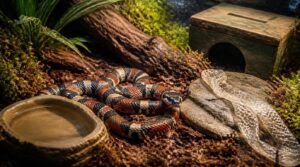
That size range comes wrapped in color, and it’s striking. Classic Honduran Milk Snakes show red, black, and yellow-white bands mimicking coral snakes, while the tangerine phase swaps yellow for warm orange saddles.
We also see albino, snow, striped, and hypomelanistic forms, each with reduced or shifted pigment. Band width stays consistent regardless of morph, a helpful health indicator during exams.
Temperament and Activity Patterns
Bold pattern aside, temperament tells you what daily life with this snake actually feels like. Honduran milk snakes show calm handling tolerance once habituated, accepting gentle restraint with minimal struggle.
Their docile nature pairs beautifully with their striking appearance, explored further in this guide to snake breeds with unique scale patterns.
Activity runs crepuscular to nocturnal, with dawn and dusk investigation driving most movement.
- Freezes briefly when startled, then retreats
- Solitary ambush predators by nature
- Benefits from enrichment and curiosity prompts
- Individual confidence varies snake to snake
Single-Snake Housing Requirement
Since milk snakes eat other snakes in the wild, housing two together invites real danger. We always recommend single housing to prevent territorial stress, feeding competition, and parasite transmission between cage mates.
This setup also simplifies health monitoring, letting you track appetite, weight, and behavior without guessing which snake did what.
Honduran Milk Snake Enclosure Setup
Getting the enclosure right matters more than most new owners expect, since this snake will spend its entire life inside whatever setup you choose. We’ve seen good health start with good housing, and the same holds true in reverse.
Choosing the right enclosure size from the start pays off for years, and this step-by-step guide to housing a snake walks you through picking dimensions that fit your snake’s actual needs.
Good health starts with good housing, since your snake will spend its entire life inside the enclosure you choose
Let’s walk through what that setup actually needs to include.
Minimum Adult Enclosure Size

How much room does a coiled snake really need? For an adult Honduran milk snake, we recommend 48” L x 24” W x 24” H as your baseline, giving enough floor area for full-body stretches and a real temperature gradient.
- Floor space over 8 sq ft
- Length allows full extension
- Width allows basking/cool zones
- Height permits light climbing
Front-Opening Enclosure Benefits
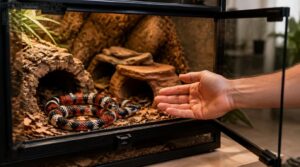
Reach in from the top, not the front, and your snake stays calmer. A front-opening enclosure guides retrieval through a controlled door instead of startling your snake face-on, which means easier access handling and safer snake retrieval every time.
Quick head-to-tail checks happen without disassembling anything, cutting maintenance stress while lowering escape risk during routine care in your enclosure setup.
Safe Substrate Options
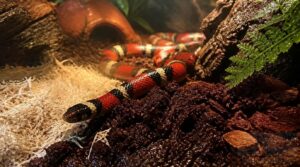
What’s under your snake’s belly matters as much as what’s above it. Coarse beech woodchip, aspen shavings, or a soil-clay mix all balance moisture without trapping ammonia. Dust-free bedding protects lungs, coconut fiber blends resist mold when pesticide-free, and bioactive mixes support live plants.
- Aspen: dry, low-dust
- Coconut fiber: moisture retention
- Cypress mulch: humidity control
Avoid cedar entirely.
Hides, Climbing, and Enrichment

A bored snake is a stressed snake, and stress shows up as illness. Give your Honduran milk snake two hides, one per enclosure end**, sized for full-body coiling. Add secured branches or cork rounds reaching 60cm for climbing. Rotate cinnamon or clove scents weekly, and hide prey under leaf litter to encourage natural foraging behavior.
Bioactive Setup Considerations

Want your enclosure to clean itself? That’s the promise of a bioactive setup.
Layer substrate 3-4 inches deep, then add isopods and springtails at a 4:1 ratio for waste processing.
Include pothos or snake plants for cover.
You’ll maintain 60-70% humidity through misting, keeping the microfauna balance stable while your cleanup crew takes care of the rest.
Temperature, UVB, Humidity, and Hydration

Once your enclosure is set up, the real work is dialing in the environment inside it. Your Honduran milk snake depends on you to get temperature, lighting, and moisture right, since even small gaps here can affect its health over time. Here’s what you need to know to set each of these up correctly.
Choosing the right substrate matters too — materials like coconut fiber and cypress mulch are among the best snake substrates for maintaining stable humidity without encouraging mold or bacterial growth.
Warm and Cool Temperature Zones
Since your Honduran milk snake can’t regulate its own body heat, you need a proper thermal gradient across the enclosure. Aim for an basking area 85-90°F on the warm end, dropping to cool side 70-80°F elsewhere. Watch for pacing, hiding, or refusal to eat, since those can be signs of stress tied to enclosure temperatures rather than simple pickiness.
This gradient lets your snake move freely to thermoregulate, so place thermometers at snake level, not tank walls, for accurate readings.
Safe Nighttime Temperature Limits
Once lights go out, that gradient still matters. Nighttime temperatures shouldn’t drop below 66°F (19°C), the absolute floor for safe rest. We recommend 70-75°F most nights, checked via floor-level probe thermometers twice daily.
During winter brumation, adults can safely handle 55-60°F for 2-3 months, adjusted gradually at 2-3°F weekly to avoid shocking their system.
Thermostats and Heat Sources
Getting temps right takes the right gear, not guesswork. We rely on digital programmable thermostats for automatic switching, paired with a basking lamp and heat mat for zoning.
Priorities:
- GFCI protection near water
- High-temp cutout safeguard
- Backup heat source ready
Dimming thermostats smooth output, reducing dry-air stress on humidity.
UVB Strength and Placement
Thermostats keep heat steady, but reptile skin still needs UVB for proper vitamin D synthesis.
We mount a 5% T5 UVB tube, like the Arcadia Shade Dweller D3 7, 6-12 inches above the basking spot, inside an Exo Terra Deep Dome with reflective backing.
Run it on a 12-hour photoperiod timer and replace bulbs every 6-12 months, since output fades before visible light does.
If you’re still piecing together the rest of your enclosure, the snake tank setup guide covers lighting placement, heating zones, and everything else that matters long-term.
Humidity, Water, and Humid Hides
Moisture matters as much as heat here. We keep ambient humidity at 60-80%, using moisture-retentive substrate, live plants, and misting once or twice daily.
A humid hide packed with damp sphagnum moss helps with healthy shedding, while a large water bowl on the cool side takes care of drinking and soaking without spiking overall humidity.
Diet, Feeding Schedule, and Safe Handling
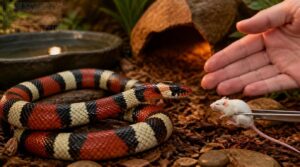
Feeding your Honduran milk snake correctly takes more than tossing in a mouse and walking away. Get the schedule, prey size, or handling timing wrong, and you risk regurgitation, obesity, or a genuinely stressed snake. Here’s what we watch for at each stage, from hatchling to full-grown adult.
Hatchling and Adult Feeding Frequency
Hatchlings grow fast, so we feed them frozen thawed pinkies every 5-7 days, tracking weight weekly. Adults shift to a 7-14 day schedule based on body condition.
- Weigh consistently
- Watch growth curves
- Adjust prey size
- Reduce frequency in cooler months
- Increase briefly after shedding
Feeding schedule balance protects long-term metabolic health.
Choosing Appropriate Prey Size
A few simple rules prevent most feeding accidents. Prey width should match your snake’s head width, not its mouth stretched wide, so measure before you thaw.
| Life Stage | Prey Guide |
|---|---|
| Hatchling | Single pinky |
| Adult | Small rat |
Refusal or lunging signals wrong sizing. Regurgitation means it was too large.
Supplements and Nutritional Balance
Do rodents alone cover it? Mostly, yes. Whole frozen-thawed prey supplies balanced calcium and vitamin D3, so healthy adults on varied rodents rarely need dusting.
Without UVB, though, dust prey with calcium/D3 every 3-4 feedings (adults) or 2-3 (juveniles), plus multivitamin monthly. Use unscented powder, applied lightly after thawing, never on produce. Store containers cool and dry, away from sunlight.
Post-Feeding Handling Precautions
Regurgitation is the biggest risk right after a meal, so wait at least 48 hours before handling. Keep the warm side at 88-90°F to support digestion, offer fresh water, and watch for musk release, twitching, or rapid breathing.
Since new arrivals need at least a week to settle and shedding snakes should be left alone, these snake handling safety precautions can help you time every session safely.
Larger meals or newly acquired snakes may need up to 72 hours before you handle them again.
Stress-Aware Handling Techniques
A calm snake tells you everything through body language. Approach from the side, never head-on, and start with a gliding touch along the mid-body before reaching the head.
Wash your hands first, both for hygiene and to avoid smelling like prey. Watch for stress indicators: hissing, rapid tongue flicks, or musk. If they appear, stop and let your snake settle for 5-10 minutes.
Cleaning, Shedding, and Health Monitoring
A clean enclosure does more than look good, it prevents the bacterial and fungal issues that send snakes to our exam tables. Shedding problems and subtle health changes often show up first in daily habits, so we pay close attention to routine.
Here’s what that routine should cover, from quick daily upkeep to the signs that mean it’s time to call a vet.
Daily Spot-Cleaning Routine
Every day, we check the enclosure for feces, urates, and leftover prey, removing waste before ammonia builds up.
Spot clean soiled substrate immediately using a reptile friendly disinfectant, wiping surfaces dry. Restore humidity after cleaning to prevent condensation. Sanitize tools after each use, and if you’re running a bioactive setup, let your cleanup crew handle what daily spot cleaning can’t.
Deep-Cleaning Schedule
Spot cleaning controls daily waste, but it can’t reset what builds up underneath. That’s why we recommend a full clean every 8 to 12 weeks, timed with seasonal humidity shifts.
Empty the enclosure, inspect for wear, then sanitize decor, hides, and water bowls with a reptile friendly disinfectant. Refresh substrate depth, and log each cleaning date alongside your snake’s behavior.
Healthy Shedding Support
While your enclosure log tracks cleanings, add shed dates too. Healthy sheds come off in one complete piece within 7-10 days.
Keep humidity at 60-80%, rising to 70% during shed cycles. Mist twice daily, refresh the humid hide’s sphagnum moss every 3-5 days, and offer a soaking bowl. Watch eyes cloud blue, then clear, signaling shed’s near.
Common Illness Warning Signs
Once shed cycles look normal, shift your attention to breathing and body signals. Wheezing, raspy breath, or open-mouth breathing signal respiratory trouble. Check for nasal discharge, mouth bubbling, or yellow cheesy buildup (mouth rot).
Look for moving skin dots (mites), facial swelling, or retained eyecaps paired with cloudy eyes. Lethargy, reduced tongue-flicking, and hiding all warn something’s off.
Weight and Body Condition Checks
Numbers don’t lie, so we weigh our Honduran milk snakes monthly (adults) or every two weeks (juveniles) using a tared digital scale.
We pair this with body condition scoring, checking for a rounded, loaf-like shape rather than a visible spine or loose skin.
A weight loss over 10% within two to four weeks, especially with meal refusal, means it’s time to call your exotic vet.
Frequently Asked Questions (FAQs)
What do I need to take care of a milk snake?
You’ll need a 48x24x24 inch enclosure, secure substrate, a proper temperature gradient (85-90°F basking, 70-80°F cool side), UVB lighting, 60-80% humidity, a water dish, and a feeding schedule of appropriately sized prey every 10-14 days.
What is the best bedding for milk snakes?
We recommend aspen shavings for odor control, or a soil-clay mix in a bioactive enclosure like the Terra Firma Kit for moisture retention. Avoid cedar or pine, and swap bedding every 4-8 weeks.
What is the lifespan of a Honduran milk snake?
Good things come to those who wait, and that holds true here: wild snakes live 10 to 12 years, but with proper reptile husbandry, captive-bred colubrid care routinely stretches lifespan past 20 years.
How long can my milk snake go without food?
Adults tolerate 7 to 20 days between meals, while juveniles shouldn’t go past a week. Refusal near a shed is often vision-related, not illness, though a fasting snake with dull eyes or stuck shed needs closer monitoring.
Are Honduran milk snakes venomous or dangerous to humans?
Their coral-snake costume is all bluff, no bite behind it. Honduran milk snakes carry no venom, so a defensive nip brings mild soreness at most, not the systemic danger people assume from that flashy banding.
Whats the average cost of a Honduran milk snake?
You’ll usually pay 60 to 200 USD, with hatchlings from reputable breeders running 60-120 and adults closer to 100- Unique morphs push prices higher, so budget accordingly before buying.
Can Honduran milk snakes be housed with other reptile species?
Mixing enclosures is a recipe for disaster, not diversity.
Solitary nocturnal predators at heart, your milk snake sees tankmates as dinner. Size mismatches, competing needs, and cannibalism risk factors make cohabitation dangerous, even with non-venomous species sharing similar temps.
Conclusion
A calm snake wearing a venomous mask, that’s the paradox you’re caring for. This honduran milk snake care sheet exists because good intentions don’t replace correct numbers, whether it’s a 40-gallon minimum, 88°F basking spots, or 10 to 14 day feeding intervals for adults.
Watch weight, watch sheds, watch appetite. Small deviations catch problems early, before they become emergencies. Get the setup right once, and you’ll spend years enjoying a snake built for the long haul, not the vet’s office.