This site is supported by our readers. We may earn a commission, at no cost to you, if you purchase through links.
Your snake doesn’t care how pretty your enclosure looks. It cares whether the floor under its belly holds moisture, drains waste, and doesn’t poison its lungs. One whiff of cedar and that’s game over.
Get terrarium substrate mixes for bioactive setups right, and a living cleanup crew breaks down waste while your hognose tunnels six inches deep. Get them wrong, and you’re scooping out anaerobic sludge every other weekend.
I’ve seen both outcomes, and the difference comes down to a few smart ingredients and clean layering. Here’s how to build a base that works for your snake’s climate.
Table Of Contents
- Key Takeaways
- Choose Snake-Safe Ingredients for Bioactive Substrate Mixes
- Mix Terrarium Substrates for Your Snake’s Climate
- 4 Ready-Made Bioactive Terrarium Substrate Options
- Layer and Hydrate Your Bioactive Terrarium Substrate
- Maintain Substrate Moisture, Leaf Litter, and Microfauna
- Frequently Asked Questions (FAQs)
- Conclusion
Key Takeaways
- Skip cedar and pine, and build your base from snake-safe ingredients like coco coir, cypress mulch, additive-free topsoil, and leaf litter, since aromatic oils irritate lungs and stress the liver.
- Match your mix to your snake’s home climate, using moisture-holding blends with sphagnum moss and orchid bark for tropical species, and loose, fast-draining mineral topsoil and washed sand, 6 to 8 inches deep, for burrowers like hognose snakes.
- Build your enclosure in clean layers (a drainage layer, a flat mesh barrier, then 10-15 cm of substrate hydrated until a squeezed handful clumps), because skipping the mesh leads to soggy, anaerobic sludge.
- Keep upkeep light by maintaining steady moisture, piling on leaf litter, and letting springtails and isopods clean up waste, so you only refresh the top inch or two yearly and replace everything after disease or contamination.
Choose Snake-Safe Ingredients for Bioactive Substrate Mixes
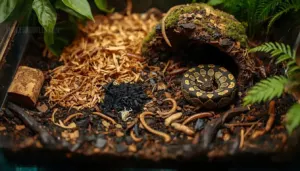
The wrong ingredient can hurt your snake, so let’s start with what’s safe. Think of your substrate as a living recipe, and every item should earn its spot.
If you’re weighing your options, this guide to terrarium substrate mixes for reptile owners shows how different ingredients blend together and which ones suit your snake’s setup.
Coco coir and cypress mulch make a great base. They hold moisture well and carry no toxic oils. Add organic topsoil, but check the label first. No fertilizers, no additives, no surprises.
Now, the dealbreakers. Skip cedar and pine entirely. Their aromatic oils irritate lungs and stress the liver. Dyed or treated wood? Also a hard no.
For the cleanup crew, mix in oak or magnolia leaf litter, small twigs, and a little horticultural charcoal to curb odors. A handful of earthworm castings feeds your plants, and isopods will devour the rest. Feeding your snake on a plate or in a separate container also helps with preventing substrate impaction risks.
Mix Terrarium Substrates for Your Snake’s Climate
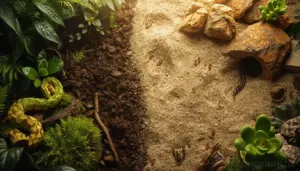
Your snake’s native climate decides which substrate mix will work best. Below, you’ll find two blends, one built to hold moisture and one built to drain and support burrowing. Pick the one that matches your snake’s home turf, and you’re halfway there.
Tropical Blends for Moisture Retention
A good tropical mix holds water without turning to soup. Here’s your base:
- Coco coir for steady moisture and airflow.
- Orchid bark and charcoal for drainage.
- Sphagnum moss for extra water-holding power.
Squeeze a handful. It should hold its shape without dripping. That’s your sweet spot.
Rainbow boa? Add more sphagnum moss. Drier forest species? Add more orchid bark.
Arid Blends for Drainage and Burrowing
Desert snakes want the opposite of that soupy mix. Think dry, loose, and fast-draining.
If you’re keeping a species that thrives in arid conditions, this guide to terrarium substrate mixes for beginners shows how sand-based blends compare with moisture-holding options.
Aim for 50 to 70 percent mineral-rich topsoil, plus calcareous sand and volcanic substrate. Use washed play sand to avoid silica dust. Add a little coco coir for microfauna, and skip the drainage layer.
Going 6 to 8 inches deep gives hognose snakes room for natural burrowing behavior.
4 Ready-Made Bioactive Terrarium Substrate Options
Mixing your own substrate is fun, but sometimes you just want a ready-made bag you can open and use. Here are four solid options that fit different snake setups, from tropical to arid. Let’s see which one earns a spot in your enclosure.
1. Exo Terra Sub Stratum Volcanic Substrate
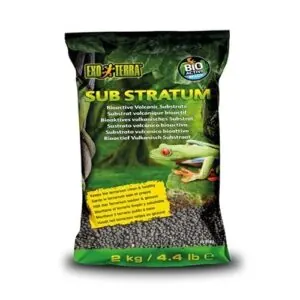
Here’s a number worth knowing: one 2 kg bag covers a surprising amount of floor space when you layer it 1-2 inches deep.
This Andisol, born from Mount Aso’s volcanic ash, is porous, so water drains and roots breathe. *No soggy mess.
*
Live Bacillus bacteria wake up on contact with moisture or waste, breaking it down while the ash traps ammonia and odors.
Rinse it, top it with leaf litter, and replace part of it yearly. Keep it indoors only.
| Best For | Hobbyists building planted, bioactive terrariums who want a drainage-friendly, odor-controlling volcanic substrate for their reptiles or plants. |
|---|---|
| Bioactive Support | Supports bioactive ecosystems |
| Plant Support | Supports lush vegetation |
| Microfauna Support | Fosters nitrifying organisms |
| Main Material | Volcanic Andisol soil |
| Size | 2 kg |
| Moisture Management | Maintains correct moisture |
| Additional Features |
|
- Porous volcanic soil drains well and lets roots and the soil breathe.
- Helps remove ammonia and unpleasant odors, keeping the enclosure cleaner.
- Supports a bioactive setup by encouraging beneficial nitrifying organisms and keeping moisture at the right level.
- It is meant for indoor use only.
- Compatibility with specific reptile or plant species isn’t detailed.
- There is no guidance on how deep to lay it or how often to replace it.
2. Exo Terra Sub Stratum Bioactive Substrate
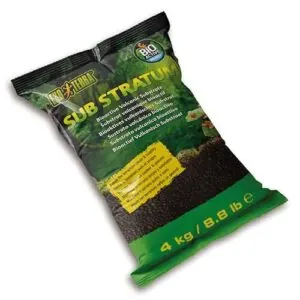
Volcanic soil from Japan’s Aso Volcano powers this bioactive pick, and it’s a smart one. The 8.8 lb (4 kg) bag packs live Bacillus bacteria and active carbon, so ammonia and odors don’t stand a chance. Drainage and aeration are excellent, too.
Use it alone at 2.5 to 5 cm deep, or mix it into plantation soil for extra water retention. The catch? Some keepers find it pricey for the amount. Still, would I use it in bioactive setups? Absolutely.
| Best For | Keepers of bioactive terrariums who want a natural volcanic substrate that controls ammonia and odors while supporting healthy plant roots. |
|---|---|
| Bioactive Support | Supports bioactive terrariums |
| Plant Support | Supports plant life |
| Microfauna Support | Fosters nitrifying organisms |
| Main Material | Volcanic tephra |
| Size | 4 kg (8.8 lb) |
| Moisture Management | N/A |
| Additional Features |
|
- Eliminates ammonia and unpleasant odors to keep the enclosure cleaner
- Provides excellent drainage and aeration for strong root development
- Fosters beneficial nitrifying organisms that help break down waste
- Customers report mixed feedback on value for money
- Some find it expensive for the amount received
- No accessories or extra items are included
3. Joshs Frogs BioBedding Tropical 4 Quarts
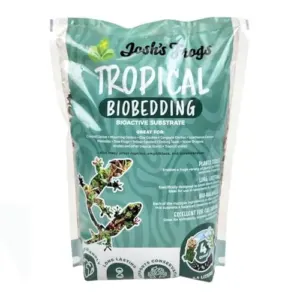
A good tropical base shouldn’t make you work for it, and this one mostly doesn’t. It blends coconut fiber, orchid bark, sphagnum moss and charcoal with beneficial fungi, so it holds humidity while your snake still burrows freely. Springtails and isopods love it too.
The 4-quart bag (model JFC81548, 0.83 kg) won’t stretch far, and some buyers question the value. Plan on stirring every 1-2 weeks, and expect a full replacement after several years. For tropical setups, I’d say yes.
| Best For | Keepers of tropical, bioactive terrariums who want a substrate that holds humidity, supports live plants and springtails or isopods, and still lets their pets dig or lay eggs. |
|---|---|
| Bioactive Support | Supports bioactive terrariums with microfauna |
| Plant Support | Supports live plant growth |
| Microfauna Support | Supports springtails and isopods |
| Main Material | Organic/inorganic blend with fungi |
| Size | 4 quarts (0.83 kg) |
| Moisture Management | Maintains humidity |
| Additional Features |
|
- Blends organic and inorganic ingredients with trace elements and beneficial fungi to support live plant growth
- Holds humidity while staying loose enough for pets to dig and lay eggs
- Supports springtails and isopods, which process waste and cut down on frequent substrate changes
- Breaks down over time and needs full replacement after several years
- Needs stirring every 1-2 weeks or whenever waste is visible
- Customer feedback is mixed on value for money, especially given the 4-quart size
4. Joshs Frogs ABG Mix Substrate
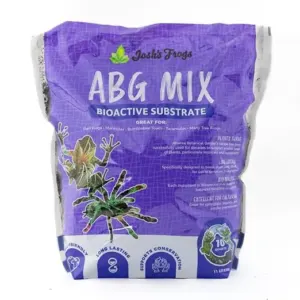
Squeeze a handful and it holds together like damp forest floor, then lets go of barely a drop. That’s this mix doing its job.
It’s the proven ABG recipe from the Atlanta Botanical Garden: charcoal, sphagnum moss, pine bark, tree fern, and peat. You get a 10 quart bag, about 2.5 gallons, built for tropical bioactive setups. It breaks down slowly. Pre-moisten it with distilled or RO water, and pair it with a false bottom and substrate barrier. Springtails thrive.
| Best For | Hobbyists building bioactive terrariums or vivariums for tropical plants, dart frogs, tree frogs, tarantulas, or reptiles who want a proven, drainage-friendly substrate for culturing springtails and isopods. |
|---|---|
| Bioactive Support | Designed for bioactive terrariums |
| Plant Support | Supports tropical plants, houseplants |
| Microfauna Support | Ideal for springtails and isopods |
| Main Material | Charcoal, moss, bark, peat blend |
| Size | 10 quarts (2.5 gallons) |
| Moisture Management | Requires pre-moistening |
| Additional Features |
|
- Uses the proven Atlanta Botanical Garden recipe, blending charcoal, sphagnum moss, pine bark, tree fern, and peat
- Supports tropical plants and houseplants while also suiting springtails, isopods, frogs, tarantulas, and reptiles
- Breaks down slowly, so it holds up well over time
- Needs to be pre-moistened with distilled or RO water before use
- Requires a false bottom and substrate barrier for good drainage
- Breaks down over time, so it will eventually need replacing
Layer and Hydrate Your Bioactive Terrarium Substrate
Picture a tiny layered cake, with a soggy bottom you never see. That’s your enclosure, and it works beautifully when the layers stay honest.
Think of substrate layering as three steps:
- Rinse your LECA, then spread a 5-10 cm drainage layer across the base.
- Lay fitted mesh flat on top, with no gaps, so soil can’t sink.
- Add 10-15 cm of substrate, hydrating gradually until a squeezed handful clumps, then crumbles.
Why bother? That reservoir slowly releases water upward, which helps humidity regulation without drowning roots. Skip the mesh and you’ll get anaerobic sludge. Gross.
Set heavy rocks on the substrate, never the mesh. That spares the mesh from tearing for years, and it keeps your moisture retention steady, too.
Maintain Substrate Moisture, Leaf Litter, and Microfauna
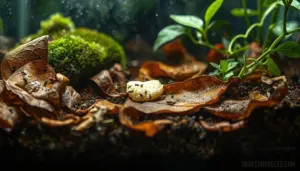
Your bioactive setup is alive, so think of upkeep as tending a tiny garden, not scrubbing a tank.
A bioactive enclosure is a living garden you nurture patiently, not a glass box you scour clean
Start with moisture. In a closed enclosure, you want light condensation on up to a third of the glass around midday. Too foggy? Mist less. Too dry? Mist more. Tropical blends need regular spritzing, while arid mixes want a lighter hand. Keep that drainage layer working, too.
Next, feed the cleanup crew. Pile fresh leaf litter one to two inches deep, and mix leaf types like magnolia and live oak. It’s food, shelter, and a humidity blanket all at once.
Then, leave things alone. Skip the full substrate swaps, offer fish flakes now and then, and drop in some cuttlebone for calcium. Your microfauna will handle the rest.
Frequently Asked Questions (FAQs)
How often should bioactive substrate be fully replaced?
Ready for the good news? You never will. A healthy bioactive terrarium keeps recycling waste, so skip routine full changes. Refresh the top inch or two yearly, and replace everything only after disease or contamination.
How do I fix substrate that stays too wet?
Soggy substrate usually means too much water going in or too little going out. Cut back your misting, then check your drainage layer weekly. Drain it when it’s half full, and mix in bark or clay balls.
Which isopods and springtails suit a snake enclosure?
Honestly, your snake enclosure could host a thousand tiny janitors! Match them to humidity: Porcellionides pruinosus isopods suit tropical setups, while Armadillidium maculatum controls arid ones. Springtails matter too, so never run isopods without them.
What are the signs of substrate mold or pests?
Picture a forest floor gone wrong: fuzzy patches, dark clumps, a sour smell. Spot white fuzzy mold, black slime, mushy leaf litter, or fungus gnats exploding, and check your snake for moving dots. Mites mean trouble.
Conclusion
Picture a corn snake owner who checks her enclosure six weeks after setup. The springtails are swarming, the pothos roots are gripping, and the floor smells like a forest after rain. That’s the payoff of choosing terrarium substrate mixes for bioactive setups with care.
Match the mix to your snake’s climate, layer it cleanly, and keep the moisture steady. Then step back and let your tiny crew do the cleaning.