This site is supported by our readers. We may earn a commission, at no cost to you, if you purchase through links.
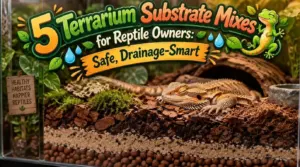
Cedar shavings smell lovely, which is exactly why they’re a trap. Those fragrant fumes irritate a snake’s lungs, and one stray mouthful can end in a vet bill. Super sneaky, right?
Your enclosure’s floor does more than look pretty. It holds moisture, drains spills, and decides whether your animal thrives or struggles. Fine sand can cause impaction, and dusty or fertilized soil brings its own health risks.
Getting the right terrarium substrate mixes for reptile owners isn’t complicated once you know the ingredients. Here are five safe, drainage-smart blends, matched to arid, temperate, tropical, and bioactive setups.
Table Of Contents
- Key Takeaways
- Choose Terrarium Substrate Mixes for Your Snake
- Compare Substrate Ingredients, Benefits, and Safety
- Five Terrarium Substrate Mixes by Habitat
- Mix and Layer Substrates for Healthy Drainage
- Maintain Substrate Moisture, Cleanliness, and Longevity
- Frequently Asked Questions (FAQs)
- What is a good substrate mix for reptiles?
- What is the best substrate mix for a terrarium?
- What is the best substrate for reptiles?
- How to make your own reptile substrate?
- Can I use substrate from my backyard?
- How do I safely sterilize new substrate?
- Is paper towel acceptable for quarantine enclosures?
- How do I stop fungus gnats in substrate?
- Should substrate be different for hatchlings versus adults?
- Conclusion
Key Takeaways
- Choose substrate for safety first by skipping cedar, pine, dusty, scented, or fertilized options and anything fine or chunky enough to cause impaction when your snake swallows it.
- Match your mix to your species’ habitat, such as 60% topsoil and 40% washed play sand for arid burrowers, coir and moss for tropical setups, and soil with heat-treated bark for temperate ones.
- Build your enclosure in layers, with a drainage layer at the bottom, a mesh barrier above it, and your substrate mix on top, so moisture stays balanced without waterlogging or mold.
- Keep the setup healthy by checking moisture weekly, spot cleaning daily, replacing loose substrate once or twice a month, and never sterilizing a bioactive setup because that kills its helpful microfauna.
Choose Terrarium Substrate Mixes for Your Snake
Why do so many snake keepers get substrate wrong? Usually because they grab a bag of whatever’s cheapest and hope for the best. Your snake deserves better, and honestly, so does your sanity.
Ball python owners in particular should check out this guide to the best reptile substrate and bedding for ball pythons, since humidity and safety vary a lot between options.
Most snake keepers get substrate wrong by grabbing the cheapest bag and hoping for the best, but your snake deserves better
Start with substrate safety. Anything dusty, scented or fertilised is out. Then think about impaction prevention: if your snake could swallow a chunk during feeding, it’s too big. Match substrate particle size to your species and you’ve dodged a nasty vet bill.
Next, consider your animal’s home turf. Sand boas want something very different from a corn snake (shocking, I know). For arid setups, a base of 60% organic topsoil and 40% washed play sand makes a solid arid substrate mix that should be at least 4–6 inches deep, or 6–8 inches for burrowers like Kenyan sand boas. Once you’ve picked a habitat, you’ll work out substrate mixing ratios that hold humidity, drain well and suit a proper naturalistic enclosure. Super simple, really.
Compare Substrate Ingredients, Benefits, and Safety
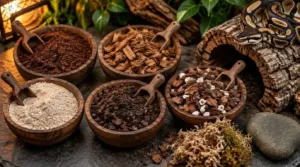
Not every substrate ingredient earns a place in your snake’s home, and a few are downright risky. Below, we’ll size up the common options side by side, so you can see what each one does for your setup (and what to steer clear of). Let’s start with the ingredient basics, because getting them right makes everything else easier.
Common Ingredients Compared
Sand drains brilliantly and suits arid species, but fine or calcium-based grains risk impaction. Coco coir holds moisture well, though you’ll rinse out salts and watch for mold.
Sphagnum moss is a super humid-hide choice (just expect it to compact). Cypress mulch fights mold, but check for sharp bits. Pumice and orchid bark keep any soil mix airy.
Habitat-Specific Mix Benefits
Different habitats call for different mixes, and that’s where habitat-specific needs really shine. Arid setups love deep, sandy soil (6-8 inches) so sand boas can tunnel. Temperate tanks lean on leaf litter and cork bark for foraging.
Even arboreal snakes appreciate a few inches of substrate for moisture pockets and digging, so check this guide on substrate depth requirements for snakes before setting up any enclosure.
Tropical enclosures need moisture-retentive coir and moss. A bioactive substrate also lets microfauna break down waste, which means less scooping for you.
Moisture Retention and Drainage
pull in opposite directions, so your mix has to referee. Coco coir holds 3-4 times its weight in water, while sphagnum moss soaks up 20 times its own. Add orchid bark for aeration and you’ve got a balanced tropical mix.
Layering helps too. Put a 1-2 inch drainage layer of LECA beneath, with mesh on top, and waterlogging won’t catch you out.
Bioactive Ingredient Benefits
Plenty of snake keepers overlook the tiny workers in a bioactive substrate. Springtails and isopods munch through waste, so your microbial community gets a steady meal. That’s proper nutrient cycling, and it keeps ammonia and mould in check.
Your terrarium setup basically cleans itself (super handy). Healthier roots, fewer smells, less fuss. Great, isn’t it?
Impaction and Toxicity Risks
Most keepers worry about loose substrate impaction, and fair enough. Your snake can swallow grit while grabbing a mouse, so particle size safety matters tonnes. Skip fine, clumping sands. (Marketing claims aren’t gospel!)
Avoid cedar shavings. Their toxic wood fumes irritate airways, and substrate ingestion risk climbs when your snake feeds on the floor. Simple fix: feed on a tile.
Five Terrarium Substrate Mixes by Habitat
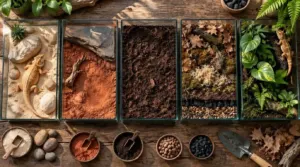
Your reptile’s home deserves a substrate that actually suits it (and your sanity at cleaning time). Below, you’ll find five habitat-matched mixes, from dry desert setups to lush planted terrariums. Pick the one that fits your enclosure, and you’re halfway to a happy, healthy animal.
Sandy Soil Blends for Arid Enclosures
Think desert, but make it cosy. Sandy soil blends give your arid enclosure proper drainage without turning into a dust bowl (nobody wants that).
Mix 60% organic topsoil with 40% washed play sand. It’s super for burrowers like leopard geckos and hognose snakes. Keep the sand fine and rounded for particle size safety, and skip anything chunky or sharp. Your snake’s gut will thank you.
Soil and Bark for Temperate Enclosures
Picture a damp woodland floor after rain: dark, crumbly, springy underfoot. That’s the feel you’re after.
Soil and bark for temperate enclosures give your snake exactly that, with proper drainage, aeration and a naturalistic base. Mix chemical-free organic topsoil with heat-treated Douglas fir bark, and skip pine or cedar. Squeeze a handful. It should clump, but not drip.
Coir and Moss for Tropical Enclosures
Want a humid habitat without the swampy mess? Coir and Moss for Tropical Enclosures is your answer.
Coir holds moisture yet drains well, which makes humidity control super easy. Mix in bark and charcoal for a bioactive setup. Here’s your layering kit:
- Coir on top
- Sphagnum moss below
- Drainage layer beneath
- Respray when dry
Smart terrarium layering keeps substrate drainage reliable.
Burrow-Supporting Soil and Clay Blends
Ever watched a snake vanish into a tunnel and wondered how it stays put? Burrow-Supporting Soil and Clay Blends are the secret. Mix 60% topsoil, 30% play sand and 10% clay, then add water until it’s moldable.
Sculpt, dry fully, and tunnels hold firm. Super smart substrate layering keeps drainage and soil aeration healthy, and helps your microfauna habitat thrive.
ABG Mix for Planted Bioactive Terrariums
Tunnels sorted? Now let’s green things up. ABG Mix is a bioactive substrate that holds moisture without turning to soup, perfect for a planted vivarium. Pop it over a drainage layer and you’ve got a terrarium substrate your plants will love. Imagine this:
- Lush, glowing greenery
- Springtails buzzing happily
- Pride in your handiwork
- A calm, healthy snake
- Zero mould worries
Mix and Layer Substrates for Healthy Drainage
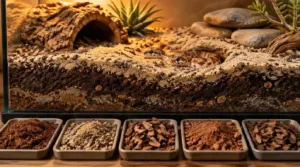
Once you’ve picked your soil mix, it’s time to build it in layers (think of it as a lasagne, minus the cheese). Start with a drainage layer of hydroballs or lava rock, about 2 to 3 inches for tropical setups and 1 to 2 for temperate ones. Desert enclosures usually skip it.
Next, lay a mesh barrier on top, such as hydro fleece or aluminium screen, cut slightly oversized and pressed to the walls. It stops substrate sinking into the gaps. A thin sheet of activated charcoal, rinsed first, helps mop up gases.
Finish with your mix, mixing coco coir through it for aeration. Keep water below halfway up the drainage layer, and fit a PVC tube for easy siphoning.
Maintain Substrate Moisture, Cleanliness, and Longevity
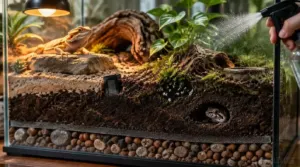
Your layers are built, so now comes the easy bit: keeping them happy.
Check moisture weekly with a hygrometer. You want damp, never waterlogged, with good moisture retention in the lower layers. In arid setups, mist lightly so the top stays dry. Soggy substrate invites black mold, so mold prevention starts with restraint.
Spot clean daily and remove uneaten food promptly. Replace loose substrate completely once or twice a month. Got a bioactive setup? Don’t sterilise it, because that kills the helpful microbes. Inspect weekly, clear dead plant matter and sift lightly to ease substrate compaction.
Keep that drainage layer working, and give burrowers at least 5 inches of soil depth. Do both, and substrate longevity takes care of itself (mostly).
Frequently Asked Questions (FAQs)
What is a good substrate mix for reptiles?
Sure, the best substrate is whatever your snake’s habitat says, not whatever’s cheapest. Match the Terrarium Substrate to the species: arid gets a sandy soil mix, tropical gets ABG Mix with coco coir, plus a drainage layer.
What is the best substrate mix for a terrarium?
I once watched a hognose bury itself in under ten seconds. Honestly? Match your species. For burrowers, use a soil mix of 60% topsoil and 40% sand. For tropical setups, choose coco coir.
What is the best substrate for reptiles?
There’s no single winner, because the best reptile substrate matches your animal’s habitat.
Desert species need low-organic sandy soil, tropical ones thrive on coir and moss, and bioactive setups love leaf litter.
Skip cedar and pine. Substrate safety first!
How to make your own reptile substrate?
Start your DIY reptile substrate recipe with a base component: organic topsoil, pesticide-free. Mix in washed play sand (40%) for arid setups, add coco fiber for humidity retention, then layer rocks below for drainage. Super simple!
Can I use substrate from my backyard?
Yes, but only after soil sterilization. Bake it at 200°C (392°F) for 20 minutes, cool it, then sift out debris. Skip anything treated with fertilizer or pesticide. Raw dirt isn’t a safe reptile substrate.
How do I safely sterilize new substrate?
Spread your substrate thin on a tray and bake it at 200-250°F for 30-60 minutes. That’s proper soil sterilization. Let it cool completely, then re-moisten before your reptile enclosure goes live. Skip this for bioactive setups.
Is paper towel acceptable for quarantine enclosures?
Why overthink a bed for a few weeks? Paper towel liners are a great choice for hatchling quarantine. You’ll spot droppings and mites instantly, and there’s no loose substrate impaction worry. Just swap it when it’s soiled.
How do I stop fungus gnats in substrate?
Think coconut coir repels gnats? Nope, its water retention matches peat. Let the top inch dry out, add pumice for airflow, and top with coarse sand. Springtails in a bioactive substrate eat the fungus, super effective!
Should substrate be different for hatchlings versus adults?
Yes, absolutely. Hatchlings need solid surfaces like paper towel, because loose Terrarium Substrate risks impaction. Adults handle a proper soil mix with drainage, moisture retention and structural materials. Switch once they’re big and feeding accurately.
Conclusion
Picture a corn snake named Biscuit, tunnelling happily through a damp, spongy mix of coir and soil, his cage dry at the top and moist below. No dust, no sniffles, no panicked vet dash. That’s the payoff of choosing well.
The best terrarium substrate mixes for reptile owners are simple: match the habitat, layer for drainage, and keep things clean. Get that right, and your floor quietly does half the husbandry for you. (Super, eh?)