This site is supported by our readers. We may earn a commission, at no cost to you, if you purchase through links.

A snake can swallow a rabbit wider than its own head, and within 48 hours its heart grows 40% heavier while its liver triples in mass. Then, once the meal is gone, those organs shrink back to baseline.
Your intuition about digestion probably treats it as a steady background process. In snakes, it works more like a controlled demolition and rebuild, with metabolic rate spiking up to 44-fold. Understanding how snakes process food internally explains why a basking python at 90°F digests faster than a cold one.
Here’s the full sequence, from the first jaw movement to the final waste.
Table Of Contents
- Key Takeaways
- How Do Snakes Swallow Whole Prey?
- How Does a Snake’s Stomach Break Down Food?
- How Do Snakes Absorb Nutrients?
- How Does Digestion Change Snake Organs?
- How Long Do Snakes Take to Digest?
- How Do Snakes Eliminate Digestive Waste?
- Frequently Asked Questions (FAQs)
- How long does it take for a snake to process food?
- What smell does a snake hate?
- What will a snake do after eating?
- How does a snake’s digestive process work?
- Can snakes digest bones, fur, and feathers?
- Why do some snakes regurgitate their meals?
- Does venom help snakes digest their prey?
- How do snakes breathe while swallowing large prey?
- What happens if a snake is disturbed after eating?
- Conclusion
Key Takeaways
- Your snake swallows prey wider than its own head because its lower jaw halves stay unjoined at the chin and move independently, letting it "walk" its mouth over the meal.
- Once the meal reaches the stomach, acid at about pH 1.5 and strong enzymes dissolve skin, flesh, and bone, but fur and feathers pass through undigested because keratin resists breakdown.
- Within 48 hours of eating, your snake’s metabolism can spike up to 44-fold while its heart grows about 40% and its liver triples, and these organs shrink back once digestion ends.
- Temperature sets the pace of digestion, so your snake seeks a basking spot around 88 to 92°F after eating, and getting too cold, stressed, or disturbed can make it regurgitate the meal.
How Do Snakes Swallow Whole Prey?
The snake’s feeding apparatus works nothing like your jaw, and that difference makes swallowing prey whole possible. Each half of the lower jaw stays unfused at the chin, joined only by an elastic ligament that stretches as the head widens.
Because each jaw half moves independently, a snake can "walk" its mouth over bulky prey, a process explained in more detail in how snakes hunt and swallow their prey.
Behind that, the quadrate bone acts as a hinge, swinging the lower jaw outward and sideways so hinged jaws can open far beyond what a rigid skull would permit. This cranial kinesis lets the maxilla, palatine, and pterygoid bones move independently.
You’d see the result as a ratchet. Backward-curving teeth hook the prey, one side of the jaws advances, grips, and releases while the other side takes over, and saliva keeps it slick as the meal inches toward the throat. Scientists describe this alternating motion as the walk feeding method, which lets a snake gradually pull in prey several times wider than its own head.
How Does a Snake’s Stomach Break Down Food?
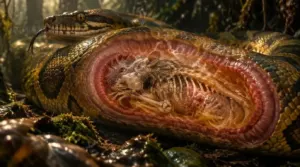
Once the meal clears the throat, the real work begins in the stomach, and it starts the moment prey arrives. Gastric acidification drops the gastric pH to roughly 1.5, because hydrochloric acid floods the lumen while pepsinogen converts into active pepsin. Proteinases and L-amino acid oxidase then attack tissue, and venom enzymes from the bite have often begun that job already.
Here’s how the process unfolds in your snake:
- Acid and enzymes soften skin, flesh, bone, and feathers.
- Strong muscular walls churn the mass, standing in for chewing.
- Digestive enzyme kinetics speed up as the mixing exposes fresh surfaces.
Expect days or even weeks for a large meal to dissolve completely.
Since a snake’s metabolism slows and ramps up around each meal, this guide to how snakes digest their food explains why bigger prey takes so much longer.
How Do Snakes Absorb Nutrients?
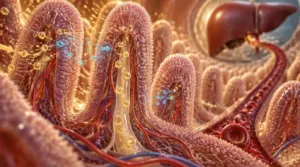
Once the stomach has reduced the meal to a nutrient-rich slurry, the small intestine takes over, and this is where nutrient absorption actually happens. Enterocytes pull amino acids and glucose across their apical membrane, while microvilli on each cell deliver a major microvilli surface area increase and carry enzymes that split disaccharides and polypeptides.
Here’s how your snake moves nutrients from gut to body:
- Intestinal villi unfold and expand as food arrives.
- Transporters for sodium, glucose, and amino acids multiply on the brush border.
- Glucose and amino acids enter blood capillaries inside each villus.
- Fatty acids and glycerol enter lacteals and travel as chylomicrons.
- The hepatic portal vein carries blood to the liver for processing.
Together, these steps drive high intestinal absorption efficiency and complete nutrient assimilation.
How Does Digestion Change Snake Organs?
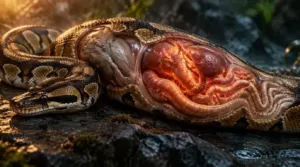
Your snake’s body doesn’t just process a meal, it rebuilds itself around it. Two changes stand out: rapid organ growth after feeding and the gut’s response to fasting. You’ll see how each one works below.
Since digestion can stretch from several days to a few weeks depending on meal size and temperature, this guide to how long it takes a snake to digest helps you time the next feeding.
Organ Growth and Increased Metabolism
Think of a python’s body as a factory that sits idle until a delivery arrives, then switches every machine on at once.
A python’s body idles like a quiet factory until a meal arrives, then switches on every machine at once
Within 48 hours of feeding, organ hypertrophy begins: the ventricle gains 40% and the liver triples.
Metabolic upregulation drives a postprandial metabolic spike up to 44-fold, the Specific Active Action (SDA) cost, before organ reversible remodeling reverses it.
Gut Changes During Extended Fasts
How does your snake survive months without a meal? Through organ atrophy, which shrinks the gut and lowers fasting metabolism so stored energy lasts longer. Intestinal villi regress, motility slows, and microbial density drops sharply.
Don’t worry about permanence. Organ reversible remodeling restores function within 24 hours of feeding, as organ hypertrophy swells enterocytes with lipid droplets, not new cells.
How Long Do Snakes Take to Digest?

A snake can finish digesting a meal in a few days or take several weeks, and the gap depends on conditions you can often observe or influence. Two factors account for most of that variation. Here’s how temperature and thermoregulation and meal size and species differences set the pace.
Temperature and Behavioral Thermoregulation
Your snake can’t generate much heat on its own, so after a meal it borrows warmth from its surroundings. This ectothermic thermoregulation, called postprandial thermophily, means it’ll shuttle to a basking spot of 88 to 92°F and stay there.
Corn snakes select about 28°C after feeding versus 25.8°C when starved. Keep that gradient stable before feeding day.
Meal Size and Species Differences
A rabbit-sized meal costs a python far more than a mouse does, yet both snakes digest them completely. Prey size influence shows in metabolic rate scaling: oxygen consumption can climb 44-fold after a large meal, and digestion stretches from days to weeks.
Organ size fluctuates: intestinal mass doubles within three days, then recedes, while interdependent organs adjust, enabling frequent feeding.
How Do Snakes Eliminate Digestive Waste?
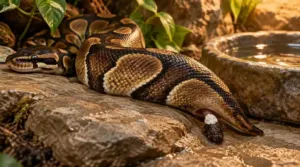
Picture a rat’s fur and bone fragments, packed in a chalky white cap, sliding out of a snake after weeks of silence. That’s waste elimination, and it happens through the cloaca, a single vent that works for your snake’s gut, kidneys, and reproductive tract.
Before anything exits, cloacal water reabsorption dries the feces and turns urine into urate paste. Since intestinal villi proliferation and organ growth carry a steep metabolic cost, snakes finish digesting completely, then expel everything at once.
Here’s what you can expect:
- Urates usually appear as a white cap coating darker fecal pellets.
- Boas and pythons pass urates days before the feces.
- Colubrids combine both in a single event.
- Dry, hard urates can signal dehydration in your snake.
Frequently Asked Questions (FAQs)
How long does it take for a snake to process food?
Digestive tract expansion starts the clock, and specific action, your snake’s metabolic cost of digestion, drives it. At 28-33°C, enzyme activity temperature peaks, so digestive transit variability runs from three days to two weeks.
What smell does a snake hate?
Snakes flick their tongues constantly, feeding scent particles to the Jacobsons organ, a vomeronasal organ. Clove, cinnamon, and garlic overload these olfactory receptors, disrupting chemical detection and prey detection, but only briefly, near where applied.
What will a snake do after eating?
Picture a ball python an hour after a rat: it slides into its hide and barely moves. You’ll see basking behavior next, as it seeks warmth, because blood flow to digestive organs and absorption demand heat.
How does a snake’s digestive process work?
Ever wondered how a snake dissolves an entire rat? Snake digestion starts with stomach expansion, where enzymatic agents and acid break down bone and fur. Then nutrient absorption follows, and you’ll notice metabolic rate climbing.
Can snakes digest bones, fur, and feathers?
Bones, yes; fur and feathers, no.
Venom proteolytic enzymes begin softening tissue, and stomach acid at pH 5 drives acidic bone dissolution. Fur digestion fails because keratin passes through intact, leaving solid lumps in waste.
Why do some snakes regurgitate their meals?
A snake’s gut is a locked vault, and a regurgitation mechanism is its emergency exit. Cold, stress, oversized prey, or handling disrupt gastric conditions, so you’ll often see meals expelled; infections can trigger it too.
Does venom help snakes digest their prey?
The weapon you’d blame for killing prey quietly doubles as a starter kitchen.
Venom proteases begin proteolytic venom action before swallowing, yet enzyme synthesis, acid secretion, and gastric conditions still set the actual digestive pace.
How do snakes breathe while swallowing large prey?
Your snake’s glottis works as a biological snorkel, sliding out beside the prey so air keeps flowing. Rib movement, aided by skeletal flexibility, still ventilates the lungs, and this feeding strategy rests on gastrointestinal adaptation.
What happens if a snake is disturbed after eating?
Pythons can raise their metabolic rate fortyfold after a meal. Disturb yours and sympathetic nervous system activation pulls blood from the digestive tract, so regurgitation climbs as organ size fluctuations peak beyond the fasting state.
Conclusion
Picture a ball python that ate a rat on Sunday and sits on an 88°F heat mat by Wednesday. Its heart has swollen, its intestines have expanded, and its stomach acid is dissolving bone. That’s the whole story of how snakes process food internally: a body that rebuilds itself for each meal, then dismantles the machinery once it’s finished.
Whenever you study one, remember that temperature sets the pace and the meal sets the price.