This site is supported by our readers. We may earn a commission, at no cost to you, if you purchase through links.
Your thermometer says 88°F. Your snake says otherwise, and she’s pressed against the cool side of the enclosure, refusing to basking. Full stop. Believe the snake.
Two probes sitting inches apart can disagree by 8°F, and one drifting sensor can run your habitat too cold or too hot for weeks before anyone notices. Cold snakes stop digesting. Hot snakes cook. Neither shows up on a dial that lies with confidence.
Spotting signs your snake tank thermometer is giving false readings is not rocket science. Here are five red flags, then the exact tests that prove which number you can trust.
Table Of Contents
- Key Takeaways
- Thermometers Disagree at The Same Spot
- Temperature Readings Jump, Freeze, or Drift
- Readings Change Dramatically With Probe Placement
- Thermometer Readings Ignore Heating Changes
- Your Snake’s Behavior Contradicts Temperature Readings
- How to Verify Suspect Snake-Tank Temperatures
- Frequently Asked Questions (FAQs)
- How to tell if your thermometer is inaccurate?
- What temperature should my snake tank be at?
- How accurate are fish tank thermometers?
- What can cause a thermometer to be inaccurate?
- How often should snake tank thermometers be replaced?
- Why do stick-on LCD thermometers read inaccurately?
- Are digital thermistors more accurate than thermocouples for terrariums?
- Can analog dial thermometers be trusted in snake enclosures?
- Where should a cool hide probe be placed?
- Conclusion
Key Takeaways
- Your snake’s behavior is the earliest alarm, so if she avoids the basking spot or hides on the cool side while the display looks fine, trust her over the thermometer.
- Jumping, frozen, or slowly drifting readings usually point to a failing device, whether from a weak battery, corroded probe connection, or an aging sensor, not a real change in the enclosure.
- Probe placement can swing a reading by several degrees, so keep the sensor at snake height, away from glass, vents, water bowls, and heat sources, and use an infrared gun for basking surfaces and a probe for air.
- Prove which number is right by comparing two sensors side by side, running an ice-water test (it should read 32°F), and replacing any unit that stays off, ideally every one to two years.
Thermometers Disagree at The Same Spot
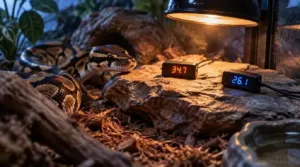
Why do two thermometers, sitting inches apart, tell you two different stories? Because they’re not measuring the same thing. Full stop.
A probe under the heat lamp soaks up radiation, so it reads high no matter what the air is doing. A shaded probe? Lower. That gap alone can hit 10°F. Add poor probe contact, an air pocket between sensor and surface, and thermal equilibrium never happens.
Placing the sensor at the right spot, as shown in this guide to the best thermometer placement in a snake enclosure, keeps you from chasing false readings and overcorrecting your thermostat.
Readings also shift with measurement location effects, since temperature differs between the edges and center of a space and changes with proximity to the heat source.
Then there’s sensor drift. Identical models age unevenly, so an older unit can carry a steady offset. Sensor calibration isn’t optional. Not rocket science.
Heating elements and lights can also inject electrical noise into digital readouts. Probe placement, measurement precision, temperature variance: they all matter.
Trust one number blindly and your snake pays for it.
Temperature Readings Jump, Freeze, or Drift

A stable thermometer doesn’t jump. Ever. If your display bounces 8°F in a minute, freezes at 84°F for hours, or creeps downward day after day, something’s wrong with the device, not the enclosure.
Start with the wiring. Humidity corrodes probe connections, and vibration loosens them. An intermittent contact produces signal noise that looks like real swings.
Then there’s age. Sensor drift builds from thermal hysteresis, because repeated heating and cooling cycles slowly change the sensing element until it reads off by a fixed amount.
Last, check the battery. Low voltage causes:
- Wild jumps that spike your heart rate
- Frozen numbers while your snake cooks
- Slow drift you’ll never notice
- False comfort at 2 a.m.
- Guesswork where you need control
Log readings daily. Data trend analysis exposes temperature variance fast.
If your warm-side readings keep dipping, check how your heat source is set up, since under-tank heater installation tips can help you keep the gradient steady.
Readings Change Dramatically With Probe Placement

Not every bad reading means a bad thermometer. Sometimes sensor accuracy is fine and the probe placement is the problem. Full stop.
A tank is never one temperature. Heat drops 3 to 8°F every six inches in still air, so a probe near the lid reads warmer than your snake’s belly ever feels. Slide it 1 to 2 cm and you can swing the display 5 to 15°F. That’s a temperature gradient doing exactly what gradients do.
Touching glass, rock, or a heat source? Falsely high. Sitting in a draft or beside a water bowl? Falsely low, 4 to 10°F.
Set your sensor placement at snake height, away from surfaces and vents. Do thermal gradient verification, probe by probe.
Thermometer Readings Ignore Heating Changes

Placement isn’t the only culprit. Sometimes you switch on the lamp and the display never moves. Thermal lag, a dead sensor, or poor heat source proximity can all hide a real change.
Wait ten full minutes for sensor stabilization, then check again. Still flat? Move the probe closer and rerun your temperature gradient verification. Not rocket science.
A frozen number costs you:
- A snake cooking on a belly-burning hotspot.
- Digestion stalling, meal after meal.
- A regurgitated meal you can’t explain.
- Weeks of guilt over a fault you never saw.
- A pet trusting you to get this right.
Check probe placement, compare a second sensor. If the reading ignores your heating, the sensor is lying. Full stop.
Your Snake’s Behavior Contradicts Temperature Readings
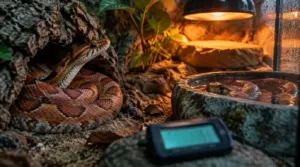
A snake never lies about heat. Your thermometer can. When the display says 88°F but your animal acts like it’s roasting, believe the animal, full stop.
When your thermometer says 88°F but your snake acts like it’s roasting, trust the snake, because thermometers can lie and animals never do
Snakes rely on behavioral thermoregulation, moving through the temperature gradient until they find comfort. Hiding on the cool side, soaking, or avoiding the basking spot means the numbers are wrong. Lethargy and odd feeding refusals can even mimic behavioral fever.
| What You See | What It Suggests |
|---|---|
| Glass surfing | Heat is too high |
| Soaking constantly | Overheating |
| Skipping the basking spot | Hot spot too hot |
It’s not rocket science. Poor sensor placement or a drifting probe can hide a problem, and data logging exposes patterns you’d miss by glancing. Your snake’s habits are the earlier alarm.
How to Verify Suspect Snake-Tank Temperatures
You’ve seen the red flags, so now it’s time to prove which numbers are wrong. Five checks will tell you whether your thermometer is honest, and none of them is rocket science. Work through them in order, because guessing with a heat lamp is how snakes get hurt, full stop.
Compare Sensors Under Identical Conditions
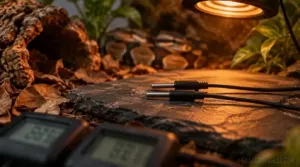
Two thermometers, one answer. That’s the goal.
Compare sensors side by side. Put both probes at the same depth, same orientation, same spot, touching the same surface. Identical conditions or the test is worthless. Full stop.
Let them settle for fifteen minutes. Then read both at once.
A gap over two degrees means one sensor accuracy problem. Not rocket science. Confirm it against a calibration reference.
Check Batteries, Units, and Probe Connections
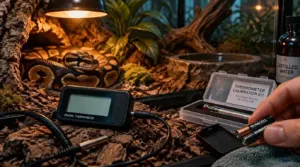
Your ball python’s hot spot reads 78°F. You crank the heat. Then you notice the display says "C." Full stop. That’s 78°C? No. The unit flipped, and 90°F became 32°C.
Check Batteries, Units, and Probe Connections first. Swap in fresh cells. Confirm the unit. Reseat the probe plug, then wiggle the cable. Still off? Run a calibration kit, because sensor placement error isn’t always your culprit.
Separate Surface and Air Measurements
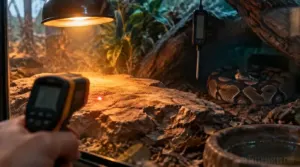
Your rock is hot, but your air isn’t. Different measurements, different tools, full stop.
- Probe contact surface: inflates air readings
- Surface heat capture: infrared guns only
- Direct radiation measurement: skips convection
- Emissivity adjustment and spot size accuracy matter
Shoot basking surfaces with the gun, then probe the shaded air above. Compare both. Never swap them, ever. It’s not rocket science.
Perform Manufacturer-Approved Accuracy Tests
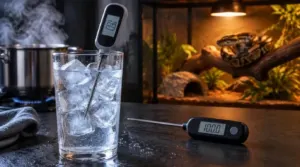
Trust nothing until you test it. Full stop.
Start with ice bath calibration. Fill a tall glass with ice and chilled water, stir, then submerge the probe. You want 32°F, within your manufacturer’s tolerance.
Try boiling water verification, adjusting for your elevation. Most probe thermometers can’t calibrate sensors, so if you’re off-spec, call the manufacturer. Compare against a reference device.
Correct Placement or Replace Faulty Thermometers
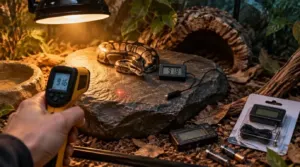
You’ve run the checks. Now act on them.
Move the probe first. Basking spot readings belong on the surface under the lamp, not on glass, not under a hide. Wrong probe placement creates false readings, full stop.
Still off? Swap batteries, clean the sensor, and test against an IR temp gun. Persistent errors mean the unit is done. Replace it. Not rocket science.
Frequently Asked Questions (FAQs)
How to tell if your thermometer is inaccurate?
Think your thermometer’s telling you the truth? Run an icewater thermometer test: a good probe reads 32°F. Off by several degrees? Suspect sensor drift, check probe placement, and repeat your calibration procedure. Sensor accuracy matters.
What temperature should my snake tank be at?
It depends on the species, full stop. Corn snakes want a warm side of 85–88°F and a cool side of 75–78°F. Ball pythons and boas run hotter, 88–92°F warm, 76–82°F cool.
How accurate are fish tank thermometers?
Myth: any fish tank thermometer is fine for snakes. Not quite. A digital thermistor holds sensor accuracy around ±1°C, while an analog dial drifts. Thermometer accuracy collapses with sloppy probe placement, full stop, every time.
What can cause a thermometer to be inaccurate?
Cheap sensors carry wide accuracy tolerances, and analog gauge limitations make it worse. Calibration drifts, batteries fade, probes corrode. Poor placement or a heater touch skews everything. Crosscheck readings, full stop.
How often should snake tank thermometers be replaced?
Your ball python’s tank read 88°F for two years. Then an infrared gun said 79°F. Full stop. Replace digital probes every one to two years, and crosscheck readings monthly.
Why do stick-on LCD thermometers read inaccurately?
Picture a cold windowpane, not warm air. Stick-on LCD thermometers read that glass; drafts skew it. Inaccurate or uncalibrated devices compound it. Follow sensor placement best practice, check with probe thermometers, and calibrate your devices.
Are digital thermistors more accurate than thermocouples for terrariums?
Wondering which sensor you can trust? Thermistors, full stop. They hit ±1°C, while thermocouples drift to ±1-2°C.
Your digital thermometer with probe already uses one. Calibrate your devices, and keep up sensor maintenance.
Can analog dial thermometers be trusted in snake enclosures?
Analog dials can miss by 5-7°F, full stop. Poor device calibration and faulty devices make that worse. Inspect devices often, and check enclosure sealing and poor enclosure ventilation.
Trust a digital probe for your snake.
Where should a cool hide probe be placed?
Think the wall is fine? It’s not, full stop.
Put your coolside temperature sensor on the coolside floor, inside the hide, at snake level. Keep it well away from the central enclosure area. Secure probes.
Conclusion
Here’s the uncomfortable truth: the most dangerous number in your enclosure is the one you never questioned. Catching signs your snake tank thermometer is giving false readings takes a minute of attention, not expensive gear.
Test every probe. Compare them side by side, swap batteries, and check placement. When two numbers clash, believe the one your snake backs up.
Replace what fails. Relax, because a verified gradient keeps her digesting, basking, and thriving. Full stop.