This site is supported by our readers. We may earn a commission, at no cost to you, if you purchase through links.
Sand looks natural in a boa enclosure, and it’s one of the fastest ways to put your snake in a vet’s office. One mistimed strike at a rat, one mouthful of grit, and you’re dealing with impaction.
Your boa’s bedding does more than cover the floor. It holds humidity, absorbs waste, and fills the air your snake breathes in a sealed tank. Fine dust irritates lungs, and sour, moldy bedding invites trouble fast.
The best terrarium substrate mixes for boa constrictors share a few traits: deep, damp-holding, and free of splinters, plastic, and clay dust. Here’s how eight popular options hold up, plus DIY blends worth mixing yourself.
Table Of Contents
- Key Takeaways
- Choosing Safe Substrate Mixes for Boa Constrictors
- Top 8 Substrates for Boa Constrictor Mixes
- 1. Riare 2 Pack Coconut Fiber Reptile Substrate
- 2. ReptiChip Coconut Substrate 72 Quart
- 3. Zilla Jungle Mix Terrarium Substrate 8 Qt
- 4. Repti360 Coconut Chip Substrate
- 5. Legigo 10LB Coconut Husk Substrate
- 6. Riare 10 LB Coconut Fiber Reptile Substrate
- 7. Riare Coconut Husk Chip Reptile Substrate
- 8. Bio Dude Terra Sahara Desert Substrate
- DIY and Bioactive Substrate Mixes for Boas
- Managing Boa Substrate Depth and Humidity
- Cleaning and Replacing Boa Substrate Mixes
- Frequently Asked Questions (FAQs)
- What is the best substrate for boa constrictors?
- What bedding should a boa have?
- What is the safest substrate for snakes?
- What is the ideal habitat setup for a boa constrictor?
- Can I use reptile carpet for boas?
- How often should I mist the enclosure?
- Can substrate mixes cause mites in boas?
- Is it safe to feed boas on substrate?
- How do I fix a substrate that smells?
- Conclusion
Key Takeaways
- Skip sand, cedar, pine, and any loose or dusty bedding, because one mistimed strike at prey can leave your boa with a costly impaction, and feeding on a bare setup is the safest fix.
- Coconut husk mixed with topsoil is your best base, since it holds moisture and releases it slowly, but sift every brick for plastic and rinse it to cut dust before it touches your snake.
- Keep substrate 3 to 4 inches deep and humidity between 55 and 75 percent (75 to 85 during a shed), letting the enclosure dry out between mistings so you avoid scale rot and respiratory trouble.
- Spot-clean waste daily and replace non-bioactive substrate every 3 to 6 months, or build a bioactive mix with soil and a cleanup crew to stretch that interval, while verifying manufacturers’ claims yourself.
Choosing Safe Substrate Mixes for Boa Constrictors
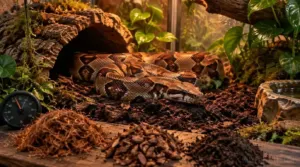
You can lose a lot of money on the wrong substrate, and your boa can lose more. Start with impaction risk. Boas strike hard, and loose bedding often rides in with the prey. Skip sand and anything that expands when wet, especially for young snakes.
If your boa stops passing waste after a meal, ingested substrate could be the culprit, so check this guide on what to do when your snake won’t poop.
Next, check dust. Fine, chemical-heavy bedding irritates the lungs in a closed enclosure, so treat "safe snake bedding" labels with some doubt until you’ve read the ingredients yourself.
Then think about humidity control. Boas need 55-75%, and coconut husk holds moisture and releases it slowly. Pile it 3-4 inches deep and the enclosure stays steadier.
Want a living setup? A bioactive substrate needs real soil, not chips alone.
Top 8 Substrates for Boa Constrictor Mixes
Here are eight substrates worth considering for your boa, and most of them start with coconut. I can’t verify every manufacturer’s moisture or durability claims, so treat the label as a starting point and check how each one holds up in your enclosure. Read each pick with your humidity and depth needs in mind before you buy.
1. Riare 2 Pack Coconut Fiber Reptile Substrate
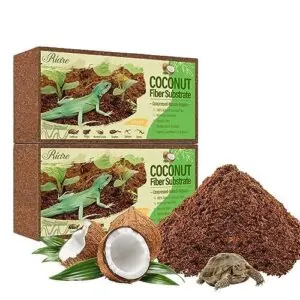
The Riare 2 Pack gives you two compressed coconut fiber bricks, each 7.8 x 3.9 x 1.97 inches. Soak them in water and they expand into a fluffy, odorless, moisture-retentive substrate that encourages digging. It absorbs waste and odors, and it’s biodegradable, so spent material can go in your garden.
Don’t expect perfect results, though. Some buyers report it breaks apart easily, and a sour smell after first use. Drying can take one to two weeks, so soak it well ahead.
| Best For | Owners of burrowing reptiles, amphibians, or invertebrates, such as bearded dragons, geckos, tortoises, and hermit crabs, who want an affordable, natural, and compostable substrate that holds moisture. |
|---|---|
| Weight | 2.86 lbs |
| Volume | N/A |
| Material | Coconut fiber |
| Humidity Control | Retains humidity |
| Brick Size | 7.8 x 3.9 x 1.97 in |
| Suitable Animals | Snakes, geckos, tortoises |
| Additional Features |
|
- Expands when soaked into a fluffy, odorless, moisture-retentive substrate that encourages natural digging and burrowing
- Absorbs liquids, waste, and odors to keep the terrarium cleaner
- Biodegradable and compostable, so used material can go in the garden or be used as plant fertilizer
- Some users report it breaks apart easily during use
- A sour smell has been noted by certain customers after initial use
- Drying can take one to two weeks, so it needs to be soaked well in advance
2. ReptiChip Coconut Substrate 72 Quart
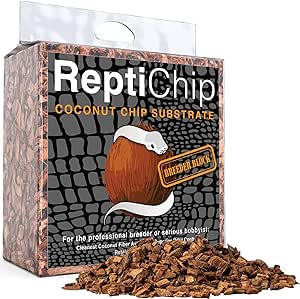
The ReptiChip 72 Quart brick is the stock-up option. It’s 100% organic coconut husk, compressed into a block that expands to 2.5 cubic feet once hydrated. The listing calls it dust and dirt free after cleaning, and it holds humidity well for tropical setups. It also encapsulates waste, absorbs odors, and works as a bioactive base for burrowing.
Some customers report plastic pieces in the substrate. The listing gives no water-to-expansion ratio, so add water gradually and sift before use.
| Best For | Keepers of tropical reptiles or hermit crabs who want a bulk, humidity-holding substrate they can hydrate as needed and use as a bioactive base for burrowing. |
|---|---|
| Weight | 10 lbs |
| Volume | 72 quarts |
| Material | Coconut husk |
| Humidity Control | Superior retention |
| Brick Size | 30.48 x 15.24 x 30.48 cm |
| Suitable Animals | Ball pythons, geckos |
| Additional Features |
|
- Expands to 2.5 cubic feet from a compressed 72-quart brick, so it works well for stocking up.
- Holds humidity well, which suits tropical habitats like those for ball pythons.
- Encapsulates waste and absorbs odors, and it also works as a bioactive base for burrowing.
- Some customers report finding plastic pieces in the substrate.
- The listing gives no water-to-expansion ratio, so you have to add water gradually.
- Customer feedback is mixed on consistency and purity, so sifting before use is a good idea.
3. Zilla Jungle Mix Terrarium Substrate 8 Qt
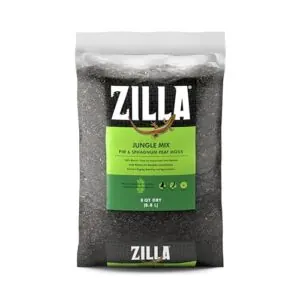
If you want something more humid than a coconut-only mix, Zilla Jungle Mix is a sphagnum moss and fir shaving mix, 100% natural, built for tropical setups. It retains a lot of moisture, which suits boas.
If you’re keeping a boa in a smaller space, these reptile substrate options for apartment living can help you manage humidity, odor, and cleanup more easily.
The 8-quart bag weighs 5.8 pounds. Spread at the recommended 1 to 2 inches deep, it covers a small enclosure or works as a mix component.
Watch for splinters, so rinse before use. Do it outdoors, since clay dust can clog pipes. Some buyers found the volume larger than expected.
| Best For | Keepers of frogs, rainforest geckos, toads, and snakes who want a natural, moisture-holding substrate for a tropical terrarium. |
|---|---|
| Weight | 5.8 lbs |
| Volume | 8 quarts |
| Material | Sphagnum moss, fir |
| Humidity Control | High retention |
| Brick Size | N/A |
| Suitable Animals | Snakes, frogs, geckos |
| Additional Features |
|
- Blends sphagnum moss and fir shavings in a 100% natural mix that retains high levels of humidity
- Supports healthy humidity in tropical terrariums
- Works at a recommended depth of just 1 to 2 inches, and the 8-quart bag can cover a small enclosure or be used as a mix component
- May contain splinters, so it needs rinsing before use
- Clay dust can clog pipes if you rinse it indoors, so rinse it outdoors
- The 8-quart, 5.8-pound bag is larger than some buyers expected
4. Repti360 Coconut Chip Substrate
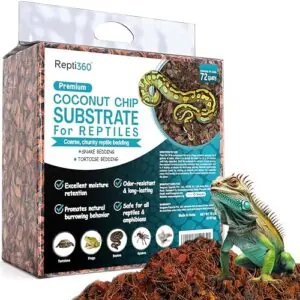
Repti360 arrives as a 10 lb compressed brick, 11" x 11" x 5", and swells to 72 quarts (2.4 cubic feet) once you hydrate it. That’s plenty of depth for a burrowing boa, though the listing names ball pythons and lizards, not boas, so treat boa suitability as your own call.
The maker markets it as dust-free, yet some buyers report dust and mixed cleanliness. Rinse it, hydrate it fully before use, and check your enclosure’s humidity and ventilation yourself.
| Best For | Keepers of reptiles, amphibians, and invertebrates, such as ball pythons, leopard geckos, frogs, and hermit crabs, who want a natural, additive-free coconut husk substrate that expands into a large volume and helps maintain tropical humidity. |
|---|---|
| Weight | 10 lbs |
| Volume | 72 quarts |
| Material | Coconut husk |
| Humidity Control | Maintains tropical humidity |
| Brick Size | 11 x 11 x 5 in |
| Suitable Animals | Ball pythons, lizards |
| Additional Features |
|
- Expands from a 10 lb compressed block to 72 quarts (2.4 cubic feet), so one brick fills a lot of space.
- Made from 100% natural coconut husk with no additives.
- Works for a wide range of animals, including bearded dragons, tortoises, salamanders, and tarantulas.
- Some customers report that it can be dusty.
- It must be hydrated with water before use.
- Users give mixed feedback on how clean the material is.
5. Legigo 10LB Coconut Husk Substrate
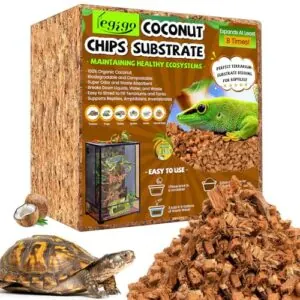
Several details make this brick appealing, and a few deserve suspicion. The 10 lb (4.5 kg) brick expands to 72 quarts and absorbs odors from feces and urine, which helps with spot cleaning. It’s made from 100% organic coconut husk chips, and it allows digging and burrowing.
Now the catch. Some buyers report plastic contamination, so sift every batch before it touches your boa. Several say the bricks run 20% smaller than advertised, and moisture retention reviews conflict. Measure yours.
| Best For | Reptile keepers with snakes, geckos, lizards, tortoises, or hermit crabs who want an organic, odor-absorbing substrate that supports natural digging and burrowing, and who don’t mind checking the product before use. |
|---|---|
| Weight | 10 lbs |
| Volume | 72 quarts |
| Material | Coconut husk chips |
| Humidity Control | Mixed retention |
| Brick Size | 11.81 x 11.81 x 5.31 in |
| Suitable Animals | Ball pythons, snakes |
| Additional Features |
|
- Made from 100% organic coconut husk chips and absorbs odors from feces, urine, and other liquids.
- Expands from a 10 lb (4.5 kg) brick to 72 quarts when water is added.
- Supports natural digging and burrowing, and can double as garden mulch, soil amendment, or hydroponic medium.
- Some customers report plastic contamination in the substrate.
- Moisture retention feedback is mixed, and some find it holds too much moisture.
- Multiple customers say the brick is about 20% smaller than advertised.
6. Riare 10 LB Coconut Fiber Reptile Substrate
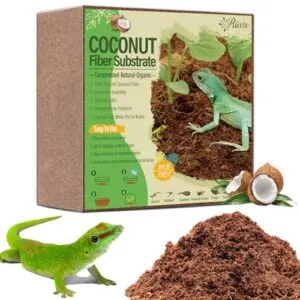
Picture a dense brick, nearly a foot square, swelling into a heap of fluffy brown bedding the moment water hits it. That’s this 10 lb coconut fiber block.
It’s odorless, holds humidity well, and gives your boa something to dig into. It’s also compostable, so old bedding can go in the garden.
Don’t ignore the downsides, though. Some owners report a sour smell after use, and drying can take one to two weeks. The fibers also break apart easily.
| Best For | Owners of burrowing reptiles and amphibians, such as bearded dragons, geckos, snakes, tortoises, and frogs, who want a natural, compostable substrate that holds humidity and encourages digging. |
|---|---|
| Weight | 10 lbs |
| Volume | N/A |
| Material | Coconut fibre |
| Humidity Control | Retains humidity |
| Brick Size | 11.81 x 11.81 x 4.72 in |
| Suitable Animals | Snakes, geckos, frogs |
| Additional Features |
|
- Made from natural coconut fibre that is odourless and holds humidity well
- Compostable, so used bedding can go in the garden or be used as plant fertiliser
- Encourages natural digging and burrowing while absorbing liquids, waste, and odours
- Some customers report a sour smell after use
- The fibres can break apart easily during handling or use
- Drying can take one to two weeks, which may affect how often you can clean
7. Riare Coconut Husk Chip Reptile Substrate
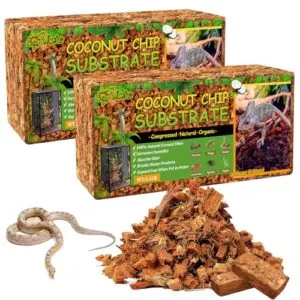
Picture a handful of dry, woody chips tumbling into a tub, rough-edged and faintly sweet-smelling, then darkening the second water hits them. That’s Riare’s loose coconut husk chip. There’s no soaking step, so open the bag, add water, and stop when it feels damp, not soggy.
Layer it at least 2 inches deep, though 3+ gives your boa better burrowing and humidity buffering. Some customers reported mite infestations, and safety feedback is mixed, so I can’t verify claims. Inspect first.
| Best For | Keepers of tropical reptiles and amphibians, such as ball pythons, tortoises, geckos, and frogs, who want a natural coco husk substrate that holds humidity. |
|---|---|
| Weight | 970 g |
| Volume | N/A |
| Material | Coco husk chips |
| Humidity Control | Maintains humidity |
| Brick Size | 8.2 x 4.1 x 2.2 in |
| Suitable Animals | Ball pythons, geckos |
| Additional Features |
|
- Made of natural, organic coco husk chips that help maintain humidity for tropical reptiles and amphibians.
- Absorbs waste and helps control odor in the enclosure.
- Expands to several times its original size when water is added (about 30 liters), so each compact 970-gram brick goes a long way.
- Some customers reported mite infestations.
- User reviews are mixed on its safety.
- Reviews are mixed on whether the product size suits different enclosures.
8. Bio Dude Terra Sahara Desert Substrate
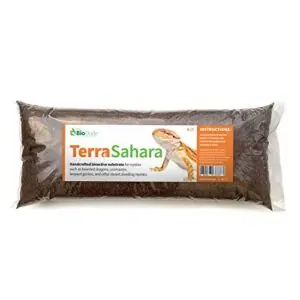
Here’s the odd one on this list: a desert substrate for a snake that wants humidity. Bio Dude’s Terra Sahara comes in a 6-quart, 8-pound bag, drains water easily, and holds tunnels well. That’s great for burrowing, but it keeps humidity low by design.
Unless you’re keeping a boa from an arid region, skip it as a standalone base. Mix it with something moisture-holding, add humid hides, and check dust levels. The "silica-free" claim is the seller’s word; verify it.
| Best For | Keepers of desert reptiles like bearded dragons and leopard geckos who want a free-draining, burrow-friendly base for a bioactive setup. |
|---|---|
| Weight | 8 lbs |
| Volume | 6 quarts |
| Material | Bioactive soil mix |
| Humidity Control | No humidity increase |
| Brick Size | N/A |
| Suitable Animals | Bearded dragons, geckos |
| Additional Features |
|
- Drains water easily, which suits desert-dwelling plants
- Holds tunnels and burrows well, helping with shedding and hydration
- Keeps humidity low while supporting a balanced bioactive ecosystem when paired with plants and a clean-up crew
- The 6-quart size may not fit all terrarium dimensions
- Customer feedback on its appearance is mixed
- Needs bioactive elements to work fully, and it is too dry on its own for humidity-loving snakes
DIY and Bioactive Substrate Mixes for Boas
Bioactive sounds like a shortcut, but it isn’t one.
A solid DIY mix starts simple. Combine two parts organic topsoil, two parts Reptisoil or similar, and one part play sand. That’s the Bio Dude’s boa recipe. ReptiFiles prefers topsoil, coconut husk fiber, and sand, but admits it isn’t bioactive-ready alone.
Making it a true bioactive substrate means adding a cleanup crew: tropical springtails, dairy cow isopods, maybe dubia roaches. Mix in sphagnum moss, leaf litter, and a microbial inoculant like Bio Shot. Skip millipedes if you’re nervous, since they can bite.
Heat matters too. Use overhead heating, because heat pads don’t work in tall enclosures. Properly maintained, the crew can keep substrate going for years, but verify that claim yourself. A bioactive substrate works as a living soil layer where microfauna and microflora decompose organic matter to cycle nutrients naturally.
Managing Boa Substrate Depth and Humidity
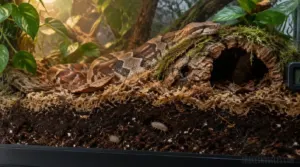
Depth does most of your humidity work, so get it right before buying a mister.
Aim for at least 3 inches of substrate depth, and go to 4 in a bioactive enclosure, where a deeper layer gives your cleanup crew room and keeps moisture steady. Anything under 2 inches won’t support burrowing, and your boa will show it by sulking on the surface.
Humidity should swing between 55 and 75 percent, rising to 75 to 85 during a shed. Don’t chase a fixed number. Let the enclosure dry out between mistings, or you’ll invite scale rot and respiratory trouble.
Mix water into the lower layers, keeping them damp but never muddy. Coconut husk offers strong humidity retention and substrate buffering.
Cleaning and Replacing Boa Substrate Mixes
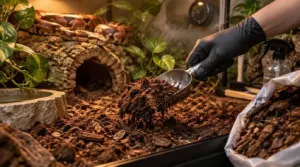
Moisture that keeps your boa comfortable also grows bacteria, so cleaning is the other half of humidity control.
The same moisture that keeps your boa comfortable also breeds bacteria, so a clean enclosure is half the battle of humidity control
Spot clean waste the day you see it. Scoop feces, urates, and soaked clumps, plus a thumb of material beneath them. A dedicated reptile waste scoop with a slotted head makes lifting soiled clumps quick while sifting clean substrate back into place.
Picture a routine that works:
- Daily: remove visible waste and wet clumps.
- Weekly: stir the top layer and check damp lower layers for odor.
- Monthly: top up depth to your 3 to 4 inch target.
- Every 3 to 6 months: do a total substrate replacement in non-bioactive setups.
- Every few years: bioactive enclosures may need one, if the cleanup crew is thriving.
Sources disagree, so treat any substrate refresh interval as a starting point. Let upkeep shape your substrate purchasing decision.
Frequently Asked Questions (FAQs)
What is the best substrate for boa constrictors?
Picture your boa sinking into cool, damp earth and vanishing from sight. Choose coconut husk mixed with topsoil: it helps humidity retention and burrowing behavior. A bioactive substrate stretches the time between each substrate refresh.
What bedding should a boa have?
Want a bedding that actually works? Choose coconut husk: it offers humidity retention. Keep substrate depth at 3-4 inches.
Planning a bioactive enclosure? Use soil-based mixes for cleanup crew establishment, and skip pine or cedar.
What is the safest substrate for snakes?
The safest snake bedding is a large-particle, low-dust one that holds humidity without crumbling. For boas, coconut husk chips or a bioactive substrate work well. Skip pine and cedar, and never use sand in a reptile enclosure.
What is the ideal habitat setup for a boa constrictor?
Give your boa a 6x3x3 foot enclosure minimum, bigger for longer snakes. Keep a 90-95°F basking spot, 75-80°F cool side, and 55-75% humidity. Add 2-4 inches of substrate depth for burrowing, plus hides and a water bowl.
Can I use reptile carpet for boas?
Wondering if reptile carpet works for a boa constrictor? Not as a primary substrate. It can’t hold moisture, snags claws, and traps waste. Use it only briefly during enclosure setup, then switch to a moisture control substrate.
How often should I mist the enclosure?
Why guess when a hygrometer can tell you? Raise misting frequency when readings drop below 60%, keeping enclosure humidity within a 55-75% range.
Good humidity control means dry periods between humidity peaks. Don’t overmist, either.
Can substrate mixes cause mites in boas?
No. Substrate doesn’t spawn snake mites; they hitchhike in on infested animals, bedding, or gear.
Quarantine new snakes and store bags away from reptiles. Harmless cleanup crew critters aren’t mites, and mold prevention matters more.
Is it safe to feed boas on substrate?
Picture a boa lunging at a mouse and coming up with a mouthful of mulch. That’s the risk. Feeding safety means skipping loose substrate: use a bare quarantine setup, tongs, and spotclean waste fast, because impaction is costly.
How do I fix a substrate that smells?
Your enclosure’s nose is a smoke alarm, so find the source. Spot clean waste, pull wet clumps, and dry any standing water. Cut misting, add airflow, and mix in charcoal or bark to ease substrate compaction.
Conclusion
Think cheap bedding is good enough? It isn’t, and your boa pays for the shortcut. Skip sand, cedar, and dusty fillers, no matter how tempting the price.
Whichever of the terrarium substrate mixes for boa constrictors you choose, keep it deep, keep it damp but never soggy, and spot-clean weekly. Watch your snake’s breathing and shedding, since they’ll tell you what the bedding is doing.
Get the floor right, and everything else gets much easier.