This site is supported by our readers. We may earn a commission, at no cost to you, if you purchase through links.

A snake sitting on the cool side of its enclosure all day isn’t being stubborn—it’s telling you the warm side is probably too hot, or your thermometer is lying to you. Probe placement determines everything your thermostat knows, and a sensor sitting too close to a heat mat can read 20°F higher than what your snake actually feels.
That gap between what your equipment reports and what your animal experiences is where health problems quietly begin. Getting the best placement for thermometer in snake enclosure setups comes down to understanding where your snake actually lives in that space—not where your heat source sits.
Table Of Contents
- Key Takeaways
- Best Thermometer Probe Placement
- Warm, Cool, and Ambient Zones
- Placement by Enclosure Type
- Securing and Maintaining Probes
- Common Placement Mistakes
- Frequently Asked Questions (FAQs)
- How to control Snake enclosure temperature?
- How to place a thermometer & hygrometer in a reptile enclosure?
- Do you need a thermometer for a reptile enclosure?
- What is a snake enclosure thermostat?
- How to regulate temperature in a snake enclosure?
- How many thermometers should one snake enclosure have?
- Are digital probes better than glass thermometers for snakes?
- How often should hygrometer probes be checked or replaced?
- What temperature gradient is ideal for ball pythons?
- Can a single thermostat control both heat and humidity?
- Conclusion
Key Takeaways
- Place at least three probes in every enclosure—one on the warm-side basking surface, one on the cool-side substrate, and one in the center—because a single reading can’t tell you what your snake actually feels.
- Keep probes at least an inch away from heat mats and six inches from ceramic emitters, since direct heat contact can skew readings by up to 20°F and fool your thermostat into cycling off too early.
- Cross-check your digital probe with an infrared thermometer weekly, and if the two readings differ by more than 2°F, reposition the probe immediately—your equipment can drift without warning.
- Your snake’s behavior is a diagnostic tool: if it camps on the cool side, refuses food, or sheds poorly, those are signs your temperature gradient is failing before your thermometer ever flags it.
Best Thermometer Probe Placement
Where you put each probe matters just as much as how many you use. A thermometer in the wrong spot can give you a number that looks fine but doesn’t match what your snake actually feels. Here are the five spots that matter most, and why each one earns its place.
Getting the basics right from the start is easier when you consult a solid guide to reptile thermometers for kids with pet snakes, since good placement habits are worth building early.
Warm-side Basking Surface
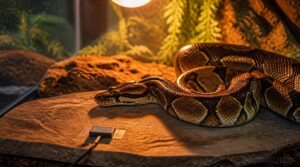
The probe on your warm-side basking surface tells you the exact temperature your snake feels underfoot. Place it directly on a slate or ceramic tile, since these materials spread heat evenly and stay stable.
Follow the thermostat probe position guidelines to guarantee accurate temperature monitoring. Target 88–92 °F for most terrestrial species.
Avoid foam or untreated wood — both can off‑gas harmful compounds at high temperatures, which irritate your snake’s respiratory system.
Cool-side Substrate Level
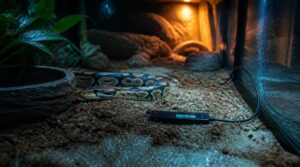
The cool-side probe belongs flat on the substrate surface at the opposite end from your basking spot. Target 22–28 °C (72–82 °F) at floor level.
If your substrate is thick or moist, it can trap heat and skew readings upward — that’s thermal layering working against you. Keep substrate depth consistent, and recheck placement seasonally as ambient air temperature shifts with changing room conditions.
Central Ambient Reading
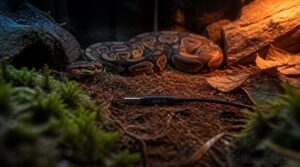
Now that you’ve covered both ends of the enclosure, the middle tells its own story.
Place your central ambient probe at the geometric center — flat on the substrate for terrestrial snakes. This measures the background air temperature your snake experiences during normal activity, not basking. It should read 2–4°F cooler than the warm side, confirming your thermal gradient is working correctly.
Inside Warm Hide
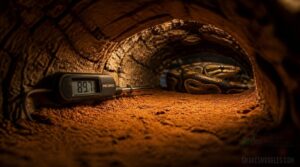
The middle zone gives you the background picture — but inside the warm hide is where your snake actually lives.
Place the thermostat probe on the substrate surface inside the hide, at the level your snake rests. Target 88–90°F there. Use an infrared thermometer to verify that reading matches the actual floor temperature, since buried probes consistently underreport. Secure the probe with zip ties so your snake can’t shift it.
Avoid Direct Heat Contact
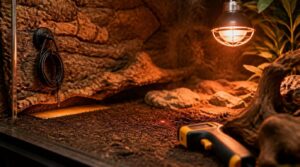
Direct heat contact is the fastest way to ruin your readings — and risk burning your snake.
- Keep probes at least 1 inch from any heat mat surface
- Maintain 4–6 inches of clearance from ceramic heat emitters
- Install wire guards over exposed heating elements
- Use a 12:1 infrared thermometer to verify probe accuracy weekly
If a probe sits too close to a heat source, it can read up to 20°F higher than your snake actually experiences.
Warm, Cool, and Ambient Zones
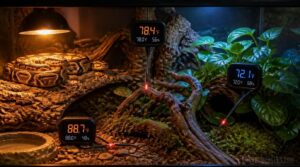
Getting the temperature right in a snake enclosure isn’t just about one number — it’s about understanding three distinct zones working together. Each zone tells you something different about what your snake is actually experiencing inside that enclosure. Here’s how to read each one correctly.
Measure The Hottest Point
The hottest point isn’t always where you think it is. As heating elements cycle on and off, the peak temperature zone can actually shift location throughout the day, so a single thermometer probe placement won’t always tell the whole story.
(https://snakesnuggles.com/under-tank-heater-vs-overhead-heat-for-snakes/) — thicker bedding slows heat transfer and can mask exactly where that hotspot is sitting at any given moment.
Place your probe directly on the basking surface — on the stone, branch, or platform sitting under the basking lamp — not hovering in the air above it. A probe suspended in ambient air can read up to 20°F lower than the actual surface your snake contacts.
| Measurement Method | What It Captures | Best Use |
|---|---|---|
| Digital probe on basking level | Continuous surface temperature | Daily monitoring |
| Infrared skin check | Snake’s actual body temperature | Spot verification |
| Data logging over 24 hours | Temperature fluctuations and spikes | Identifying heating cycles |
Use multi-thermometer cross-verification by pairing your digital probe with an infrared thermometer gun, set to an emissivity of 0.95, to confirm your basking temperature readings match. If those two readings differ by more than 2°F, reposition the probe. Also factor in vertical air stratification — air near the ceiling can run 2–4°F warmer than floor level, which affects temperature readings in taller enclosures. Data logging fluctuations over a full 24-hour cycle will reveal the true peak, not just a snapshot.
Track Cool-side Comfort
The cool side is just as important as the warm side — without a reliable cool-side probe, your snake has no safe thermal retreat, and the whole temperature gradient breaks down.
Place your cool side probe directly on the substrate at the opposite end of the reptile enclosure from the heat source. For corn snakes, target 75–80°F on the cool side; for ball pythons, aim for 76–80°F. If nighttime temperatures drop below 65°F, your snake risks chilling — so monitoring thermal retreats around the clock matters.
Keep the probe away from water bowls, too. Evaporation from a nearby dish skews readings low, making the cool side appear colder than it actually is.
Here are three things to confirm when tracking cool-side comfort:
- Substrate level accuracy — rest the probe flat on the substrate surface, not buried beneath it, so it captures the temperature your snake actually experiences.
- Species-specific targets — double-check your target range for your exact species, since a ball python and a corn snake don’t share identical needs.
- Nighttime temperature minimums — verify the cool side holds its range after lights out, when room temperatures naturally dip.
Check Floor-level Temperatures
Floor temperature is the one reading most keepers overlook — and it’s exactly where your snake spends most of its time.
Rest a temperature sensor placement probe flat on the substrate surface, not buried beneath it, so you capture what your snake actually contacts. Substrate thermal conductivity matters here: ceramic tiles transfer heat quickly, while loose mulch or carpet insulates and holds warmth differently.
| Zone | Target Floor Temp | Species Example |
|---|---|---|
| Warm basking floor | 30–32°C (86–90°F) | Ball python, desert species |
| Central gradient floor | 28–30°C (82–86°F) | Corn snake, king snake |
| Cool side floor | 22–26°C (72–79°F) | Most temperate colubrids |
| Tropical species floor | 26–28°C (79–82°F) | Boa constrictor |
| Nighttime floor minimum | 24–26°C (75–79°F) | All common species |
Monitoring thermal inertia — how slowly your floor holds or loses heat — tells you whether your setup stays stable overnight or crashes when room temperatures drop. Update floor readings every 6–12 hours to catch those nighttime dips.
For mitigating floor moisture, keep your cool side probe away from water bowls, since evaporation pulls readings artificially low and distorts your temperature readings. If the substrate temperature reads more than 2°F off from an infrared gun check, reposition the probe immediately.
Separate Thermal Zones Clearly
Think of your enclosure as a highway with two distinct exits — one hot, one cool — and your snake needs both clearly marked.
Defining zone boundaries at least 10 cm apart gives your snake genuine thermal choices rather than a blurry middle ground. Use a dedicated temperature sensor in each zone, controlled by its own thermostat, so warm and cool zones don’t interfere with each other’s readings. Microclimate creation through hides, branches, and substrate changes adds useful in-between spots. Update seasonal setpoint targets as room temperatures shift, and partitioning enclosure space — even with simple dividers — keeps your temperature gradient honest all year.
Confirm With Infrared Thermometer
Your probe readings are only as trustworthy as the tool checking them. An infrared temperature gun gives you an instant, contact-free surface temperature reading to cross-check your probes.
Hold it roughly 10 cm away, confirm your emissivity setting sits between 0.85–0.95 for enclosure surfaces, and compare the result against your digital probe. If the difference exceeds 2 °F, reposition or replace that sensor immediately.
Placement by Enclosure Type
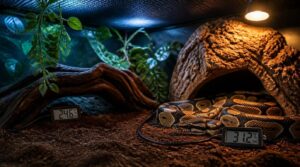
Where you place your thermometer probes depends heavily on the type of enclosure your snake lives in. A terrestrial setup calls for a completely different approach than an arboreal or heat-mat-based one. Here’s how probe placement breaks down across the most common enclosure types.
Terrestrial Snake Setups
For terrestrial snakes, probe placement at floor level is non‑negotiable, since your snake lives, hunts, and thermoregulates entirely on the substrate.
Place your warm‑side probe directly on the basking surface, your cool‑side probe on the substrate opposite the heat source, and a third probe centrally to capture average ambient temperature. If you’re using a heat mat, position the thermostat probe inside the warm hide, resting on top of the substrate — not beneath the mat — so it reflects what your snake actually experiences.
Keep substrate depth at 5–8 cm, since deeper substrate insulates the lower layers and can cause probes buried even slightly to read cooler than actual surface conditions. Position your water bowl away from the warm side to prevent evaporation from skewing your humidity readings near the probes.
Watch your snake’s daily movement patterns, too — if it’s consistently pressing against the cool end, that’s your enclosure telling you the thermal gradient needs adjusting.
Arboreal Snake Setups
Arboreal snakes live their lives off the ground, which means your probe placement strategy needs to shift upward entirely.
In an arboreal enclosure, place your warm-side probe directly on the basking branch surface, not in the surrounding air — air readings can run 15–20°F cooler than what your snake actually contacts. Position your cool-side probe centrally, elevated off the floor, to capture the ambient temperature your snake experiences mid-height.
Here’s a quick checklist for arboreal probe placement:
- Basking branch probe — rest it on the branch surface directly beneath the heat source
- Cool-zone probe — mount it mid-height on the shaded end, away from airflow
- Thermostat probe placement — secure it inside the arboreal hide at perch height
- Humidity probe — center it at mid-volume, not near the water dish
- Branch grip texture check — confirm probes don’t interfere with your snake’s movement
For temperature gradient accuracy, use an infrared thermometer to verify branch surface readings weekly. If your snake keeps descending to the floor, that’s a clear signal your temperature monitoring setup needs adjusting upward.
Heat Mat Enclosures
Unlike arboreal setups, heat mat enclosures keep warmth at ground level — which makes probe placement precision especially important.
Rest your thermometer probe on the enclosure floor, directly above the mat’s center, within 0.25 inches of the surface. If the probe sits too high, you’ll miss the actual underbody warmth your snake experiences. For thermostat sensor depth, embed it 2–3 cm beneath the substrate.
Branch and Perch Readings
Climbing species rest on branches, not floors, so your probe needs branch contact. Surface vs ambient readings differ 5-10°F due to natural wood conductivity. Branch diameter variations and material thermal mass affect response time—wood lags, PVC reacts fast. Vertical temperature drops of 2-3°F per foot matter too.
- Place probe on thickest branch section
- Position secondary probe at mid-height
- Compare wood versus PVC readings
- Check multiple measurement points
- Verify with infrared thermometer
Substrate Depth Effects
How deep you layer your substrate changes more than just the look of your tank—it affects thermal inertia and probe accuracy.
Thicker layers (5–7 cm) slow heating but hold warmth longer, smoothing nighttime dips.
Substrate type and moisture retention shift heat mat distribution too, so check probe depth against the surface weekly for true microclimate stability.
Securing and Maintaining Probes
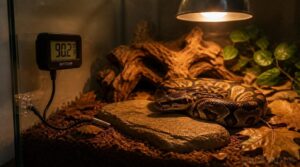
Getting your probe in the right spot is only half the job. If it shifts, gets buried, or drifts out of accuracy over time, your readings won’t mean much. Here’s what it takes to keep your setup reliable day after day.
Use Safe Zip Ties
A loose probe gives you a false sense of security, so pick the right tie. Use nylon ties rated for outdoor use; they resist UV and heat up to 90°C, won’t corrode, and reuse easily for repositioning. Skip metal burrs.
- Secure, not strangled
- Routed away from heat
- Checked after cleaning
Good cord routing prevents abrasion and keeps readings accurate.
Avoid Sharp Edges
Sharp edges are a quiet hazard that can damage probe cables over time, causing inaccurate readings or full failure. Route wires along flat enclosure walls, away from seams or rough cutouts.
If decor has jagged corners, sand them smooth or reposition them. Cover the probe section near any edge with smooth heat-resistant tubing to prevent abrasion and keep readings reliable.
Prevent Probe Burial
Substrate burial is one of the sneakiest ways to lose accurate temperature data. A probe that’s slowly covered by loose bedding reads cooler than the actual surface, and your snake pays the price.
Raise the probe on a rigid platform — a slate tile or commercial stand like SENSORLOCK works well — and secure the cable flat against the wall to prevent the snake from dragging it under.
Inspect Placement Daily
Daily probe checks are your first line of defense against silent temperature failures. Snakes are surprisingly good at nudging sensors out of position, so verify probe placement each morning before feeding or handling.
Confirm the sensor stays exposed to air, cables are untangled, and mounting points feel firm. If anything’s shifted, log the displacement — patterns help you adjust placement permanently.
Calibrate Readings Monthly
Even a perfectly placed probe lies to you over time. Digital sensor drift can creep in at half a degree monthly, so calibrate the probe every month using the ice-point method.
Cross-check with the boiling-point technique for high-range probes, then keep a calibration log documentation with NIST traceability standards. Add weekly verification between sessions, since temperature verification habits catch problems before your snake does.
Common Placement Mistakes
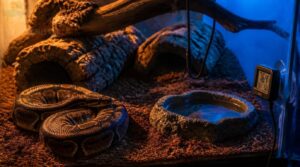
Even with the best probe and a careful setup, small placement errors can throw off your readings without you noticing right away. Most of these mistakes happen quietly, and your snake usually feels the effects before you do. Let’s look at the five slip-ups that trip up keepers most often.
Too Close to Heaters
If your probe sits too close to a heater, it picks up radiant heat bias instead of real basking temps.
This causes sensor conduction errors, artificial temperature spikes, and thermostat cycling issues. Your thermostat shuts off early, leaving the substrate cooler than intended.
Keep probe placement a safe distance from heat source placement to prevent temperature drift and protect sensor accuracy.
Near Water Bowls
Heaters aren’t the only sneaky source of bad readings. Water bowls cause their own water proximity risks, since evaporation and local humidity throw off both temperature readings and ambient humidity levels.
- Keep probes off bowl rims for stable bowl heat stability
- Skip nearby spots to avoid humidity sensor errors
- Maintain drinking accessibility without humidity control issues
Good substrate moisture control keeps temperature monitoring accurate.
In Drafts or Airflow
Water bowls aren’t the only hidden culprit — moving air causes trouble too. Vents, fans, and HVAC cycling create airflow spatial variance of several degrees across just a few inches.
Use draft avoidance techniques: shield sensor probes with hides, avoid vertical airflow paths near branches, and recheck ambient temperature after doors close. Stable temperature readings depend on calm air, not moving streams, at your measurement points.
Loose Buried Sensors
Moving air isn’t your only invisible enemy — shifting substrate is just as sneaky. When a snake burrows or rearranges bedding, buried probes drift out of position, giving you readings that no longer reflect actual temperatures.
Four burial mistakes that silently compromise your monitoring:
- Probe slides too deep, missing the snake’s contact zone
- Cable pinch points form near heavy décor or heat mat edges
- Sensor loses contact with substrate, reading ambient air instead
- Substrate settles unevenly, changing accurate depth placement
Secure each probe with soft ties, and inspect placement daily to catch drift early.
Ignoring Snake Behavior
Your thermometer tells only half the story. If your snake persistently stays cool-side, that’s a live signal that your warm-zone readings may be off.
Behavioral cues — feeding refusals, sluggish movement, incomplete sheds — often expose temperature gradient failures before your probe does.
Feeding refusals, sluggish movement, and incomplete sheds expose temperature failures before your probe ever does
Trust what your snake shows you, then verify with your thermometer.
Frequently Asked Questions (FAQs)
How to control Snake enclosure temperature?
Think of your thermostat as your snake’s personal climate manager. Pair a digital data logger with species-specific heat targets — like 88–92 °F for ball pythons — and calibrate monthly for reliable temperature control.
How to place a thermometer & hygrometer in a reptile enclosure?
Place thermometer probes on the basking surface and cool-side substrate, and mount your hygrometer mid-height to capture average ambient humidity — avoiding heat sources, drafts, and water bowls for accurate readings.
Do you need a thermometer for a reptile enclosure?
Yes, absolutely — old-school mercury gauges won’t cut it anymore. Since snakes are ectothermic, they can’t self-regulate; without temperature probes confirming your gradient, you risk thermal stress, poor digestion health, even with a working thermostat.
What is a snake enclosure thermostat?
A snake enclosure thermostat is a temperature controller that regulates your heater — whether a heat mat or lamp — to maintain stable, safe temperatures and support a proper thermal gradient.
How to regulate temperature in a snake enclosure?
To regulate temperature in a snake enclosure, combine a reliable thermostat with proper probe placement to maintain a stable temperature gradient — giving your snake distinct warm and cool zones to self-regulate naturally.
How many thermometers should one snake enclosure have?
Most experts recommend at least three probes: one on the warm side, one on the cool side, and one for ambient air. A fourth inside the warm hide rounds out complete enclosure mapping.
Are digital probes better than glass thermometers for snakes?
For accuracy, digital probes win out. They offer real-time fluctuation tracking, data logging, and trend analysis, while glass thermometers only give manual readings, limiting precision for proper probe placement and digital thermostat control.
How often should hygrometer probes be checked or replaced?
Check your hygrometer probe every 1–3 months in humid setups, every 3–6 months otherwise. Replace it when readings consistently drift or you spot corrosion on the sensor housing.
What temperature gradient is ideal for ball pythons?
For ball pythons, keep the basking zone at 88–92°F and the cool side around 75–80°F. That 10–15°F gradient gives your python the thermal choice it needs to digest properly and regulate metabolism.
Once your setup is dialed in, protect that thermal gradient with a quarantine period and fecal testing, both covered in these reptile parasite control methods.
If your python still seems off despite good temperatures, it helps to know the signs of a sick ball python so you can catch problems early.
Can a single thermostat control both heat and humidity?
Yes, some thermostats can. Modern smart thermostats with integrated humidity sensors and dual-function control modules manage both heat and humidity — but only if your hardware is compatible.
Conclusion
Every good keeper eventually learns what the snake already knows: the thermostat only tells the truth if you ask it the right question. The best placement for a thermometer in snake enclosure setups isn’t a single spot—it’s three or four honest checkpoints across warm, cool, and ambient zones.
Place your probes with care, check them daily, and trust the readings only as much as your snake’s behavior confirms them.
That partnership between data and observation is what keeps your animal safe.
- https://www.reptiles.swelluk.com/help-guides/reptile-thermostat-setup-where-to-put-the-thermostat-probe-in-your-vivarium
- https://www.evolutionreptiles.co.uk/blog/vivarium-thermostat-probe-position
- https://www.thebiodude.com/blogs/reptile-and-amphibian-lighting-faqs-and-help/how-to-place-thermometer-and-hygrometer-probes