This site is supported by our readers. We may earn a commission, at no cost to you, if you purchase through links.

Your kid’s corn snake isn’t being dramatic—it genuinely can’t survive without the right temperatures. Snakes are cold‑blooded, which means they rely entirely on their enclosure to regulate body heat. Too cold, and digestion stalls. Too hot, and the damage can happen fast.
That’s a lot of pressure on a small device stuck to a glass wall. The right thermometer gives you and your child a clear, accurate picture of what’s happening inside the tank at any moment. Some reptile thermometers for kids with pet snakes run under $15; others offer dual probes, alarms, and Bluetooth alerts for parents who want backup.
Here’s how to find the one that fits your setup.
Table Of Contents
- Key Takeaways
- Top 10 Thermometer Picks for Kid Snakes
- 1. Lucky Reptile Dual Zone Thermometer
- 2. Zoo Med Repti Temp Digital Thermometer
- 3. Etekcity Infrared Temperature Gun
- 4. Qooltek Mini Digital Hygrometer Thermometer
- 5. Hagen Exo Terra Mini Compact Light Fixture
- 6. Exo Terra Reptile Terrarium Thermometer
- 7. Exo Terra Digital Thermometer Hygrometer
- 8. Flukers Digital Thermometer Hygrometer
- 9. Repti Zoo Digital Terrarium Thermometer Hygrometer
- 10. Zoo Med Dual Thermometer Hygrometer
- Kid-Friendly Display Features
- Safe Power and Mounting
- Accuracy and Calibration Tips
- Probe Placement for Snake Heat
- Thermometer Types Compared
- Budget and Value Choices
- Frequently Asked Questions (FAQs)
- What is the best thermometer for a ball python enclosure?
- What’s the best thermometer for reptiles?
- How often should kids clean their thermometer probes?
- Can thermometers double as humidity alarms for snakes?
- What age is appropriate for kids to monitor readings?
- Do glass tanks affect thermometer sensor performance?
- Which snake species need the tightest temperature control?
- Conclusion
Key Takeaways
- Corn snakes need a clear temperature gradient, so a dual-probe thermometer that tracks both warm and cool sides (like the Lucky Reptile Dual Zone at $45) beats any single-point option.
- For most families with one tank, a simple digital combo unit under $15—like the Repti Zoo or Fluker’s—covers both temperature and humidity without the clutter of extra gadgets.
- Probe placement matters as much as the thermometer itself: position sensors where your snake actually rests, not just wherever the cord reaches.
- Check max/min memory daily and run an ice-bath test when readings seem off—small drifts of even 1–2°F can quietly stall digestion before your kid notices anything’s wrong.
Top 10 Thermometer Picks for Kid Snakes
Finding the right thermometer makes snake care a lot less stressful — for kids and parents both.
If you’re managing more than one enclosure, this guide to thermometers for multiple snake terrariums helps you monitor every tank without the guesswork.
These ten picks cover a solid range of budgets, features, and enclosure types.
Here’s what made the cut.
1. Lucky Reptile Dual Zone Thermometer
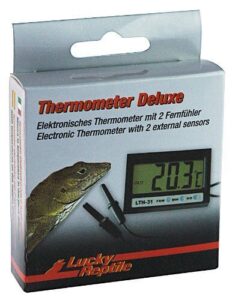
The Lucky Reptile Dual Zone Thermometer ($45) is a solid pick if your kid needs to track both the warm and cool ends of a snake enclosure at once.
Two waterproof probes handle separate zones simultaneously — no guessing, no swapping sensors.
The large display shows both readings side by side, and it even includes a built-in clock.
Probes resist humidity well, making them safe near misting areas.
It’s straightforward enough for a child to check daily without adult supervision.
| Best For | Reptile hobbyists who need to monitor two temperature zones at once — especially useful for snake or lizard setups with both a warm side and a water area. |
|---|---|
| Display Type | Large LCD |
| Mounting Method | Freestanding/probe |
| Housing Material | Silicone & plastic |
| Measures Humidity | No |
| Power Source | Battery |
| Reptile Compatible | Yes |
| Additional Features |
|
- Two waterproof probes let you track ambient and water temps simultaneously, no swapping required
- Large display makes it easy to check readings at a glance, with a built-in clock as a bonus
- At $45, it’s an affordable alternative to pricier handheld infrared thermometers
- Only covers two zones — if your setup is more complex, you’ll need extra devices
- No data logging or wireless connectivity, so you can’t track trends remotely
- Battery info isn’t listed, and the plastic housing may not hold up great in very humid environments long-term
2. Zoo Med Repti Temp Digital Thermometer
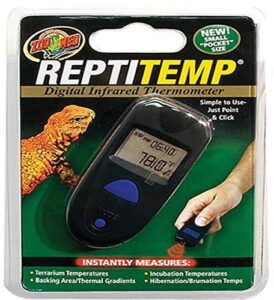
Two probes covering two zones are great — but sometimes you just want one reliable unit that gets the job done without fuss. That’s where the Zoo Med Repti Temp Digital Thermometer earns its spot.
It reads temperature quickly, displays numbers clearly, and runs on a standard battery for months. Kids can check it at a glance without touching anything inside the tank. Simple, durable, and accurate enough for everyday snake care — it’s a dependable first thermometer for any starter setup.
| Best For | Beginner reptile keepers who want a simple, no-fuss thermometer for everyday temperature checks without a complicated setup. |
|---|---|
| Display Type | Digital LCD |
| Mounting Method | Handheld/lanyard |
| Housing Material | Plastic |
| Measures Humidity | No |
| Power Source | Lithium battery |
| Reptile Compatible | Yes |
| Additional Features |
|
- Instant, non-contact readings mean you never have to disturb your snake or reach inside the tank
- Single-button operation makes it easy for kids and beginners to use right away
- Compact size with a lanyard makes it easy to store and grab whenever you need it
- Won’t read accurately through glass or acrylic, so you need a clear line of sight to the surface
- The auto shut-off can fail, which drains the battery if you forget to turn it off manually
- The small display can be tough to read in bright light or for anyone with vision difficulties
3. Etekcity Infrared Temperature Gun
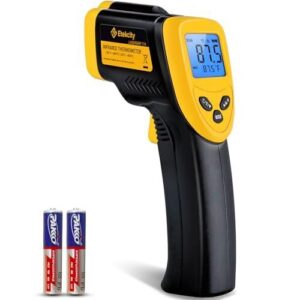
Sometimes you want something even faster than a probe. The Etekcity Infrared Temperature Gun reads surface temperatures in under half a second — no contact, no fuss, no waking up a coiled snake.
Just point and shoot across the enclosure — then cross-reference your readings with boa constrictor heat lamp wattage guidelines to make sure every zone hits the mark at every life stage.
Point it from about 14 inches away, press the trigger, and the backlit LCD shows results instantly. It covers a huge range, from -58°F up to 716°F, so hot basking spots are no problem.
Safe, cordless, and dead simple for kids to use.
| Best For | Reptile keepers, hobbyists, and home cooks who need quick, no-touch surface temperature readings without the hassle of probes or cables. |
|---|---|
| Display Type | Backlit LCD |
| Mounting Method | Handheld |
| Housing Material | Plastic |
| Measures Humidity | No |
| Power Source | 9V battery |
| Reptile Compatible | Yes |
| Additional Features |
|
- Reads temps in under half a second — point, shoot, done
- Covers an impressive range (-58°F to 716°F), handling everything from freezer checks to hot basking spots
- Simple enough for anyone to use right out of the box, no learning curve
- Fixed emissivity means readings can be off on shiny or reflective surfaces
- Only works well at about 14 inches away — get too far and accuracy drops
- Can’t measure internal food temps, so you’ll still need a probe thermometer for cooking meat safely
4. Qooltek Mini Digital Hygrometer Thermometer
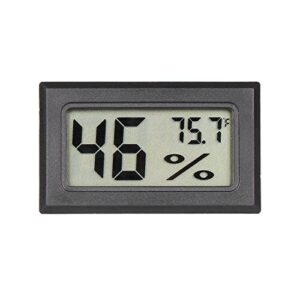
If speed is the Etekcity’s superpower, the Qooltek Mini is all about staying put and staying simple. This tiny unit — barely 1.9 inches wide — fits inside almost any terrarium without crowding the setup.
It tracks both temperature and humidity on one small LCD screen, which is exactly what a young snake keeper needs at a glance.
Pre-installed batteries mean it works straight out of the box. One honest note: it only displays Fahrenheit, so keep that in mind.
| Best For | Beginner reptile keepers or hobbyists who need a no-fuss, compact hygrometer for small enclosures like terrariums, humidors, or incubators. |
|---|---|
| Display Type | Mini LCD |
| Mounting Method | Freestanding |
| Housing Material | Plastic |
| Measures Humidity | Yes |
| Power Source | Pre-installed battery |
| Reptile Compatible | Yes |
| Additional Features |
|
- Tiny footprint (under 2 inches wide) slides into tight spaces without getting in the way
- Tracks both temperature and humidity on one screen — simple and easy to read at a glance
- Comes with a battery pre-installed, so it’s ready to go right out of the box
- Only displays Fahrenheit — no option to switch to Celsius
- Humidity accuracy is ±5% RH, which might not cut it for precision-sensitive setups
- Some users have reported screen blackouts and inconsistent readings between units
5. Hagen Exo Terra Mini Compact Light Fixture
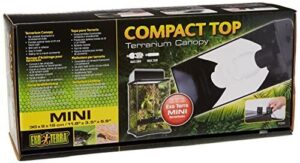
Here’s something a little different on this list — the Hagen Exo Terra Mini Compact Light Fixture isn’t a thermometer. It’s a lighting canopy built specifically for Exo Terra’s mini glass terrariums. It holds a single E27 bulb — UVB, fluorescent, or incandescent — and its aluminum reflector spreads light evenly across the enclosure.
The built-in on/off switch keeps things simple for kids. It adds only about 1–2°C of warmth, so you’ll still need a separate thermometer to track temps accurately.
| Best For | Small terrarium owners — especially beginners or kids — who want a clean, simple lighting setup for Exo Terra mini enclosures. |
|---|---|
| Display Type | No display |
| Mounting Method | Canopy mount |
| Housing Material | Glass & aluminum |
| Measures Humidity | No |
| Power Source | Corded electric |
| Reptile Compatible | Yes |
| Additional Features |
|
- Fits perfectly on Exo Terra mini terrariums without blocking the mesh top
- Works with UVB, fluorescent, or incandescent bulbs, so it’s flexible for different setups
- Built-in on/off switch makes it super easy to use day to day
- The side-exit power cord can look messy and may not reach outlets without an extension
- Only holds one bulb, so it won’t cut it for larger tanks or heat-hungry species
- Doesn’t provide enough heat on its own — you’ll still need a separate heat source and thermometer
6. Exo Terra Reptile Terrarium Thermometer
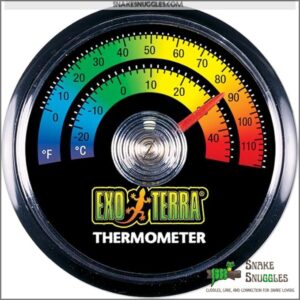
Exo Terra’s analog thermometer is the no-fuss option parents often reach for first. At just $4.94, it’s battery-free and mounts directly onto glass or acrylic with its adhesive backing.
For tighter gradient control, pair it with a dual-probe setup using tips from this snake habitat lighting and temperature guide.
The 7-inch strip fits most standard tanks without crowding the setup. It shows both Fahrenheit and Celsius side by side — no guessing, no conversions.
Just know that analog readings aren’t as precise as digital. Grab two and place one on each side for a simple warm-to-cool gradient check.
| Best For | Budget-conscious reptile owners who want a simple, battery-free way to keep an eye on tank temps without any setup hassle. |
|---|---|
| Display Type | Analog dial |
| Mounting Method | Adhesive backing |
| Housing Material | Plastic |
| Measures Humidity | No |
| Power Source | No battery needed |
| Reptile Compatible | Yes |
| Additional Features |
|
- Super affordable at under $5 — easy to grab two for warm and cool zone monitoring
- No batteries needed, and it sticks right onto the glass for a clean look
- Shows both Fahrenheit and Celsius at the same time, so there’s no mental math involved
- Analog readings aren’t the most precise, so you might see slight inaccuracies
- The adhesive pad is a one-shot deal — once you peel it off, it won’t stick as well again
- No digital perks like alarms or data logging if you need closer monitoring
7. Exo Terra Digital Thermometer Hygrometer
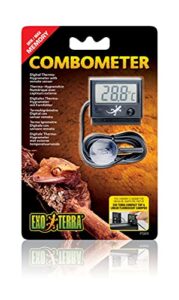
This one steps up from the analog strip — and kids love it. The Exo Terra Digital Thermometer Hygrometer reads both temperature and humidity on one clear display, so your child gets the full picture at a glance.
The remote sensor attaches inside via suction cup while the unit stays safely outside the tank.
It tracks daily highs and lows automatically. No cords inside the enclosure, simple one-button controls, and battery-powered — exactly what a junior snake keeper needs.
| Best For | Reptile and amphibian owners who want a simple, all-in-one readout of both temperature and humidity without having to reach inside the enclosure. |
|---|---|
| Display Type | Digital LCD |
| Mounting Method | Probe/external |
| Housing Material | Plastic |
| Measures Humidity | Yes |
| Power Source | Battery |
| Reptile Compatible | Yes |
| Additional Features |
|
- Shows temperature and humidity together on one display, plus daily min/max values so you can spot trends easily
- The long cable lets you read conditions from across the room without opening or disturbing the tank
- Battery-powered and straightforward to use — no complicated setup required
- Temperature readings can be slow to stabilize, so it may lag behind what’s actually happening inside the enclosure
- Humidity accuracy tends to drift after several months of use, with some owners reporting readings that are off by 20–30%
- The LCD is only easy to read straight-on, which can be awkward depending on where your tank is positioned
8. Flukers Digital Thermometer Hygrometer
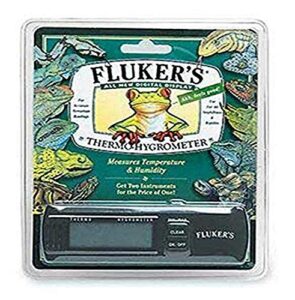
Fluker’s keeps things refreshingly simple — and that’s a win for busy parents and new snake keepers alike.
This compact unit measures about 4 inches, runs on a single CR2032 battery, and sticks right inside the enclosure with its adhesive backing.
The digital display shows temperature and humidity at once, with 0.1-degree resolution that’s easy to read through glass.
Max/min memory tracks daily highs and lows automatically.
One button, no clutter, no cords — just reliable numbers your kid can actually use.
| Best For | New reptile and amphibian owners — especially beginners or parents — who want a simple, no-fuss way to monitor their pet’s enclosure conditions without spending a lot. |
|---|---|
| Display Type | Digital LCD |
| Mounting Method | Adhesive/Velcro |
| Housing Material | Plastic |
| Measures Humidity | Yes |
| Power Source | Battery |
| Reptile Compatible | Yes |
| Additional Features |
|
- Reads both temperature and humidity on one screen, so you’re not juggling two separate gadgets
- Super affordable, which means you can grab a few and place them at different spots in the enclosure
- Sticks right inside with adhesive backing — no drilling, no cords, no hassle
- Accuracy isn’t lab-grade; humidity can be off by up to 10% and temp by around 3°F, which matters for sensitive species
- The adhesive can give out over time, and a loose unit in the enclosure is a real hazard for climbing or small animals
- Some users have reported the humidity sensor dying within a month or throwing off random errors
9. Repti Zoo Digital Terrarium Thermometer Hygrometer
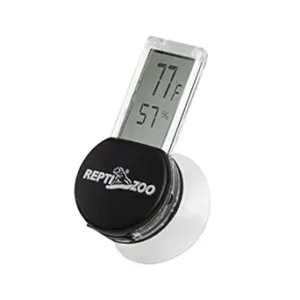
At $13.99, the Repti Zoo Digital Terrarium Thermometer Hygrometer punches well above its price tag.
It shows both temperature and humidity on a single LCD screen — large numerals your kid can read from across the room.
The dual-position suction cup mounts on front or side glass, so placement is flexible.
Two AA batteries last up to a year, and the snap-in compartment makes swaps painless.
It’s a solid, no-fuss pick for first-time snake keepers.
| Best For | First-time reptile owners who want a reliable, easy-to-read thermometer/hygrometer without spending much. |
|---|---|
| Display Type | Digital LCD |
| Mounting Method | Suction cup |
| Housing Material | Glass & plastic |
| Measures Humidity | Yes |
| Power Source | 2x AA battery |
| Reptile Compatible | Yes |
| Additional Features |
|
- Shows both temperature and humidity on one clear LCD screen — no need for two separate gadgets
- Suction cup mounts on front or side glass, so you can reposition it anytime without leaving a mess
- Two AA batteries last up to a year, and swapping them out takes about ten seconds
- Suction cup doesn’t stick well to acrylic or textured surfaces, so some tanks will give you trouble
- Not waterproof — get it too close to a mister and you might fry it
- A few users report the battery compartment cracking or the display cutting out after a couple months
10. Zoo Med Dual Thermometer Hygrometer
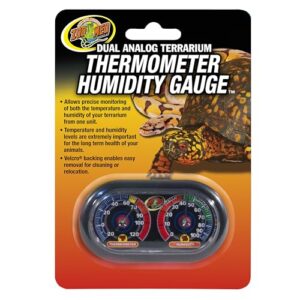
The Zoo Med Dual Thermometer Hygrometer keeps things refreshingly simple. No batteries needed — it runs on two analog dials that show temperature and humidity at the same time.
Your kid can glance at it from across the room without squinting. The Velcro backing makes repositioning easy when you’re hunting hot spots.
It won’t win accuracy awards (analog drift is real), but for a budget-friendly backup or starter unit, it does exactly what it promises.
| Best For | Budget-conscious beginners and hobbyists who want a no-fuss way to keep tabs on temperature and humidity in reptile, amphibian, or small-critter enclosures. |
|---|---|
| Display Type | Analog dial |
| Mounting Method | Velcro backing |
| Housing Material | Rigid plastic |
| Measures Humidity | Yes |
| Power Source | No battery needed |
| Reptile Compatible | Yes |
| Additional Features |
|
- Two readings in one — temperature and humidity on a single unit saves space and money
- No batteries required, and the needle responds quickly for easy spot-checking
- Velcro backing makes it simple to move around and find hot or dry zones
- Analog readings can drift over time, especially in high-humidity setups
- No calibration option, so accuracy may slip a few percent without you knowing
- The plastic build feels a bit flimsy, and the Velcro can lose its grip after extended use
Kid-Friendly Display Features

Reading a thermometer shouldn’t feel like decoding a science textbook — especially for a kid checking on their snake before school. The display is the first thing your child sees, and the right one makes all the difference.
what to look for.
Large, Easy-to-read Digit Sizes
Digit size matters more than most parents realize. Look for thermometers with 16–22mm character height — that’s the ideal digit height for reading across a terrarium without squinting.
Bold numerals design with 6–8 point stroke width standards keeps numbers sharp at a glance. Segmented digit clarity and proper digit spacing guidelines prevent crowding, making large easy-to-read displays genuinely useful for kids checking temperatures quickly.
High-contrast Numbers Through Terrarium Glass
Big digits only help if you can actually read them through the glass. Look for high-contrast dark digits on a light background — some models use retroreflective ink that bounces light straight back at you.
Anti-glare coating cuts reflection by up to 65%, and UV stable coating prevents yellowing over time. Backlit illumination and viewing angle optimization keep numbers sharp from wherever you’re standing.
Dual Fahrenheit and Celsius Labels
Once you can read the numbers, you need to know what they mean. That’s where dual display Fahrenheit and Celsius labels come in handy.
Color-Coded Scales let kids match temperatures at a glance, no math needed.
Edge-Bonded Labels on moisture-resistant vinyl handle tank humidity without peeling.
Glass-Mount Adhesion keeps conversion reference guides visible right through the enclosure wall.
Night-mode or Glow Display Options
Knowing the units is half the battle. The other half? Actually, seeing the screen at night. A good night-mode display shifts to warm color temperature — think amber, not harsh white — so low light visibility stays sharp without waking your snake.
Scheduled glow activation kicks in automatically at dusk. Dimmed alert indicators and blue light reduction keep things calm while large easy-to-read displays still show high-contrast dark digits clearly.
Bluetooth Alerts for Remote Checks
Sometimes you can’t hover over the tank all day — that’s where Bluetooth connectivity comes in. A Bluetooth model sends real-time notifications straight to your phone when temps drift out of range. Here’s what to look for:
- Threshold Triggering — alerts fire automatically when readings cross safe limits
- Battery Level Alerts — no surprise monitoring gaps
- Secure Pairing — one-time QR or code setup keeps connections private
- Multi-tank Monitoring — track several enclosures in one app
Remote monitoring makes choosing kid-friendly reptile thermometers and child-safe terrarium accessories genuinely stress-free.
Safe Power and Mounting
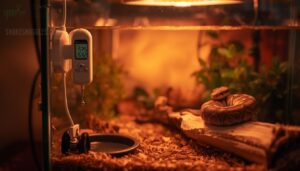
When your kid’s snake setup is running smoothly, power and mounting are two things you really don’t want to stress about.
A good thermometer should be safe to handle, easy to place, and stay put without a mess. Here’s what to look for.
Cordless, Battery-powered Designs
Cords inside a snake enclosure are a hazard no kid needs. That’s why battery-powered, cordless designs are the smarter pick.
Most run on rechargeable battery types with USB charging methods built right in — no hunting for outlets.
Child-friendly battery compartments snap open easily, and battery indicator displays let your child check power at a glance.
Clean, simple, and genuinely safe.
Low-voltage Battery Safety for Kids
Not all batteries are equal — especially around kids. Reptile thermometers using CR2032 or LR44 button cells run on low‑voltage power, which means low‑voltage shock prevention is built into the design.
Look for:
- Child-proof battery compartments with tamper-resistant housing that requires a coin or tool to open
- Overcurrent protection to prevent dangerous heat buildup
- Battery swelling monitoring — check monthly and replace immediately if anything looks off
Be aware that button battery ingestion can cause severe esophageal burns.
Auto-sleep Features for Longer Battery Life
A good auto-sleep feature is basically a tiny power manager working quietly in the background. Most quality reptile thermometers use Timer Sleep or Deep Sleep Mode to cut standby current to under 1 mA — stretching a CR2032 for months.
| Sleep Feature | How It Works | Kid-Friendly Benefit |
|---|---|---|
| Timer Sleep | Sleeps after set idle time | Saves battery automatically |
| Deep Sleep Mode | Powers down most circuits | Months of battery life |
| Proximity Wake Sensors | Wakes when you approach | No button‑pressing needed |
| Standby Current Reduction | Drops draw below 1 mA | Fewer battery changes |
| Battery Cycle Management | Optimizes charge patterns | Extends overall battery health |
Optimizing battery life in cordless devices means your child’s digital thermometer stays reliable without constant maintenance — a quiet win for battery safety and child‑friendly design.
Adhesive, Suction, and Magnetic Mounting
Three mounting options keep your thermometer locked in place without fuss:
- Adhesive — Clean the glass with alcohol first. Mounting Surface Preparation really does matter for Adhesive Longevity.
- Suction cup — Press firmly to expel air. Suction Strength Tips: avoid mist zones where condensation weakens grip.
- Magnetic — Tool-free, residue-free. Apply a protective coating for Magnetic Corrosion Prevention.
All three offer Reusable Mounting Solutions — a smart, child-friendly design choice.
Exterior Placement Away From Sunlight
Direct sunlight is a silent saboteur — it causes temperature drift faster than almost anything else.
Keep your thermometer on the north or east side of the enclosure, at least two feet from any direct sun. Eye-level placement makes readings easy for kids.
Use ventilated housing on non-reflective surfaces, and maintain proper clearance distance. An IP65-rated, weather-resistant external mounting setup manages humidity without missing a beat.
Accuracy and Calibration Tips
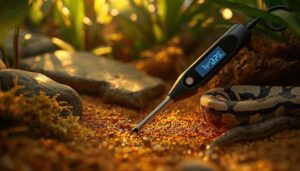
pretty display means nothing if your thermometer is lying to you. Getting accurate readings is the real job here, and a few simple habits make all the difference.
Here’s look for and check regularly.
Choosing ±1.5 to 2°F Accuracy
Aim for ±1.5 to 2°F when picking kid-friendly reptile thermometers — that’s the sweet spot for temperature accuracy in snake enclosures. Sensor tolerance standards matter here because small drifts from battery voltage impact or environmental interference can quietly push readings off. Track long-term accuracy by noting sensor calibration dates.
For kid-friendly snake setups, aim for a thermometer with ±1.5 to 2°F accuracy to keep readings trustworthy
A reliable digital thermometer with solid sensor tolerance standards keeps your child’s snake genuinely safe.
Verifying Readings With an Ice-bath Test
Once you’ve picked a thermometer with solid accuracy, test it yourself.
Ice Bath Preparation is simple: fill a cup with crushed ice, add just enough distilled water to cover the gaps — the Distilled Water Requirement matters since minerals can skew results.
Use Full Submersion Method, wait 30–60 seconds for the Stabilization Wait Time, then check: it should read 32°F.
Log any offset for your Drift Documentation Procedure.
Using Max/min Memory for Trends
Once your ice-bath test confirms accuracy, the max/min function becomes your daily safety net.
Kid-friendly reptile thermometers with data logging let you spot calibration drift detection early — if the digital thermometer’s stored highs keep creeping up weekly, something’s shifting. Check extremes each morning, set alert thresholds for your snake’s safe range, and reset memory after any major enclosure change.
Checking Humidity Sensor Reliability
Temperature accuracy gets all the attention, but your humidity sensor matters just as much. Look for models with Ingress Protection ratings — waterproof probes handle misting without false readings.
Self-Test Diagnostics flag sensor drift monitoring issues early. Battery Impact Analysis shows that low batteries can skew humidity tolerance readings too.
Cross-check your hygrometer function against a trusted unit monthly.
Spotting Drift Before It Affects Enclosure Temps
Drift sneaks up slowly — small temperature swings of 0.5 to 1.0°F within a 30‑minute window are your first red flag.
Use your digital thermometer’s max/min function for Baseline Trend Monitoring, and watch for Nighttime Drift Patterns that hint at insulation gaps.
Cross-Device Comparison and Hourly Variance Alerts catch Sensor Aging Indicators early, keeping your temperature monitoring and data logging accurate before your snake notices.
Probe Placement for Snake Heat
Where you put the probe matters more than most people think. A snake needs a proper temperature gradient, and your thermometer can only help if it’s reading the right spot.
Here’s how to place your probes so your readings actually mean something.
Warm-side Probe Placement Near The Heat Source

Getting the warm side temperature right starts with exactly where you place the probe. Think of it as putting your snake’s thermometer in their favorite chair — not too close to the heat source, but close enough to matter.
- Position the probe at the basking surface contact point where your snake actually rests
- Route the wire routing path along the enclosure wall, away from direct heat
- Adjust probe height adjustment weekly as your setup changes
- Use protective barrier placement — a flat stone works — if the sensor sits too close to the heat source
- Confirm heat source compatibility before mounting; not all probes handle high-wattage lamps equally
Cool-side Probe Placement for Gradient Checks

Once the warm side is sorted, the cool side tells the other half of the story.
Place your probe in the Middle Enclosure Position — roughly center-to-cool — with 2‑Inch Glass Clearance to avoid distorted readings. Use Secure Clip Placement and Vertical Alignment Consistency to keep it stable.
Reference Thermometer Calibration confirms your digital thermometer is reading the true cool side temperature and gradient accurately.
Keeping Probes Away From Direct Contact Heat
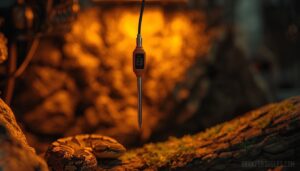
Direct heat contact skews readings quickly.
Keep probes at least 2–4 inches from the heat lamp or basking area using Adjustable Probe Arms, so the tip floats in open air.
Add Ceramic Spacer Use, Thermal Insulation Sleeves, or Reflective Shielding to block radiant heat.
Air Gap Housing along probe cables also prevents heat creep — keeping your temperature gradient honest.
Logging Daily Readings for Consistency
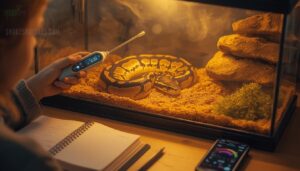
A short log takes thirty seconds, but saves a lot of guesswork. Record warm-side, cool-side, and ambient readings at the same time daily — Uniform Time Stamps keep your data honest.
Use Standard Data Templates to track max/min recording highs and lows.
Add Behavioral Context Notes, flag Missing Entry Alerts, and let app data logging generate Weekly Trend Summaries automatically.
Thermometer Types Compared
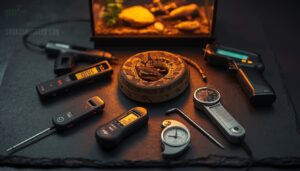
Not all thermometers work the same way, and that actually matters for your snake’s setup. Each type has a sweet spot depending on your enclosure size, your kid’s age, and how hands-on you want monitoring to be.
If you want something flexible enough to fit different tank styles, check out this guide to digital thermometers with magnetic mounts for humidity monitoring, which stick to wire enclosures or stand upright wherever you need them.
Here’s a quick breakdown to help you pick the right fit.
Analog Gauges for Simple Monitoring
Analog thermometers keep things beautifully simple — no batteries, no setup. Bourdon tube mechanism moves a mechanical needle display in real time, giving kids an instant visual they can actually trust.
Dial face visibility is decent, though high-contrast dark digits on large easy-to-read displays aren’t always guaranteed at this price point. vibration damping design and corrosion resistant coatings make these tough enough for daily handling.
Digital Thermometers for Clearer Readings
Step up from analog and you get real precision.
Digital thermometers display temperature to the tenth of a degree on a backlit LCD — no squinting, no guessing. High-contrast dark digits on large easy-to-read displays cut through glare beautifully, even through terrarium glass.
High-resolution sensors and rapid response time mean accurate reads within seconds.
Simple one-button controls make them genuinely kid-friendly.
Dual-probe Models for Two-zone Setups
Dual-probe thermometers take temperature monitoring a step further. One probe tracks the warm side, the other watches the cool end — that’s temperature gradient mapping in real time.
Independent alarm settings alert you when either zone drifts off.
Wireless data sync keeps readings on your phone.
For kids managing multiple zones, dual-probe thermometers with solid battery life management and multi-probe compatibility are genuinely worth it.
Infrared Guns for Quick Surface Checks
Infrared thermometers flip the script entirely. Point, pull the trigger, done — reading in under half a second. The Etekcity Lasergrip 774 Noncontact Digital Laser Infrared Gun is a solid pick here.
- Laser Aiming Aid targets the exact spot instantly
- Rapid Response Time under 0.5 seconds for quick checks
- Emissivity Adjustment matches different surface materials accurately
- Spot Size Ratio grows with distance, so stay close
- Battery Life Count reaches up to 15,000 measurements per charge
Best Type for Different Snake Enclosures
Quick surface checks with infrared thermometers work great for glass tanks, but your enclosure material shapes everything else. Glass compatibility is solid with suction mounts.
PVC thermometer fit calls for a digital thermometer with a probe — humidity stays locked in.
Melamine suitability, wood sealing needs, and acrylic stability all favor secure mounting options with analog dial or digital displays matching your temperature range recommendations.
Budget and Value Choices
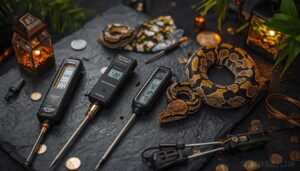
You don’t have to spend a lot to keep your snake’s tank dialed in. From a $7 analog gauge to a $30-plus multi-probe setup, there’s a solid option for every budget.
Here’s what’s worth your money at each price point.
Cheapest Options for Starter Setups
You don’t need to spend much to get started. Budget-friendly options for reptile care cover the basics surprisingly well.
- Basic Dual Thermometers with AA/AAA battery models run $6–$12 and cover both tank zones.
- Mini Hygrometer Units cost $8–$15 with simple one-button controls that kids can actually use.
- Infrared Surface Guns start around $15 for quick spot checks.
Starter Pack Deals often bundle two digital thermometers together — cutting the per-unit cost nicely.
Mid-range Picks With Better Features
Once you’re ready to step up from the basics, mid-range picks in the $15–$26 range deliver a genuinely feature-rich interface without breaking the bank. Models like the Repti Zoo Digital Terrarium Thermometer Hygrometer offer waterproof probes, a compact probe design, and max/min function for tracking daily temperature swings.
Fluker’s slim probe fits neatly around tank décor — simple one-button controls, your kid can actually master.
Premium Models for Multi-zone Monitoring
Step up to $30-plus territory, and you get serious hardware.
Premium models like REPTI ZOO run two independent channels simultaneously, so warm and cool temperature zones appear on large easy-to-read displays with high-contrast dark digits.
Extended probe cables reach every corner. Zone-specific alarms ping your phone if readings drift.
Automatic averaging, multi-zone memory, and a max/min function make trend-spotting genuinely simple.
Best Value for Parents Buying One Tank
One tank, one thermometer — that’s all most parents actually need. Single-zone cost efficiency means skipping features you’ll never use. Kid-friendly reptile thermometers like the Zoo Med Repti Temp hit that sweet spot: budget-friendly options for reptile care without sacrificing quality.
- Large easy-to-read displays with simple one-button controls
- Battery-powered designs with long-term battery savings via auto-sleep
- Durable housing materials and simple mounting solutions included
Multi-pack Options for Several Enclosures
Running more than one enclosure? Multi-pack kits are a smart move.
They cut per-unit cost and often include plug-and-play mounts, synchronized displays, and shared power rails — no tangled wiring mess. Many feature UV-resistant plastics and modular rack design for clean setups.
| Feature | Benefit |
|---|---|
| Dual probes | Warm and cool zone tracking |
| Synchronized displays | Quick at-a-glance temp checks |
| Plug-and-play mounts | No tools, no hassle |
| Budget-friendly options for reptile care | Lower cost per enclosure |
Frequently Asked Questions (FAQs)
What is the best thermometer for a ball python enclosure?
The Lucky Reptile Dual Zone Thermometer wins here.
It covers both warm and cool sides, hits the 88–92°F range accurately, and keeps readings clear with high-contrast dark digits that your kid can actually see.
What’s the best thermometer for reptiles?
The best reptile thermometers for kids combine high-contrast dark digits, battery-powered simplicity, and single-button controls.
Look for durability under mist, fast sensor response time, and multi-zone expandability as your collection grows.
How often should kids clean their thermometer probes?
Clean the probe after every use. A quick wipe with 70% isopropyl alcohol takes seconds. In humid tanks, daily hygiene routine matters — moisture prevention stops mold before it starts.
Can thermometers double as humidity alarms for snakes?
Some reptile thermometers for kids double as humidity alarms — but only combo units with a built-in hygrometer function.
Look for app notification alerts and alert threshold settings to catch dangerous humidity swings early.
What age is appropriate for kids to monitor readings?
Around age 7, Early Numeracy Skills kick in — kids can start Supervised Monitoring with a nudge. Progressive Independence grows naturally, and Age-based Responsibility and Cognitive Readiness fully bloom by
Do glass tanks affect thermometer sensor performance?
Yes, glass tanks do affect sensor performance. Thermal lag, condensation bias, and infrared glass error can skew readings.
Use an interior probe for accuracy, and recalibrate periodically to catch temperature drift early.
Which snake species need the tightest temperature control?
Some snakes just can’t wing it.
Ball Python Tightness is real — they need 78–92°F. Green Tree Gradient stays narrow. Corn Snake Sensitivity and King Snake Precision matter for steady thermoregulation and reptile health monitoring.
Conclusion
Maya’s corn snake, Blaze, stopped eating for two weeks—until her dad noticed the warm side had dropped eight degrees. One small thermometer swap fixed everything.
That’s the quiet power behind choosing the right reptile thermometers for kids with pet snakes: it turns invisible problems into numbers you can actually act on.
Pick a model that fits your budget, mounts securely, and shows a clear reading. Your kid’s snake will do the rest.