This site is supported by our readers. We may earn a commission, at no cost to you, if you purchase through links.
Many captive snakes live under lighting that feels chaotic to them. A bright room after dusk, a cheap bulb over mesh, or a basking lamp left on overnight can disrupt feeding, shedding, and the hormonal clock that guides daily behavior.
Snake habitat lighting requirements go beyond picking a UVB package labeled “reptile.” Your snake needs darkness, usable UVA and UVB at the basking site, and enough shade to choose its own exposure.
A corn snake, ball python, and desert colubrid should not share one lighting recipe. Set the photoperiod, UVI, fixture distance, and heat gradient with the animal’s natural history.
Table Of Contents
- Key Takeaways
- Essential Snake Habitat Lighting Requirements
- UVA and UVB Requirements for Snakes
- Species-Specific Snake Lighting Requirements
- Choosing and Installing Enclosure Lighting
- Maintaining Safe, Consistent Snake Lighting
- Frequently Asked Questions (FAQs)
- What is the best light for a snake enclosure?
- Do I keep my snakes’ heat lamp on all night?
- Are LED lights ok for snakes?
- How long can snakes go without a heat lamp?
- Can snakes see colored lights at night?
- Do LED lights work for snake enclosures?
- How far should lights be from snakes?
- When should I turn off UVB lighting?
- Do albino snakes need different lighting?
- Can snakes see red or blue nighttime lights?
- Conclusion
Key Takeaways
- Give your snake a fixed daily light cycle—usually 10–12 hours of light—with complete, uninterrupted darkness at night to protect normal feeding, shedding, activity, and hormone rhythms.
- Match lighting to the species and habitat: use measured UVB at the basking site, lower exposure and deeper shade for tropical or nocturnal snakes, and stronger daylight and UVB gradients for desert species.
- Build choice into the enclosure by placing UVB and heat over only part of the habitat, maintaining a safe warm-to-cool temperature gradient, and providing dark hides where your snake can retreat.
- Use timers, thermostats, and UV meters to verify conditions, account for mesh reducing UVB output, prevent overheating and burns, and replace UVB bulbs when readings fall below target levels.
Essential Snake Habitat Lighting Requirements
Getting your snake’s lighting right isn’t just about aesthetics—it directly affects their health, behavior, and biological clock. A few fundamental principles shape every good lighting setup, from how many hours of light your snake gets to what happens after dark. Here’s what you need to understand before setting up your enclosure.
Avoid common snake husbandry lighting mistakes by providing a consistent day-night cycle and complete darkness overnight.
Light, Darkness, and Circadian Rhythms
Circadian rhythms don’t just apply to humans. Your snake’s body runs on a biological clock synced to light and dark, governing feeding, shedding, and hormone cycles.
Photoperiod stability is the foundation. Without it, these rhythms break down, suppressing melatonin production and triggering stress behaviors. Even ambient room light at night introduces light pollution effects that silently undermine your snake’s rest. Research shows that light exposure modulating circadian photoentrainment can directly affect mood, sleep, and hormonal regulation in vertebrates, underscoring why consistent dark periods matter for reptiles too.
Standard 12-Hour Light Cycle
The simplest rule that works for most captive snakes: 12 hours on, 12 hours off. Lights on at a fixed morning time, off at a fixed evening time, every day.
That consistency stabilizes routine. Document your lighting cycle on the enclosure so it never gets guessed. Sudden changes disrupt photoperiods and trigger stress responses fast.
Seasonal Photoperiod Adjustments
A fixed 12:12:12 cycle works year-round for many tropical species, but temperate snakes read day length like a seasonal calendar. Shift to 13 hours of light in summer and 11 hours in winter.
That 1-2 minute daily drift signals melatonin pulse changes that trigger breeding behavior and dormancy prep. Pair those light shifts with temperature adjustments to keep circadian entrainment accurate.
Gradual Dawn and Dusk Transitions
Getting your hours right is only step one. Abrupt switches stress snakes visibly. Dawn ramp duration spans 30 to 60 minutes, climbing from 0.1 to 1000 lux. Dusk light decline follows the same pace.
- Warm tones first; broad spectrum by midday
- Red and amber wavelengths linger at dusk
- Dimmable LEDs handle twilight spectral shifts
- Gradient light zoning keeps hides dark as basking zones brighten
Uninterrupted Darkness After Dusk
Darkness isn’t passive. Uninterrupted darkness after dusk is an active requirement, and even small ALAN impacts (artificial light at night) cause melatonin suppression and circadian rhythm disruption.
Even small nighttime light exposure can suppress melatonin and disrupt your snake’s circadian rhythm
Seal enclosure fronts and lids completely. Blackout curtains block window glare effectively.
For darkness verification, use a light meter to confirm zero lux at night inside the habitat, always staying below 0.1 lux.
UVA and UVB Requirements for Snakes
UVA and UVB do different jobs in a snake’s enclosure, from supporting natural activity to helping the body use calcium. Your setup must match the species, age, and access to shade. Use the following points to choose a safe, effective level of exposure.
UVA Effects on Natural Behavior
UVA organizes daytime behavior. Under suitable photoperiods and dawn-dusk transitions, you may observe:
For practical snake-avoidance tips during peak activity, stay alert near sunny rocks and trails at dawn or dusk.
- Basking duration changes, often longer near warm surfaces.
- Head turning shifts toward illuminated areas.
- Foraging movement increases after lights come on.
- Shelter seeking reduces, with playful tail flicking early in exposure.
Match intensity and species-specific photoperiod to preserve stable daily circadian rhythms.
UVB and Vitamin D3 Synthesis
Use UVB lighting to trigger vitamin D3 synthesis in skin. UVB converts 7-DHC to previtamin D3; warmth forms D3, then liver and kidney activate it for calcium metabolism. Output, duration, age, skin thickness, melanin, and species-specific photoperiod affect efficiency.
| Check | Control |
|---|---|
| Bulb | Replace 6–12 months |
| Exposure | Match UVI and duration |
| Fixture | Account for mesh losses |
Improves dietary calcium absorption but requires proper gradients.
Calcium Absorption and Bone Health
Calcium absorption determines whether your snake builds resilient bone or draws minerals from its skeleton. Vitamin D3, produced under UVB lighting, helps dietary calcium move from gut to blood.
- Provide varied calcium sources
- Support basking behavior
- Maintain thermal gradients
- Avoid dietary shortfalls
- Watch growth
Poor absorption factors force bone remodeling, lower bone density, and may cause metabolic bone disease.
Choosing Appropriate UVI Levels
Set UVB by UVI target, not bulb percentage. Build a UV index gradient: measure the basking spot with a UVI meter, then provide shade.
| Species group | Basking spot UVI |
|---|---|
| Ball python | 3–4 |
| Corn snake | 4–6 |
| Desert species | 8+ |
Adjust UVB distance, usually 12–18 inches. UVB output degrades, so retest after replacements. Adjust seasonal UVI alongside each species photoperiod adjustment schedule.
Preventing Metabolic Bone Disease
Metabolic bone disease begins when UVB lighting, heat, and diet lose balance. Plan UVB bulb replacement every 6–12 months and use thermal gradient optimization, with 88–92°F basking zone, to support vitamin D3 synthesis and calcium metabolism.
Manage dietary phosphorus balance, tailor calcium supplementation frequency by age and breeding, and arrange vitamin D3 monitoring with veterinarian. Hides let basking behavior regulate exposure.
Species-Specific Snake Lighting Requirements
A lighting setup that suits one snake can be excessive or inadequate for another. Activity pattern, native climate, age, and access to cover all shape the safe UVB level and daily light cycle.
Use the following species and habitat profiles to match your enclosure lighting to the snake you keep.
Corn Snake Lighting Needs
Corn snake lighting needs are straightforward: maintain Photoperiod Consistency with a 12hour onoff lighting schedule, usually 10–12 hours daily. A timer prevents irregular light exposure that can disrupt feeding, shedding, and activity.
Provide low-level UVB lighting at a UVI of 0.4–0.6. Pair it with a 85–90°F basking area and 75–80°F cool side. Dawn/Dusk Simulation over 30 minutes helps a natural thermal gradient and species specific photoperiod.
Ball Python Lighting Needs
Ball Python Lighting Needs favor restraint. Use a consistent 12-hour photoperiod and preserve complete darkness overnight. Provide a low-intensity UVB lamp across only part of the enclosure, allowing choice and retreat.
Maintain a 90°F basking spot with 80°F ambient conditions. This thermal gradient lets your python regulate body temperature safely. Replace UVB lighting every 6–12 months, even if the bulb still appears bright.
Boa Constrictor Lighting Needs
Like ball pythons, boas need restraint, but their larger enclosure needs a broader light gradient. Run 12-hour photoperiods, with gradual dawn and dusk transitions, then protect complete nighttime darkness.
Mount UVB lighting over part of the basking zone, 12–18 inches above it. Keep the basking spot at 86–90°F, cooler elsewhere for a thermal gradient. Replace UVB bulbs every six months.
Diurnal Versus Nocturnal Species
Your boa’s gradient shows the rule: match lighting to activity. Diurnal species need bright days and a basking area; daylight stimulates visual hunting and basking.
- Day-active snakes use color vision.
- Nocturnal snakes hunt after dusk.
- Crepuscular snakes peak at dawn.
Give nocturnal species darkness overnight. Light pollution disrupts circadian rhythm and predator avoidance. Match UVB exposure to daytime activity patterns.
Desert Versus Tropical Species
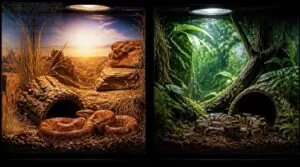
Desert versus tropical species need different light strategies. Desert snakes benefit from bright daylight, longer seasonal photoperiods, and a strong thermal gradient that helps with basking and digestion. Provide higher, species-appropriate UVB lighting and dry, shaded retreats.
Tropical snakes need filtered daylight, moderate heat, and stable humidity. Keep photoperiods consistent, use gradual dawn and dusk, and provide lower UVB exposure with deep shade.
Choosing and Installing Enclosure Lighting
The fixture you choose determines how reliably your snake receives usable light and heat. Installation matters just as much—distance, coverage, and enclosure conditions can change the output dramatically. Use the following options to build a setup that is safe, measurable, and suited to your species.
T5 HO Linear UVB Fixtures
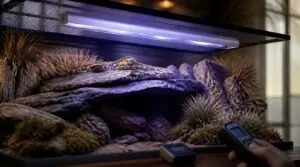
T5 HO linear fixtures provide controlled snake UVB delivery. Use high-output T5 HO UVB tubes, not lower-output T8 lamps, with a compatible electronic ballast and reflector. Reflectors boost delivery 40–60%.
Mount 12–18 inches above basking zones, verify UVI with meters. Mesh can cut UVB by 50%, so adjust distance. Use timers for photoperiod scheduling and replace tubes as output degrades.
Daylight LEDs and Basking Lamps
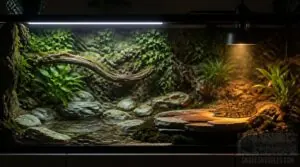
Daylight LEDs create bright, even enclosure illumination without adding much heat. Choose 5000K–6500K units, then dim them from 1,000 to 4,000 lux to match your snake’s activity cycle.
Place basking lamps directly above the warm zone. Set the hotspot for the species, usually 90–120°F, and keep the bulb 8–12 inches above the surface. LEDs use only 6–15 watts; heat lamps supply digestion-supporting radiant warmth.
Reflectors, Sockets, and Moisture Ratings
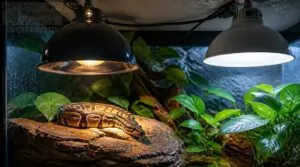
Use a built-in aluminum reflector to drive UVB downward. Baked-enamel aluminum reflects 85–95%; deep parabolic styles focus basking beams, while matte-white interiors diffuse them.
Install heat lamps securely in heat-resistant ceramic sockets, using IP44-rated fixtures in humid enclosures. Clean dust to preserve output, avoid mesh where safe, follow the lamp’s UVB-distance guidance, and dim daylight lighting for smooth dawn-dusk simulation.
Mounting Height and Enclosure Coverage
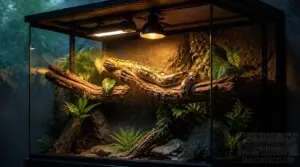
Position fixtures so light reaches animal, not enclosure floor. Mount top fixtures 5–15 inches above the heat zone, with basking hotspot aligned to your snake’s mid-body height.
- Keep ceiling UVB at least 12 inches above substrate.
- Give arboreal and nocturnal species 8–12 inches clearance.
- Fit adjustable mounts; they preserve coverage as furnishings change and offset UVB degradation.
Mesh Screen UVB Reduction
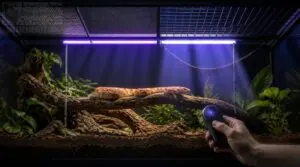
Mesh screen UVB blockage means you must measure at the basking zone. Dense 1.0-mm openings can block about 40% more than 2.0-mm mesh; distance compounds loss.
| Screen | Effect | Action |
|---|---|---|
| Tight | High blockage | Raise output |
| Loose | Lower blockage | Test UVI |
| Nylon | UVB output degrades | Inspect |
| Metal | Stable | Keep taut |
Adjust UVB distance. T5-versus-T8 tubes differ; follow bulb-replacement schedules per manufacturer guidance.
Maintaining Safe, Consistent Snake Lighting
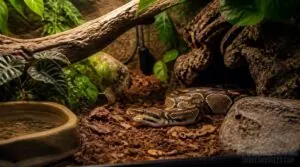
Safe lighting depends on more than choosing the right bulb. You need consistent timing, controlled heat, and enough shade for your snake to regulate its exposure. Use the following checks to keep the enclosure stable and safe.
Timers and Programmable Dimmers
Set programmable timers on a 24-hour schedule, with separate events for lights and dimming. Digital models provide minute-level control, battery-backed memory, and reliable light cycle automation after outages.
Choose humidity-resistant dimmers rated for your enclosure. Dawn-dusk simulation lighting should ramp over 30–60 minutes. Gentle light intensity ramping reduces abrupt change. Smart-home connectivity can monitor schedules remotely, but always verify the fixture’s current status manually.
Coordinating Light and Thermal Gradients
Timers only work when lighting and heat follow the same daily plan. Map a thermal gradient from a 28–32°C basking zone to a retreat 6–12°C cooler.
Ramp daylight and basking heat together over 15–30 minutes for circadian entrainment. Keep UVB distance optimized above the warm zone, then log surface and air temperatures at several heights.
Shade, Hides, and Self-Regulation
With the thermal gradient established, your hide placement strategy should promote self-regulating behavior. Thermal microclimates allow behavioral thermoregulation, while substrate buffering effects steady the retreat.
- Use two hides, including a cool-side hide.
- Provide 2–4 inches of substrate beneath each hide.
- Monitor shade availability daily using entrance-temperature checks. Reposition shade above 3°C boundary shifts.
Preventing Burns and Overheating
Good shade lets a snake retreat, but thermal burn prevention depends on equipment. Keep every heat source outside reach and guard overhead heating, including ceramic heat emitters.
- Run each lamp or mat through thermostat regulation.
- Verify basking temperature with an infrared thermometer.
- Maintain a temperature gradient, with a cool retreat.
- Use insulating coconut fiber or reptile carpet; never bury heaters.
Place sources 5–12 cm overhead. Temperature monitoring twice daily detects hotspots; cool the enclosure above 32°C for 30 minutes.
UVB Testing and Bulb Replacement
Verify UVB at the basking surface with a calibrated meter, held at your snake’s normal distance and angle. Check reflector cleanliness and output monthly.
Bulb output can drop 20% within six months, even when it still glows. Plan UVB bulb replacement every 6–12 months, sooner if readings fall below species targets. Log installation dates, UVI readings, placement changes, and fixture checks.
Frequently Asked Questions (FAQs)
What is the best light for a snake enclosure?
The right tool for the job is UVB lighting with UVB intensity matched to species-specific UVI needs, plus daylight LEDs, basking spot, heat-tolerant fixture, temperature gradient, consistent photoperiod, and dimmed dawn-dusk transitions for circadian rhythms.
Do I keep my snakes’ heat lamp on all night?
Don’t leave a heat lamp on overnight. Use a non-light heat source on a thermostat if needed, allowing a 5–10°F drop. Keep darkness intact, monitor both enclosure sides, and use secure guards to prevent burns.
Are LED lights ok for snakes?
LEDs are no villain for snakes: choose full-spectrum, low-flicker daylight fixtures 6–12 inches away. They supply little heat and unreliable UVB as output degrades; provide darkness or dim amber nights, species-specific lamps, and UVB-meter checks.
How long can snakes go without a heat lamp?
Ectothermic survival limits vary, but treat heat source duration as hours, not days. During outages, protect the temperature gradient, basking spot, nocturnal activity, and thermal regulation with power outage preparedness, including heatonly ceramic emitters ready.
Can snakes see colored lights at night?
Reptile photobiology shows night-vision sensitivity favors blue-green perception; red-light detection is weaker. Pupil adaptation helps nocturnal vision adaptation, yet colored-light impact can disrupt crepuscular species’ nocturnal activity patterns.
Use darkness after dusk and dawn-dusk transitions.
Do LED lights work for snake enclosures?
Daylight LED fixtures work well for color rendering, safe low-heat illumination, and timer-controlled cycles. Mount them above mesh, use dimming for dawn, and provide separate heat and UVB. Verify UVB with a meter; replace bulbs every 6–12 months.
How far should lights be from snakes?
Oddly, closer isn’t safer: mount basking lamps 8–14 inches above small snakes, 12–18 for larger ones. Place UVB 12–18 inches away, verify with a UVB meter, monitor temperatures, and replace degrading bulbs on schedule regularly.
When should I turn off UVB lighting?
Turn off UVB lighting at dusk after 15 to 30 minute dimming change, then provide 10 to 12 hours of nighttime darkness. Use timers for seasonal shifts, align exposure to activity, and manage heat for cooling.
Do albino snakes need different lighting?
Albinos deserve a lighter touch: use low-intensity UVB (about 0), farther from basking areas and sensitive eyes. Separate heat from light, offer shade, support subdued diurnal stimulation, replace degrading bulbs, and tailor exposure to species.
Can snakes see red or blue nighttime lights?
Snakes can detect red light, though often less readily than blue. Their rod-dominated nocturnal vision favors motion and brightness, while blue is more conspicuous. Avoid both after dusk: light pollution disrupts darkness. Use infrared heat if needed.
Conclusion
Measure twice, cut once. Your snake can’t tell you when a lamp is too harsh or darkness arrives too late, but its feeding response, posture, sheds, and activity will.
Build snake habitat lighting requirements around measured UVI, a stable photoperiod, safe temperatures, and deep shade. Then check output with a UV meter and adjust for species, season, and enclosure layout.
Good lighting becomes invisible to you, yet it keeps the animal’s internal clock running true.