This site is supported by our readers. We may earn a commission, at no cost to you, if you purchase through links.

A ball python cooking on a heat rock isn’t a rare accident story. It happens because keepers grab the wrong equipment and guess at placement instead of measuring it. Snakes can’t feel burns building under their scales the way you’d feel a stove getting hot, so by the time damage shows, it’s already done.
Creating a basking spot in a snake enclosure takes more than clipping a lamp to the tank and calling it done. You’re building a gradient, a heat source, a thermostat, and a cool zone working together so your snake can regulate its own body temperature on demand. Get the wattage, probe placement, and clearance wrong, and you’re either running a burn risk or a snake that can’t digest its last meal.
The steps below walk through equipment choice, correct positioning, thermostat setup, and species-specific temperature targets, so you can build a gradient that actually works.
Table Of Contents
Key Takeaways
- Skip heat rocks entirely—their coils heat unevenly and can spike past 150°F, causing severe burns before you even notice a problem.
- Every heat source needs its own thermostat, and a proportional (dimming) thermostat holds basking temps far steadier than a basic on-off model.
- Place your probe right at the basking surface where the snake actually makes contact, not in the air above it, since misplacement throws off every reading that follows.
- Match basking and cool-zone temps to your specific snake—ball pythons need 88-92°F, for example—and keep at least a 10-15°F gap between warm and cool zones so your snake can actually thermoregulate.
Choose a Safe Basking Heat Source
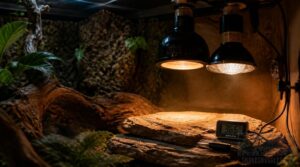
Not every heat source belongs in a snake enclosure, and picking the wrong one can cost your snake more than a bad shed. Your basking spot only works if the equipment behind it produces steady, controllable heat instead of unpredictable spikes. Here’s how the main options stack up against each other.
Understanding the difference between ambient and basking temperatures helps you choose equipment that creates a true gradient instead of one uniform hot zone.
Compare Overhead Heating Options
Before picking a heat source, weigh your options. Radiant panels run efficient and even, ceramic emitters need reflector hoods for focused output, and heat lamps add light that can disrupt nocturnal cycles. Gas heaters pack power but demand ventilation. For most keepers, electric options beat gas: no combustion byproducts, simpler thermostat setup, safer basking spot control.
Match Wattage to Enclosure
Wattage isn’t one-size-fits-all. Enclosure size wattage scales up fast: small tanks run 25-60 watts, medium setups need 60-120, and large enclosures often demand 120-200 watts for a proper gradient.
Factor in heat loss adjustment too. Taller enclosures lose 10-30% more heat, and room temperature shifts your ideal wattage higher or lower depending on airflow and ambient drift. This kind of careful, data-centered approach to reading environmental variables can help you fine-tune wattage decisions rather than relying on guesswork.
Consider Daytime and Nighttime Heat
Getting wattage right only solves half the equation. Your basking spot still needs day-night heat cycling, since reptiles evolved with rising and falling temperatures, not constant heat.
Daytime surface temps should peak within your species range, then taper off. At night, your heat source shouldn’t emit light, dropping surface temps naturally while your thermostat holds a safe minimum.
Avoid Dangerous Heat Rocks
Heat rocks belong on the banned list, period. Their internal coils heat unevenly, and surface temps can spike past 150°F, causing severe thermal burns before you notice a problem.
Skip them entirely. Choose ceramic heat emitters or radiant panels instead, always wired through a thermostat, with placement checked to protect your basking spot’s temperature gradient.
Position The Basking Spot Correctly
Picking the right heat source solves only half the problem. Where you put that basking spot matters just as much, since a poorly placed heat zone can leave your snake stressed instead of settled. Here’s exactly how to position it for real thermoregulation.
Create One Focused Heating Zone

A snake can’t thermoregulate if warmth floods the whole tank. Focused heat placement creates one defined basking spot, not a warm side that blurs into the rest of the enclosure. Aim your heat source, whether an infrared lamp or ceramic heater, at a single contact point under thermostat control.
This zone isolation lets your snake choose between targeted warmth and a genuine temperature gradient.
Place a Warm Hide Nearby
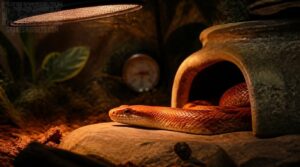
Tuck a hide within 2 to 4 inches of your heat source, entrance facing the warmth. This thermal refuge lets your snake digest and rest without crossing hot substrate. Use furniture-grade plastic or ceramic, vented to avoid trapping heat. Check surface temps under the lid regularly.
Pair that hide with a dedicated thermostat for each heat source, since our guide to proper snake heating and lighting setups breaks down safe temperature ranges for different species.
Nearby hide placement curbs tail-flicking and erratic movement, stabilizing behavior on the warm side.
Maintain Safe Heater Clearance
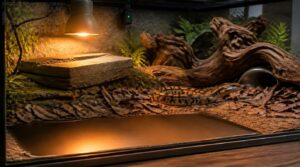
Once your heat source is mounted, clearance becomes the safety issue. Keep 3 feet of open space around any heater, away from bedding, cords, and water bowls. Undertank heat pads need firm, stable placement, never covered.
Confirm tip-over protection is active, and check cords weekly for fraying. Ground rules first, warmth second.
Add Arboreal Basking Perches
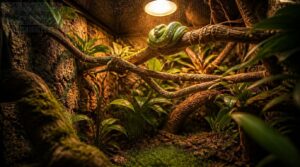
Arboreal species climb toward heat, so your basking zone needs structure, not just floor space.
Position climbing structures at perch height, directly under the heat source, using grapevine or rattan for natural grip texture. Space perches at varied heights for thermal variety. Check weekly for cracks. Keep branches clear of the temperature probe and heater cords entirely.
Preserve a Cool Escape Zone
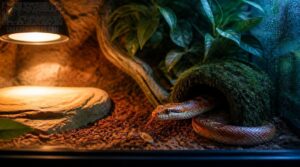
A basking spot only works if there’s somewhere to retreat from it. Place a shaded hide on the cool side, at least 10 to 15°F cooler than the heat source, to preserve real thermal gradient balance.
This cool zone placement lets your snake thermoregulate safely, moving between warm and cool sides as its body demands, without ever getting trapped near the heat.
Install and Configure The Thermostat
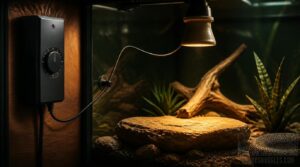
A perfect basking spot means nothing without a thermostat controlling it—no exceptions, no shortcuts. One unregulated heat source is all it takes to turn a basking zone into a burn hazard. Here’s how to wire, place, and back up your thermostat so that never happens.
Connect Every Heat Source
Every heat source in the enclosure needs its own thermostat connection, no exceptions. Wire ceramic emitters, radiant panels, and heat mats through shielded cords to prevent chew risks. Skipping even one device invites runaway heat.
Three wiring priorities:
- Route cords away from substrate
- Use dedicated power distribution
- Shield connections fully
Position The Probe Correctly
Wiring means nothing if the thermostat can’t read true conditions. Set the probe placement at the basking surface’s contact point, not the air above it. For arboreal perch probing, mount it directly on the branch or shelf where coils rest.
Keep it clear of vents to dodge draft-skewed readings that wreck thermal gradient accuracy.
Secure The Probe Firmly
A probe that drifts loses accuracy fast, so lock it down with a heat resistant clip rated for cylinders up to 6mm, or a dedicated mount holding the tip 1.5cm off the substrate.
- No wire tension or loops the snake could snag
- Route cable through a channel, clipped every 10cm
- Recheck calibration against an infrared temperature gun after any bump
Select The Right Thermostat
Not all thermostats regulate heat the same way. On-off models cycle full power, causing swings of several degrees. A proportional thermostat (or dimming thermostat) modulates output continuously, holding basking temps within a degree. For ball pythons needing 88-92°F, that stability matters. Pick proportional units for precise thermal regulation, on-off types only for less sensitive setups.
Add an Overheating Cutoff
A proportional thermostat controls daily swings, but it isn’t a fire safety plan. Add a backup thermostat or thermal fuse as an emergency power cutoff, set to trip a few degrees above your basking target. Test the thermal switch monthly and confirm cutoff threshold alignment with species ranges.
Fail-safe reset options let power resume once surface temperature monitoring confirms safe levels.
Set Species-Specific Basking Temperatures
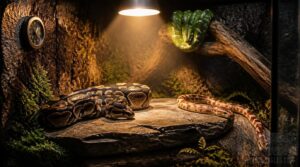
Your thermostat is set, but the target number depends entirely on what species is living in that enclosure. Ball pythons don’t bask like corn snakes, and boas don’t bask like arboreal species. Here’s the exact range you need for each one.
Ball Python Temperature Range
Ball pythons digest best when the Ideal Basking Range sits between 88 and 92°F, verified by infrared temperature gun at contact point, not air.
- Warm zone: 88-92°F
- Cool zone: 76-80°F
- Nighttime low: 70°F
Anything above 95°F risks dehydration. Position your heat source so this basking spot stays consistent, since gradient swings over 5-7°F disrupt feeding and shedding cycles.
Corn and King Snake Range
Generalists by nature, corn snakes and king snakes need less intensity than a ball python. Set the basking spot to 85-88°F, cool side around 75°F.
A well-chosen enclosure design makes hitting those temperature targets much easier — browse some corn snake cage setups that naturally support good thermal gradients for inspiration.
If you’re shopping around, this guide to corn snake heating pad setups breaks down wattage and placement options for different tank sizes.
Their habitat flexibility, from pine forests to urban edges, means captive setups tolerate minor swings better. Still, keep your thermostat locked in.
Prey availability drove this species-specific range: steady rodent diets, moderate metabolism.
Common Boa Temperature Range
Boas run hotter than corn snakes but cooler than pythons. Set ideal basking temps at 88-90°F, with the cool side near 78°F for proper thermal gradient balance.
Verify contact heat with an infrared temperature gun, not ambient readings. Keep the warm side hide close, and maintain humidity during heating around 60% to prevent shedding issues.
Rainbow Boa Temperature Range
Rainbow boas run cooler than most boas, needing a basking surface temp of 80-85°F on the warm side, dropping to 70-75°F on the cool side. Neonates need 82-86°F. Night temps shouldn’t dip below 70°F.
Keep humidity at 70-90% during basking to protect shedding. Verify readings with an infrared temperature gun, not guesswork.
Arboreal Snake Temperature Range
Climbing species need heat where they perch, not the floor. Green tree pythons and tree boas want 85 to 90°F at branch height, dropping to 75-82°F below. Set your thermostat probe at perch level for probe placement accuracy.
- Perch Height Heating places warmth where snakes actually rest
- Thermal Gradient Design requires clear vertical drop-off
- Humidity-Temperature Balance prevents dehydration during basking
- Seasonal Basking Adjustments account for ambient shifts
- Cool zones stay reachable below the warm side
Test and Adjust The Thermal Gradient
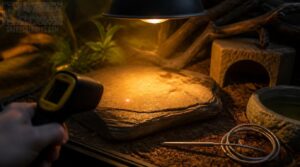
Setting the numbers on paper is one thing—getting them right inside the enclosure is another. Your thermostat and heat source can only do so much if you never check their actual output at snake level. Here’s how to confirm your gradient works the way it’s supposed to.
A good place to start is keeping your heat lamp on a consistent daily schedule—how long to leave a heat lamp on for snakes matters just as much as the temperature itself.
Measure The Basking Surface
Trust your eyes less than your equipment. Point an infrared thermometer straight at the basking surface, not the air above it, right where the snake’s belly makes contact.
| Check | Tool | Frequency |
|---|---|---|
| Surface temp | IR thermometer | Weekly |
| Calibration | Known heat source | Monthly |
| Contact accuracy | Direct aim | Each reading |
Log every number. Drift happens slowly, and your thermostat won’t tell you.
Check Warm and Cool Zones
One number confirms basking accuracy. A second confirms the gradient exists at all.
Aim your thermometer at the cool zone floor. It needs to read several degrees below basking temp, that gap is what drives thermoregulation. No gap means your snake can’t choose, can’t cool down, can’t escape overheating. Zone separation check done, thermal gradient balance holds.
Without a real gap between warm and cool zones, a snake can’t thermoregulate, choose, or escape overheating
Monitor Temperature and Humidity
Zone checks confirm the gradient exists, but only ongoing monitoring keeps it accurate.
Mount a hygrometer and thermometer at mid-height, away from heater airflow and water dishes. Log ambient air temperature and surface temperature every 5 minutes. Set alert thresholds for drift.
Calibrate every 3 to 6 months. Clean sensors monthly, replace worn probes promptly.
Make Seasonal Heating Adjustments
Consistent logs mean nothing if your thermostat setpoints never change with the seasons.
Lower nighttime temps 5-10°F in winter, raise daytime basking 2-4°F during spring and fall transitions.
- Increase overhead heater runtime during winter cold snaps
- Boost wattage 10-20% temporarily if needed
- Recheck setpoints after two weeks
Adjust humidity targets too, higher in summer, lower in winter, to prevent shedding complications.
Correct Common Heating Problems
Seasonal tweaks expose old mistakes fast. Probe positioning errors top the list: a probe too close to a ceramic heat emitter causes rapid cycling and false readings, wrecking thermostat accuracy.
Wattage mismatches show up as stuck cold zones. Gradient imbalance means checking both ends, not just the basking spot temperature range, and recalibrating your thermostat against a fresh gun reading.
Frequently Asked Questions (FAQs)
What substrate depth works best under a basking area?
Think of substrate like a mattress: too thin and you feel the floor, too thick and you sink. Give non-burrowing snakes two to three inches; burrowing species need four to six for stable basking temperatures.
Conclusion
Roughly 20% of reptile burns treated by exotic vets trace back to unregulated heat rocks, a number that should stop any keeper cold. That statistic alone justifies every step above.
Creating a basking spot in a snake enclosure isn’t about buying a lamp and hoping for the best. It’s about wattage, probe placement, clearance, and species-specific numbers working in concert. Get the gradient right, and your snake regulates itself. Get it wrong, and silence hides the damage until it’s done.
The same precision applies to handling tools — a snake hook that pinches instead of supports can bruise underscales and compromise the organs beneath without any immediate sign of harm.