This site is supported by our readers. We may earn a commission, at no cost to you, if you purchase through links.
A snake that can’t regulate its body temperature can’t digest food properly, fight off infection, or behave normally—and most keepers don’t realize this until something already looks wrong. Unlike mammals, snakes rely entirely on their environment to manage internal processes, which means the thermal setup you build determines nearly everything about their long-term health.
Get it right, and your snake eats consistently, sheds cleanly, and stays active on a predictable schedule. Get it wrong, and the signs are subtle at first—a refused meal here, a sluggish response there—until they aren’t.
Providing proper snake heating and lighting isn’t complicated, but it does require matching the right equipment to your specific enclosure, species, and daily routine.
Table Of Contents
- Key Takeaways
- Choose Safe Snake Heat Sources
- Create a Proper Temperature Gradient
- Install UVB and Daylight Lighting
- Choosing Appropriate UVB Lighting for Pet Snakes
- UVB Needs for Diurnal, Nocturnal, Desert, and Tropical Species
- Proper UVB Distance From The Basking Area
- Using LED Lighting for Natural Daylight Cycles
- Creating a 12–14 Hour Day/night Photoperiod
- Why Red and Blue Lights Should Be Limited
- Preventing Metabolic Bone Disease With Proper UVB
- Control Temperatures With Monitoring Equipment
- Using Thermostats With Every Heat Source
- Choosing On/off, Pulse-proportional, or Dimming Thermostats
- Correct Thermostat Probe Placement
- Measuring Warm-side and Cool-side Temperatures
- Using Infrared Temperature Guns for Basking Surfaces
- Monitoring Humidity Alongside Heating and Lighting
- Setting Timers for Lights, UVB, and Heat Lamps
- Maintain Heating and Lighting Safety
- Securing Cords, Fixtures, Guards, and Mesh Screens
- Keeping Heat Sources Away From Water Bowls
- Preventing Burns, Overheating, and Fire Hazards
- Replacing UVB Bulbs Every 6–12 Months
- Logging Bulb Changes and Equipment Checks
- Cleaning Around Fixtures, Hides, Décor, and Substrate
- Budgeting for Bulbs, Thermostats, Timers, and Electricity
- Frequently Asked Questions (FAQs)
- How to properly heat a snake enclosure?
- Do snakes need light or just heat?
- What is the best way to heat a snake?
- What kind of lighting does a snake need?
- Should I leave my snakes heat lamp on at night?
- What is the best heating method for snakes?
- What is the best heating and lighting for a ball python?
- Is it safe to leave a reptile heat lamp on all day?
- What should my snakes heating pad be at?
- How often should I replace my snakes heating equipment?
- Conclusion
Key Takeaways
- Heat rocks are genuinely dangerous and should never be used — they can’t create a proper temperature gradient and will burn your snake before it thinks to move away.
- Every heat source needs its own thermostat, and matching the right type (on/off, pulse-proportional, or dimming) to your specific equipment is what keeps temperatures stable instead of dangerously swinging.
- UVB bulbs lose their output long before they stop glowing, so replacing them every 6–12 months and verifying intensity with a calibrated meter isn’t optional — it’s how you prevent metabolic bone disease.
- A working thermal gradient means setting up a distinct warm side, cool side, and basking zone with hides in both temperature areas, because without accessible retreats, your snake can’t actually use the environment you’ve built.
Choose Safe Snake Heat Sources
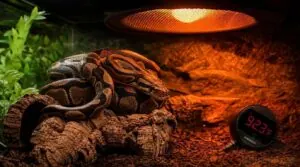
Not all heat sources are created equal, and picking the wrong one can put your snake at real risk. The type of enclosure you have, combined with your snake’s natural habitat, will point you towards the right setup.
Getting the match right matters more than most people realize, so it’s worth checking out this snake cage heat source guide before you buy anything.
Here’s what you need to know before you buy anything.
Matching Heat Sources to Enclosure Type and Snake Species
Not every heat source works in every enclosure — and that mismatch is where most problems start. Maintaining a proper temperature gradient is essential for snake health.
- Glass tank heating works best with under-tank heaters placed on one side only.
- Wood vivarium radiators (radiant panels) mount overhead, avoiding substrate contact.
- Plastic enclosure warmth distributes evenly using low-wattage mats with a thermostat.
Match your heater sizing and heat source placement to your species’ heat requirements first.
Why Heat Rocks Should Never Be Used
Once you’ve matched your heat source to your enclosure type, the next critical decision involves knowing what to avoid entirely. Heat rocks top that list due to their inherent dangers. These devices create a localized burn risk that’s easy to underestimate, as snakes may rest on dangerously hot surfaces without moving away. Reptiles often fail to respond to overheating quickly enough to prevent tissue damage, making heat rocks particularly hazardous. Beyond burns, hot spot failure is common when internal controls malfunction, causing temperatures to rise uncontrollably.
Thermoregulation disruption poses another serious threat. Heat rocks only warm the ventral contact area, preventing snakes from moving between essential temperature gradients. This uneven heating pattern interferes with digestion and normal behavioral thermoregulation, stressing the animal. The absence of a measurable gradient undermines a snake’s ability to self-regulate its body temperature effectively.
| Risk Factor | Heat Rock Problem | Impact on Snake |
|---|---|---|
| Localized burn risk | Surface overheats contact area | Belly burns, scale damage |
| Hot spot failure | Internal thermostat stops working | Uncontrolled temperature rise |
| Thermoregulation disruption | Only ventral area warms | Disrupted digestion, stress |
| Uneven heating | No measurable gradient created | Inability to self-regulate |
| Heat source safety protocols | No external thermostat support | No shutoff if temperature spikes |
Alternative safe methods—such as thermostatic heat mats, radiant panels, and ceramic emitters—mitigate burn risks through external temperature control and proper placement. These options provide reliable, regulated heating that heat rocks lack entirely.
When to Use Overhead Heating Versus Under-tank Heating
Once you’ve ruled out heat rocks, the next step is deciding where your heat source comes from. Enclosure height considerations play a key role here: overhead radiant heat lamps suit tall enclosures and arboreal species, while flat, low setups work better with heat mats or under-tank heaters (UTH).
Species activity zones further guide this choice:
- Ground-dwelling snakes benefit from UTHs and conductive belly warmth
- Climbing species need overhead heat for accurate habitat climate replication
- Desert setups favor radiant heat lamps for broad heat distribution patterns
- Tropical builds often combine both for layered gradients
Under-tank heaters draw less power, making power consumption comparison a critical budget factor. Regardless of the method chosen, heat source placement and safety protocols—including thermostats, guards, and proper positioning—apply equally to both systems.
Choosing Nighttime Heat Without Disrupting Sleep Cycles
Placement and power type are settled — now consider timing. Nighttime heating should rely on ceramic heat emitters paired with thermostat control, dropping the warm side 5–10°F below daytime levels for a gradual temperature shift that facilitates circadian rhythms.
Set a firm nighttime setpoint, enforce light blackout, and address draft mitigation around vents. Maintain thermal stability through consistent thermal gradient design without reintroducing visible light.
Create a Proper Temperature Gradient
A snake can’t regulate its own body temperature the way you do — it depends entirely on the environment you build for it.
Your snake doesn’t regulate its own temperature — it depends entirely on the environment you create
Getting that environment right means thinking in zones, not just single numbers. Each part of the enclosure needs to do its specific job to maintain the snake’s health.
Setting Up a Warm Side, Cool Side, and Basking Zone
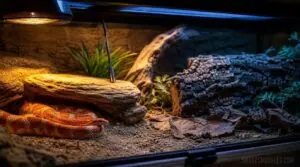
Think of your enclosure as a spectrum, not a switch. Position your heat source at one end to establish the warm side temperature, then allow the opposite end to serve as the cool zone.
Gradient mapping across several points confirms smooth thermal gradient transitions.
Choose basking platform materials—such as flat rocks or cork bark—to enhance substrate heat retention.
Use thermostat control to lock in your basking area precisely, ensuring consistent thermal regulation.
Recommended Basking Temperatures for Most Snakes
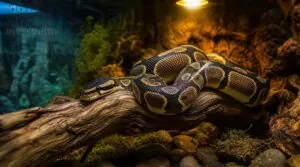
Every snake species runs on a slightly different internal thermostat, so nailing species-specific ranges matters more than most beginners expect. Basking temperatures directly drive digestion, immunity, and activity — get them wrong, and thermal stress signs like lethargy or refusal to eat show up fast.
A ball python temperature and humidity guide can help you dial in exact basking zones while reinforcing safe substrate layering to avoid burns.
Here are five species-specific basking targets to guide your thermal gradient design:
- Ball pythons — 90–92°F warm side, 78–80°F cool side
- Corn snakes — 82–88°F basking zone, 72–78°F cool end
- King/rat snakes — 84–88°F bask spot placement, 74–78°F cool retreat
- Boa constrictors — 88–92°F warm side, 78–80°F cool side
- Garter snakes — 82–85°F basking area, 72–75°F cool zone
Seasonal adjustments also matter — allow a modest 2–3°F dip in winter to mirror natural temperature tolerance limits and support healthy cycling.
Cool-side Temperature Targets for Thermoregulation
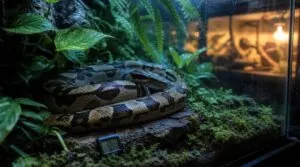
Maintaining the cold side temperature is just as deliberate as setting your basking zone. For most tropical species, target temperature ranges sit between 26–28°C, while boas and pythons often prefer 25–27°C.
High humidity can skew probe calibration methods and push cool-zone readings up by 1–2°C — adjust accordingly.
Seasonal target shifts of 2–3°F downward in winter keep your thermal gradient design biologically accurate.
Desert Versus Tropical Snake Temperature Needs
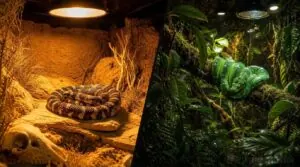
Desert and tropical snakes live in completely different thermal worlds. Desert species need basking temperatures reaching 90–100°F with sharp nighttime cooling down to 60–70°F — that diurnal temperature swings drive their metabolism. Tropical species prefer a steadier 86–92°F basking zone with modest nighttime drops to 75–82°F.
Humidity influences, substrate heat conduction, and species-specific guidelines all shape how you build each thermal gradient.
Placing Hides in Both Warm and Cool Areas
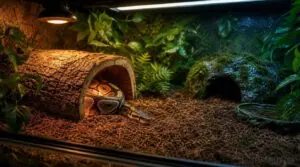
Hides are the backbone of a working thermal gradient — without them, your snake can’t effectively utilize the temperature zones you’ve created. Match hide size to your snake’s body, and position each entrance away from direct heat sources.
Here’s a robust dual-hide configuration:
- Warm hide — placed directly over the heat source with substrate integration underneath
- Cool hide — positioned at the far end, maintaining a moisture gradient to support shedding
- Elevated secure hides — for species that prefer height, ensuring multiple hides remain accessible across both temperature zones
Designing Vertical Basking Spots for Climbing Snakes
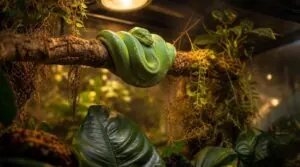
Climbing snakes don’t bask at floor level — they want height, warmth, and something solid underfoot.
Perch Diameter should match your snake’s body thickness, and Support Strength matters more than looks.
Keep Clearance Distance between perch and heat source safe, and choose a Surface Material that grips well.
Height Placement and heat lamp placement work together to complete your temperature gradient design.
| Feature | Recommendation | Why It Matters |
|---|---|---|
| Perch Diameter | Match snake body width | Prevents slipping, bears weight |
| Height Placement | Warm side, upper third | Aligns with natural basking behavior |
| Surface Material | Cork bark or smooth branch | Reduces abrasion risk |
| Clearance Distance | 9–12 inches from heat source | Prevents burns |
| Support Strength | Anchored, no movement | Safe climbing during thermoregulation |
Install UVB and Daylight Lighting
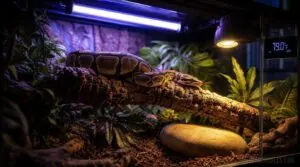
Lighting does more than brighten your snake’s enclosure — it drives essential biological processes that affect long-term health. Getting it right means understanding which bulbs your snake actually needs, how far to position them, and how to structure the daily light cycle.
Here’s what you need to set up UVB and daylight lighting correctly.
Choosing Appropriate UVB Lighting for Pet Snakes
Not all UVB bulbs are created equal — spectrum selection matters as much as wattage. For choosing appropriate UVB lighting for reptiles, use T5 HO fluorescent tubes rated 6%–12% output. UVB lighting requirements for reptile health also require fixture shielding, meter calibration checks, and tracking UVB bulb lifespan every 6–12 months.
Five essentials for smart UVB setup:
- Match UVB bulb types to enclosure size
- Verify UVB intensity with a calibrated meter
- Apply seasonal UVB adjustments quarterly
- Shield fixtures to protect eyes from direct exposure
- Log species-specific lighting considerations alongside replacement dates
UVB Needs for Diurnal, Nocturnal, Desert, and Tropical Species
Ferguson Zone Mapping groups species by natural sun exposure, guiding UVB dose calculations for captive setups. This system ensures tailored lighting for different snake species. Diurnal species require UVB intensity reaching a UVI of 1.0–3.5 at the basking spot, while nocturnal snakes thrive with low-output options.
Desert species demand 10–12% UVB spectrum output, whereas tropical species maintain better health with 5% UVB. These distinctions reflect their evolutionary adaptations to specific environments.
Shade provision strategies allow every snake to self-regulate exposure, promoting natural behavior and well-being in captivity.
Proper UVB Distance From The Basking Area
Once you’ve matched UVB dosage to your snake’s species needs, placement determines whether that dosage actually reaches the basking area. Measure UVB intensity at basking height measurement — specifically at your snake’s back level, not the floor.
T5 HO tubes work best placed 12–16 inches inside enclosures. However, mesh screens and lamp guards significantly reduce output, so shorten that distance accordingly.
Use adjustable platform heights to optimize exposure. Always confirm safe levels with UVB meter calibration.
Using LED Lighting for Natural Daylight Cycles
LEDs bring more to the table than just visibility. With tunable color temperature, you can run a full 6500K daylight spectrum during peak hours, then ease into warmer tones at dusk using sunrise-sunset ramps spanning 15–60 minutes.
Smart timer integration automates those shifts daily. Keep brightness calibrated between 300–1000 lux and confirm flicker-free operation — your snake’s eyes will thank you.
Creating a 12–14 Hour Day/night Photoperiod
Set your timer for 12–14 hours of light daily — 14 in summer, 12 in winter — to support healthy day-night lighting cycles and circadian rhythm support. Timer ramp programming manages gradual sunrise/sunset transitions automatically.
Dark period integrity matters just as much: light leak prevention prevents stray room light from disrupting the full 8-hour dark period.
Consistent daily timing keeps your snake’s internal clock synchronized.
Why Red and Blue Lights Should Be Limited
Red and blue LED lights might seem like handy tools for nighttime observation, but they carry real risks. Blue light pollution drives melatonin suppression and circadian disruption in snakes, throwing off their circadian rhythm even at low intensities. Red light, however, offers far better safety—it skips harmful short wavelengths entirely.
For nocturnal observation, prioritize spectral filtering or warm-toned sources over standard colored LEDs. This approach minimizes ecological disruption while maintaining visibility, ensuring safer practices for both wildlife and observers.
Preventing Metabolic Bone Disease With Proper UVB
Skipping UVB entirely is one of the fastest routes to metabolic bone disease. Without proper UVB intensity, timing, and spectral output quality, vitamin D3 synthesis stalls, and calcium absorption is compromised.
Even calcium-rich diets can’t compensate when the UVB bulb is outdated or mispositioned.
Preventing metabolic bone disease through proper UVB means replacing bulbs every 6–12 months and tracking blood calcium levels alongside your UVB requirements schedule.
Control Temperatures With Monitoring Equipment
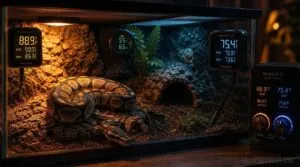
Getting the heat right is only half the job — knowing it’s right is what actually keeps your snake safe.
That means using the correct monitoring tools, placed correctly, and set up to work together.
Here’s what you need to control and track temperatures properly.
Using Thermostats With Every Heat Source
Every heat source in your enclosure needs its own thermostat — no exceptions. Without heat source regulation, temperatures can spike dangerously fast.
Zone thermostats let you control each device independently, so your basking lamp and heat mat never compete. Smart integration with a central controller simplifies energy tracking and temperature monitoring.
Run a thermostat calibration routine monthly to catch drift before it becomes a problem.
Choosing On/off, Pulse-proportional, or Dimming Thermostats
Not all thermostats work the same way — and matching the right type to your heat source is what separates stable temperatures from dangerous swings.
- On/off thermostats — low-cost, reliable for heat mats, but temperature stability suffers from wider cycling gaps.
- Pulse-proportional thermostats — best for ceramic emitters, improving energy efficiency through rapid modulation.
- Dimming thermostats — required for incandescent basking bulbs, providing smoother temperature monitoring and minimal flicker stress.
Always verify wiring requirements and wattage ratings before connecting.
Correct Thermostat Probe Placement
A misplaced probe is the same as a broken thermostat — your temperature sensor placement defines what the system actually controls.
Mount the probe on a safe mounting surface like glass or tile, 2–5 cm from the heat source for correct probe distance.
Maintain ideal probe height near the basking zone, Avoid draft zones near vents.
Schedule regular probe validation monthly to keep digital thermostats and your temperature gauge accurate.
Measuring Warm-side and Cool-side Temperatures
Once your probe placement is locked in, your next task is to monitor the overall temperature profile. Use a Multiple Probe Strategy—one digital thermometer on the warm side near the basking zone, another mid-enclosure on the cool side.
Target 88–92°F warm, 76–82°F cool to maintain a proper gradient.
Run sensor battery checks monthly, monitor for temperature drift alerts, and log Ambient Surface Comparison readings to ensure accuracy and consistency.
Using Infrared Temperature Guns for Basking Surfaces
Digital thermometers measure air temperature, but your snake lives on surfaces. That’s where an infrared temperature gun earns its place. By pointing it perpendicular to the basking spot and maintaining a consistent distance each time, you’ll obtain reliable surface emissivity readings that a probe simply can’t capture.
To ensure accuracy, follow these essential practices:
- Apply Calibration Procedures against a known reference surface monthly
- Use Min Max Logging to track temperature swings across the day
- Aim the infrared temperature gun at the heat source zone, not beside it
- Keep Perpendicular Targeting consistent for accurate basking area readings
Monitoring Humidity Alongside Heating and Lighting
Heat isn’t the only variable your enclosure is managing — humidity levels ride alongside temperature every hour of the day. Managing humidity alongside lighting means placing sensors at mid-height, away from water bowls and heat sources, for accurate enclosure humidity management.
| Metric | Warm Side | Cool Side |
|---|---|---|
| Daytime RH Target | 40–55% | 50–60% |
| Alert Thresholds | Above 65% | Below 35% |
| Sensor Placement | Away from basking lamp | Near substrate, mid-height |
| Calibration Schedule | Monthly | Monthly |
Use a data logger to capture readings every 10–30 minutes. Pair substrate moisture checks with your RH data — wet substrate skews everything.
Setting Timers for Lights, UVB, and Heat Lamps
Once humidity is dialed in, timers become your enclosure’s backbone. Use dual outlet timers to run your basking lamp and UVB lamp together, then automate the full lighting schedule — 12 to 14 hours on, 8 hours of true darkness.
Stagger the sequence: LEDs first, then UVB, then heat. Sunrise/sunset ramping mimics natural light shifts.
Always plug into surge-protected outlets, verify wattage compliance, and keep a backup timer system ready.
Maintain Heating and Lighting Safety
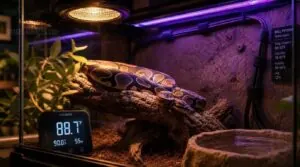
Getting the setup right is only half the job — keeping it safe is what protects your system long-term.
A few consistent habits around your equipment will prevent burns, overheating, and costly failures before they happen. Here’s what to stay on top of.
Securing Cords, Fixtures, Guards, and Mesh Screens
Loose cords and unsecured fixtures are a fire waiting to happen. Use cord clips and cable channels to route power cleanly, keeping wires elevated and away from humidity zones. Mount fixtures with nonconductive brackets, and cover every heat source with stainless steel mesh guards backed by rigid frames.
- Secure excess cord with zip ties
- Install heat shields made from ceramic or tempered glass
- Anchor mesh guards with corrosion-resistant fasteners
- Inspect protective guards weekly for cracks
Electrical safety and heat lamp safety depend entirely on consistency — inspect everything regularly.
Keeping Heat Sources Away From Water Bowls
Water and heat are a bad combination in any enclosure. Maintain Bowl Distance Guidelines of at least 6–8 inches from heat sources by placing your water bowl on the cool zone side. A Heat Shield Barrier, mounted to the enclosure wall, blocks radiant energy while supporting Condensation Management and Splash Prevention Setup.
For optimal Cool Zone Bowl Placement, follow this guide:
| Placement Factor | Recommendation |
|---|---|
| Minimum distance from heat lamp | 6–8 inches |
| Bowl position | Cool-side wall |
| Heat shield material | Nonflammable barrier |
| Condensation control | Cool airflow zone |
| Splash prevention | Away from heated decor |
Preventing Burns, Overheating, and Fire Hazards
Burns and fires in snake enclosures almost always trace back to a handful of preventable mistakes. Fit every bulb with Metal Lamp Guards to block direct contact, and route cords through Cable Heat Shields to manage Electrical safety risks.
Your thermostat’s built-in Thermostat Fail‑Safe stops runaway heating, but Redundant Temperature Monitoring confirms it’s actually working.
Use Fire‑Resistant Substrate, avoid heat rocks entirely, and your Burn risk mitigation plan is solid.
Replacing UVB Bulbs Every 6–12 Months
UVB output decay is the silent problem most keepers miss — the bulb still glows, but the UV is already gone. Build your replacement schedule around these guidelines:
- Replace linear T8 fluorescents every 6–8 months
- Replace T5 HO bulbs annually
- Replace compact fluorescents every 6 months
- Use meter-based replacement if UVI drops below species requirements early
Clean fixture lenses monthly and label install dates so nothing slips through.
Logging Bulb Changes and Equipment Checks
A good log is your second set of eyes. Every UVB replacement entry should capture the date, bulb type, wattage, brand, and fixture location — that’s your Change Timestamping and Bulb Type Tracking working together.
| Log Field | What to Record | Why It Matters |
|---|---|---|
| Date & Time | Exact change timestamp | Tracks bulb lifespan accurately |
| Bulb Details | Type, wattage, brand | Ensures compatible UVB replacement |
| Condition Notes | Flickering, dimming, heat | Flags equipment needing inspection |
Inspection Checklists keep your Maintenance Frequency honest. Quarterly Compliance Reviews catch drift before it harms your snake.
Cleaning Around Fixtures, Hides, Décor, and Substrate
Dust is the quiet enemy of your enclosure’s performance. A solid Cleaning Tool Checklist — microfiber cloth, soft brush, cotton swabs, infrared gun — keeps your Fixtures Dust Removal and Hide Sanitation Routine efficient every week.
- Wipe light fixtures with a dry microfiber cloth for reliable UVB lamp maintenance
- Swab Hide interiors to remove secretions without soaking
- Apply the Substrate Sifting Method to clear surface mold
- Inspect Decor closely for early Decor Mold Prevention
- Reassemble and test fixtures after routine deep cleaning
Budgeting for Bulbs, Thermostats, Timers, and Electricity
Once your enclosure is clean and running smoothly, it’s time to think about the real cost of keeping it that way. Initial Equipment Costs include thermostats around $49.98 and timers built for solid Timer Capacity Planning.
Annual Bulb Replacement means budgeting two UVB bulbs yearly. A 100-watt basking lamp adds roughly $7 monthly in Energy Consumption Costs.
So thermostat investment and cost-effective heating solutions genuinely pay off long-term.
Frequently Asked Questions (FAQs)
How to properly heat a snake enclosure?
Proper snake heating starts with a reliable thermostat controlling your heat lamp or ceramic heat emitters.
A clear thermal gradient from warm to cool side ensures the snake can regulate its body temperature effectively.
Implement backup heating and power outage protocols to maintain consistent warmth during emergencies.
Do snakes need light or just heat?
Snakes need both heat and UVB exposure. Heat drives ectothermic regulation and digestive efficiency, while UVB exposure helps vitamin D3 synthesis and behavioral activity.
Without proper lighting and heating, you risk metabolic bone disease and chronic stress response.
What is the best way to heat a snake?
No single heat source works for every snake.
The best approach combines a thermostat-controlled under-tank heater or ceramic emitter with temperature mapping tools to create a reliable thermal gradient suited to your species.
What kind of lighting does a snake need?
Your snake’s lighting needs depend on its species. Diurnal snakes require UVB lighting for vitamin D3 synthesis, while nocturnal species need minimal light.
Species-specific lighting considerations always drive your fixture placement strategy and spectrum choices.
Should I leave my snakes heat lamp on at night?
No, don’t leave it on. Visible heat lamps disrupt a snake’s circadian rhythm. Switch to a ceramic heat emitter at night — it maintains your thermal gradient without interfering with sleep.
What is the best heating method for snakes?
No single method wins outright — the best heating method depends on your species.
Ceramic heat emitters, radiant heat panels, and heat mats each serve distinct roles when paired with a thermostat.
What is the best heating and lighting for a ball python?
Ball pythons thrive with a thermostat-controlled overhead heat lamp, a basking zone of 88–92°F, a cool side at 75–80°F, and a 12–14 hour photoperiod using full-spectrum LED lighting.
Is it safe to leave a reptile heat lamp on all day?
Too much of a good thing can harm. Leaving a heat lamp on all day causes Thermal Regulation Failure and Stress Hormone Release.
Stick to a 12-hour on/off cycle for your snake’s health.
What should my snakes heating pad be at?
Set your heat mat to maintain 88°F to 95°F on the warm side.
Use a thermostat and digital temperature gauge to verify temperature stability, and never neglect monitoring — guesswork can harm snakes.
How often should I replace my snakes heating equipment?
Replace UVB bulbs every 6–12 months, infrared lamps on the same schedule.
Heat mats and ceramic emitters usually last 5–7 years.
Run a monthly inspection routine and keep a spare parts budget ready.
Conclusion
Your snake doesn’t care how much research you did—it only reacts to what you’ve actually built. Providing proper snake heating and lighting isn’t a one-time setup; it’s a system you calibrate, monitor, and maintain season after season. Get the gradient right, run the UVB on schedule, and let the thermostat do its job.
Do that consistently, and your snake will show you exactly what a well-regulated environment looks like: steady feeding, clean sheds, and predictable behavior.
- https://therepstylist.wordpress.com/2020/04/01/creating-a-temperature-gradient/
- https://toadranchcages.com/blogs/news/best-ways-to-heat-your-reptile-enclosure?srsltid=AfmBOopvPmEAjTf-G-YC6I2neFLg9GTaYHx-zuMa3sfIB-xUNIiJnAw8
- https://showmereptileshow.com/resources/creating-a-natural-environment-for-snakes-the-importance-of-uvb-lighting