This site is supported by our readers. We may earn a commission, at no cost to you, if you purchase through links.

Getting snake cage heat source right isn’t optional—a cold snake is a stressed snake, and a stressed snake stops eating, stops growing, and starts getting sick. Reptiles can’t generate their own body heat, so every degree inside that enclosure either promotes digestion and immune function or quietly undermines it.
Most keepers understand this in theory, but the gap between knowing temperature matters and actually choosing the right heating equipment trips up beginners and experienced hobbyists alike.
Ceramic emitters, heat mats, dimming fixtures, UVB combo lamps—each one solves a different problem, and the wrong choice for your setup creates new ones.
Table Of Contents
- Key Takeaways
- Top 10 Snake Cage Heat Sources
- 1. Reptitrip Dual UVB Heat Lamp
- 2. Domica E26 Ceramic Heat Emitter
- 3. REPTI ZOO Dimming Reptile Light Fixture
- 4. Lucky Herp Ceramic Heat Emitter
- 5. DXOPHIEX Dual Reptile Light Fixture
- 6. REPTI ZOO Reptile Heat Lamp
- 7. Pawfly Reptile Heat Pad
- 8. BN LINK Reptile Heating Pad Thermostat
- 9. iPower Reptile Terrarium Heating Pad
- 10. BN Link Reptile Heating Pad
- Choosing Heat for Your Snake
- Heat Mats and Heat Tape
- Ceramic Emitters and Deep Heat
- Radiant Panels for Large Enclosures
- Heat Lamps and UVB
- Thermostats and Temperature Probes
- Safe Installation and Fire Prevention
- Temperature Gradients and Monitoring
- Frequently Asked Questions (FAQs)
- What is the best heat source for a snake enclosure?
- How to humidify a snake enclosure?
- What are the sources of heat for snakes?
- What is the best heat source for a PVC enclosure?
- How to keep a snake enclosure warm?
- How to heat reptile enclosures?
- What is the cheapest way to heat a vivarium?
- What is the ideal temperature for a ball pythons cage?
- How do I choose the right heat source for my snake?
- Can I use a heat rock as a heat source?
- Conclusion
Key Takeaways
- Every snake enclosure needs a thermostat paired with its heat source — without one, even a quality ceramic emitter or heat mat can overheat your snake or become a fire risk.
- The right heat source depends on your specific setup: heat mats deliver belly warmth for smaller tanks, ceramic emitters handle 24-hour heating without disrupting nocturnal species, and radiant panels distribute even overhead heat for larger PVC or wood enclosures.
- A proper temperature gradient — warm side at 88–95°F and cool side at 22–26°C — is what lets your snake actually thermoregulate, digest food, and stay healthy, not just survive.
- Heat rocks are never a safe option because snakes can’t detect belly overheating until the damage is already done, making burns and thermal inconsistency an unavoidable risk.
Top 10 Snake Cage Heat Sources
Not all heat sources work the same way, and picking the wrong one can stress your snake or create real safety risks. The ten options below cover the most reliable choices across different setups, wattages, and heating styles.
If you want a side-by-side breakdown before committing, this snake terrarium heating options comparison lays out exactly how each type performs in real setups.
Here’s what’s worth your attention.
1. Reptitrip Dual UVB Heat Lamp
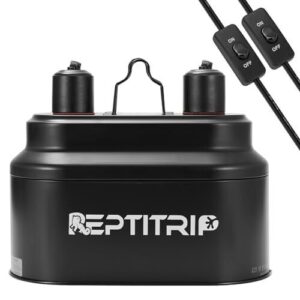
Reptitrip Dual UVB Heat Lamp gives you two jobs in one fixture — UVB exposure and ambient light — without piling on extra heat your snake doesn’t need. Its 8-watt LED-based UVB output suits compact enclosures well, and because it runs cool, you won’t fight overheating issues the way you might with a ceramic emitter.
The timer-compatible control makes scheduling daytime UVB cycles straightforward.
Pair it with a separate heat source, and you’ve got clean, independent control over both elements.
| Best For | Reptile owners who want precise, separate control over basking heat and UVB lighting for bearded dragons, tortoises, or ball pythons. |
|---|---|
| Heat Type | Radiant/lamp |
| Power Rating | 160W per socket |
| Voltage | 120V AC |
| Built-in Thermostat | No |
| Warranty | Not specified |
| Bulbs/Pads Included | 0 (fixture only) |
| Additional Features |
|
- Two independent switches let you control heat and UVB separately — no more all-or-nothing setups.
- The polished interior bounces light and UVB back into the enclosure, so your reptile actually gets more out of every bulb.
- All-metal build handles the heat and the bumps of a busy household without flinching.
- Bulbs aren’t included, so factor that into your budget before you buy.
- The exterior gets seriously hot during use — not something you want to grab by accident.
- No built-in timer, so you’ll need a separate smart plug or controller if you want automated day/night cycles.
2. Domica E26 Ceramic Heat Emitter
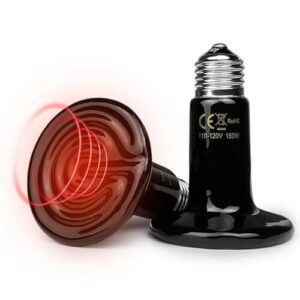
When you need heat without any light at all, the Domica E26 Ceramic Heat Emitter earns its place. Running at 150W, it pumps out steady infrared warmth around the clock without touching your snake’s photoperiod — a real advantage for nocturnal species.
The high-density ceramic body manages temperatures up to 500°F, and the standard E26 base fits most common reptile fixtures.
Just pair it with a thermostat, because that surface gets seriously hot.
| Best For | Reptile and small animal owners who need round-the-clock heat without any light disruption, especially for nocturnal species. |
|---|---|
| Heat Type | Infrared ceramic |
| Power Rating | 150W per bulb |
| Voltage | 110-120V AC |
| Built-in Thermostat | No |
| Warranty | Not specified |
| Bulbs/Pads Included | 2 bulbs |
| Additional Features |
|
- Keeps heat going all night without messing with your animal’s day/night cycle
- Tough ceramic build means it lasts longer than glass heat bulbs
- Fits standard E26 fixtures, so no special hardware needed
- No indicator light, so you can’t tell at a glance if it’s actually working
- Surface gets dangerously hot — a thermostat isn’t optional, it’s essential
- Some users report units arriving dead out of the box
3. REPTI ZOO Dimming Reptile Light Fixture
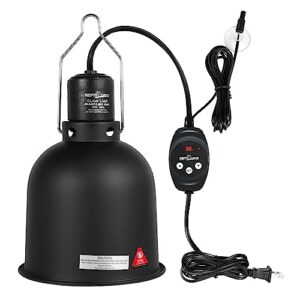
If your snake needs both visible light and controlled heat during the day, the REPTI ZOO Dimming Reptile Light Fixture gives you real precision. Its integrated PID dimming thermostat adjusts output automatically, holding your target temperature without constant manual tweaking.
The 5.5-inch deep aluminum dome concentrates heat and boosts UVA output, and the ETL-certified E26 socket supports bulbs up to 100W.
One thing to watch: probe placement matters here — put it wrong, and the lamp won’t read the enclosure accurately.
| Best For | Reptile keepers who want hands-off temperature control for basking setups — especially those housing bearded dragons, turtles, or other heat-loving species. |
|---|---|
| Heat Type | Radiant/lamp |
| Power Rating | 100W max |
| Voltage | 120V AC |
| Built-in Thermostat | Yes |
| Warranty | Not specified |
| Bulbs/Pads Included | 0 (fixture only) |
| Additional Features |
|
- The PID thermostat keeps temps steady without you hovering over it — great for maintaining consistent basking zones.
- The deep aluminum dome focuses heat and boosts UVA output, so you’re getting more out of every watt.
- ETL-certified build means it’s been tested for safety, and the E26 socket handles up to 100W bulbs.
- No power switch on the unit itself — you’ll need to unplug it or grab a smart strip if you want to turn it off.
- Some users have reported the thermostat not cutting off heat in colder rooms, which could stress your animals.
- Probe placement is a bit fussy — put it in the wrong spot and your temperature readings will be off.
4. Lucky Herp Ceramic Heat Emitter
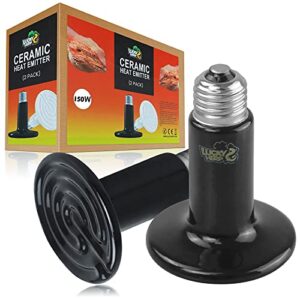
When visible light isn’t what you need — especially overnight — the Lucky Herp Ceramic Heat Emitter fills that gap cleanly. Rated at 150W with an E26 base, it produces pure infrared heat with zero light output, so your snake’s day-night rhythm stays intact.
It reaches working temperature in about four minutes and is built to last up to 10,000 hours. Pair it with a quality thermostat and ceramic fixture, and it runs reliably through the night without skipping a beat.
| Best For | Reptile and amphibian owners who need consistent overnight warmth without disrupting their animal’s natural sleep cycle. |
|---|---|
| Heat Type | Infrared ceramic |
| Power Rating | 150W per bulb |
| Voltage | 120V AC |
| Built-in Thermostat | No |
| Warranty | Not specified |
| Bulbs/Pads Included | 2 bulbs |
| Additional Features |
|
- Zero light output means your reptile’s day-night rhythm stays completely undisturbed
- Heats up fast — you feel warmth within 10 seconds and hit full temp in about 4 minutes
- Built to last up to 10,000 hours, so you’re not swapping bulbs every few months
- Gets extremely hot to the touch, so mounting and placement need to be done carefully
- Frequent on/off cycling can shorten its lifespan — it likes to run steady, not constantly toggled
- Reliability can be hit or miss; some users report premature failure, so quality fixtures matter
5. DXOPHIEX Dual Reptile Light Fixture
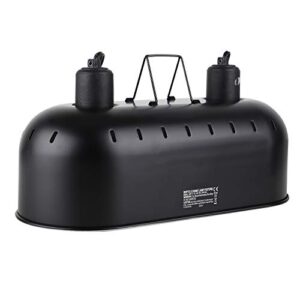
The DXOPHIEX DLF15 gives you two independent 150W sockets in one compact 15-inch housing — so you can run a ceramic heat emitter on one side and a UVB bulb on the other without crowding your enclosure lid. Each dome has its own switch, letting you cut one source while keeping the other active.
The built-in red warning indicator is a smart safety touch: when it lights up, keep your snake clear.
Just watch the cord routing — it can contact the hood if left unchecked.
| Best For | Reptile keepers who need both heat and UVB in one tidy fixture — great for bearded dragons, tortoises, and lizards in medium to large enclosures. |
|---|---|
| Heat Type | Radiant/lamp |
| Power Rating | 150W per socket |
| Voltage | 120V AC |
| Built-in Thermostat | No |
| Warranty | Not specified |
| Bulbs/Pads Included | 0 (fixture only) |
| Additional Features |
|
- Two independent sockets and switches let you control heat and UVB separately without juggling two fixtures
- Built-in red warning indicator is a simple, no-fuss safety feature that tells you when things are running hot
- Solid heat dissipation across 15 inches means fewer hot spots and longer bulb life
- The power cord can brush against the hood if you’re not careful about routing it, which is a real burn risk
- 150W per side might not cut it for larger enclosures that need more serious heat output
- The hanging hook needs a secure mount — if it’s not anchored well, the whole fixture can sag or drop
6. REPTI ZOO Reptile Heat Lamp
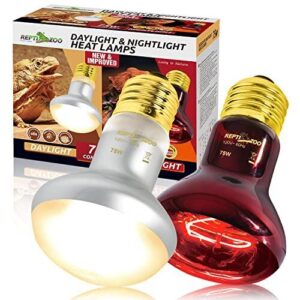
The REPTI ZOO Reptile Heat Lamp pairs a standard E26 ceramic base with a reflective interior that focuses infrared heat directly onto your basking zone — no wasted output. Rated up to 150W per socket, it supports ceramic heat emitters for 24-hour warming or daytime basking bulbs without breaking a sweat.
Built-in ventilation keeps the fixture from overheating, and the protective cover reduces direct contact risk.
Pair it with a thermostat and you’ve got reliable, controllable warmth, your snake will actually use.
| Best For | Reptile owners who need round-the-clock heat for species like bearded dragons or leopard geckos and want day/night lighting handled by a single combo pack. |
|---|---|
| Heat Type | Infrared/UVA lamp |
| Power Rating | 75W per bulb |
| Voltage | 120V AC |
| Built-in Thermostat | No |
| Warranty | 90 days |
| Bulbs/Pads Included | 2 bulbs |
| Additional Features |
|
- Covers both day and night with one purchase — the UVA bulb handles daytime basking while the infrared lamp keeps things warm overnight without disturbing your reptile’s sleep cycle.
- UVA light helps stimulate appetite and supports healthy calcium metabolism, which is a real win for reptile health long-term.
- 90-day replacement policy with a 24-hour response promise gives you some peace of mind if something goes wrong early on.
- Real-world bulb life often falls well short of the advertised 2,000–3,000 hours — some users report burnout in just one to three months.
- These bulbs run hot, so you’ll likely need a heat gun or thermometer to make sure your enclosure isn’t creeping into dangerous temperature territory.
- The product listing has some confusing details (like a "400W scent" description) that suggest possible errors — worth double-checking specs before you buy.
7. Pawfly Reptile Heat Pad
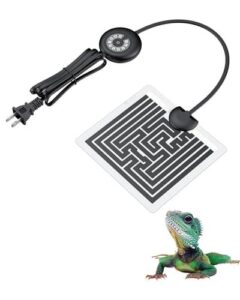
The Pawfly Reptile Heat Pad keeps things simple where it counts. Its graphene element draws just 5 watts while spreading heat evenly across a compact 5.9 × 5.5-inch surface — no hot spots, no temperature spikes.
That steady, low-wattage output pairs well with a reliable thermostat — a combination worth understanding before you set up your snake enclosure heating system.
Ten selectable levels let you dial in belly heat between 85–90 °F for most snakes, and the IPX3‑rated surface wipes clean easily.
At 3.5 oz, it sits unobtrusively under small enclosures.
Pair it with a separate thermostat, though — the built‑in control alone isn’t enough for precise, reliable warmth.
| Best For | Small reptile and amphibian owners who need a simple, low-cost heat pad for compact enclosures. |
|---|---|
| Heat Type | Conductive pad |
| Power Rating | 5W |
| Voltage | 120V AC |
| Built-in Thermostat | Yes |
| Warranty | Not specified |
| Bulbs/Pads Included | 1 pad |
| Additional Features |
|
- Graphene element spreads heat evenly across the surface — no hot spots
- Ten temperature levels give you decent control for belly heat
- Ultra-thin and lightweight, so it tucks under tanks without getting in the way
- Won’t cut it for larger or well-insulated enclosures — heat output is just too low
- No built-in attachment system, so you’ll need tape or zip ties to keep it in place
- Some users report failures after a month or two, so keep that warranty info handy
8. BN LINK Reptile Heating Pad Thermostat
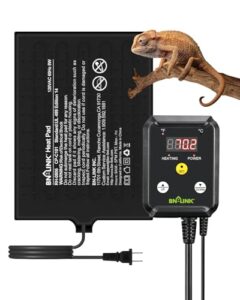
The BN LINK Reptile Heating Pad Thermostat earns its spot by bundling the pad and controller into one ready-to-use kit.
The 6×8-inch pad draws just 8 watts, making it right-sized for 10–25 gallon enclosures.
Its digital thermostat adjusts between 40–108 °F, and the three-button interface keeps setup quick.
Place the probe near the warm hide, not directly on the pad, for accurate readings.
One limitation worth noting: at 8 watts, don’t expect it to heat tanks larger than 20 gallons reliably.
| Best For | Reptile and small animal owners who want a simple, all-in-one heating solution for 10–25 gallon enclosures housing turtles, lizards, frogs, or hermit crabs. |
|---|---|
| Heat Type | Conductive pad |
| Power Rating | 8W |
| Voltage | 120V AC |
| Built-in Thermostat | Yes |
| Warranty | 15 months |
| Bulbs/Pads Included | 1 pad |
| Additional Features |
|
- Comes as a complete kit — pad and digital thermostat included, so there’s nothing extra to buy
- Easy three-button setup with a wide 40–108 °F range and a clear LCD display you can read in the dark
- Water-resistant and flexible, so it works on tank sides or bottoms and even doubles for mushroom chambers or small incubators
- At only 8 watts, it struggles to heat tanks over 20 gallons or spaces with poor insulation
- Some users report the pad can’t always hit or hold the temperature the controller is set to
- Packaging sometimes arrives damaged, and the two-piece setup can cause confusion about which temperature spec applies to what
9. iPower Reptile Terrarium Heating Pad
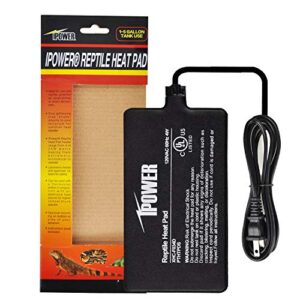
iPower Reptile Terrarium Heating Pad keeps things simple for smaller setups. At just 4 watts, it’s built for 1–5 gallon tanks — think hatchling tubs or temporary enclosures, not a full adult ball python setup.
The PTC heating film warms up fast and spreads heat evenly, and the waterproof fabric surface makes cleaning easy.
That said, you’ll want an external thermostat — this pad can run warm on its own.
The 3M adhesive holds well on smooth glass, and the 6-foot cord gives you real flexibility.
| Best For | Hobbyists with small terrariums (1–5 gallons) housing hatchlings, spiders, amphibians, or small reptiles who need reliable, low-cost bottom heat. |
|---|---|
| Heat Type | Conductive pad |
| Power Rating | 4W |
| Voltage | 120V AC |
| Built-in Thermostat | No |
| Warranty | Not specified |
| Bulbs/Pads Included | 2 pads |
| Additional Features |
|
- Heats up fast and spreads warmth evenly thanks to the PTC heating film
- Waterproof surface is easy to wipe down between uses
- Low 4W draw keeps electricity costs minimal over time
- Can run hotter than you want — an external thermostat is pretty much a must
- Adhesive backing doesn’t stick well to every surface, so you might need extra fastening
- Only suited for small tanks; larger setups will need a higher-wattage option
10. BN Link Reptile Heating Pad
The BN Link Reptile Heating Pad punches above its weight for a 16W under-tank heater. It covers a 12×8 inch footprint, making it a solid fit for 10–20 gallon terrariums housing ball pythons or corn snakes.
Surface temps reach 104–122°F, so pairing it with an external thermostat isn’t optional — it’s essential.
The waterproof, flexible backing sticks cleanly to glass and holds up in humid setups. Just don’t skip that thermostat, and your snake’s warm side stays dialed in.
| Best For | Reptile owners with 10–20 gallon tanks who want a low-cost, space-saving heat source for snakes, lizards, or amphibians. |
|---|---|
| Heat Type | Conductive pad |
| Power Rating | 16W |
| Voltage | 120V AC |
| Built-in Thermostat | No |
| Warranty | 15 months |
| Bulbs/Pads Included | 1 pad |
| Additional Features |
|
- Heats up fast and stays in the 104–122°F range, giving your reptile a solid warm side
- Waterproof and flexible — sticks well to glass and holds up in humid enclosures
- Low energy draw at 16W keeps running costs minimal over time
- No built-in thermostat, so you’ll need to buy one separately to avoid overheating your animal
- Adhesive can weaken over time, especially at the edges, and may need reinforcing
- Some users report uneven heat distribution or partial failures, so quality can vary unit to unit
Choosing Heat for Your Snake
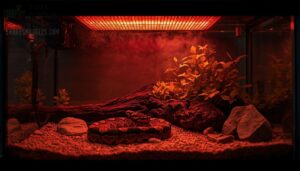
Not every heat source works for every snake, and a lot of that comes down to your specific setup. The right choice depends on your enclosure size, the species you’re keeping, and how you want to manage temperatures through the day and night.
Here’s what you need to think through before deciding.
Cage Size and Enclosure Material
Your enclosure shape and material directly affect which heat source will actually work. A too-small cage can’t hold a proper gradient, and the wrong material will fight your setup every step of the way.
Before buying anything, consider:
- Minimum Floor Area — length-to-width ratio should support full-body stretching
- PVC and custom reptile enclosures — better material moisture resistance than glass
- Heat distribution uniformity — solid panels outperform spot sources in enclosed builds
- Secure latch design — enclosure insulation and heat source selection based on enclosure size both depend on a sealed environment
Using foam-core PVC panels can considerably improve heat retention and reduce heater cycling.
Ball Python, Corn Snake, and Boa Needs
Each species has its own sweet spot.
Ball pythons need a warm side of 88–92°F, while corn snakes do well at 85–90°F — and boas sit comfortably around 90–92°F for basking.
Pair heat mats or ceramic heat emitters with a thermostat to hold that temperature gradient steady, and hydration management, shedding assistance, and proper escape prevention all fall into place naturally.
Daytime Versus Nighttime Heating
Your snake’s heat source scheduling should shift with the clock. Daytime calls for heat lamps or radiant heat panels to build that basking hotspot.
At night, switch to non-light sources — heat mats or ceramic emitters — to respect your snake’s circadian heat cycle without disrupting sleep:
- Day: 80–85°F ambient
- Night: 70–75°F ambient
- Thermostat holds both targets automatically
Belly Heat Versus Ambient Heat
Belly heat and ambient heat work through different Heat Transfer Mechanisms. Heat mats and under tank heaters use Substrate Conductivity Impact to warm your snake from below, encouraging coiled resting and digestion. Radiant heat panels raise air temperature evenly, supporting Behavioral Thermoregulation Patterns across the whole enclosure.
Without a thermostat, both carry a Risk of Overheating — so pair either with reliable controls to maintain your temperature gradient safely.
Wattage Based on Tank Size
Wattage scaling follows a simple rule: roughly 5 watts per gallon in a warm room, and more if your basement runs cold.
A 20-gallon setup usually needs around 100 watts, while a 55-gallon in a 60°F room may demand 200–300 watts total.
Temperature differential drives heat source selection — pair a Zilla Heat Mat or 150-watt ceramic heat emitter with a thermostat, and consider heater redundancy to cover heat loss factors.
Heat Mats and Heat Tape

Heat mats and heat tape are some of the most reliable tools for delivering steady belly warmth without adding any light to your enclosure.
Getting them right comes down to a few key decisions — coverage, placement, and how you pair them with a thermostat. Here’s what you need to know before choosing your setup.
Best Use for Under-tank Heating
Under-tank heaters work best when you treat them as your gradient’s foundation, not a standalone fix. heat mats or heat pads on the warm side only, paired with a thermostat to dial in steady temperatures.
Substrate conductivity matters here — tile transfers warmth far better than loose bedding.
Factor in wattage scaling and insulation layering to maintain your thermal gradient without overworking the system.
Safe Coverage Percentages
Most keepers get this wrong: covering too little floor area creates cold gaps, while covering too much eliminates the cool retreat your snake needs.
For heat distribution and temperature gradient maintenance, aim for 30–40% floor coverage on the warm side.
Belly heat coverage improves with proper substrate heat transfer, and thermostats lock in heat spread uniformity through smart coverage calibration and percentile adjustment without overheating the enclosure.
Warm Hide Placement
Your warm hide should sit directly over the heat mat — heat source alignment is everything here. Keep substrate depth shallow beneath it so heat transfers efficiently into the hide cavity, and verify the interior hits your warm-side target with an infrared thermometer.
- Position the hide on the warmest enclosure end
- Maintain minimal substrate depth directly underneath
- Confirm hide height allows full-body entry
- Validate interior temps before placing your snake
Pairing With Thermostats
A heat mat running without a thermostat is a fire and burn risk waiting to happen.
Pair every mat with a digital thermostat — on/off models work reliably for most setups, while dimming thermostats handle Multi-Heat Source Integration more smoothly.
Wireless Thermostat Sync simplifies Dual-Stage Redundancy across ceramic heat emitters and radiant heat panels. Always confirm Power Supply Matching and run Thermostat Calibration Procedures before introducing your snake.
When Substrate Thickness Matters
Substrate thickness quietly controls how well your heat mat actually performs. Keep organic substrates like coconut fiber within one to two inches — anything thicker creates an Insulation Balance problem, killing Hot Spot Clarity and triggering Thermal Lag that throws off your entire thermal gradient.
Material Density Effect matters too: denser substrates slow Heat Transfer Rate considerably. Thin layers give substrate heating, consistent, readable warmth with better heat retention.
Ceramic Emitters and Deep Heat

Ceramic emitters and deep heat projectors work around the clock without flooding your snake’s enclosure with light, making them a go-to for nocturnal keepers. They push infrared heat deep into tissue, which is something a basic bulb simply can’t match.
Here’s what you need to know about choosing and using** them safely.
No-light Heat for 24-hour Use
One advantage ceramic heat emitters have over every other option is simple: they run around the clock without disturbing your snake. No glow, no flicker — just steady infrared heat working quietly through the night. Nighttime Energy Consumption stays low, and Silent Operation Design means your snake never knows the heat source is even there.
- Infrared Heat Efficiency improves when you pair ceramic heat emitters with heat mats below the enclosure
- Substrate Thermal Retention helps maintain warmth longer, reducing how hard your emitter works overnight
- Heat Shield Materials like lamp cages keep your snake safely away from the hot element
Best for Nocturnal Species
Nocturnal species like ball pythons and boa constrictors genuinely benefit from Silent Heat Emitters and Quiet Operation Heaters that don’t interrupt their natural dark cycle. Ceramic emitters work as reliable Infrared Night Warmers, delivering Non-Visible Warmth while maintaining Nighttime Gradient Control without the stress that heat lamp alternatives would cause.
Your snake stays comfortable, hunts normally, and thermoregulates through safe heating practices using steady infrared heat.
Choosing Wattage for Enclosures
Wattage isn’t one-size-fits-all. A 150 watt ceramic heat emitter suits larger enclosures, while smaller snake cage heaters with heat mats handle tighter spaces more efficiently.
Factor in your Heat Load Calculation, Insulation Impact, and Ventilation Effect before committing to a wattage. Always add a 10–25% Safety Margin, verify your Power Supply Rating, and let your thermostat maintain consistent thermal gradient maintenance.
Infrared Heat and Tissue Warming
Beyond wattage, think about how your ceramic emitter actually warms your snake.
Infrared IRA and infrared B IRB wavelengths penetrate tissue at varying penetration depth levels, triggering vasodilation effects that boost local circulation. That’s real, functional warmth — not just surface heat.
Use infrared temperature guns to verify thermal dose control and maintain thermal gradient maintenance without guesswork. Match your infrared wavelength selection to your species’ needs.
Clearance and Socket Requirements
Ceramic emitters run hot for hours, so socket clearance isn’t optional — it’s foundational. Keep at least 6 inches between your heat source and any flammable material, and always use GFCI Protection on enclosure outlets.
Pair your emitter with a surge protector rated for its wattage, route cords through designated cord holes, and choose ETL Listed fixtures. Good cable management keeps electrical safety for reptile equipment from becoming an afterthought.
Radiant Panels for Large Enclosures
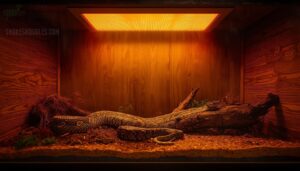
Radiant heat panels are worth serious consideration if you’re working with a larger PVC or wood enclosure. They mount overhead, spread warmth evenly, and keep temperatures stable in ways that heat mats simply can’t match at scale.
Here are the setups where they genuinely shine.
Even Overhead Ambient Heating
Radiant heat panels work like a silent sun overhead — delivering Uniform Ambient Warmth across the entire enclosure without visible light or hot spots.
Ceiling Heat Distribution keeps the warm zone stable and consistent, while Silent Infrared Emission runs quietly 24 hours a day.
This overhead heating system also provides Minimal Enclosure Clutter, freeing up floor space for hides, water bowls, and décor that your snake actually uses.
Best for PVC and Wood Cages
PVC and wood cages are where radiant panels genuinely shine. PVC Heat Insulation holds warmth efficiently, while Wood Moisture Sealing prevents warping from heat cycling. Unlike heat mats or ceramic heat emitters, panels distribute radiant heat evenly across the ceiling without fighting Edge Protection Strips or Ventilation Compatibility gaps.
- PVC walls retain ambient heat better than bare wood
- Sealed wood cages benefit from steady overhead warmth without moisture damage
- Panel Mounting Clearance keeps installation safe and snake‑accessible
- Thermostats pair cleanly with panels for precise, stable control
Low-profile Mounting Options
Most low-profile heat panels mount without bulk, and that matters in a tight build.
VESA Slim Brackets let you swap panel styles quickly, while Corner Bracket Systems tuck radiant heat panel units into corners, freeing central space.
Magnetic Mounts reposition without tools, and Under-Tank Tray Mounts keep snake cage heaters completely out of sight.
Integrated Cable Channels route power cleanly along the wall for a safe, uncluttered setup.
Temperature Stability Across Large Setups
Large enclosures are unforgiving when heat distribution fails. Radiant heat panels paired with distributed sensor arrays keep your temperature gradient locked in, with PID control holding variance within ±0.5°C.
Thermal insulation panels cut heat loss dramatically, while adaptive heater allocation shifts power to cooler zones automatically. Add redundant power feeds and properly placed thermostats, and your setup accommodates overnight swings without intervention.
When Panels Beat Heat Mats
For bigger builds, radiant heat panels simply outperform heat mats where it counts. Uniform overhead heat means no cold pockets hiding under thick substrate, and minimal substrate contact removes the burn risk that poorly padded mats create.
Panels respond quickly to thermostats for quick temperature adjustments, holding your temperature gradient steady.
That enhanced safety margin and energy efficient operation make them the smarter choice among snake cage heaters.
Heat Lamps and UVB
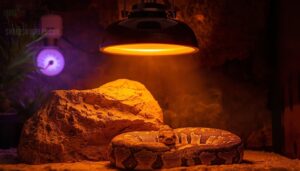
Heat lamps do double duty — they create a warm basking zone while also giving you the option to layer in UVB if your setup calls for it. Choosing the right bulb style and fixture makes a real difference in how stable and safe that hotspot ends up being.
Here’s what you should know before picking your setup.
Daytime Basking Hotspot Creation
Your basking spot works best when the heat lamp angle directs warmth onto a defined, stable surface — not scattered across the whole enclosure. Aim for a hotspot size optimization of roughly 8 to 12 inches in diameter, sitting 6 to 12 inches below the bulb.
A thermal insulation layer beneath the basking surface material holds heat longer, giving your snake a reliable, consistent warm zone throughout the day.
Flood Bulbs Versus Projector Bulbs
The bulb style you pick shapes how heat moves through the enclosure. Flood bulbs spread warmth across a wide beam angle — think broad, even heat distribution with softer spot ambient temperatures.
Projector style bulbs tighten the focus to 10–40 degrees, hitting a precise zone hard. Mounting precision matters more with projectors, and thermostats stay non‑negotiable for both to keep safety considerations for reptile heating equipment in check.
Combining Heat and UVB Safely
Running heat and UVB off Independent Power Circuits prevents overloads and gives you Dual Zone Control over each source independently.
Follow Fixture Spacing Guidelines — keep UVB bulbs positioned away from your heat source so direct warmth doesn’t degrade UVB output.
UVB Heat Shielding and Safety Cutoff Integration round out a setup that takes integrating UVB lighting with heat sources for reptile health seriously, without compromise.
Dimming Fixtures for Better Control
Once your heat and UVB sources are balanced, a dimmer gives you the next layer of precision. Quality dimming fixtures with soft-start ramping ease bulbs up gradually, protecting both the lamp and your snake.
Thermal sensor feedback paired with temperature control systems keeps output steady, while wireless dimmer integration lets you fine-tune without opening the enclosure.
Watch your LED color temperature and linear brightness curve — both shift at low settings.
Best Uses for Visible Light Heat
Visible light shines brightest as a daytime tool. Pair heat lamps or halogen flood lights with a raised rock or wood slab for thermal mass optimization — the surface holds warmth between cycles.
UVB light integration adds biological benefit without extra hardware. Choose glare-free lighting and energy-saving bulb choices to hit basking temperatures of 88–92°F across the basking area while keeping daytime basking efficiency high and heat lamp safety intact.
Thermostats and Temperature Probes
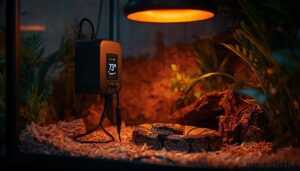
good heat source only does half the job — a thermostat makes sure it stays in check.
Without reliable temperature control and accurate probe placement, even the best ceramic emitter or heat mat can overheat your enclosure quickly.
Here’s what you need to know about keeping temps dialed in safely.
On-off Versus Dimming Thermostats
Think of your thermostat as the brain behind the whole setup — and choosing between on-off and dimming types matters more than most keepers realize. On-off thermostats are straightforward, with lower Cost Comparison and Installation Complexity, but they create 2–5°F swings. Dimming thermostats offer better Temperature Precision, wider Compatibility Range, lower Energy Consumption, and smoother temperature monitoring.
- On-off units cycle heaters fully on or off, creating noticeable temperature swings
- Dimming thermostats modulate output gradually, holding temperatures within a fraction of a degree
- Digital thermostats with dimming capability work with mats, ceramic emitters, and halogens
- On-off controls suit simple resistive heaters and tighter budgets
- Safety considerations for reptile heating equipment favor dimmers for sensitive or nocturnal species
For heat source installation and placement best practices, pair any thermostat type with a properly positioned probe.
Probe Placement for Accuracy
Where you position your thermostat probe directly determines how accurate your temperature monitoring will be. Fix it at your snake’s typical head height — Probe Height matters more than most keepers expect.
Avoid direct heat sources to prevent inflated readings, and use Multiple Wall Placement to capture the full gradient.
A fixed mount ensures Mounting Stability through cleanouts, and a regular Calibration Routine keeps digital thermometers reliable.
Warm-side and Cool-side Readings
Your thermal gradient only works if you’re reading both ends correctly. Place digital thermometers at the warm side (28–32 °C) and cool side (22–26 °C) to confirm a proper temperature zone exists.
Run Data Logging over several days, set Temperature Alerts for unsafe peaks, and schedule regular Calibration Checks.
Nighttime Variance is normal — just keep Reading Accuracy consistent across both zones.
Timers and Day-night Cycles
A good timer does more than flip a switch — it keeps your snake’s internal clock on track. Pair programmable timers with your thermostats to coordinate light cycle management and nighttime heating solutions without visible light.
- Use Gradual Light Ramps to avoid abrupt temperature shifts
- Enable Surge Protected Scheduling to protect devices during outages
- Set Programmable Cycle Offsets for smooth temperature cycling transitions
- Activate Temperature Sync Alerts for overnight monitoring
Battery Backup Timers keep the day-night cycle running even when power drops.
Backup Controls for Safer Heating
Even a brief power outage can send enclosure temps crashing within minutes. That’s why redundant power supply setups and failover thermostat logic aren’t optional extras — they’re your safety net.
Dual sensor monitoring tracks both ambient and warm-side temps, triggering automatic fault diagnostics if readings drift. Battery runtime alerts warn you before backup power runs dry, giving you time to move your snake before temperatures become dangerous.
Safe Installation and Fire Prevention
Getting the heat right is only half the job — keeping it safe is the other half. A few smart habits can protect your snake, your equipment, and honestly, your home.
Here’s what you need to know before you plug anything in.
Avoiding Burns and Overheating
Burns don’t happen all at once — they build up from repeated, unregulated contact with an overheated surface. That’s why Thermostat Redundancy isn’t optional; it’s your first line of defense. Pair every heat source with its own thermostat, maintain Air Gap Enforcement between heaters and enclosure walls, and use Fire‑Resistant Barriers beneath emitters.
These three steps cover Burn Prevention, Substrate Insulation, and basic fire safety all at once:
- Run a Heat Guard Inspection weekly — look for gaps, warping, or loose mesh
- Never skip Substrate Insulation under heat mats; direct contact accelerates thermal stress
- Use Thermostat Redundancy with a backup probe to catch sensor failures early
Lamp Cages and Heat Guards
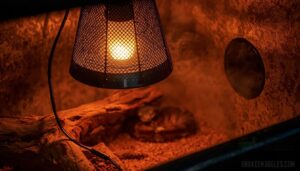
Once you’ve addressed overheating risks, lamp guards become your next layer of protection. A well-built guard relies on Guard Material Durability — steel mesh with a Corrosion Resistant Coating holds up in humid enclosures without warping.
Spring Door Design lets you swap bulbs fast, while Cable Gateway Integration keeps cords tidy.
Mesh Visibility Balance means your snake can’t reach the hot surface, but heat still flows freely.
Cord, Plug, and Socket Checks
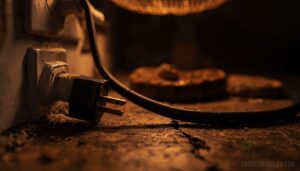
Guards protect your snake from hot surfaces, but the wiring behind those heaters needs just as much attention.
Make Cord Inspection part of your monthly routine — run your fingers along the full length, feeling for cracks, stiff spots, or exposed copper. Check Plug Integrity by looking for corroded prongs or discolored plastic. Confirm Socket Grounding is solid, add Strain Relief where cords enter plugs, and keep Electrical Documentation of every inspection date.
Proper Placement Inside The Enclosure

Wiring checks get the heater running safely—placement decides whether that heat actually works.
Center heat mats under the warm hide for focused Heat Pad Centering, keeping pads away from water bowls and cool zones.
For radiant heat panels, Overhead Panel Centering along the enclosure’s centerline creates an even temperature gradient.
Use a Sidewall Heat Guard where needed, maintain a Ventilation Gap, and route cords cleanly with smart Cable Management so your thermostat reads accurately and your snake thermoregulates without interference.
Why Heat Rocks Should Be Avoided

Heat rocks might look like a natural fit, but they’re one of the few heating options you should skip entirely. The localized burn risk is real—snakes can’t always sense overheating on their bellies until damage is done.
Heat rocks look natural but pose a real burn risk—snakes can’t detect belly overheating until damage is done
- Uneven heat zones disrupt natural thermoregulation
- Metabolic disruption follows inconsistent core temps
- Frequent temperature checks become exhausting and unreliable
- Electrical fire danger increases with cracked casings or moisture
- Overheating hotspots form even when ambient temps seem fine
Temperature Gradients and Monitoring
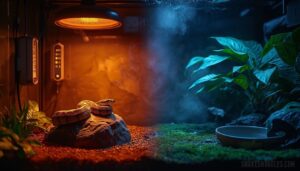
Getting your temperature gradient right is the foundation of a healthy snake setup. Once you understand what warm side, cool side, humidity, and seasonal shifts actually mean in practice, managing your enclosure becomes a lot less stressful.
Here’s what you need to know to keep things dialed in year-round.
Warm Side and Cool Side Targets
Your warm side should hold steady between 29–32°C, with a hotspot reaching around 34°C — that’s your Warm Spot Consistency target.
Cool Side Insulation keeps the far end at 22–26°C, giving you the Gradient Ratio Control your snake depends on for temperature zone creation.
Thermostats handle Target Range Calibration automatically, so seasonal shifts stay manageable without constant manual adjustments to your snake cage heaters.
Daytime and Nighttime Ranges
During daylight hours, your thermal gradient should reflect natural diurnal swing — warmer ambient temps with a defined basking zone.
Once lights drop, night cooling begins, and ceramic heat emitters or radiant heat panels step in as nighttime heating solutions without visible light.
Heat mats add thermal inertia to slow temperature lag, giving your snake steady heat retention through the night without disruption.
Humidity Balance With Heating
Heating and humidity are more connected than most keepers realize. As your heat source warms the enclosure, substrate moisture release kicks in — coconut fiber and sphagnum moss push vapor into the air, shifting your readings quickly.
Place a humidity sensor at both the warm side and the cool side, and pair it with your thermostat for reliable nighttime humidity control without guesswork.
Fixing Cold Spots and Hot Spots
Cold spots and hot spots both tell you something’s off — either your heat source is misplaced, or heat is escaping faster than you can replace it. Run an insulation audit on seams and panel joints, apply air sealing around any gaps, and check for ductwork balancing issues in room HVAC.
Supplemental heat placement near cold zones corrects the gradient while you resolve the underlying issue.
Seasonal Adjustments and Power Outages
Your enclosure doesn’t live in a vacuum — seasonal shifts change how hard your heating equipment works.
Winter Power Planning means testing your Backup Generator Testing protocol before the first freeze, not during one.
Use Insulation Strategies like foam-backed panels to retain warmth, watch Grid Outage Alerts, and practice Seasonal Thermostat Calibration.
For power failures, heat packs outside the enclosure buy critical hours.
Frequently Asked Questions (FAQs)
What is the best heat source for a snake enclosure?
There’s no single best answer — right heat source depends on your snake’s species, your enclosure size, and your budget.
Heat mats, ceramic heat emitters, and radiant heat panels each serve a distinct role.
How to humidify a snake enclosure?
Mist the enclosure daily using dechlorinated water, humid hide packed with damp sphagnum moss, and water dish on the warm side to encourage steady evaporation through humidity substrate.
What are the sources of heat for snakes?
Snakes can’t generate their own body heat — that’s the whole challenge.
They rely on heat mats, undertank heaters, ceramic heat emitters, radiant heat panels, warm hides, heat packs, basking rocks, ambient room heat, and sunlight exposure.
What is the best heat source for a PVC enclosure?
For PVC enclosures, radiant heat panels are your best bet. They distribute warmth evenly overhead without warping the material — something direct-contact sources can risk with PVC at higher temps.
How to keep a snake enclosure warm?
Layer your approach: use heat pads for belly warmth, radiant heat panels for ambient coverage, and thermostats to lock in your thermal gradient. Consistent monitoring keeps temperatures stable year-round.
How to heat reptile enclosures?
Heat your reptile enclosure by pairing a primary heat source with a reliable thermostat, placing probes at both ends to maintain a steady temperature gradient that your ectothermic animal can actually use.
What is the cheapest way to heat a vivarium?
Under-tank heat mats are your cheapest option, running €10–25, using under 10 watts. Pair one with a basic thermostat and you’ve got reliable belly heat without overspending.
What is the ideal temperature for a ball pythons cage?
For a ball python, keep your warm side target at 89–95°F, cool side range at 76–80°F, and allow a nighttime drop to around 75–78°F to support natural thermoregulation.
How do I choose the right heat source for my snake?
What’s the best fit for your setup?
Start with your species’ needs, enclosure size, and budget constraints — then match the heat source to those factors for long-term safety and heat source longevity.
Can I use a heat rock as a heat source?
Skip heat rocks entirely. They create surface temperature spikes, can’t regulate heat safely, and pose a real burn hazard to your snake.
Thermal inconsistency and power failure risk make them a poor alternative heating choice.
Conclusion
The devil’s in the details regarding your snake cage heat source—and now you have the details.
You know emitter suits a nocturnal species, why a thermostat isn’t optional, and how gradient spacing affects digestion rather than just comfort.
Getting this right means your snake eats consistently, sheds cleanly, and stays healthy through every season.
That’s not just good husbandry—it’s the difference between a snake that survives and one that genuinely thrives.