This site is supported by our readers. We may earn a commission, at no cost to you, if you purchase through links.
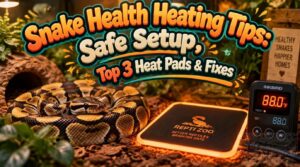
A ball python can sit on a 75°F floor and still starve itself. The snake isn’t picky. It’s cold, and a cold snake can’t digest its meal.
Most snake health heating tips come down to one idea: build a gradient. Your snake needs a 88-96°F basking spot to digest and a cool side near 75-80°F to settle down. Skip either end and regurgitation, respiratory infections, or burns follow. I see all three in my exam room every month.
The fix costs less than a vet visit. Here’s how to choose the right heat source, set up your thermostat, and keep your snake’s enclosure safe.
Table Of Contents
- Key Takeaways
- Creating a Healthy Snake Enclosure: Species-Specific Temperatures and Gradients
- Choosing Snake Heat Mats and Alternative Heat Sources
- Top 3 Snake Heating Products: Heat Pads and Thermostat Controls
- Safe Snake Heat Mat Installation: Placement and Thermostat Setup
- Monitoring, Maintaining, and Troubleshooting Snake Enclosure Heating
- Frequently Asked Questions (FAQs)
- Is 90 degrees too hot for a snake?
- What is the best way to heat a snake tank?
- What temperature is too cold for a snake?
- How long can my snake go without heat?
- How do you heat a snake?
- Do snakes need heat?
- How do you protect a snake from heat?
- Do snakes need Heat mats?
- Why do snakes need smart heating?
- Do snakes need heating cables?
- Conclusion
Key Takeaways
- Your snake needs a temperature gradient, with a warm basking spot of 88-96°F (for ball pythons) and a cool side around 75-80°F, because skipping either end can lead to regurgitation, respiratory infections, or burns.
- Heat just one end of the enclosure, covering about a third of the floor, and keep hides and water dishes off the heat source so they don’t block warmth or cause overheating.
- Plug every heat mat or heater into a thermostat, and place the probe correctly (touching the mat, under the substrate), since a displaced probe is a leading cause of burns.
- Check temperatures weekly with an infrared gun and a digital probe, and recalibrate your thermostat monthly so you catch drift before it hurts your snake.
Creating a Healthy Snake Enclosure: Species-Specific Temperatures and Gradients

You can’t build a healthy enclosure without a proper temperature gradient, so start there. Your snake needs a warm end and a cool end, which lets it move between them and regulate itself. The warm side aids digestion, while the cool side lets the snake lower its body temperature, so distinct warm and cool zones matter for both feeding and comfort.
Learn your species-specific temperature needs first. Ball pythons want a basking spot of 88-96°F with a cool side of 75-80°F. Corn snakes do well with a basking area of 88-92°F and a cool side near 75°F. At night, let temperatures drop 5-10°F, but never below 75°F for ball pythons.
If you keep more than one enclosure, snake thermometers for multiple terrariums make it easy to track each setup’s gradient without constantly moving a single probe around.
Give the warm zone about one third of the floor, and keep the enclosure at least 36 inches long. Plan your heat mat placement at one end only.
Choosing Snake Heat Mats and Alternative Heat Sources

Now you need something to heat that warm end. A heat mat is the simplest option, but it isn’t right for every setup.
A heat mat warms the surface it touches, so substrate heat transfer is slow and the air stays cool. Pair it with a thermostat. A thermostatically controlled heat mat gives you temperature regulation and protects your snake from burns.
Match the heat source to your setup:
- Heat mat: Best for tubs, rack systems, and terrestrial corn snakes.
- Ceramic heat emitter: Lightless heat for nighttime, though it dries the air.
- Radiant heat panel: Even warmth for large PVC or wood enclosures, with better humidity.
In a cold room, add overhead heat to keep your thermal gradient steady.
If your enclosure sits in a chilly space, check a snake heating pad size guide to match the right wattage and coverage to your tank.
Top 3 Snake Heating Products: Heat Pads and Thermostat Controls
You’ve covered how heat mats work and what your snake needs, so now it’s time to pick gear. Below are three heating products worth a look, covering both heat pads and a thermostat controller. Each one helps you keep your setup steady and your snake comfortable.
1. Reptile Heat Pad 8×12 Under Tank Heater
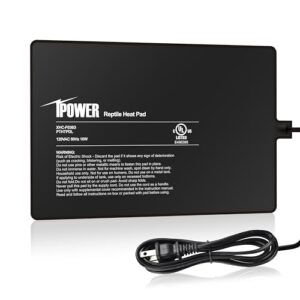
Picture a ball python on sand, digesting a meal, while your tank’s cool end drifts to 74°F. A reptile heat pad 8×12 under tank heater fixes that. Its 16 watts suit a 30-40 gallon setup, and a heat mat wattage calculation confirms it.
Pair it with a thermostatically controlled heat mat, and sand’s substrate heat transfer builds a temperature gradient.
2. Reptile Heat Mat Thermostat Controller PID

A heat pad is only as good as the brain running it, and that’s where the PY-23T comes in. This PID thermostat holds your enclosure within 1°F by delivering steady power output instead of slamming on and off, so your snake isn’t stressed by swings.
Set your target with the UP/DOWN buttons and read it on the digital display. It remembers that setting after a power outage.
Since the settings survive a power cut, your reptile’s habitat stays steady, and this corn snake temperament and care guide can help you pick the right target temperature.
No mat included, and the timer won’t cycle daily, so flip the switch.
- Holds the enclosure within 1°F using PID control and steady power output
- Easy to use, with a digital display and UP/DOWN buttons for setting the temperature
- Remembers your set temperature after a power outage
- The timer doesn’t cycle on and off daily, so you have to use the power switch manually
- No heat mat or lamp is included in the package
- No automatic daily scheduling
3. CAVACHEW Reptile Heat Pad with Thermostat

A compact option for smaller setups, the CAVACHEW Reptile Heat Pad pairs a carbon film mat with a PID smart thermostat. The model, JAHM08, suits 10-20 gallon terrariums and measures 9.21 x 6.42 inches. You can set it anywhere from 20°C to 50°C (68°F to 122°F), and the adhesive backing mounts it to the bottom or side of the tank.
Keep your expectations realistic, though. Some owners report inaccurate settings, and the adhesive may not be reusable. Inspect housing often.
- Carbon film heating material provides even heat distribution
- PID smart thermostat offers a wide control range of 20°C to 50°C (68°F to 122°F)
- Adhesive backing lets you mount it on the bottom or side of the terrarium
- Some customers report inaccurate temperature settings that require higher settings to reach the desired heat
- The adhesive may not be reusable after the first application
- Some users report the thermostat housing coming apart and exposing wiring after weeks of use
Safe Snake Heat Mat Installation: Placement and Thermostat Setup
Heat mats belong at one end of the enclosure, covering about a third to half of the floor. Good heat mat placement gives your snake a temperature gradient, so it can warm up or cool down at will.
Fix the mat with heat-safe tape, then keep hides and water dishes off it, since they block heat and raise overheating risks. Add no more than 1 cm of substrate for even substrate heat distribution.
For thermostat setup, slide the probe under the substrate, touching the mat. On a glass tank, tape it between mat and glass instead. Set the warm end to 88-90°F for ball pythons, then check surface and air temperatures with a temperature gun before your snake moves in.
Monitoring, Maintaining, and Troubleshooting Snake Enclosure Heating
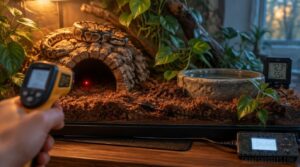
Think of your thermostat probe as the smoke detector of your snake’s enclosure. It only protects you if it’s in the right spot and actually working.
A thermostat probe is your snake’s smoke detector, protecting it only when placed correctly and working properly
Check your temperature monitoring setup weekly. Use an IR gun on the warm hide floor and a digital probe in the cool end, then confirm your temperature gradient still matches your species.
Test heat mat safety features too, and recalibrate your thermostat against a second thermometer monthly. That’s a simple thermostat calibration frequency that catches drift early.
Here’s what a displaced probe can cost you:
- A snake burned on its belly
- Weeks of painful healing
- A pet that stops trusting its hide
- Vet bills you never planned for
- Guilt over something preventable
Keep a quick troubleshooting guide taped nearby: probe moved, mat uncovered, sunlight hitting the glass, or room temperature shifting. Fix those first.
Frequently Asked Questions (FAQs)
Is 90 degrees too hot for a snake?
Does 90°F cook your snake or keep it comfy? It depends on species.
Ball pythons love it, but corn snakes risk overheating. Support temperature regulation with a thermal gradient, temperature monitoring, and careful thermostat calibration.
What is the best way to heat a snake tank?
The best way is a temperature gradient with one heat source at one end, run through a thermostat. Use a heat mat for small tubs, or overhead heat for bigger tanks, and place the probe where your snake rests.
What temperature is too cold for a snake?
Your snake won’t die at 59°F, but don’t wait.
Below 60°F, cold stress sets in, and under 50°F digestion fails. Use a thermometer to keep the ideal temperature range and temperature gradient for reptile thermoregulation.
How long can my snake go without heat?
Adult snakes can skip heat mat usage for 6 to 12 hours if the room stays above 55°F. Watch your temperature monitoring devices, because reptile thermoregulation needs a thermal comfort zone. Temperature fluctuation stresses juveniles.
How do you heat a snake?
Heat one side of the enclosure, never the whole thing. Run a heat mat under a third of the floor, plug it into a thermostat for overheating protection, and check the thermal gradient with digital thermometers.
Do snakes need heat?
Picture a corn snake refusing dinner in a cool room. Do snakes need heat? Absolutely. Offer a temperature gradient using a heat mat, basking spot, and thermostat temperature control, so digestion and immunity keep working.
How do you protect a snake from heat?
Think of your snake’s enclosure as a stove: it needs a dial. Put every heater on a thermostat, secure the probe, and shield heat sources. Add a thermal cutoff switch, keep a cool retreat, and check temperatures daily.
Do snakes need Heat mats?
Ball pythons want a 95°F basking spot, but a heat mat isn’t required. If you use one, add a thermostat for temperature control, cover one-third of the floor, for enclosure safety and a temperature gradient.
Why do snakes need smart heating?
Think a plain heat mat is enough? Not quite.
Smart reptile enclosure heating gives precise temperature control, keeps a steady temperature gradient, and protects thermal comfort for snakes, so your basking spot never overheats overnight.
Do snakes need heating cables?
Not strictly, but heating cables suit racks well.
Run them through a thermostat for temperature regulation, do a heat mat wattage calculation, plan your thermal gradient setup, and meet enclosure safety standards to prevent overheating.
Conclusion
That 88-96°F basking spot is the number that separates a thriving snake from a struggling one. Hit it, and digestion runs smoothly.
Every one of these snake health heating tips comes back to the same habit: check, don’t guess. Pair a quality heat pad with a thermostat, confirm temperatures with a probe, and glance at the gauges daily. Your snake can’t tell you it’s cold. You can make sure it never has to. Start tonight.