This site is supported by our readers. We may earn a commission, at no cost to you, if you purchase through links.

Most people assume snake wrapping around them means aggression. It doesn’t. Snakes coil because they’re looking for stability—your arm is just a better branch than empty air.
That one misread moment is where most handling mistakes begin, and some of them turn dangerous fast. Snake wrapping and handling isn’t complicated, but it does follow a specific logic rooted in the snake’s biology, not yours. Get the grip wrong, position the head wrong, or ignore a stress signal, and a calm animal becomes a liability.
The techniques ahead will change how you read, hold, and release snakes—with confidence and zero guesswork.
Table Of Contents
- Key Takeaways
- Prepare for Safe Handling
- Why Snakes Wrap Around People
- Hold and Support The Snake Properly
- Watch for Stress and Unsafe Positions
- Unwind Coils and End Handling Safely
- Frequently Asked Questions (FAQs)
- Why do ambulances have a snake wrapped around a pole?
- Could you handle ALL snakes even if you follow these rules?
- What do you do when a snake poops? Do you clean it right away?
- Can someone handle a viper?
- What do you do if a snake wraps around you?
- What does the Bible say about handling snakes?
- Why do snakes wrap around their owners?
- Why do snakes wrap around your hand?
- How do you handle a snake that bites?
- Can children safely interact with pet snakes?
- Conclusion
Key Takeaways
- When a snake wraps around you, it’s not being aggressive — it’s gripping for balance, the same way it would grip a branch, so stay calm and support its body instead of pulling away.
- Always check the snake’s mood before you pick it up: cloudy eyes, stiff posture, or no tongue-flicking are your cues to put the gloves down and walk away.
- Keep the snake below shoulder level at all times — the moment it gets near your neck, you’ve lost control and the airway restriction becomes very real, very fast.
- When it’s time to end the session, always unwind from the tail first, move slowly, and wash your hands for a full 20 seconds after — Salmonella doesn’t give warnings.
Prepare for Safe Handling

Before you pick up any snake, a little groundwork goes a long way. Getting the basics right — species, mood, environment, tools — is what separates a smooth interaction from a stressful one.
If you’re not sure where to start, this simple guide to taming snakes with helpful tricks walks you through building trust at a pace your snake can handle.
A quick read through safe snake handling techniques for beginners can help you feel confident before your first real interaction.
Here’s check before you ever reach before you ever into that enclosure.
Identify The Species and Size
Before you touch any snake, know exactly what you’re dealing with.
Head Pattern Recognition and Scale Count Analysis are your first tools — dorsal row counts and head scales can confirm species quickly.
For pythons and boas or any constrictor snakes over 6 ft, Body Circumference Measurement and Sexual Dimorphism Indicators matter too.
Use Geographic Range Matching to narrow your identification down and choose safe methods for handling large snakes accordingly.
Check The Snake’s Mood and Health
Once you know your species, check how the snake is actually doing right now. Look for clear eyes, clean skin, and normal posture — cloudy eyes or respiratory discharge are immediate stop signs. Watch for snake stress response in its body language before you ever reach in. A relaxed snake often shows steady tongue flicking(https://www.furrycritter.com/pages/articles/snakes/reading_snake_body_language.htm) as a sign of comfort.
- Sudden appetite changes or weight monitoring concerns signal underlying illness
- Unusual posture or lethargy are stress signals in snakes worth taking seriously
- Defensive tightening during light contact is a real-time health and safety flag
Avoid Handling During Shedding or Feeding
Even a healthy snake can become a handling risk at the wrong moment. Shedding Sensitivity is real — Skin Fragility during this phase means a single session can tear new tissue. Feeding Stress is just as serious. Both states trigger a snake stress response that turns calm animals unpredictable.
| Situation | Risk | What To Do |
|---|---|---|
| Active shedding | Skin Fragility, defensive behavior | Wait until shed is fully complete |
| Opaque/blue-eye phase | Heightened stress signals in snakes | No handling — monitor only |
| Post-feeding period | Regurgitation, dangerous snake handling behaviors | Wait 48 hours minimum |
Timing Adjustments protect both of you. Use Enclosure Feeding with tongs to avoid proper snake restraint techniques becoming handling mistakes.
Set Up a Quiet, Distraction-Free Space
Once your timing’s sorted, the space you choose matters just as much. Dim the lights, cut the noise — Sound Dampening isn’t optional.
Snakes detect vibrations, so bass, traffic, and barking all count.
Temperature Stability between 20–24°C keeps behavior predictable.
Non-slip Flooring, set Clear Boundaries away from stairs, and you’ve built a calm environment that makes stress reduction strategies for captive snakes actually work.
Gather Tools for Large or Nervous Snakes
Gearing up properly before you reach for a large or nervous snake isn’t optional — it’s what separates a controlled interaction from a trip to urgent care.
Keep a long snake hook (24–60 inches), padded restraint tongs, and a ventilated transport crate within arm’s reach. Add protective gloves, a snake tube for secure containment, and a field identification kit.
That’s safety for the handler, sorted.
Why Snakes Wrap Around People

Snakes don’t wrap around you because they like you — they wrap because their instincts are running the show. Understanding the "why" makes you a smarter, safer handler.
Snakes don’t wrap around you out of affection — they wrap because instinct is always in charge
Here are the three main reasons it happens.
Seeking Stability on an Unfamiliar Surface
Think of your arm as a tree branch — your snake is just trying not to fall off. When you pick up a snake, it immediately reads the surface beneath it. Rough, stable, and warm? It relaxes. Slick or unpredictable? It grips tighter.
That grip isn’t aggression — it’s instinct.
Key factors that reduce unnecessary wrapping tension:
- Surface Friction Management – Dry, textured surfaces give scales something to anchor against naturally
- Midsection Weight Distribution – Cradling the middle keeps the body balanced and reduces the urge to coil
- Tail Support Techniques – A supported tail signals security; an unsupported one triggers panic-gripping
- Temperature Consistency – Warm, stable hands lower stress and discourage heat-seeking constriction
Stress and Defensive Tightening
When a snake feels unsupported or startled, its body doesn’t just tighten randomly — that’s a defensive response driven by physiological stress hormones kicking in fast. Vibration sensitivity triggers a reflex that locks coils down hard.
Watch for behavioral escalation indicators: rigid body tension, hissing, rapid repositioning. Ignore that snake body language, and you’re risking blood flow restriction or respiratory compromise risks — especially around the neck.
Heat Seeking and Thermoregulation
You’re basically a living heat lamp to a snake. Pit vipers and pythons use infrared pit function to detect thermal gradient navigation — picking up temperature differences as small as a fraction of a degree.
That neural heat processing draws them toward your warmth instinctively. It’s basking thermoregulation in action.
Understanding this heat-driven prey detection explains one major reason for snake wrapping behavior during handling.
Hold and Support The Snake Properly
How you hold a snake in the first few seconds sets the tone for the whole interaction. Get it wrong and the snake gets stressed — get it right and everything stays calm.
Here’s what proper support actually looks like.
Use a Two-Handed Support Technique

One wrong grip, and everything escalates fast. Slide both hands under the body — palms up, wrists relaxed — and let even pressure do the work.
Palm alignment keeps you from accidentally compressing the spine. This is the foundation of safe snake handling safety: weight distribution across broad palms, not fingertips.
Hand coordination between both hands turns a nervous snake into a manageable one.
Support The Midsection and Tail
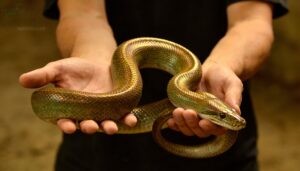
Place one palm under the midsection — that’s your Midsection Cushioning base — and let the other hand cradle the tail using the Tail Anchor Method. Support the snake’s body so weight spreads evenly across both arms.
If handling reveals visible weight loss or protruding vertebrae along the spine, it may be time to explore step-by-step guidance on tube feeding a snake to help restore healthy body condition.
Grip lightness matters here; firm enough to prevent slipping off a Slip-Resistant Surface, never squeezing. Pressure Monitoring keeps you ahead of any sudden tightening before it becomes a problem.
Keep The Head Free Without Grabbing

Once your hands are supporting the body well, resist the urge to grab the head — that’s where most handlers go wrong. Head Position Control means letting the head move freely while you guide the body. Barrier Techniques and proper Tool Placement keep your fingers away from the snout entirely.
- Let the head float naturally without pinning
- Use a hook for Guidance Without Grabbing near sensitive areas
- Maintain Head Neck Distance to reduce defensive strikes
- Watch snake body language — a raised head means back off
Keep The Snake Below Shoulder Level

snake below your shoulders isn’t just a good habit — it’s how you stay in control. Lower Carry Mechanics means the coils physically can’t reach your neck without climbing through your hands first. That’s Coil Path Blocking working for you.
| Position | Risk Level | Why It Matters |
|---|---|---|
| Above shoulder | High | Coils reach neck easily |
| Shoulder height | Moderate | Limited Weight Shift Control |
| Below shoulder | Low | Posture Stability maintained |
| Neck level | Severe | Respiratory obstruction risk |
| Forearm level | Safest | Full Shoulder Free Positioning |
Redirect upward movement immediately.
Handling Larger Snakes With a Second Person

For snakes over six feet, go straight to Dual-Handler Safety — no shortcuts. Your primary handler takes the head and front third while the second handles the midsection and tail.
That Load Distribution keeps coils from bunching unpredictably.
Use Team Communication through clear hand signals, and agree on an Emergency Release plan before you start.
Coordinated Movement keeps everyone — and the snake — safe.
Watch for Stress and Unsafe Positions

Even a calm snake can shift moods fast, and missing the early signs is how things go wrong.
Your body position matters just as much as the snake’s behavior — some spots are simply off‑limits.
Here’s what to watch for before a small problem becomes a real one.
Signs The Snake is Becoming Uncomfortable
Your snake doesn’t shout — it whispers. Miss those whispers, and handling turns risky fast. Recognizing snake stress and warning signs early is the whole game.
Watch for these stress signals in snake body language:
- Reduced tongue-flicking — a calm snake explores; a stressed one goes quiet
- Tense body stiffness replaces smooth, flowing movement
- Head tucked against your arm or clothing
- Freeze response — sudden stillness signals it feels trapped
- Limited breathing patterns under visible muscular tension
Coiling, Hissing, and Defensive Body Language
When a snake shifts from curious to defensive, it’s loud — if you know what to look for. Muscle Tension Indicators appear first: the body firms up, ridged and coiled tight. Head Elevation Posture follows, with the neck forming that classic S-curve. Then comes the Gape Display Dynamics — mouth partially open, a clear "back off" signal. Tail Vibration Signals and rising Breath Rate Changes confirm one thing: stop now.
| Signal | What It Means |
|---|---|
| Tight, ridged coils | High defensive arousal |
| Elevated S-curve neck | Strike preparation |
| Open-mouth gape | Active threat display |
| Tail vibrating | Final warning issued |
| Shallow, rapid breathing | Peak stress response |
These are your snake body language red flags. Respecting them is what separates safe snake handling techniques from a dangerous situation — especially before snake constriction escalates or a snake coils around your neck becomes a real risk. Snake handling safety guidelines exist for moments exactly like this.
Risks of Letting a Snake Wrap Your Neck
Let a large constrictor drape across your neck, and you’ve handed over control.
Airflow Restriction happens fast — coils pressing near your throat leave little time to react. Blood Flow Compromise follows, reducing circulation toward your brain.
Bite Proximity to essential areas turns any accidental bite serious. Panic Injury from yanking the snake makes things worse.
Emergency Delay when you’re alone? That’s the real danger.
How Sudden Movements Trigger Tighter Gripping
Every jerk or flinch you make sends a direct signal — and the snake answers with tighter coils. Here’s what’s actually happening:
- Muscle Reflex Activation — A flash movement triggers instant muscle contraction, amplifying snake constriction within seconds.
- Surface Instability Reaction — Slippery or shifting surfaces prompt the snake to tighten its grip to stay anchored.
- Vision Threat Perception — Quick gestures near the head read as predator attacks, triggering defensive reflex tightening.
- Temperature Tension — Cold or variable surfaces increase baseline muscle tone, making sudden movements far more provocative.
- Metabolic Stress Amplification — A hungry or stressed snake wraps more aggressively when startled.
Good stress and handling etiquette mean reading snake body language before it escalates.
Common Handling Mistakes to Avoid
Most handling injuries trace back to the same avoidable slip-ups. Don’t ignore species temperament — a nervous ball python behaves nothing like a calm corn snake.
Bare hand contact with venomous or agitated snakes skips every snake handling safety guideline that exists. Overfeeding before handling spikes the constriction risk. Inadequate tool use and poor posture alignment quietly set you up for a bite.
Know the wrong way before you learn the right one.
Unwind Coils and End Handling Safely

Getting a snake off your body the wrong way can stress the animal — and honestly, it can stress you out too.
The good news is there’s a clear, step-by-step way to end every handling session calmly and cleanly.
Here’s exactly what to do when it’s time to unwind and wrap things up.
Start Loosening From The Tail End
Start at the tail — always. Tail-first release works because the snake’s grip is weakest there, making coil pressure reduction easier without triggering fresh tension.
Use calm hand movements and work through sequential coil loosening, one ring at a time. Rushing breaks the snake’s sense of support and causes re-tightening.
Directional body mechanics matter here — loosen along the wrap’s natural direction, not against it.
Support The Body While Unwrapping
Think of your hands as a living cradle. While loosening each coil, keep both hands actively supporting the midsection and tail — that’s non-negotiable for pressure distribution and balance anchoring.
Hand positioning matters: palms up, weight shifting smoothly as the snake moves.
Core stability from your stance prevents unexpected drops.
Support the snake’s body continuously, because unsupported sections trigger defensive tightening fast.
What to Do if The Snake Tightens
Even with perfect support, a snake can tighten suddenly. Stay calm — rapid coil release starts with stillness, not force.
- Stop all movement immediately; calm movement technique works better than panic
- Breathing safety priority: if coils reach the neck or chest, treat it as an emergency release protocol
- Monitor pressure monitoring across coils — tightening often signals stress, not aggression
- Get a second person helping immediately for preventing snake constriction injuries
snake body language in that moment tells you everything.
When to Stop and Return The Snake
Knowing when to put the snake down is just as important as knowing how to hold it. The moment you notice rigid defensive coiling, sustained tightening, or uncertain identification of behavior — stop. This matters even more with child proximity or an immunocompromised handler nearby.
If your time limit has been exceeded or you spot tool failure, don’t push it. Set the snake down and call it done.
Hand Washing and Surface Cleaning After Handling
Once the snake is back in its enclosure, don’t skip the cleanup — reptile handling hygiene is non‑negotiable.
- Soap Duration: Scrub with soap and warm running water for at least 20 seconds.
- Sanitizer Use: No sink nearby? Use alcohol‑based sanitizer, then wash properly when you can.
- Surface Disinfectant Protocol: Wipe down handling surfaces with an approved disinfectant — let it sit the full contact time.
- Tool Sterilization: Disinfect equipment after every session; store cleaned tools in a sealed container.
- Laundry Hygiene: Wash snake‑contact clothing separately using warm water and detergent.
Post‑handling health and sanitation procedures protect everyone — Salmonella doesn’t announce itself.
Frequently Asked Questions (FAQs)
Why do ambulances have a snake wrapped around a pole?
That snake on the ambulance isn’t a handling demo — it’s the Rod of Asclepius, a Medical Symbol History staple representing healing.
Part of the Star of Life, it’s pure Emergency Vehicle Branding, not biology.
Could you handle ALL snakes even if you follow these rules?
No, not even close. Venomous handling protocols and legal liability considerations exist for good reason. Species-specific limits are real. Without experience-based competency, some snakes will always be beyond safe reach.
What do you do when a snake poops? Do you clean it right away?
Yes, clean it right away. Put on protective gloves, lift the waste — don’t smear it — seal it in a disposal bag, then sanitize the surface.
Wash your hands after. Salmonella is real.
Can someone handle a viper?
Handling a viper is possible, but only with proper Training Certification, strict Safety guidelines for venomous and nonvenomous snakes, full Protective gear for snake handlers, solid Emergency Protocols, and awareness of Legal Regulations governing venomous species in your area.
What do you do if a snake wraps around you?
Stay calm and don’t yank. A snake coil around your neck demands slow, deliberate escape positioning — start unwinding from the tail, support the body, and get help fast.
What does the Bible say about handling snakes?
Mark 16:17‑18 references believers handling snakes as a sign of faith, but theological ethics and interpretive debates have led most churches to view this symbolically rather than literally, prioritizing safety over ritual.
Why do snakes wrap around their owners?
They’re not hugging you — they’re reading you.
Snakes wrap around their owners for stability, warmth, and exploratory curiosity, driven by owner’s scent attraction and a natural tactile feedback loop, not affection.
Why do snakes wrap around your hand?
Snakes wrap around your hand through Tactile Exploration — feeling Surface Texture Preference and using Chemical Cue Detection to read you. It’s Temperature Gradient Response meets curiosity, not aggression.
How do you handle a snake that bites?
Calm, collected, careful — that’s your first aid protocol when a bite happens. Don’t yank the snake away. Stay still, note the species for bite documentation, seek immediate medical evaluation.
Can children safely interact with pet snakes?
Yes, but only with close adult supervision. If a child can’t sit still for a few minutes, skip it. Immunocompromised children shouldn’t handle snakes at all. Always wash hands after.
Conclusion
Mastering snake wrapping and handling is a breakthrough, literally saving lives. With practice, you’ll transform from a nervous beginner to a confident handler.
Remember, snake wrapping and handling isn’t about taming; it’s about understanding. By respecting a snake’s biology and boundaries, you’ll build trust and guarantee safe interactions.
Take control with knowledge, not fear. Practice these techniques, stay vigilant, and you’ll become a pro in no time, handling snakes with ease and assurance, always.