This site is supported by our readers. We may earn a commission, at no cost to you, if you purchase through links.
Your first boa feeding can feel like a high-stakes test. One wrong move, and a bite, a stress response, or a regurgitated meal sets you back weeks.
The good news: the safest method is also the simplest. Frozen-thawed rodents, offered with tongs, protect both of you from injury and infection. Pick boa constrictor feeders for beginners wisely, and you’ll sidestep most of the mistakes I see new keepers make.
The details matter, though. Prey size, thawing temperature, and feeding schedule all shape whether your boa thrives or struggles. Here’s how to get each one right, starting with what belongs on the menu.
Table Of Contents
- Key Takeaways
- Choose Safe Feeder Prey for Boas
- Size Feeders to Fit Your Boa
- Follow Age-Based Feeding Schedules
- Prepare and Offer Feeders Step by Step
- Fix Common Boa Feeding Problems
- Know When to Call a Vet
- Frequently Asked Questions (FAQs)
- What should I feed my boa constrictor?
- Are boa constrictors beginner friendly?
- How long can a boa go without food?
- Can a boa eat a small dog?
- How do I set up a feeding enclosure?
- Should I feed my boa in the dark?
- Can boas share a feeding space safely?
- How do I store bulk feeder rodents long-term?
- Does water intake change around feeding time?
- How long can frozen feeder rodents be stored?
- Conclusion
Key Takeaways
- Feed your boa frozen-thawed rodents with tongs instead of live prey, since it gives the same nutrition without the bites, infections, or stress.
- Choose prey that’s 1 to 1.5 times the thickness of your boa’s widest body part and under 10% of its body weight, and warm it to 98-100°F before offering it.
- Space meals by age, from every 7-10 days for neonates to every 3-6 weeks for adults, and leave your boa alone for 24-48 hours afterward so it can digest.
- Call a reptile vet right away if you see repeated regurgitation, wheezing, open-mouth breathing, stargazing, or tremors, and fix temperatures and humidity first when your boa refuses food.
Choose Safe Feeder Prey for Boas
What you put in your boa’s food bowl, so to speak, matters as much as how often you feed. Two choices shape nearly every safe feeding routine, and you’ll see both below. Let’s start with what belongs on the menu and what doesn’t.
For rescue boas especially, the safest feeders are usually pre-killed, appropriately sized rodents, and this guide to boa constrictor feeders for rescue owners explains which options to choose and which to avoid.
Frozen-Thawed Rodents
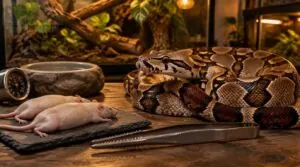
Mice and rats sold as frozen-thawed rodents are the safest staple for your boa. They’re clean, convenient, and nutritionally complete when you feed them whole. Thaw them overnight in the fridge or in warm (not hot) water, and never microwave them, since proper thawing and warming rodents helps keep meals safe.
- Match prey size to your boa’s girth
- Stick to your feeding schedule
- Use feeding tongs every time
Learn solid prey preparation methods and you’ll feel confident at every meal, keeping your boa healthy and thriving.
Why to Avoid Live Feeding
Live feeding sounds natural, but it’s a gamble. Prekilled prey gives your boa the same nutrition without the bites.
| Risk | Live | Prekilled |
|---|---|---|
| Bites | Likely | None |
| Infection | Possible | Rare |
| Escape | Possible | None |
| Stress | High | Low |
Rodent bites can puncture deep and cause infections needing antibiotics. Use feeding tongs, correct prey item size, safe handling techniques, and a steady feeding schedule instead.
If you’re weighing the risks of live prey, this guide to feeding a snake live prey explains how to handle mealtime safely and when frozen-thawed makes more sense.
Size Feeders to Fit Your Boa

Once you’ve picked frozen-thawed prey, the next question is how big it should be. Getting the prey item size right keeps your boa comfortable and your feeding frequency steady.
Match whole prey to your snake’s body, not its age. Here’s how to check:
- Measure the widest part of your boa’s body.
- Choose pre-killed prey that’s 1 to 1.5 times that thickness.
- Keep the meal under 10% of body weight.
A slight lump after eating is normal. A big bulge isn’t normal.
If you’re wondering whether handing food to your snake is safe, what happens when you feed a snake by hand explains the risks of accidental bites and feeding confusion.
Some lineages, like Boa c. constrictor, regurgitate oversized meals in their first year, so stay extra conservative. Weigh your snake regularly, and bump up the prey item size only when its body condition and digestion tell you it’s ready.
Follow Age-Based Feeding Schedules
Prey size selection sets the portion, but feeding frequency sets the pace. Your boa’s age and growth rate decide how often it eats.
| Age | Interval | Notes |
|---|---|---|
| Neonates | 7–10 days | Pinkies or fuzzies |
| Under 1 year | 10–14 days | Increase prey gradually |
| 3+ years | 3–6 weeks | Adjust to body condition |
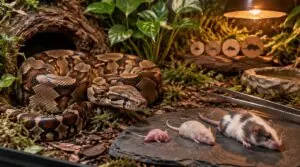
Don’t feed neonates more often than every 7 days, since regurgitation becomes likely. Between 1 and 3 years, expect every two to three weeks, a bit shorter in summer and longer in winter. Cooler months naturally slow appetite, so stretch intervals gradually rather than all at once.
Always use digestion monitoring before offering the next meal. Handling and temperament often turn defensive after meals, so leave your boa alone for 48 hours.
A digital reptile scale lets you track weight changes after each meal, so you can tell when digestion has finished.
Prepare and Offer Feeders Step by Step
Start with a safe enclosure setup before you thaw anything, because a calm boa eats better. Keep the warm side at 80-90°F and move your boa to a separate feeding tub if substrate worries you.
Work through these steps:
- Thaw frozen-thawed rodents in a sealed bag in cold water, changing it every 30 minutes.
- Warm the prey in 100-110°F water for 10-15 minutes, then confirm 98-100°F with a temp gun.
- Grip the prey mid-body with long tongs and wiggle it near your boa’s side or front.
- Let your boa strike and constrict, then leave it.
Wait 24-48 hours before handling, and use two-handed handling only afterward. Spot clean, remove uneaten prey after 12-24 hours, and keep your feeding frequency consistent.
Fix Common Boa Feeding Problems
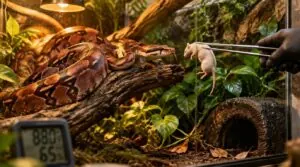
Troubleshooting feeding problems starts with your setup, not your boa. Check temperatures first: keep the hot spot near 88°F and humidity at 60-80%.
| Problem | Likely cause | Fix |
|---|---|---|
| Refusal | Cool temperatures, stress | Warm enclosure, skip handling |
| Regurgitation | Large prey | Downsize, wait 10 days |
| Stuck shed | Low humidity | Mist enclosure, add moist hide |
Match prey size to the widest part of your boa’s body, and offer only frozen-thawed rodents, warmed properly. If your boa refuses, don’t tempt it with extra meals. Return to the feeding schedule for its age and leave it undisturbed.
After any regurgitation, skip handling for two weeks and refeed only once your boa seems recovered. Rushing a second meal repeats the problem, so patience is your best tool.
Know When to Call a Vet
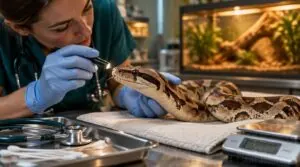
Say your three-year-old boa threw up her last meal four days after eating, then did it again a week later. That’s not a fluke, and waiting it out can cost her fluids she can’t spare.
Most feeding hiccups resolve on their own. Some don’t. Call a reptile vet if you see:
- Repeated regurgitation, especially days after a meal
- Wheezing, open-mouth breathing, or discharge, which signal respiratory infections
- Stargazing, head tremors, or poor coordination
- Sunken eyes, skin tenting, or stringy saliva
- Lumps, cheesy mouth deposits, or cloudy eyes
Minor problems like stuck shed, early scale rot, or mites also deserve attention, but respiratory and neurological signs need immediate veterinary care. Don’t wait. Call today. Your boa can’t tell you she’s hurting.
Your boa can’t tell you she’s hurting, so don’t wait on respiratory or neurological signs; call a reptile vet today
Frequently Asked Questions (FAQs)
What should I feed my boa constrictor?
Why complicate your snake diet nutrition? Feed frozen-thawed rodents: mice for juveniles, rats for adults.
Choose frozen over live prey for safety, match prey size to your boa’s widest girth, and keep a feeding schedule.
Are boa constrictors beginner friendly?
Boas can work as a beginner reptile species if you’re well prepared. They’re a serious longterm pet commitment, though. You’ll need a large, secure enclosure setup, confident handling techniques, and a steady snake feeding schedule.
How long can a boa go without food?
Think a healthy boa constrictor can’t skip meals for months? Wrong. Adults can fast over two months without harm, far beyond a normal snake feeding schedule.
Still, steady weight loss signals trouble, so call your vet.
Can a boa eat a small dog?
No, a boa can’t eat a small dog. Adult boas top out around 60 pounds, so prey size rules it out. Stick with frozen-thawed rodents, keep the enclosure secure, and mind handling safety around dogs.
How do I set up a feeding enclosure?
Boas need about 48 undisturbed hours after eating. Keep your enclosure setup simple: a secure enclosure with a locking lid, proper enclosure size, hiding spots, and a feeding plate. Use tongs, and skip loose substrate.
Should I feed my boa in the dark?
Your boa doesn’t need a spotlight to find dinner. Dark environment feeding suits a nocturnal and crepuscular hunter, so offer frozen-thawed rodents at dusk with tongs and skip two-handed handling.
Calm snake feeding behavior follows.
Can boas share a feeding space safely?
Think of feeding time as a race with no referee. Put two boas in one space and both can strike the same frozen-thawed rodent, so keep snake feeding separate to avoid injury.
How do I store bulk feeder rodents long-term?
Picture 40 frozen-thawed rodents arriving at once. Double-bag them, label size and date, and hold 0°F steadily. Use oldest first. Like enclosure sanitation, substrate selection for boas, and disinfection protocols, this helps longterm reptile ownership.
Does water intake change around feeding time?
Warm frozen-thawed prey to 98-100°F, but keep your water bowl at room temperature. Hydration needs stay constant, so refill daily. Post-meal soaking is normal. Fresh water always helps digestive health reptiles and shedding cycle care.
How long can frozen feeder rodents be stored?
Think of your freezer as a pause button, not a time machine. Frozen-thawed rodents hold up for 6 to 12 months when vacuum sealed at 0°F or colder. Toss anything with torn packaging or freezer burn.
Conclusion
Thaw the prey fully. Match it to your boa’s girth. Offer it with tongs, then leave the snake alone. Those three habits carry nearly every feeding.
Choosing boa constrictor feeders for beginners comes down to safety, size, and schedule, and you now have all three. Expect a refusal or a regurgitation. Stay calm, adjust, and call your vet when something looks off. Your boa wants consistency, not flawlessness, and steady routines build a healthy snake.