This site is supported by our readers. We may earn a commission, at no cost to you, if you purchase through links.

A stressed boa won’t breed. That’s the reality most novice keepers learn the hard way, after pairing two healthy adults in mismatched enclosures and watching a season pass with no results. Temperature swings, cramped quarters, and shared airspace between quarantine and breeding stock quietly sabotage more clutches than any disease ever will.
Getting boa constrictor enclosures for breeding pairs right means treating the room, not just the tank, as part of the setup. Airflow, electrical capacity, and thermal zoning all shape whether a female cycles properly and a male responds.
Get the fundamentals in place first, and the rest of the process, from introductions to gravid care, becomes far more predictable.
Table Of Contents
- Key Takeaways
- Prepare The Boa Breeding Room
- Choose Correct Adult Enclosure Dimensions
- Top 4 Boa Breeding Enclosures
- Create Stable Heat and Humidity Zones
- Pair Boas Safely, Then Separate
- Frequently Asked Questions (FAQs)
- Can you house two boas together?
- What is the best enclosure for a boa constrictor?
- How many babies can a boa have at once?
- How long to keep boas paired for breeding?
- How long do boa constrictors stay pregnant?
- What age do boa constrictors reach breeding maturity?
- How many babies do boa constrictors have?
- Do breeding boas need to be fed differently?
- How often should you check on breeding boas?
- Conclusion
Key Takeaways
- Successful boa breeding starts with the room itself, not just the enclosure, since stable electrical capacity, temperature, and airflow keep pairs healthy enough to cycle and breed.
- Adults should be housed separately in properly sized front-opening PVC enclosures, only brought together for supervised, time-limited introductions during breeding season.
- Each enclosure needs its own thermostat, thermal gradient, and humidity control so gravid females can regulate their own microclimate as their needs shift.
- Careful tracking, from pairing dates and behavior logs to enclosure labeling, turns breeding from guesswork into a predictable, repeatable process.
Prepare The Boa Breeding Room
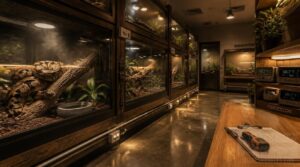
Before you buy a single enclosure, the room itself has to be ready to support it. Electrical load, temperature stability, airflow, quarantine separation, and labeling all need to be settled first, or your setup will fight you later. Get these five fundamentals right, and everything you house in that room will have a real chance to thrive.
Once the room’s dialed in, take a few minutes to review safe python handling techniques so your first interactions build trust instead of stress.
Check Dedicated Electrical Capacity
Before racks and enclosures go anywhere, call an electrician for a proper circuit load assessment. Breeding rooms need 15-20 amp dedicated circuits, GFCI protection on every receptacle, and dedicated circuit isolation so heaters don’t share power with fans or humidifiers.
Confirm electrical code compliance locally, then install a labeled power strip for enclosure-by-enclosure control. This groundwork protects your temperature control systems long before breeding season starts.
Stabilize Ambient Room Temperatures
With power secured, turn to the room itself. Keep ambient temps at 75-80°F year-round using a dedicated thermostat, separate from enclosure heaters, so equipment isn’t overworked.
- Seal gaps with door sweeps
- Add thermal mass (masonry, dense cabinetry)
- Calibrate sensors at room center
- Insulate walls to cut heat exchange
Stable rooms mean stable thermal gradients inside every enclosure.
Add Filtered Airflow and Fans
Once room heat holds steady, add filtered airflow with ceiling or wall intakes, placing filters where they catch dust without blowing across hides or front opening doors.
Match fan selection to filter resistance, balance intake and exhaust, and aim for two to four air changes hourly.
Gentle airflow patterns protect enclosure size, temperature gradient, and temperature regulation.
Maintain filters regularly.
Separate Housing and Quarantine Zones
Once airflow is steady, set separate housing and quarantine zones on opposite sides, with card-locked access, air curtains, Visual Observation Barriers, Dedicated Waste Streams, and independent HVAC for Zone Airflow Control.
Use front-opening PVC or ABS enclosures in quarantine, restrict entry to trained staff, rely on remote animal monitoring, and keep Emergency Containment Planning ready for any breach on file.
Label Enclosures for Tracking
Standardize Label Enclosures for Tracking with waterproof Label Materials, clear Placement Guidelines, and Data Content: enclosure number, animal ID, breeding status, keeper initials, room zone, health checks, and pairing windows for gravid females in your breeding setup.
Follow Update Protocols after every move, verify Durability Standards against moisture, disinfectants, and heat, and sync each code to HatchLedger for traceable husbandry.
Choose Correct Adult Enclosure Dimensions
Sizing an enclosure correctly isn’t guesswork; it’s a matter of matching dimensions to your boa’s body length and adult weight class. Get this wrong, and you’ll deal with a stressed, poor-feeding snake instead of a productive breeder. Here’s what you need to know before picking dimensions for your adults.
House Adults Separately Between Pairings
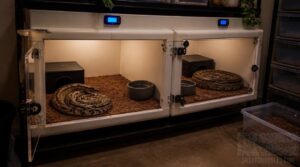
Boas aren’t cuddly pair animals, and housing them together full-time invites unnecessary stress and aggression.
- Separate front-opening PVC enclosures
- Staggered feeding schedules
- Quarantine-ready isolation
This setup simplifies health monitoring, keeps records accurate, and protects gravid females from forced contact. Your room layout should reflect this: distinct zones, clear labels, and easy visual checks reduce stress while keeping your breeding setup organized and traceable.
Match Length to Body Length
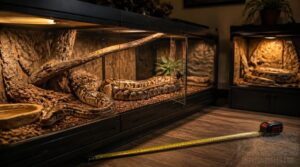
A snug fit matters more than square footage alone. Take an accurate snake body measurement, then size enclosure length to match.
Adult females over 6 feet need 8-foot enclosures, males under 7 feet do fine in 6- to 7-foot vivarium setups.
Juvenile size matching starts at 24-36 inches, scaling 2-4 feet as growth progresses toward breeding pair sizing and front opening door access.
Scale Space for Gravid Females
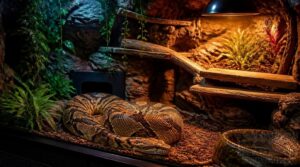
A gravid female’s belly can nearly double her girth, so gestational space planning can’t be an afterthought.
Use progressive enclosure scaling with stepped zones, thermal zoning between 82-86°F basking and 75-78°F cool sides, and a humidity-controlled microhabitat at 60-70% RH.
Build in stress-reduced retreat design with secluded resting spots, non-skid flooring, and room enough to shift postures as breeding weight climbs.
Prefer Insulated Front-opening PVC
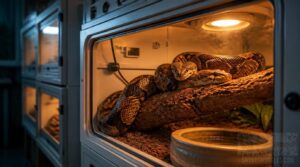
Glass tanks lose heat fast and fog with reflections that stress breeding pairs.
Insulated front-opening PVC cuts heat loss 20-30%, using multilayer cores and gasket seals rated to 60 kPa for stable humidity. UV-stabilized panels resist yellowing for 5+ years. Front access lets you feed, clean, and monitor without disturbing enclosure stability or the animal’s thermal gradient.
Use Locks and Secure Vents
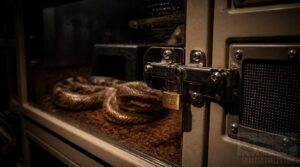
An unlocked door undoes every other precaution you’ve taken. Front opening PVC or ABS enclosures need a true lockable door, tamper resistant latches, and stainless hardware standing up to humidity.
Run Lock Integrity Checks monthly, pair them with Vent Security Screening and Vent Tamper Prevention hardware, and follow Secure Access Protocols with logged entries and Emergency Override Procedures ready for escape prevention.
Top 4 Boa Breeding Enclosures
Choosing the right dimensions is only half the job; you still need an enclosure built to hold up under daily breeding operations. Not every product on the market meets the insulation, access, and durability standards your pairs require.
Here are four options worth your consideration, each suited to different stages of your breeding setup.
1. RepWild PVC Reptile Enclosure 4x2x2
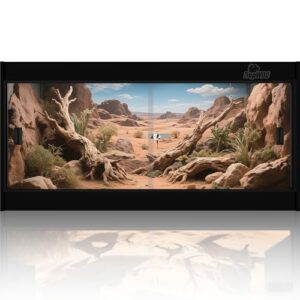
When you need a working enclosure without building one yourself, the RepWild 4x2x2 covers the basics well. Its 5/16" PVC panels resist warping in humid setups, and the tempered glass sliding door locks securely for handling safety.
The rust-proof mesh top controls ventilation and UVB penetration, though you’ll want HVAC tape over portions to hold humidity. Assembly takes under 30 minutes with predrilled panels, and at 63 lbs empty, it’s manageable for one person to position.
| Best For | This enclosure is best for keepers of bearded dragons, ball pythons, geckos, and other terrestrial or semi-arboreal reptiles who want a stable, easy-to-clean home for desert or tropical species. |
|---|---|
| Material | PVC |
| Door Type | Tempered glass sliding, locking |
| Top Ventilation | Rust-proof mesh top |
| Capacity | 120 gallon |
| Assembly | Tool-free, under 30 min |
| Target Species | Bearded dragons, ball pythons, geckos |
| Additional Features |
|
- Thick PVC panels offer strong insulation and stability in high-humidity setups
- Tempered glass sliding door with a lock makes access secure and simple
- Tool-free assembly guide gets the enclosure set up in under 30 minutes
- Screw holes can strip if over-tightened during assembly
- Not ideal for arboreal species that need significant vertical climbing space without added modifications
- Bioactive setups or deep substrate require extra silicone sealing around interior edges
2. ToxiRium PVC Reptile Terrarium 120 Gallon
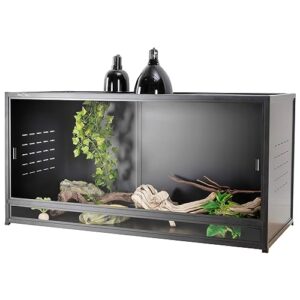
If you want doors that actually come off for deep cleaning, the ToxiRium 120 Gallon solves what the RepWild can’t. Its removable tempered glass doors give full access for substrate changes, essential when housing a gravid female who needs frequent monitoring.
PVC construction with aluminum framing holds humidity better than glass, and front vents let you dial in airflow without sacrificing that retention. At 48"x24"x24", it meets minimum sizing for adults under 3 kg, with combination locks adding security.
| Best For | Owners of desert-habitat reptiles like bearded dragons, leopard geckos, ball pythons, and uromastyx who want a lightweight, movable enclosure for easy front-access feeding and care. |
|---|---|
| Material | Aluminum frame + PVC |
| Door Type | Tempered glass sliding, locking |
| Top Ventilation | Mesh top with side vents |
| Capacity | 120 gallon |
| Assembly | Challenging, vague instructions |
| Target Species | Bearded dragons, geckos, ball pythons, uromastyx |
| Additional Features |
|
- Lightweight aluminum-and-PVC build makes it much easier to move than a comparable glass tank
- Front sliding doors with a secure lock simplify daily feeding and maintenance
- Side vents and mesh top support good airflow and let heat/UV lamps do their job
- Doors are fixed in place, so deep cleaning and substrate changes are trickier without full access
- Tempered glass doors are on the thin side and can crack or break if handled roughly
- Assembly instructions are vague, and stacking multiple units can be fiddly to align
3. OiiBO 135 Gallon Tempered Glass Reptile Terrarium
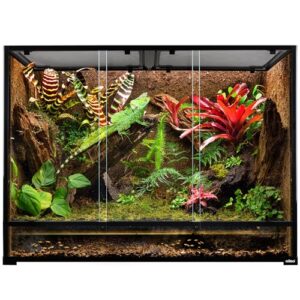
Full visibility matters when you’re monitoring a breeding pair around the clock, and the OiiBO delivers that with tempered glass on all four sides. At 48"x18"x36" with 135 gallons of capacity, it clears minimum sizing for adult females while giving you an unobstructed view for behavior tracking.
The raised, waterproof base works with substrate heaters directly beneath the enclosure, and double-locking front sliding doors keep escapes off the table during routine handling.
| Best For | Reptile and amphibian keepers who want a large, fully visible enclosure for species like bearded dragons, leopard geckos, snakes, or frogs, including those monitoring breeding pairs. |
|---|---|
| Material | Tempered glass |
| Door Type | Tempered glass double sliding, dual locks |
| Top Ventilation | Screen top with 12 wire holes |
| Capacity | 135 gallon |
| Assembly | Two-person required |
| Target Species | Bearded dragons, geckos, snakes, frogs |
| Additional Features |
|
- Full tempered glass on all sides offers unobstructed viewing for behavior tracking
- Waterproof raised base supports substrate heaters for desert or rainforest setups
- Double-locking front sliding doors make feeding and cleaning easy while keeping escapes off the table
- Requires two-person assembly due to its size and glass panel weight
- Some users report missing or hard-to-install vertical support poles
- Flat-packed shipping means self-assembly, with possible alignment gaps needing screw adjustment
4. ToxiRium 8x2x2ft PVC Reptile Enclosure
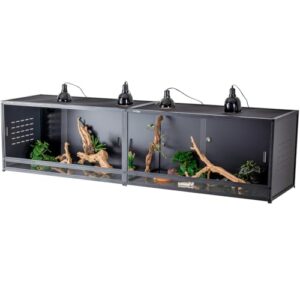
Glass viewing has its place, but once a pair settles into a rhythm, privacy often works better for them. The ToxiRium’s non-reflective PVC panels cut glare and reduce stress, which matters most for skittish females.
At 8x2x2 feet, it meets the minimum recommended length for breeding pairs without stacking. The front-opening door makes feeding and maintenance easy, while integrated vent slots and secure locks keep humidity stable and curious boas contained.
| Best For | Boa keepers and other desert-dwelling reptile owners who want a privacy-focused, breeding-ready enclosure with reliable temperature and humidity control. |
|---|---|
| Material | Non-reflective PVC |
| Door Type | Tempered glass sliding, locking |
| Top Ventilation | Stainless steel mesh with support bars |
| Capacity | 240 gallon |
| Assembly | Video-guided, modular |
| Target Species | Bearded dragons, geckos, snakes, tortoises |
| Additional Features |
|
- Non-reflective PVC panels reduce glare and stress, helping skittish reptiles settle in
- Spacious 8x2x2 ft footprint meets minimum recommended length for breeding pairs without needing to stack units
- Secure locks and vent slots help keep curious or strong reptiles contained while maintaining stable humidity
- Not watertight, so it’s not a good fit for rainforest or aquatic setups needing high humidity or standing water
- Lock mechanisms can sometimes misalign, which may require manual adjustment or replacement parts
- Non-locking base wheels mean the enclosure can shift on smooth flooring unless placed against a wall or secured
Create Stable Heat and Humidity Zones

Your room-level setup controls ambient conditions, but each enclosure still needs its own thermal gradient and moisture control to keep a breeding pair healthy. Ambient stability alone won’t cut it, since your female needs precise, adjustable microclimates she can move through as her needs shift.
Here’s what that setup requires, piece by piece.
Control Each Enclosure Separately
Every enclosure needs its own independent thermostat and dedicated heat mat, never a shared circuit. Log temperatures separately per unique enclosure ID, since one unstable unit shouldn’t jeopardize breeding weight across your whole room. Sound electrical infrastructure and steady ventilation support this, but individual control prevents temperature instability.
- Dedicated heat mats
- Independent thermostats
- Separate temperature logs
- Unique enclosure IDs
- Front-opening PVC or ABS enclosures
Provide Warm, Cool, Humid Hides
Hides do more than decorate; they anchor the thermal gradient. Diagonal placement, warm hide opposite cool hide, encourages exploration while a humid hide holds 70 to 90 percent humidity for shedding.
| Hide Type | Temperature | Key Feature |
|---|---|---|
| Warm | 28-32°C | Insulated walls |
| Cool | 24-26°C | Ventilated, nonporous |
| Humid | N/A | Moisture liner |
Snug sizing prevents entrapment.
Adaptation in reptiles includes behavioral and physiological traits that improve survival in captive environments. Adaptation is a key concept from the rainforest glossary that applies to how boa constrictors adjust to enclosure conditions.
Use Moisture-retaining Boa-safe Substrate
Substrate acts as your humidity engine, not just bedding. Coconut coir or cypress mulch, kept damp-sponge moist, holds 60 to 70 percent humidity while supporting burrowing behavior for thermoregulation.
Choose bioactive, non-toxic materials only. Skip cedar or pine. Depth matters for tunneling, and fibrous substrate aids odor management by trapping waste between refreshes.
Offer a Large Soaking Dish
A soaking dish does double duty: hydration and shed support. Size it at least 24 by 18 inches, 4 to 6 inches deep, with a heavy, non-slip base.
Place it away from heat sources to hold 75-85°F. Choose ceramic or high-grade plastic, smooth-surfaced, overflow-resistant, and easy to clean between soaks.
Anchor Branches and Perches Securely
A loose branch is a liability, not enrichment. Mount with keyhole brackets and stainless anchors, adding epoxy at junctions to kill micro-movement. Slope branches slightly downward to shed condensate.
- Load test each branch to hold 25+ lbs
- Use quick-release fasteners for cleaning
- Cap screws to prevent injury
- Check manzanita or PVC-coated wood for safety
Pair Boas Safely, Then Separate

Pairing isn’t something you rush into blindly; it takes preparation, close supervision, and a clear exit plan once breeding behavior occurs. Your enclosures and your recordkeeping both play a role in keeping this process safe for the animals. Here’s what you need to get right, from temperature cycling to newborn housing.
Cycle Temperatures Before Introductions
Boas won’t breed on a flat thermostat setting. Begin your temperature ramping schedule 14 days out, raising basking zones 1-2°F every three days toward 88-92°F while maintaining thermal gradient integrity.
Start the cooling phase timing 5-7 days before introductions, dropping nighttime lows to 72-76°F gradually, never abruptly.
Calibrate sensors at each zone beforehand; a miscalibrated probe undermines the entire cycling effort.
Supervise Temporary Breeding Introductions
Once temperatures are cycled, don’t just open the doors and hope. A trusted handler wears gloves, holds a clear barrier, and watches for lunging or coiling within 30 seconds.
Give it a full 60-minute observation window for tail flicks and retreats. Intervene fast if aggression exceeds two minutes, then return each boa to its front-opening enclosure for a 24-hour cooling period.
Track Pairing Dates and Behavior
Every introduction earns a line in your pairing date log, noting the exact day and the 24-hour result. Record tail position, coiling, and tongue flicks alongside enclosure temperature for correlation tracking.
Use these criteria to decide next steps:
- Courtship coiling observed — continue pairing
- Refusal or aggression — separate immediately
- No response within 60 minutes — log and retry later
Keep Gravid Females Quiet
Once ovulation confirms the pairing worked, your job shifts from matchmaker to guardian. Move her to a quiet enclosure with stable microclimate calm, dim lighting, and visual barriers blocking foot traffic. Limit handling, speak softly, and delay feeding activity management until she settles.
Reduced disturbance now protects the whole clutch later.
Protect a gravid boa’s calm now, and you protect her entire clutch later
Prepare Individual Newborn Housing
That quiet gravid enclosure was practice. Now newborns need their own hermetic escape prevention setup.
- Sealed units with 6-inch lips
- Moisture-retentive substrate, 2-3 inches deep
- Basking zone at 28-30°C
- Dim, low-glare lighting
- Shallow water dish, under 5% of floor space
Non-porous panels wipe clean fast, protecting your whole neonate housing biosecurity.
Frequently Asked Questions (FAQs)
Can you house two boas together?
Good fences make good neighbors, and the same holds true in reptile breeding. Housing multiple boas invites territorial behavior, feeding competition, and escape risks. Keep pairs separate except during supervised introductions, with strict quarantine protocols and daily behavioral observation for stress indicators.
What is the best enclosure for a boa constrictor?
For breeding pairs, front-opening PVC or ABS enclosures win out, like the ToxiRium 240 Gallon PVC, offering better heat retention, humidity control, and ventilation system design compared to glass, while meeting size requirements for gravid females.
How many babies can a boa have at once?
Think fax machine reliability: litter sizes usually run 10 to 60 neonates, occasionally as few as 6 to Body condition and age drive clutch outcomes, gestation runs 5-6 months, and mothers briefly coil newborns before independence begins.
How long to keep boas paired for breeding?
Plan on 4 to 6 weeks for most breeding pairs, extending to 12 if courtship lags. Watch for ovulation signs, then separate immediately, since prolonged pairing after mating raises stress and offers no reproductive benefit.
How long do boa constrictors stay pregnant?
Roughly 5 to 7 months, that’s the window most breeders plan around. Gravid females shift feeding and basking as gestation progresses, so watch body condition, temperature stability, and pre-birth shedding, usually one to two weeks before neonates arrive.
What age do boa constrictors reach breeding maturity?
Females usually hit breeding maturity between 2 and 4 years, once they exceed 5 feet and weigh 5 to 5 kilograms; males mature slightly earlier, around 2 years, at 4 to 5 feet in length.
How many babies do boa constrictors have?
Litter sizes usually range from 10 to 65 neonates, with well-fed gravid females producing larger clutches. After a five-to-six month gestation, live young arrive weighing 20 to 40 grams and reach postnatal independence within days.
Do breeding boas need to be fed differently?
Like a compass swinging with the seasons, feeding must shift too. Yes, gravid females need gestation nutrition adjustments, prey sized to 80% girth, and feeding frequency changes, from every 7-10 days to 10-14 during cooler cycling phases.
How often should you check on breeding boas?
Plan on twice-daily checks, morning and evening, verifying temperature and humidity each time. Gravid females need daily observation for posture shifts and body condition recovery, while behavior observation stays constant through seasonal cycling and gestation monitoring.
Conclusion
A breeding room runs like an orchestra, and every instrument, heat, humidity, airflow, has to hit its cue. Get those cues right, and well-designed boa constrictor enclosures for breeding pairs do the quiet work of turning biology into predictable results.
Skip the fundamentals, and no amount of luck fixes a stressed female or a disinterested male. Build the room correctly first.
The pairing, the cycling, the clutch, all of it follows from that single decision.