This site is supported by our readers. We may earn a commission, at no cost to you, if you purchase through links.
Your boa doesn’t care how often you mist. It cares what the hygrometer reads. Spray twice a day in a screen-top tank and you might still sit at 40%, while the same routine in a sealed enclosure with cypress mulch leaves the glass dripping and the substrate sour.
That gap explains why a fixed misting schedule for boa constrictor keepers copy from a forum rarely works. Humidity depends on your substrate, your ventilation, and the season. Juveniles need 60-80%, adults 50-70%, and a shedding boa wants even more.
Here’s how to read your numbers first, then build a routine that fits your enclosure.
Table Of Contents
- Key Takeaways
- Check Boa Constrictor Humidity Before Misting
- Build a Humidity-Based Boa Constrictor Misting Schedule
- Mist Your Boa’s Enclosure Without Overwetting
- Adjust Boa Misting During Shedding and Seasons
- Top 6 Boa Constrictor Misting Support Products
- Frequently Asked Questions (FAQs)
- How often should I mist my snake tank?
- What is the typical feeding schedule for boa constrictors?
- How hot is too hot for a boa?
- Do snakes need a misting system?
- Can misting alone replace a water bowl?
- What happens if I forget to mist?
- Should baby boas be misted differently than adults?
- Is tap water safe for misting my boa?
- How do I know if misting is working?
- Conclusion
Key Takeaways
- Let your hygrometer decide when to mist, keeping juveniles at 60-80% and adults at 50-70% humidity, and skip misting whenever the reading already sits in range.
- Start with one or two sessions a day, adjust one variable at a time, and tailor the routine to your substrate and ventilation, since a screen top sheds moisture fast while a sealed tank needs far less spray.
- Spray the walls and decor from 12-18 inches away, and cut back if the substrate feels muddy or glass condensation lingers past two hours.
- Raise humidity to 75-85% with a damp sphagnum moss hide when your boa starts to shed, expect to mist more in dry winter air, and return to your normal routine once the skin comes off in one piece.
Check Boa Constrictor Humidity Before Misting
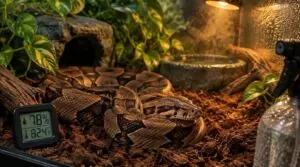
Grab a calibrated digital hygrometer before you pick up the spray bottle. Your boa constrictor doesn’t need extra moisture every time you think it does, and guessing is how enclosures end up soggy.
If you’re still weighing whether a snake fits your lifestyle, this guide to whether boa constrictors make good pets covers the daily care commitment, including humidity upkeep.
Measure your boa’s humidity with a hygrometer before misting, because guessing is how enclosures end up soggy
Take a reading first. Adults do best at 50-70%, while juveniles need 60-80%. If your humidity levels already sit inside that range, skip the misting. Only mist when the number falls below it.
Check more than one spot. Place the probe on the cool side, the warm side, and down at substrate level, since heat and airflow can shift readings by several points. Your substrate type matters too: cypress mulch holds moisture longer than newspaper, so it changes your misting frequency. Note every reading to spot patterns. Placing the device 12-18 inches off the substrate and away from heat sources, plus calibrating your hygrometer accurately with a psychrometer or dew point thermometer, keeps your baseline readings trustworthy.
Build a Humidity-Based Boa Constrictor Misting Schedule
Once your readings are in, you can turn them into a routine. Start with one session in the early morning or late evening, when your heat source has time to evaporate extra moisture before the night cools off.
Most boa constrictor setups land at one to two sessions daily. Let your hygrometer decide which. Log the number before each session for a week. If humidity levels stay inside range after the morning mist until evening, drop the second session. If they sag by noon, add one.
Ventilation and substrate shift your misting frequency, so adjust slowly. Change one variable at a time, then watch for several days.
A humid hide on the cool side holds moisture between sessions, saving sprays.
Mist Your Boa’s Enclosure Without Overwetting
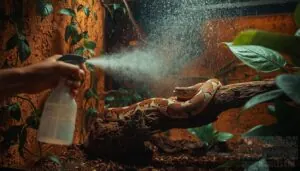
Your schedule only works if each session adds moisture without soaking anything. Good enclosure moisture management starts with how you spray, not just how often.
Here’s the routine that keeps things balanced:
- Use a fine mist sprayer and hold it 12 to 18 inches back, aiming at the walls and decor instead of your boa or the substrate.
- Touch the substrate afterward. It should feel damp, never muddy.
- Watch the glass. If condensation lingers past two hours, cut your misting frequency or shorten each session.
Ventilation changes the math. Screen tops shed humidity fast, so they tolerate more spray, while sealed tanks need less to avoid stagnant air. Always aim for balanced misting and let your humidity levels guide you.
Adjust Boa Misting During Shedding and Seasons
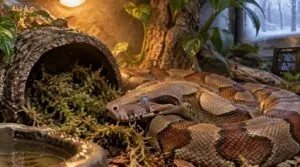
Even a perfect routine needs tweaking when your boa constrictor’s body or the weather changes the rules.
When shedding season arrives or a dry spell hits, check your ideal humidity levels for a boa constrictor terrarium so the enclosure stays comfortable alongside your temperatures.
Watch for the first signs of the shedding process: dull skin and cloudy, bluish eyes. Raise humidity levels to 75-85% and add a humid hide packed with damp sphagnum moss. Increase your misting frequency gradually, since sudden spikes leave surfaces soaking wet. Let your hygrometer set the pace, not the calendar.
Winter calls for the same attention. Dry indoor heating pulls moisture from the air, so you’ll likely mist more often. In summer, 60-80% suits a Central American boa, while winter can sit closer to 50-60%. When dry winter air makes misting a chore, a reptile terrarium fogger can help hold humidity steady between your manual sprays.
After each shed, check that the skin came off in one piece and the eye caps are gone. Then return to your normal misting routine.
Top 6 Boa Constrictor Misting Support Products
A good misting routine works best when the right gear backs it up. Below are six products that help you hold steady humidity, from foggers and automatic misters to a humidity spray and sphagnum moss. Pick the ones that fit your setup and your boa’s needs.
1. 1 Gallon Reptile Humidifier Fogger
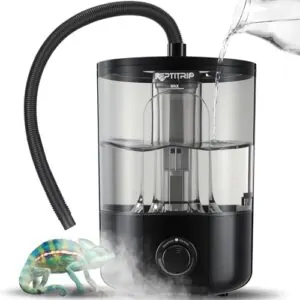
Can a single fogger really keep a boa’s tank steady? This one gets close. Its ultrasonic oscillation produces a micro-fine mist at 5-10μm, and the rotary dial lets you run anywhere from 50ml to 400ml per hour.
The 1-gallon (4L) tank means you’re not refilling daily, and dry-burn protection kicks in within a second of running empty. Use distilled water only.
It won’t hold an exact percentage, so you’ll adjust by hand. Reviews on durability are mixed, with some reports of leaks.
| Best For | Reptile keepers with tropical or humidity-loving species like geckos, snakes, or amphibians who want a large-capacity fogger that cuts down on refills and don’t mind adjusting the output by hand. |
|---|---|
| Material | Plastic |
| Color | Black |
| Weight | 1.34 kg |
| Humidity Support | 50-95% humidity |
| Reptile Compatibility | Snakes, geckos, dragons |
| Water Source | 1-gallon reservoir |
| Additional Features |
|
- Large 1-gallon (4L) tank runs for multiple days, so refills are infrequent
- Adjustable fog output from 50ml/hr to 400ml/hr with a simple rotary dial
- Dry-burn protection shuts off the unit within a second of running out of water
- Can’t be set to a specific humidity percentage, so you have to adjust it manually
- Mixed durability reviews, with some reports of leaks and early failure
- Requires distilled water, which adds ongoing cost and effort
2. Zilla Tropical Mist Humidity Spray
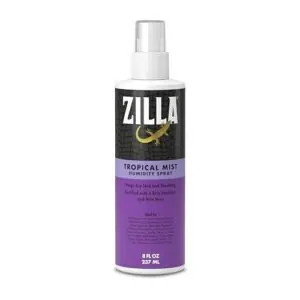
A quick spritz of Zilla Tropical Mist can give your boa’s enclosure a humidity lift when the air feels dry. The formula uses emollients and aloe vera conditioners, and it helps with healthy shedding and skin hydration. The bottle is slim, about 7.4 inches tall, so it’s easy to keep nearby.
Be realistic, though. Some keepers report a strong odor, and feedback on humidity control is mixed. Test it first, and don’t expect it to replace a proper daily misting routine.
| Best For | Keepers of tropical reptiles and amphibians, such as geckos, iguanas, frogs, and turtles, who want a conditioning mist to help with shedding and skin hydration alongside their regular misting routine. |
|---|---|
| Material | N/A |
| Color | N/A |
| Weight | 9.6 ounces |
| Humidity Support | Raises terrarium humidity |
| Reptile Compatibility | Geckos, iguanas, frogs |
| Water Source | N/A |
| Additional Features |
|
- Made with emollients and aloe vera conditioners to support skin hydration
- Helps with healthy shedding in reptiles and amphibians
- Slim bottle that is easy to keep nearby
- Some keepers report a strong or unusual odor
- Feedback on humidity control is mixed
- Not everyone finds it worth the cost
3. Sukh Sphagnum Moss for Reptiles
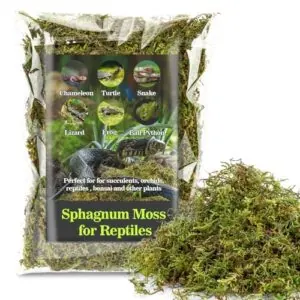
One 5.6-ounce pack of Sukh Sphagnum Moss holds humidity steady in your boa’s enclosure, so you’ll reach for the spray bottle less often.
Soak it first so it reaches full water-holding capacity, then tuck it into a hide. Your boa gets a soft, moist surface that helps with smoother sheds and helps prevent retained skin.
Keep it clean and damp, never soggy. It’s not a primary substrate, so pair it with poplar shavings or sand, and replace it when it sours.
| Best For | Reptile and amphibian keepers, especially owners of snakes, geckos, turtles, or frogs, who want an easy way to keep humidity steady in hides, nesting spots, and egg-laying boxes. |
|---|---|
| Material | N/A |
| Color | Green |
| Weight | 5.6 ounces |
| Humidity Support | Stable substrate humidity |
| Reptile Compatibility | Snakes, turtles, geckos |
| Water Source | Requires moistening |
| Additional Features |
|
- Absorbs water well and holds moisture, so humidity stays stable and the substrate dries out less
- Gives animals a soft, natural surface for hiding, nesting, and shedding
- Works as an egg-laying and incubation medium, and also doubles as a growing medium for orchids, ferns, and succulents
- Needs regular upkeep: it must stay clean and moist, but not overly wet
- Has to be replaced when it goes bad to avoid health problems
- Not a primary substrate, so it must be mixed with materials like poplar shavings, sand, or gravel for certain species
4. MECESOR Automatic Reptile Mister System
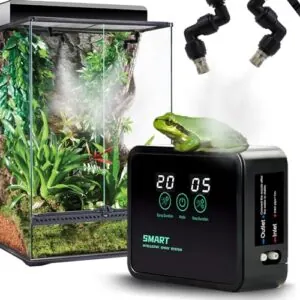
Worried about the leak reports? Fair, so check every hose connection on day one. The MECESOR TC021 draws from an external reservoir, like a bucket, so keep the unit above it to prevent siphoning. You can set sprays from 5 to 60 seconds and intervals from 1 to 24 hours, which suits a boa’s schedule nicely. Its two nozzles rotate 360°, so you can aim mist precisely.
Note it doesn’t resume settings after a power cut, so recheck it afterward.
| Best For | Reptile and amphibian keepers, such as owners of chameleons, frogs, or snakes, who want an automated, schedulable way to keep terrarium humidity steady and don’t mind checking connections and settings regularly. |
|---|---|
| Material | Tempered glass housing |
| Color | Black |
| Weight | 0.6 kg |
| Humidity Support | Terrarium humidity |
| Reptile Compatibility | Snakes, chameleons, frogs |
| Water Source | External reservoir |
| Additional Features |
|
- Spray duration (5s–60s) and interval (1H–24H) are adjustable, so you can match the schedule to your animal’s needs.
- Two 360° rotating nozzles let you aim the mist exactly where you want it.
- Installation hardware (zip ties, foam tape, brackets) is included, and it can also serve for plant watering or greenhouse humidification.
- Users report leaking from the device, hoses, or connections, so every fitting needs a careful check at setup.
- It doesn’t resume your settings after a power interruption, so you have to reprogram it each time.
- Reviews mention inconsistent spray pressure and timing, along with unclear instructions and a front panel that can detach.
5. MYGIIKAKA Automatic Reptile Mister Fogger
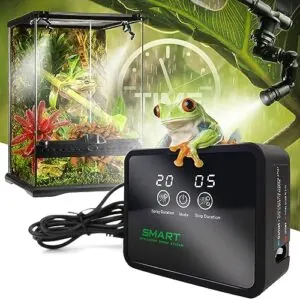
Want to mist your boa on a schedule without standing over the enclosure? This fogger does the work for you. Two 360° adjustable nozzles let you aim the spray where your boa actually lives, and the three-button timer takes care of the rest.
There’s no built-in reservoir, so you’ll supply a bucket or jar and a tubing line. Set your cycles once and the unit remembers them.
Expect some noise, occasional nozzle drips, and hose connections that can loosen. Check them now and then.
| Best For | Reptile owners who want to keep their terrarium humid on a schedule, especially while at work or away on vacation, and don’t mind supplying their own bucket or jar for water. |
|---|---|
| Material | Polyethylene |
| Color | Black |
| Weight | N/A |
| Humidity Support | Terrarium humidity |
| Reptile Compatibility | Reptile terrariums |
| Water Source | External reservoir |
| Additional Features |
|
- Two 360° adjustable nozzles let you aim the mist exactly where your reptile lives
- Programmable spray and stop cycles through a simple 3-button interface automate misting during work or vacation
- Works with custom reservoir setups like buckets and jars, so you can choose the water supply that fits your space
- Has no built-in reservoir, so you need to provide an external water container
- The pump is noticeably noisy, and the nozzles may drip after spraying
- Hose connections can loosen under pressure and disconnect, so they need regular checking
6. Smart Touch Reptile Fogger Humidifier
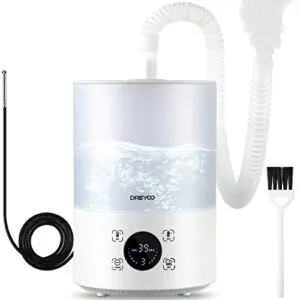
Tired of guessing whether your boa’s enclosure sits in the right range? This fogger lets you set humidity upper and lower limits on a smart touch screen, then takes care of the rest. Its 2.5L top-fill tank shuts off automatically, and the retractable hose stretches from 1.18 ft to 4.79 ft. It measures 11.61"D x 7.68"W x 7.68"H and puts out 205 ML/H.
Know the catch. You’ll need to restart and reconfigure it after a power outage, and some owners report failures.
| Best For | Reptile and amphibian keepers, or indoor growers with a greenhouse or grow tent, who want a hands-off humidifier with adjustable humidity limits and are willing to restart it after a power outage. |
|---|---|
| Material | N/A |
| Color | N/A |
| Weight | 0.9 kg |
| Humidity Support | Upper/lower humidity limits |
| Reptile Compatibility | Snakes, lizards, turtles |
| Water Source | 2.5L top-fill tank |
| Additional Features |
|
- Smart touch interface lets you set both upper and lower humidity limits
- Top-fill 2.5L tank with automatic shutoff makes refilling easy and adds safety
- Retractable hose extends from 1.18 ft to 4.79 ft for flexible placement
- Needs a manual restart and reconfiguration after a power outage
- Some users report inconsistent mist output or no mist at all
- Multiple customers report the product failing within 7 months of use
Frequently Asked Questions (FAQs)
How often should I mist my snake tank?
Boas need 55-75% humidity, so your hygrometer sets your misting frequency. Mist once or twice weekly, keeping each misting session brief.
Shedding calls for a misting schedule for shedding that lifts humidity levels to 70-80%.
What is the typical feeding schedule for boa constrictors?
You’ll obsess over misting frequency and humidity levels, yet forget dinner.
Your boa constrictor’s feeding schedule shifts with age: hatchlings eat every 10-12 days, juveniles 10-14, adults 3-8 weeks. Keep enclosure setup calm after meals.
How hot is too hot for a boa?
Anything above 90°F ambient is too hot, and a basking surface over 95°F can cause neurological damage or death. Aim for a 88-92°F basking spot, and use temperature monitoring with a thermostat with safety cutoffs.
Do snakes need a misting system?
A mist system is a rain cloud you rent, not a lifeline. Most snakes don’t need one.
Humidity control comes from a water bowl, damp substrate, and ventilation, plus extra moisture during the shedding process.
Can misting alone replace a water bowl?
You could mist a million times a day and still fail your snake.
Keep a water bowl in the enclosure for drinking and soaking. Misting frequency, substrate type, and hygrometer readings only fine-tune humidity levels.
What happens if I forget to mist?
Forgetting to mist can lead to shedding complications like stuck skin on digits or eye caps, dry air contributing to respiratory infections or scale rot, and poor microclimate control due to lack of humidity regulation.
Should baby boas be misted differently than adults?
Hatchlings are more sensitive to humidity swings, so keep humidity levels higher and mist them more often. During the shedding process, follow a Misting Schedule for Shedding, since proper humidity levels soften the keratin layer.
Is tap water safe for misting my boa?
Yes, tap water is generally fine if it’s safe for you to drink.
Just remember that bowl size matters too, since baby hognose snakes do best with shallow dishes while a green tree python prefers something narrow and deeper, so this guide to choosing the right water dish for your snake can help.
Water quality matters, though. Let it sit 24 hours, or switch to distilled water or reverse osmosis water for chlorinefree water.
How do I know if misting is working?
Humidity levels should hit 60-75% after misting, then fade over 4-8 hours.
Check your hygrometer, watch behavioral humidity indicators like soaking, and track the shedding process. Clean sheds confirm your misting schedule for shedding works.
Conclusion
Juveniles thrive at 60-80% humidity, adults at 50-70%, and no spray bottle schedule changes that math. Your best misting schedule for boa constrictor care is simply the one that keeps your hygrometer in range.
Adjust when your boa sheds, when winter dries the air, or when the glass starts dripping. Trust the hygrometer reading over any forum routine, and you’ll stop guessing. So read first, then mist. Your boa will quietly show you the rest.