This site is supported by our readers. We may earn a commission, at no cost to you, if you purchase through links.
A boa that’s shedding in patches or breathing with its mouth open is already under stress. Low humidity doesn’t announce itself loudly; it builds quietly through small, easy-to-miss changes in your snake’s skin and behavior.
Boa constrictors rely on consistent moisture to shed cleanly, stay hydrated, and breathe without strain. Get the levels wrong, and you’re looking at retained eye caps, dull scales, and respiratory infections that escalate fast. Boa constrictor humidity too low signs are your earliest warning system.
This guide walks you through what to watch for, how to measure accurately, and what to do about it.
Table Of Contents
- Key Takeaways
- Signs Boa Constrictor Humidity is Too Low
- Boa Constrictor Humidity Levels by Life Stage
- Measure Humidity and Temperature Accurately
- Raise Enclosure Humidity Safely
- When Low Humidity Needs Veterinary Care
- Frequently Asked Questions (FAQs)
- What is the ideal humidity level for a boa constrictor?
- How humid is too humid for a snake?
- How cold can boas tolerate?
- Is 70% humidity too high for a ball python?
- Can low humidity affect boa constrictor digestion?
- Does dry air shorten a boa constrictors lifespan?
- How do boa subspecies differ in humidity tolerance?
- Conclusion
Key Takeaways
- Incomplete or patchy shedding, open-mouth breathing, and lethargy are your earliest physical signs that your boa’s enclosure is too dry.
- Humidity targets shift with age—hatchlings need 65–70%, subadults 60–65%, and adults 55–60%—so dial your setup to your snake’s life stage.
- Combining a moisture-retaining substrate like coconut coir, a damp sphagnum hide, and calibrated hygrometers placed on the cool side at mid-body height gives you the most reliable humidity control.
- If wheezing, retained eye caps, sunken eyes, or worsening lethargy persist after you’ve corrected humidity conditions, stop adjusting and get a reptile vet the same day.
Signs Boa Constrictor Humidity is Too Low
When humidity drops too low, your boa shows clear, physical signs. The most common indicator of underhumidification is incomplete or patchy shedding, where old skin clings in pieces rather than coming off in one clean layer. Pay close attention to the eyes and tail tip, since retained shed can tighten as it dries and cause real damage if you don’t address it.
Setting up a proper enclosure with humidity-retaining materials makes managing these shedding risks far easier, as explored in this guide to boa constrictor racks for rescue caretakers.
Shedding issues often appear alongside skin problems. Scales may look dull, rough, or less flexible than usual, reflecting moisture loss through the skin.
Respiratory issues point to a different kind of stress. Watch for open-mouth breathing or unusual nasal discharge. Increased lethargy during your boa’s normally active hours can also signal that low humidity is causing ongoing discomfort.
Boa Constrictor Humidity Levels by Life Stage
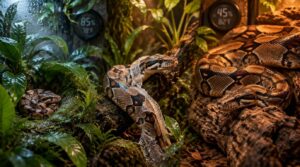
Once you know what to watch for, understanding the correct targets for your snake’s life stage is the logical next step, since boa constrictor humidity requirements shift noticeably as your animal grows.
Hatchlings and juveniles need the highest levels, ideally sitting between 65 and 70 percent. Their bodies shed more frequently during rapid growth, and you don’t want lower humidity increasing the risk of the retained shed and skin problems described above.
As your snake enters the subadult phase, pull humidity levels down slightly, targeting 60 to 65 percent. Adult boas do best in a slightly drier range of 55 to 60 percent. That lower ceiling helps reduce the risk of respiratory infections while still keeping their skin properly hydrated.
Measure Humidity and Temperature Accurately
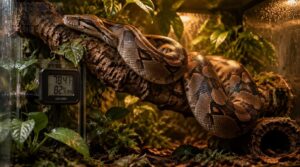
Knowing your boa’s humidity is one thing—knowing it’s accurate is another. The tools you choose and where you place them directly affect whether your readings reflect what your snake actually experiences. Two key factors determine that reliability.
Understanding boa constrictor housing requirements can help you identify the best sensor placement and gauge types for your specific setup.
Hygrometer Placement
Does it matter where your digital hygrometers sit in the enclosure? More than you’d think. Place them on the cool side at mid-body height, about 5 cm above the substrate.
That gives clean humidity monitoring without heat or spray distortion. Avoid corners and water bowls, which skew readings. For humidity mapping, add a second unit near your boa’s favorite hide.
Calibration and Daily Tracking
Even well-placed digital hygrometers drift over time. Hygrometer calibration keeps readings honest: run a salt-solution test monthly and after any bump or move. Apply the measured offset before logging anything. A salt calibration kit takes the guesswork out of this process by providing a consistent, pre-measured reference solution every time.
For humidity monitoring and logging, record raw readings at the same two daily windows. That consistency separates real humidity variance from normal diurnal shifts and helps you spot drift early.
Raise Enclosure Humidity Safely
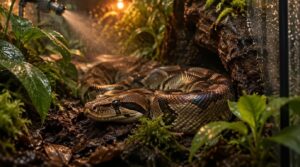
Raising humidity safely comes down to choosing the right combination of enclosure elements. A few targeted adjustments can bring your boa’s environment into the correct range without creating excess moisture that leads to bacterial growth. The following options give you practical starting points to work with.
Moisture-Retaining Substrates
Your substrate choice does more for moisture retention than almost any other factor. A hygroscopic substrate like coconut coir blended with sphagnum moss locks water into its fibers, naturally slowing evaporation.
Keep substrate hydration consistent at 5-7 cm deep under hides. Stable substrate moisture content gives your enclosure passive moisture buffering, cutting down on how often you’ll need to intervene.
Humid Hides and Water Bowls
A humid hide gives your boa a localized retreat during shed. Pack it with damp sphagnum moss.
Your water bowl keeps humidity levels stable and helps maintain the enclosure’s humidity gradient through evaporation.
Good reptile husbandry here means:
- Damp moss, not soaking
- No standing water inside
- Bowl large enough to soak in
- Clean water twice weekly
- Small hide opening traps moisture
Misting and Ventilation Balance
Think of your enclosure like a leaky bucket: if your misting system doesn’t outpace ventilation’s draw, humidity never holds long enough.
| Ventilation Level | Misting Frequency | Result |
|---|---|---|
| Low | Once daily | Stable humidity |
| Moderate | Twice daily | Acceptable gradient |
| High | Three+ times | Overhumidification risk |
Balance air circulation carefully. Too little airflow traps stagnant air; too much collapses your humidity gradient and risks overhumidification.
When Low Humidity Needs Veterinary Care
A humidity tweak won’t heal a sick boa. If you’ve corrected conditions and your snake still shows signs of trouble, adjustments are no longer enough.
When corrections fail and your boa still suffers, the problem has outgrown your hands
Watch for these warning signs that need a vet, not a substrate change:
- Wheezing or open-mouth breathing that continues beyond 24 hours
- Retained eye caps that won’t come free after a proper soak
- Visible dehydration, including sunken eyes or tacky oral tissue
- Lethargy and appetite loss that worsen despite better conditions
Respiratory issues and respiratory infection risk escalate when dehydration goes untreated. If your boa is showing two or more of these signs at once, get a prompt veterinary evaluation, not another humidity adjustment. Find a reptile vet and book an appointment that same day.
Frequently Asked Questions (FAQs)
What is the ideal humidity level for a boa constrictor?
For adult boas, the ideal boa constrictor humidity range is 50–60% relative humidity day to day. When your snake’s shedding, you’ll want to raise humidity levels to around 70–80% to help loosen old skin cleanly.
How humid is too humid for a snake?
Sustained levels above 80% quickly become a problem. Persistent humidity spikes encourage mold growth and stress your snake’s mucous membranes, raising respiratory infection risk.
Keep yours at 55–75% and let it dry between moisture boosts.
Poor humidity management can also directly affect shed quality and eye health, as retained eye caps that persist after a second shed cycle pose a serious risk and require veterinary attention.
How cold can boas tolerate?
Even a single cold night can wreck your boa’s ability to thermoregulate effectively. Keep ambient temps above 75°F at all times. Brief nighttime dips to 68°F are tolerable, but anything lower risks serious respiratory infections.
Is 70% humidity too high for a ball python?
No, 70% isn’t too high. It falls squarely within the ideal 60-80% range and is actually the standard target during shedding. Issues arise only when it stays above 70% with poor ventilation or low temperatures.
Can low humidity affect boa constrictor digestion?
Poor gut motility is a real risk when your boa’s enclosure stays too dry. Dehydration gradually slows the digestive process, making waste harder to pass and raising constipation risk if boa constrictor humidity drops consistently.
Does dry air shorten a boa constrictors lifespan?
Imagine your boa repeatedly shedding in patches for months on end.
Chronic humidity stress leads to dehydration, respiratory issues, and ongoing skin problems that build on each other, all of which can meaningfully shorten lifespan.
How do boa subspecies differ in humidity tolerance?
Ironically, one humidity label doesn’t fit all boa subspecies. Your tropical line from a humid natural habitat requires 60–80% RH, while arid-adapted subspecies stay healthiest around 40–60%. Always match your boa constrictor humidity to origin.
Conclusion
Retained eye caps account for a significant share of emergency boa vet visits, and the root cause is almost always humidity that has gradually dropped too low. Spotting boa constrictor humidity too low signs early keeps you in control of the outcome.
Keep your substrate damp, your humid hide stocked, and your hygrometer calibrated. Check the shed after every cycle. A complete, clean shed tells you the enclosure is working. That’s worth the daily habit.