This site is supported by our readers. We may earn a commission, at no cost to you, if you purchase through links.
Most keepers blame their misting schedule when humidity drops. The real culprit sits at the bottom of the enclosure.
Substrate moisture retention drives evaporation, which drives humidity. Choose the wrong material, and no misting frequency or ventilation adjustment will stabilize your readings. Choose right, and you spend less time chasing numbers and more time watching your snake behave naturally.
The best substrate materials for humidity control work by creating a moisture gradient from the enclosure floor up to the ventilation points. The right layering strategy turns that gradient into a steady, self-regulating microclimate you can fine-tune with precision.
Table Of Contents
- Key Takeaways
- How Substrates Control Snake Enclosure Humidity
- Best Moisture-Retaining Substrate Materials
- Best Drainage and Aeration Materials
- Layer Substrates for Stable Humidity
- Choose and Maintain Your Snake’s Substrate
- Frequently Asked Questions (FAQs)
- What material holds humidity the best?
- What material absorbs humidity?
- What is the cheapest homemade moisture absorber?
- What are some effective dehumidifying materials?
- Can substrate choice affect a snakes shedding success?
- Which substrates best resist mold in humid enclosures?
- How does enclosure temperature affect substrate moisture retention?
- Are bioactive substrates appropriate for all snake species?
- What substrate works best for snake egg incubation?
- Conclusion
Key Takeaways
- Your substrate — not your misting schedule — controls enclosure humidity, because evaporation from substrate moisture is what drives relative humidity levels in the first place.
- Coconut coir and sphagnum moss are the strongest performers for moisture retention, holding 2–3x and up to 25x their dry weight respectively, and releasing it slowly to keep humidity stable between waterings.
- Layering substrates in a deliberate sequence — drainage base, structural middle, moisture-retentive top — creates a self-regulating humidity gradient that works passively without constant manual adjustment.
- Temperatures above 28°C strip substrate moisture faster than it can be replenished, making temperature management just as critical as material choice for maintaining stable enclosure humidity.
How Substrates Control Snake Enclosure Humidity
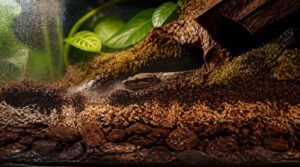
Moisture content in your substrate is the primary driver of enclosure humidity. As water evaporates from exposed surfaces, it raises relative humidity above the substrate layer, creating a humidity gradient that climbs from floor to ventilation points. How fast that gradient builds or collapses depends on your substrate’s moisture retention capacity and its total exposed surface area.
Substrate porosity also shapes how quickly that gradient shifts, much like how water dishes designed for humid climates introduce an additional evaporative surface that can accelerate humidity buildup in tightly ventilated enclosures.
Capillary action draws water upward through the substrate column between waterings, sustaining steady evaporation without pooling. A deep, well-chosen substrate keeps humidity stable long after you’ve misted. Pair that with ventilation control to regulate how quickly moisture exchanges with outside air, and you hold precise command over the enclosure’s microclimate.
Track results with a hygrometer positioned at center height inside the enclosure.
Best Moisture-Retaining Substrate Materials
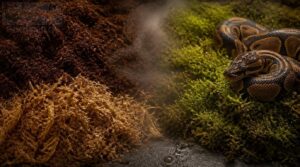
Moisture retention starts with the substrate you choose. Some materials absorb several times their own weight in water and release it slowly, giving you consistent humidity without constant intervention.
The three substrates below are the most reliable options for long-term moisture control in tropical and semi-tropical snake enclosures.
Coconut Coir
A lignocellulosic fiber structure gives coconut coir its excellent water-holding capacity, retaining 2-3 times its dry weight in moisture without compacting or pooling. It’s near-neutral in pH (6.0-6.8), so it won’t disrupt enclosure chemistry, and its slow decomposition preserves humidity retention for weeks.
Rinse it with dechlorinated water first to remove residual salts, then soak 12-24 hours before substrate mixing.
For tap water without a filter, dechlorinating before snake substrate cleaning ensures harmful chemicals won’t disrupt the soaking process.
Sphagnum Moss
Sphagnum moss pushes moisture retention further than coir, holding up to 25 times its dry weight and releasing humidity gradually as it dries. That slow-release behavior keeps humidity regulation stable without saturation spikes.
Layer it 2-5 cm deep in your bioactive soil mixes. Its acidity resists mold, and substrate aeration prevents compaction. Dampen to 60-70% moisture; replace every 6-12 months.
Cypress Mulch
Where sphagnum excels at saturation, Cypress Mulch controls substrate moisture retention differently, absorbing water into lignin-rich chippings and releasing it slowly as the humidity gradient shifts. Its substrate porosity buffers fluctuations without waterlogging.
Layer it 2-4 cm deep, water the surface only, and make ventilation and drainage adjustments if it stays wet past 48 hours.
Refresh every 6-12 months.
Best Drainage and Aeration Materials
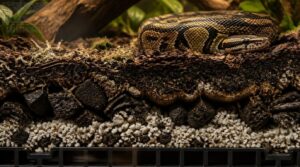
Moisture retention keeps humidity stable, but drainage and aeration prevent the waterlogging that leads to bacterial growth and respiratory issues.
The right structural materials create air pockets within the substrate that regulate both gas exchange and moisture distribution across the enclosure floor.
These three options each accomplish that through distinct physical properties worth understanding before you build your substrate layer.
Coconut Husk Chips
Coconut husk chips function like a hygroscopic buffer, pulling in excess moisture and releasing it slowly to maintain a stable humidity gradient.
For best results, meet substrate depth requirements by layering them 30 to 50 mm deep. Their coarse, open structure naturally allows ventilation and drainage adjustments throughout the enclosure, while the fibrous matrix sustains consistent moisture retention without compacting.
Orchid Bark
Orchid Bark‘s porous fragment structure releases moisture gradually, making it your go-to choice for maintaining a steady humidity gradient without oversaturation. It’s most effective in a bioactive enclosure setup where consistent airflow through ventilation strips naturally regulates evaporation rate.
- Moderate moisture retention without pooling
- Air pocket formation that slows release
- Compatibility with top-dampening routines
- Layering under moss for humidity spikes
Expanded Clay Pellets
Picture a hidden foundation that quietly breathes beneath your substrate. Expanded clay pellets are lightweight porous spheres delivering steady moisture retention without saturating surface layers, keeping enclosure humidity stable.
For a bioactive enclosure setup, place a 2-4 cm drainage layer at the base before adding top substrates. They won’t decompose, so your substrate layering stays structured and aerated over time.
Layer Substrates for Stable Humidity
Think of your enclosure’s substrate as a layered reservoir, not a flat bed. Each layer acts in a distinct function in moisture gradient optimization, and getting that sequence right is how you achieve genuine microclimate regulation.
Your substrate is a layered reservoir, and sequence is what turns it into a self-regulating microclimate
Here’s what a well-built stack gives you:
- A moisture-retentive base layer that holds water and releases it slowly upward
- A structural middle layer that maintains substrate depth and porosity
- A fast-draining top layer that prevents stagnation at the surface
- Humidity retention that stays stable even when you open the enclosure
Pre-wet your base to 60-70% relative humidity potential before adding upper layers. Substrate layering works because moisture migrates from dense to porous material during evaporation cycles, creating a self-regulating buffer your snake benefits from constantly.
Choose and Maintain Your Snake’s Substrate
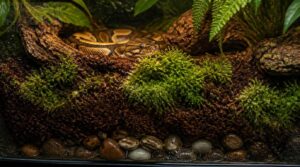
Your substrate choice sets the ceiling your enclosure humidity can reach. Match it to your species’ target humidity gradients and you’ll gain precise control.
Start with coconut coir as your base, then layer sphagnum moss where sustained moisture retention is critical. For bioactive soil mixes, integrate drainage materials beneath to prevent saturation and anaerobic zones.
Maintain your setup with these habits:
- Replace sphagnum moss every 6-12 months before moisture performance drops
- Spot-clean coconut coir weekly; replace fully every 3-4 months
- Check moisture retention by pressing substrate; it should hold shape without releasing water
- Monitor RH daily; adjust layer depth to shift humidity gradients
- Inspect drainage layers quarterly for compaction or anaerobic buildup
Adjust layer depth before adjusting your misting frequency.
Frequently Asked Questions (FAQs)
What material holds humidity the best?
For moisture retention, coconut coir clearly leads. Its hygroscopic properties let it absorb water up to four times its dry weight, making it your best pick for stable humidity. Sphagnum moss is a close second.
What material absorbs humidity?
Any porous material can hold water, but hygroscopic properties determine how well it buffers humidity. Coconut coir and sphagnum moss actively absorb ambient moisture through capillary action, releasing it gradually to stabilize your enclosure’s RH.
What is the cheapest homemade moisture absorber?
Baking soda paste is your cheapest homemade option: mix baking soda with a little water and place it in a small dish near humidity hot spots. Calcium chloride absorbs faster but costs a bit more.
What are some effective dehumidifying materials?
Silica gel and activated charcoal act as silent sponges, pulling excess moisture from your enclosure’s air. Ventilation and drainage adjustments boost their effect without oversaturating your substrate.
Can substrate choice affect a snakes shedding success?
Yes, absolutely. The right substrate directly drives shedding success by regulating enclosure humidity levels. Without consistent moisture retention, your snake’s skin simply won’t loosen evenly, leading to incomplete sheds, retained eye caps, and serious injury.
Which substrates best resist mold in humid enclosures?
Cypress mulch, orchid bark, and expanded clay pellets give you the best fungal growth inhibition through drainage and aeration. Their substrate porosity promotes rapid surface drying. Keep yours on a humidity cycle with dry periods.
How does enclosure temperature affect substrate moisture retention?
Temperature’s impact on moisture retention is sharper than you’d expect. Above 28°C, heat raises vapor pressure inside substrate pores, stripping moisture faster than you can replenish it and directly undermining your enclosure’s humidity control efforts.
Are bioactive substrates appropriate for all snake species?
Bioactive setups don’t suit every snake. Tropical species tolerate elevated moisture retention well, but desert and dry-adapted species face over-humidity risks, respiratory issues, and mold growth that can compromise your enclosure microclimate and reptile care.
What substrate works best for snake egg incubation?
Like a vessel preserving fragile potential, coconut coir is your best foundation. Its moisture retention suits most snake species. Mix in sphagnum moss for humidity, and you’ll want a drainage layer for stable substrate layering.
Conclusion
Think of your enclosure like a sponge, not a spray bottle. Moisture lives in the substrate, not in the air hovering above it.
The right substrate materials for humidity control build a foundation that works passively, absorbing and releasing moisture as conditions naturally shift. Layering strategically matters just as much as choosing the materials themselves.
Get the base right, and your misting schedule becomes a minor adjustment, not a constant correction. Stable humidity starts underground.