This site is supported by our readers. We may earn a commission, at no cost to you, if you purchase through links.

A ball python sitting at 78°F instead of 88°F isn’t just uncomfortable; it’s slowly losing its ability to digest food, fight infection, and regulate its own metabolism. The difference between thermostat types for snakes is what stands between a thriving animal and a chronic health crisis hiding in plain sight.
Not every thermostat controls heat the same way. On/off units cycle through temperature swings of 1–2°C, while PID controllers eliminate that cycling entirely through continuous closed-loop calculation. Your choice of controller shapes every gradient in the enclosure.
This guide breaks down each type, matches them to your heat sources, and helps you install them correctly.
Table Of Contents
- Key Takeaways
- How Snake Thermostat Types Differ
- Match Thermostats to Snake Heat Sources
- Choose by Species, Setup, and Budget
- Install Probes and Prevent Heating Failures
- Top 8 Snake Temperature Control Products
- 1. Inkbird ITC-308 Temperature Controller
- 2. Reptile Thermometer Humidity Gauge Kit
- 3. BSRESIN 2-Pack Reptile Thermometer Hygrometer
- 4. Aiicioo 8 Watt Reptile Heating Pad
- 5. REPTIZOO Dimming Thermostat for Reptiles
- 6. Reptile Thermometer Humidity Gauge 2pc
- 7. Oasirep Reptile Thermometer Hygrometer
- 8. BN-LINK Reptile Heating Pad with Thermostat
- Frequently Asked Questions (FAQs)
- What is the best thermostat for snakes?
- What are the four main types of thermostats?
- What is the best type of heating for snakes?
- What should I set my ball python thermostat to?
- Can one thermostat control multiple enclosures simultaneously?
- Do reptile thermostats affect enclosure humidity levels?
- What happens if a thermostat malfunctions overnight?
- How long do reptile thermostats typically last?
- Can smart home systems integrate with reptile thermostats?
- Conclusion
Key Takeaways
- PID thermostats offer the tightest temperature control by continuously calculating and correcting error, making them the safest choice for thermally sensitive species like ball pythons.
- Your heat source determines which thermostat type you need — under-tank mats tolerate basic on/off cycling, while ceramic emitters and radiant panels require proportional or pulse control to stay stable.
- Probe placement is the single biggest variable in thermostat accuracy — position it where your snake actually rests, away from direct heat, or your controller will misread and overcorrect.
- A stuck relay or loose probe overnight can push temperatures to lethal extremes, so dual-probe setups, weekly relay tests, and temperature alerts are essential safeguards, not optional extras.
How Snake Thermostat Types Differ

Thermostats aren’t all built the same, and the type you choose directly affects how consistently your snake’s enclosure holds temperature. Each design controls heat through a different mechanism, with real differences in precision, compatibility, and cost.
Understanding your snake’s specific thermal needs is a good starting point—choosing the right heat source for your snake’s enclosure can help you match thermostat type to heating method more effectively.
The four types below cover everything from basic cycling units to complex controllers, so you can match the right tool to your setup.
On/Off Thermostats
The simplest type, on/off thermostats switch your heat source fully on or off based on a single set point you configure.
They’re affordable and reliable, but temperature stability is limited. Expect a temperature swing of 1–2°C as part of normal cycling. Probe placement determines your accuracy most, so keep it in your snake’s resting zone, away from the heater.
Proportional Dimming Thermostats
Where on/off models cycle abruptly, proportional dimming thermostats continuously adjust output voltage to your heat source. Power decreases as temperature nears your setpoint, tightening temperature stability to ±0.5–1°C.
That precision has one condition: non-coiled heat mats and ceramic heat emitters handle variable wattage well, but coiled elements and radiant sources behind glass can produce skewed readings.
Pulse Proportional Thermostats
Where dimming models vary voltage, pulse proportional thermostats fire your heater in rapid on/off bursts, adjusting duty cycle to hit your setpoint.
- Ceramic heat mats handle pulses better than coiled elements
- Probe placement away from heat paths reduces overshoot
- Larger enclosures need longer OFF intervals for thermal gradient maintenance
Temperature stability comes from thermal mass, not continuous power.
PID Thermostats
PID thermostats calculate error continuously and adjust output using three tuned parameters: proportional, built-in, and derivative. That closed-loop control eliminates the cycling that pulse systems can’t fully prevent.
Place your probe where your snake actually rests. Poor placement triggers built-in windup, pushing the controller into overcorrection. In larger enclosures, lower your proportional gain to protect your thermal gradient and avoid overshoot.
Spot-checking with a reptile infrared temperature gun lets you verify surface temps across the enclosure without disturbing your snake’s position.
Match Thermostats to Snake Heat Sources

Because your heat source determines how a thermostat must respond, heat source compatibility should guide your decision first. A small under-tank mat draws low current and responds gradually, making on/off control sufficient. A ceramic heat emitter or radiant panel concentrates output more aggressively, so you’ll need proportional or pulse control for reliable temperature stability.
Three compatibility factors matter most:
- Heat source size sets your current load; your thermostat’s wattage rating must exceed the element’s draw.
- Heat source placement, whether overhead or undertank, directly affects what your probe actually reads.
- Flexible mats alter thermal gradient formation differently than rigid emitters, so calibration needs vary.
Matching these factors to your thermostat type keeps your control consistent and your setup safe.
For a full picture of how your setup is performing, cross-check your thermostat readings against a ball python health signs checklist, since environmental consistency shows up directly in your snake’s behavior and condition.
Choose by Species, Setup, and Budget

For reptile keepers managing multiple setups, the right thermostat comes down to three factors working together: your snake’s size, your enclosure’s complexity, and your budget.
- Large or thermally sensitive species like ball pythons need tighter gradients and PID or proportional control to prevent dangerous temperature swings.
- Complex enclosures combining heat pads and ambient sources benefit from multi-outlet thermostats with independent sensors per zone.
- Budget doesn’t dictate safety; entry-level on/off units suit beginners with simple setups, while mid-range proportional controllers add meaningful protection for a modest step up.
If you’re running a single juvenile snake on one heat pad, a basic unit controls it cleanly. But as your collection grows, matching control precision to enclosure complexity keeps every animal safer.
Install Probes and Prevent Heating Failures
Picture a probe slipping loose at 2 a.m., your heating system reading cool air instead of substrate warmth, and the thermostat pushing output higher to compensate. That’s thermal runaway, and it’s preventable.
A loose probe at 2 a.m. can turn your thermostat into a runaway heater—but it’s preventable
Place thermostat probes on the warm side of the enclosure, away from basking spots, and use a probe shield to block radiant lamp bias. For reliable temperature consistency, run a dual-probe setup: one near the substrate source, one at mid-air level. A dual probe reptile thermostat controller lets you monitor both zones simultaneously, cutting the guesswork out of overnight temperature management.
| Failure Scenario | How to Prevent It |
|---|---|
| Probe detachment | Secure with a shield and cable clips |
| Relay stuck-on | Test controller cycle weekly |
| Thermostat drift | Cross-check probes monthly |
Log temperature monitoring data at 1-5 minute intervals to catch slow drifts, and set up SMS or email alerts for probe failure detection so your heating system stays accountable overnight.
Top 8 Snake Temperature Control Products
The products below cover the full range of thermostats, heating pads, and monitoring tools you’ll need to build a safe, stable snake enclosure. Each option is chosen for reliability, practical value, and fit across common setups and budgets.
Use this list to match the right hardware to your specific heat source and species.
1. Inkbird ITC-308 Temperature Controller
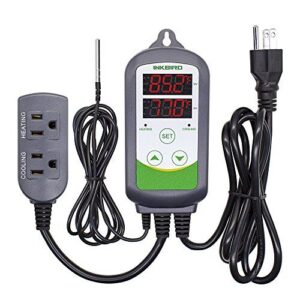
The ITC-308 gives you dual relay outputs for heating and cooling, making it one of the more adaptable budget controllers available. Its range spans -58 to 248°F, covering virtually any snake’s thermal requirements. At 1,100W / 10A capacity, it controls most heat mats and ceramic emitters comfortably.
Because it uses on/off relay cycling rather than true PID, probe placement matters a lot. Position the included 6-foot sensor carefully and verify it against a calibrated thermometer before trusting it.
| Best For | Homebrewers, reptile keepers, and hobbyists who need reliable dual-stage temperature control on a budget. |
|---|---|
| Product Type | Dual-relay thermostat |
| Power Source | 100–240V AC |
| Reptile Use | General reptiles and snakes |
| Mounting Method | Plug-in with probe |
| Display Type | Dual LCD |
| Housing Material | Plastic |
| Additional Features |
|
- Controls both heating and cooling equipment simultaneously with dual relay outputs
- Wide temperature range (-58 to 248°F) suits almost any application
- Built-in compressor delay and overload protection help safeguard your equipment
- On/off relay cycling (not true PID) means probe placement is critical for accurate results
- Temperature accuracy drifts to ±2°F at higher ranges, so independent verification is recommended
- Plastic housing and unclear instructions may frustrate users in demanding or industrial settings
2. Reptile Thermometer Humidity Gauge Kit
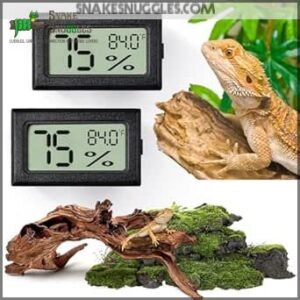
The Vodolo thermometer kit gives you two digital hygrometers for monitoring separate zones simultaneously, with 0.9°F temperature accuracy and adhesive backing that requires no tools to install. Battery power keeps the setup clean and cable-free.
There’s a real limitation to know upfront: readings above 50% humidity tend to lock at 99%, making this kit unreliable for moisture-dependent species. For dry-adapted snakes kept under that threshold, it performs consistently. Position each probe at mid-enclosure height, well away from substrate and water sources, for dependable results.
| Best For | Keepers of dry-adapted reptiles like bearded dragons and leopard geckos who need to monitor multiple enclosure zones without dealing with cables or complicated installation. |
|---|---|
| Product Type | Digital hygrometer 2-pack |
| Power Source | Replaceable battery |
| Reptile Use | Bearded dragons, geckos, snakes |
| Mounting Method | Adhesive backing |
| Display Type | Digital, no backlight |
| Housing Material | Plastic |
| Additional Features |
|
- Comes with two hygrometers, so you can track different zones or separate enclosures at the same time
- Adhesive backing makes mounting quick and tool-free
- Battery-powered design keeps the setup clean with no cords to manage
- Humidity readings above 50% are unreliable and often freeze at 99%, making it a poor fit for moisture-loving species
- The display has no backlight, so checking readings in dim conditions is difficult
- The adhesive can fail on glass or weaken after cleaning
3. BSRESIN 2-Pack Reptile Thermometer Hygrometer
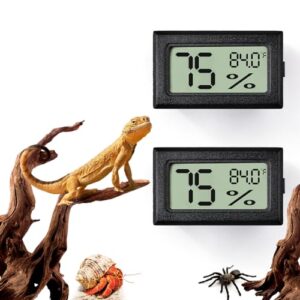
Two probes mean you’re covering both ends of the enclosure at once. The kit measures temperature from -58°F to +158°F with ±1°F accuracy and humidity from 10% to 99% RH, updating every five seconds so you catch shifts quickly. Each gauge runs on pre-installed 1.5V button cells rated for over a year of continuous use.
Place one near the basking spot and one in the cool zone. Just know the included adhesive dots can lose grip on glass over time.
| Best For | Reptile owners who want to monitor both ends of their enclosure simultaneously with fast, accurate temperature and humidity readings. |
|---|---|
| Product Type | Digital gauge 2-pack |
| Power Source | 1.5V button cell |
| Reptile Use | Ball pythons, bearded dragons, geckos |
| Mounting Method | Adhesive dot glue |
| Display Type | Digital display |
| Housing Material | Plastic |
| Additional Features |
|
- Covers two zones at once with dual gauges, so you can track the basking spot and cool side without buying a second kit
- Updates every five seconds, giving you a near-real-time look at conditions inside the tank
- Pre-installed batteries rated for over a year mean you can set it up and forget about power for a long time
- The adhesive dots can lose their grip on glass over time, leaving gauges sliding or falling
- Accuracy and durability have drawn mixed reviews, so readings may drift as the units age
- The small display can be hard to read from across the room
4. Aiicioo 8 Watt Reptile Heating Pad
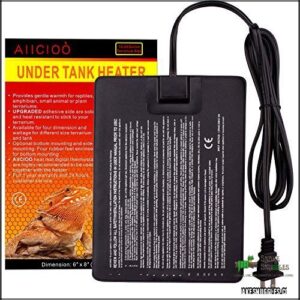
Good readings only matter if your heat source stays consistent. The Aiicioo 8 Watt pad outputs steady under-tank heat between 104°F and 122°F, fitting 10-20 gallon enclosures at 10.8 x 4.9 inches. Solid nichrome wire construction keeps it durable through regular cleaning, and the upgraded adhesive resists melting and separation.
Pair it with a thermostat, since it has no built-in control. Glass surfaces only; plastic and acrylic aren’t safe. Don’t bury it under dense substrate, since it needs ventilation to run safely.
Once the heater is set up, check both ends of the enclosure with a digital probe, and use this guide to heating a snake terrarium properly to fine-tune the gradient.
| Best For | Reptile and amphibian owners who need reliable, consistent under-tank heat for glass terrariums in the 10-20 gallon range. |
|---|---|
| Product Type | Under-tank heater |
| Power Source | 120V AC |
| Reptile Use | Snakes, lizards, turtles, hermit crabs |
| Mounting Method | Adhesive to glass |
| Display Type | None |
| Housing Material | Solid-state construction |
| Additional Features |
|
- Steady heat output between 104°F and 122°F gives tropical species a dependable warm zone around the clock
- Nichrome wire construction holds up well over time and makes cleaning straightforward
- Upgraded adhesive is less likely to melt or peel away from the tank surface
- No built-in thermostat, so you’ll need a separate temperature controller to avoid overheating
- Only safe for glass tanks — plastic, acrylic, and water tanks are all off the table
- Must stay ventilated and can’t be fully buried under substrate, which limits placement flexibility
5. REPTIZOO Dimming Thermostat for Reptiles

That thermostat pairing is exactly where the REPTIZOO TC02 earns its place. It uses PID dimming mode to gradually reduce power as temperatures near your setpoint, keeping basking zones steadier than simple on/off cycling.
The control range runs from 41°F to 140°F, with a 300W maximum load that covers most heat lamps, mats, and cables. Position the probe at least 15cm from the heat source, and confirm with a separate thermometer, since readings aren’t always reliable out of the box.
| Best For | Reptile keepers who want precise, stable temperature control for terrariums using heat lamps, mats, or cables up to 300W. |
|---|---|
| Product Type | Dimming PID thermostat |
| Power Source | AC outlet |
| Reptile Use | General reptile terrariums |
| Mounting Method | Plug-in with probe |
| Display Type | Digital display |
| Housing Material | ABS plastic |
| Additional Features |
|
- PID dimming mode gradually adjusts power output, preventing the temperature spikes and drops that simple on/off thermostats cause
- Wide control range (41°F to 140°F) suits a broad variety of reptile species and setups
- Compatible with multiple heat sources, including lamps, mats, and cables, making it versatile across different enclosure types
- Temperature readings can be inaccurate out of the box, so you’ll likely need a separate thermometer to verify accuracy
- 300W maximum load rules out high-wattage heating equipment, limiting its use in larger setups
- The probe must be placed at least 15cm from the heat source, which can complicate placement in smaller enclosures
6. Reptile Thermometer Humidity Gauge 2pc
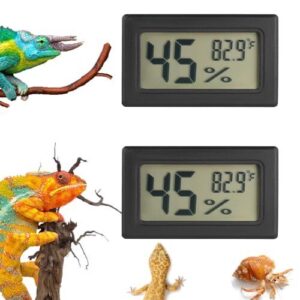
Once your thermostat stabilizes heat, tracking humidity alongside temperature matters too. This 2-pack measures both simultaneously, with a 10-second response time that keeps you current when conditions shift. Accuracy sits at ±1°F and ±5% RH, covering ball pythons, bearded dragons, and leopard geckos. Battery life is four months, and each unit includes two spares.
Position probes away from direct heat to avoid skewed readings, and be aware the compact LCD can be hard to read at a glance.
| Best For | Reptile keepers who need to monitor both temperature and humidity simultaneously across multiple enclosures for species like ball pythons, bearded dragons, and leopard geckos. |
|---|---|
| Product Type | Digital monitor 2-pack |
| Power Source | Built-in battery |
| Reptile Use | Ball pythons, bearded dragons, geckos |
| Mounting Method | Adhesive mounting |
| Display Type | LCD display |
| Housing Material | ABS plastic |
| Additional Features |
|
- Measures temperature and humidity at the same time with a fast 10-second response, so you catch environmental shifts quickly
- Comes as a 2-pack with two spare batteries per unit, giving you coverage for multiple tanks right out of the box
- Four-month battery life means less frequent swapping and more consistent monitoring
- The compact LCD can be difficult to read at a glance, especially from a distance
- Adhesive backing is unreliable for some users, making wall or tank mounting a challenge
- Durability is hit or miss, with some users reporting a shorter-than-expected lifespan
7. Oasirep Reptile Thermometer Hygrometer
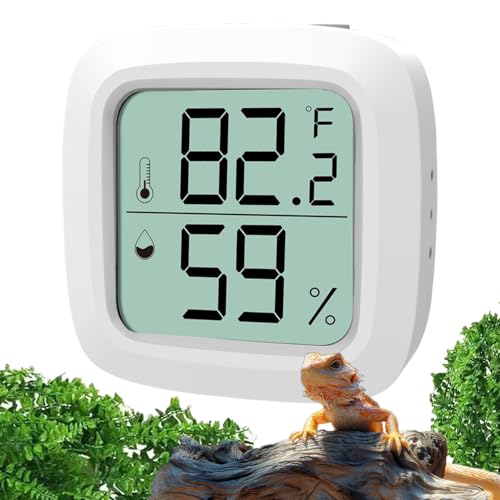
The Oasirep combats the readability issue directly: its large LCD display is visible from across the room without squinting. Accuracy sits at ±1°C for temperature and ±5% RH for humidity, covering ball pythons, leopard geckos, and similar species reliably. Battery life runs up to 12 months on a single CR2032, well above most competitors.
Installation takes seconds with the included adhesive pad. Keep it away from misters since it isn’t waterproof, and expect a smaller footprint than product images suggest.
| Best For | Reptile owners who need a reliable, easy-to-read thermometer/hygrometer for enclosures like ball python or leopard gecko setups. |
|---|---|
| Product Type | Digital hygrometer |
| Power Source | CR2032 battery |
| Reptile Use | Snakes, turtles, lizards, bearded dragons |
| Mounting Method | Double-sided adhesive |
| Display Type | Large LCD |
| Housing Material | ABS resin |
| Additional Features |
|
- Large LCD display is easy to read from across the room
- Accurate readings within ±1°C and ±5% RH, suitable for a wide range of reptiles
- Long battery life of up to 12 months on a single CR2032
- Not waterproof, so it can’t be used near misters or high-moisture setups
- Physical size is smaller than product images imply, roughly 1 inch square
- Battery life may vary depending on environmental conditions and usage
8. BN-LINK Reptile Heating Pad with Thermostat
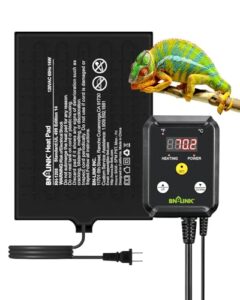
Pick up the BN-LINK and you get an 8" x 12" heating pad paired with a digital thermostat ranging from 40 to 108°F, controlled through a simple 3-button interface with Fahrenheit and Celsius display. At 8W, it suits 30 to 45 gallon tanks and works well for ball pythons, leopard geckos, and hermit crabs.
Mount it on the outside bottom of glass tanks only. Loose substrate limits heat transfer, and the adhesive backing is hard to remove once fully applied.
| Best For | Reptile keepers with 30–45 gallon glass tanks housing ball pythons, leopard geckos, hermit crabs, or similar species who want precise, around-the-clock temperature control. |
|---|---|
| Product Type | Thermostat with heating pad |
| Power Source | 120V AC |
| Reptile Use | Ball pythons, turtles, lizards, frogs |
| Mounting Method | External bottom placement |
| Display Type | Digital display |
| Housing Material | Unspecified |
| Additional Features |
|
- Digital thermostat with a 40–108°F range and a simple 3-button interface lets you dial in and monitor temperatures easily in both Fahrenheit and Celsius
- Provides steady, uniform heat at 104–122°F, making it a reliable 24-hour heat source for a variety of reptiles and amphibians
- Low 8W draw and compact 8" x 12" size are a practical fit for mid-size terrariums without taking up much space
- Only works on the outside bottom of glass tanks, so it won’t suit setups with wood, plastic, or non-glass enclosures
- Thick or loose substrate layers block heat transfer, reducing effectiveness for species that need deep bedding
- The adhesive backing is difficult to remove once fully applied, which risks damaging surfaces if you need to reposition or replace the pad
Frequently Asked Questions (FAQs)
What is the best thermostat for snakes?
For most snakes, a PID thermostat gives you the tightest temperature consistency and the least risk of overshoot. It’s the safest default for reptile keepers who want reliable thermal environment control at any set point.
What are the four main types of thermostats?
Think of a light switch versus a dimmer. Onoff thermostats toggle heat fully on or off. Proportional thermostats modulate output continuously. Pulse proportional thermostats cycle heat rapidly. Digital thermostats deliver temperature consistency through PID calculation.
What is the best type of heating for snakes?
Proportional thermostats are the best choice for most snakes. They vary output continuously, giving your snake a stable thermal environment without the temperature swings that on/off controllers produce, which improves temperature regulation and reptile husbandry.
What should I set my ball python thermostat to?
For a ball python, set your thermostat to a set point of 88-92°F on the warm side. The ambient cool side should stay at 76-80°F, creating a stable thermal environment your snake can self-regulate within.
Can one thermostat control multiple enclosures simultaneously?
Yes, you can run multiple enclosures from one thermostat, but only when they share identical heat loads and your controller has multiple probe inputs. Uniform rack systems handle this well; mixed-species setups need separate controllers.
Do reptile thermostats affect enclosure humidity levels?
Reptile thermostats don’t directly control humidity. They handle temperature regulation only. That said, your heat source can raise evaporation rates, shifting relative humidity indirectly. For reliable humidity control, use dedicated sensors and humidification tools separately.
What happens if a thermostat malfunctions overnight?
A stuck relay once killed a keeper’s ball python overnight. Without temperature alarm and overheat protection, thermostat malfunctions can lock output high or low. Temperature monitoring and backup heating options catch failures before dawn.
How long do reptile thermostats typically last?
Under normal use, most reptile thermostats last 2 to 5 years. PID types cycle less, reducing relay wear. Keep yours within rated load limits, and your probes should stay accurate for 1 to 3 years.
Can smart home systems integrate with reptile thermostats?
Connection is possible, but it’s almost always indirect. Most reptile thermostats lack native WiFi connectivity, so you’ll use smart thermostat technology through smart plugs to enable remote monitoring, basic app connectivity, and voice assistant connection.
Conclusion
Once you’ve wrapped your head around the difference between thermostat types for snakes, the right choice becomes much clearer. On/off units suit tight budgets and forgiving setups just fine. PID controllers earn their price when precision matters most.
Match your thermostat to your heat source, position your probe correctly, and you’ve built an enclosure that works reliably for your animal every single day. Your snake can’t tell you it’s comfortable, but the numbers always will.